Utah Birds, Utah Birding, and Utah Birders. Promoting the sharing of information, and the conservation of habitat for birds in Utah and elsewhere. We are a group of people who want to share what we know, and create a positive birding experience in Utah.

BIRDERS BLOG

a blog by and for Utah Birders

Not Birds: Spiders of Utah

posted by Ryan O'Donnell at
on Tuesday, September 6, 2011 

A Platycryptus sp. jumping spider on a wall in Logan, Utah. ©Ryan O'Donnell and Stephanie Cobbold, 2011. 
Would you like to learn more about spiders, in Utah and around the world?  Stephanie Cobbold's PhD dissertation is on some of the spiders of Utah. Lately we've been taking lots of spider photos, and she's been sharing some of them at her blog. Check it out!

Labels: , ,

Where are the Wilson's Warblers...

posted by Tim Avery at
on Wednesday, August 31, 2011 

If you've been out birding along the Wasatch front in the past couple of weeks you may have noticed a common migrant missing from the picture.  This August the Wilson's Warblers just aren't around like they normally are.  Usually the last week of the month sees the greatest influx of these migrants as they head south, but this year it hasn't been that great.  In eBird there have only been 2 reports entered all month in Salt Lake, Davis, Utah, Weber, and Box Elder County.  Compare that to the history for this species in Utah and you can see serious differences.  Check out the graphic below:

infographic by author

Well spring migration was late, summer was late, and that may very well be leading to a late migration.  Should be interesting to see what the next couple weeks bring, and if the height of fall passerine migration is a couple weeks behind.  On a side note, about two weeks ago in the High Uintas I saw about half a dozen migrating Wilson's Warblers... Maybe they are sticking to the high country this year!

Labels: ,

Video: Broad-tailed Hummingbird

posted by Tim Avery at
on Sunday, August 28, 2011 

It's that time of year again, when the hummingbirds are moving through northern Utah in concentrated numbers, giving us great opportunities to study, watch, photograph, and take video of them as they visit feeders on their treks south. In the past week I have had all 4 of Utah's regular fall migrants in my yard, and today spent some time watching the Broad-taileds as they fought over the sugar water with the Black-chinnned. This video was the best I was able to capture.

Labels: , ,

The Moose in Lamb's Canyon

posted by Jeff Bilsky at
on Thursday, August 25, 2011 


In need of an adventure, I took to the mountains this evening. Lamb's Canyon is one of my favorite places to go hiking. It is mainly a narrow chute of a trail winding in a fairly steep manner up to a western overlook. The trail is flanked by the canyon waters on one side and a steep incline on the other. Aspens and conifers abound and for the most part, hikers do not. It's exactly the kind of place I like to go when I'm looking to do some thinking or unwind or just get away for a bit. The trail is clearly used by the creatures of the woods as well; specifically moose tracks are all over it. In addition to the moose and mule deer I've seen in this canyon the bird life is great. Owls, Thrushes, Towhees, Flycatchers, Kinglets, Warblers, Nuthatches, Woodpeckers, Vireos and the list goes on. On this particular evening, I wasn't necessarily expecting to see much. By the sound of it (or lack thereof) the Thrushes have for the most part vacated. This is unfortunate because the sound of singing thrushes is truly unparalleled in my opinion. Highlights, however, did include several Golden-crowned Kinglets, Red-breasted Nuthatches, Mountain Chickadees, a Broad-tailed Hummingbird gorging for an imminent migration, a Common Nighthawk at the summit at dusk, a Cooper's Hawk perched in a dead conifer and a handful of Macgillivray's Warblers and Dark-eyed Juncos. I reached the summit right around sunset, knowing I'd have a long, dark hike if I lingered long but I couldn't help myself. As I struck down the mountain after snapping a few pics, the light began to disappear and before I knew it I was reaching for my small flashlight. There really is nothing like being alone in the dark in the mountains knowing no one is around. It's exhilarating and terrifying but you sure know you're alive. I knew I'd run into a moose at some point, I just hoped it wouldn't be in the trail since they rarely get out of your way when they've picked a spot. Sure enough, as I came around a bend I heard a tremendous crashing in the woods to my left. There is nothing subtle about a moose; when they move, they crunch and crush. My small flashlight found the eyes staring at me. I issued a quick "hello, how you doing, just passing through" and bolted past the moose and down the trail keenly aware that moose attack more people than bears and wolves combined. Of course I still had quite a bit of hiking to do to get back to my car and knew there could easily be another moose or who knows what else. So began the "Hey Moose, Hey Bear, Hey Lion Hey Hey Hey" for what seemed an eternity. As an amusing aside, I noticed that the way I called it out sounded very much like a vendor at a baseball game: "Moose Moose Moose, Hey Hey Hey Get Your Moose Here".

Perhaps this whole adventure was foolhardy but I'm not sure life is meant for anything else.


Labels: ,

Atlantic Coast Birding 2: Patteson Pelagic

posted by Ryan O'Donnell at
on Monday, August 22, 2011 


On Saturday and Sunday (30 and 31 July 2011) of my quick four-day trip to the Atlantic coast, we joined Brian Patteson on two of his famous pelagic trips out of Hatteras, North Carolina. Hatteras is the point of land in the U.S. that is closest to the Atlantic continental shelf and to the warm tropical waters of the Gulf Stream, so it is the best place to search for tropical seabirds.
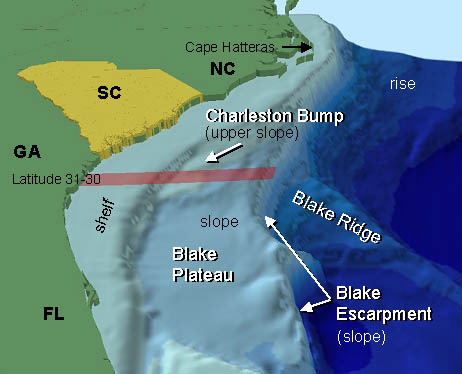
Southeastern United States continental shelf
NOAA image, accessed from wikimedia commons.

The first pelagic bird of the trip, a Cory's Shearwater, was a lifer for me, as were most of the species we saw on the open ocean. Craig Fosdick and I estimated a total of about 200 of this species on the first day and 100 on the second day, but we did not actually keep a count. In reviewing my photographs, I found that most of the 20 or so birds I photographed were of the Scopoli's subspecies, which breeds in the Mediterranean, rather than the borealis subspecies, which breeds in the Atlantic Ocean. Note the white tongues on the primary feathers, where a borealis bird should have primaries that are entirely or mostly black with small, diffuse white tongues at the most.


Two other shearwater species were much less common, but we estimated 10-30 of each of these on each of the two days. Audubon's Shearwater nests in the Caribbean and is the smallest shearwater regularly seen in North American waters.


Greater Shearwater breeds on islands of the southern hemisphere and migrates into our northern waters when it is not breeding. Despite its name, it seemed to me to be a little smaller than Cory's. My field guide says that it has a longer body, but a shorter wingspan.


The most common seabird species we saw was Wilson's Storm-Petrel. We estimated 300 or so on each day, but it was tough to make an accurate estimate because there were always a few of them following the boat. We were constantly watching out for other, rarer species like Band-rumped, Leach's, White-faced, or European Storm-Petrels, but I never saw any of these. (The trip leaders spotted two Band-rumpeds quickly flitting past the far side of a large flock of Wilson's, but neither Craig nor I were able to pick them out before they disappeared into the distant waves).


One of the highlights for me was also a specialty of this area, the Black-capped Petrel. This is the only regularly-occuring member of the genus Pterodroma in North American waters. It breeds in the Caribbean and forages in the Gulf Stream. We saw about 12 of these on our first day and about 20 on our second day.


By far the rarest bird of our pelagic adventures came on the second day. We had just come into a big flock of shearwaters and there were fish all around the boat. Others had told me that tropicbirds are attracted to activity of fish, boats, and other birds, and will often fly in high over the boat, so they can sometimes be missed if you're watching the birds on the water too closely. Each time we got into a situation like this, I tried to remember to also check the sky above us. As I peeked up from the shearwaters off the bow and looked behind me over the captain's wheelhouse, I saw the distinctive shape I was looking for. I yelled out, "TROPICBIRD!!!!" and before I could finish the word two or three other people were yelling the same thing. A beautiful adult White-tailed Tropicbird graciously made several circles around the boat before heading off towards the horizon.


All images copyright 2011 by Ryan P. O'Donnell except the illustration from NOAA.

Labels: , , , , , , ,


UTAH BIRDERS FLICKR POOL


    SEE MORE AND SHARE ON FLICKR