Utah Birds, Utah Birding, and Utah Birders. Promoting the sharing of information, and the conservation of habitat for birds in Utah and elsewhere. We are a group of people who want to share what we know, and create a positive birding experience in Utah.

BIRDERS BLOG

a blog by and for Utah Birders

Status and Distribution of "Western" Flycatcher in Utah?

posted by Tim Avery at
on Wednesday, February 11, 2015 

Sorry to get scientific with the post title--but this post will delve a little or a lot bit in to the realm of science--depending on how you want to look at things. I am not a scientist or a biologist, but on a daily basis I analyze data, and use that data to make predictions, hypotheses, and come up with solutions to problems.  Today I'm not solving a problem, but more or less looking at a problem and proposing some ideas.  These ideas came to fruition after a phone call with Rick Fridell about a number of reports in eBird of Pacific-slope Flycatcher.  Back in 2006 Rick and I found 2 empids at Red Hills Golf Course in January.  Both birds represented the first winter records of empids in southwestern Utah--and the only in eBird for Utah during the winter months.  Historical information about empids in Utah is quite lacking so there may be some from pre-2000, but the data just isn't there to look at.


One of the birds was rather straight forward and was a DUSKY FLYCATCHER.  The other bird was a bit more troubling as it was a "WESTERN" FLYCATCHER, so either a Cordilleran or a Pacific-slope Flycatcher.  At the time the general though was--it's winter, it's a Western-type Flycatcher, it's not calling, so it's best left to just "Western" Flycatcher species.  However, conventional wisdom at the time suggested that ONLY Pacific-slope Flycatchers over-wintered in the interior southwest, with a handful of reports annually in southern California and Arizona along the Colorado River.
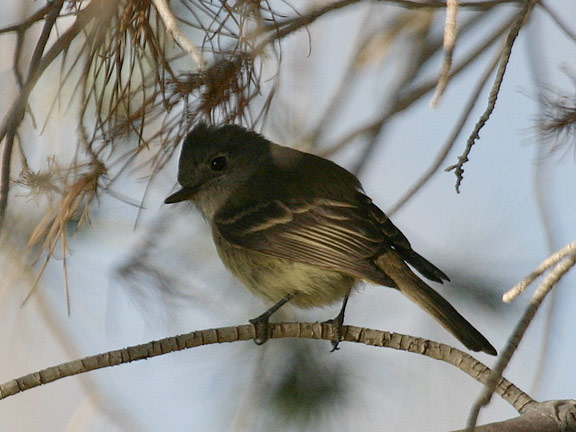
Dusky Flycatcher in St. George from January 2006

But I'll digress, at the time I left it as just a spuh and moved on.  Later that same week, Rick found another "Western" Flycatcher in Washington County, making it 3 empids in one week in winter.  Fast forward to this week and the phone call I had with Rick.  I am for the time being helping review sightings in Washington County on eBird--Rick will be taking over in the near future, but I was doing some cleanup and noticed he had submitted a handful of reports for PSFL. In all 11 reportfrom the spring and fall. This was unexpected for me; even more so was that one checklist from May 27, 2012 had 5 PSFL included on the report. Unprecedented in Utah.

If you don't know Rick, quite frankly he's probably the best birder in Utah hands down.  He's been responsible for numerous state first records, and finds great birds on an almost weekly basis down in Washington County.  So when Rick added these birds to his lists, he immediately had my attention.  Basically what Rick shared with me, was that birders in Arizona and Nevada birding at lowland habitats during migration were not finding Cordilleran Flycatchers, ONLY Pacific-slopes.  During the spring calling birds were identified by their audibles, and based off banding projects it was basically assumed that all Western's at these sites were actually PSFL's.  What?

This one really through me for a loop.  Although I was sure this species migrated through Utah, I thought that it was impossible to say for sure which species we were actually seeing during migration. De-facto I called everything in Utah a Cordilleran--even birds not calling.  Have we been doing this wrong for years? Is it only safe to identify on territory or calling Cordilleran Flycatchers? Were we actually seeing Pacific-slope as the majority of valley and lowland Western Flycatchers during migration?  Was this a Pacific-slope Flycatcher?
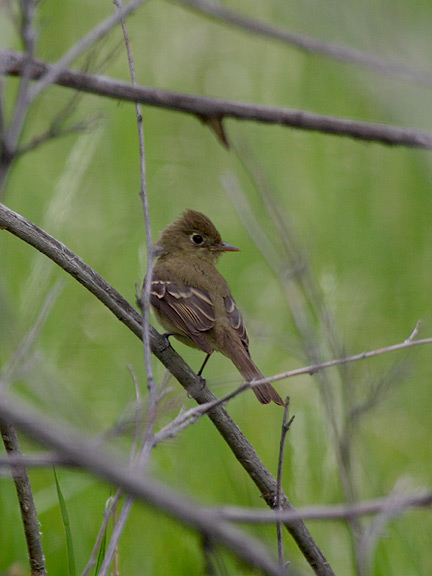
Migrant "Western" Flycatcher at Fontenelle, Wyoming in May 2005
Due to inland location and overall elevation it was ID'd as a Cordilleran.
However, Fontenelle, is a "lowland" trap by Wyoming standards.

The assumption that the lowland birds are all Pacific-slope seems to go hand in hand with the idea that Cordilleran Flycatchers migrate through the mountains and highlands to their wintering sites, predominately in the mountains and pacific slopes of south central Mexico.  Parallel ideas are that of birds like Cassin's Vireo, Townsend's, Nashville, and Hermit Warbler, and Rufous Hummingbird.  All  of these species are rare and some non-existant in spring in Utah.  Some do show up occasionally, but these are predominantly only fall migrants in Utah  None-the-less they are only found during migration--like the speculation of PSFL and its occurence here.

Hermit Warbler interestingly are rarely if almost never found away from high elevation sites with a coniferous component in the interior southwest during the fall.  While all the others tend to show up at various elevations and habitats.

So I've droned on--but lets actually look at some maps I generated via eBird and customized to show information about Cordilleran and Pacific-slope Flycatchers.


This first map shows the year round range (via actual detections in eBird) of both COFL and PSFL.  COFL is shown in blue; strictly in the mountain west through central Mexico.  PSFL is show in red from Alaska to southern Mexico on of all things the Pacific coast and slopes.  The purple blocks represent overlap where both species have been or are reported.  Much of this is migration and winter grounds.  Note the interior range of PSFL into Washington State and Canada almost directly north of Utah.

Do we assume these birds migrate "around" the Great Basin, following the Sierra Nevada slopes and the coast, north and south during migration, or is it more likely they shoot straight over one or both directions?  Looking at this map is seems almost impossible that this species misses Utah, and that in all likelihood a large number pass through at least during the fall; but presumably also during the spring.


The map above shows year round Cordilleran Flycatcher reports from eBird specifically in southwest Utah. The light green spots represent breeding reports from what mostly appear to be high elevation sites as they should.  The blue and orange dots represent migrant reports  You'll notive that while there are numerous locations around the light green dots, there are alos some out in low laying areas; notably around Las Vegas and St. George.  The dark green spots represent overlap where birds have been reported at a minimum of at least spring and/or fall migration and the breeding season.  Again the majority of these dark dreesn show up at the high elevation sites.  ONe thing to note is that there are no winter records from this region.

Well what about Pacific-slope Flycatcher reports? Below shows the map of reports year round from the same region as above. Take a look...


There are obvioulsy much fewer reports on this map; and that is expected. Afterall a large portion of the map is high elevation coniferous forest around Flagstaff, the North Rim of the Grand Canyon, and throughout southern Utah.  This is the breeding habitat of COFL.  Of note there are no breeding season reports from this area; there were several reports from the first week of June at lowland sites around Las Vegas which presumably are late northbound migrants.

The interesting thing about this map is the clear data points to the west, southwest, and south of Utah, basically everything around our fair state.  Yet in Utah; nada. There is something wrong with this picture, and had Rick not brought this to my attention, I don't know how long I would have gone before actually looking at these maps.  I think its a fair assumption that the lack of reports in Utah is not due to the fact that they don't occur here; but instead is due to the fact that physically they look the same as our Cordilleran Flycatchers.  How many Pacific Slope Flycatchers have been right underneath our noses? I pulled up the list of Cordilleran Flycatcher sightings just from Lytle Ranch.  Every record occurs in spring or fall migration and in all there are only 22 individual birds reported from 17 dates. That's actaully very slim numbers in comparison to let's say Dusky Flycatcher where there are over 50 indicvidaul reports.

The last figure I created below is of the winter reports of both species of "Western" Flycatcher.  In pink you can see PSFL, and in blue is COFL.  The purple dots along the Pacific slope in Mexico represent overlapping reports.


Aside from 4 or 5 wintter reports in America for COFL--all east of El Paso, Texas; all other reports in the lower 48 in winter are of PSFL.  Notably in the desert southwest in rizona, California and along the Colorado River.  So what does this mean?

I went into eBird and changed all my spring/fall lowland sightings in Washington county to Cordilleran/Pacific-slope Flycatcher. There are now 16 reports in queue to be reviewed for PSFL in Washingtong County during the spring or fall with an additiaonl 7 or 8 Pac-slope/Cordilleran already approved.  I used that nomenclature for the time being as it is safest.  However, where Rick has heard the vocalizations it can likely be said his birds were indeed PSFL.

But what is the true extnet of this species in Utah?  Does it extend beyond the reaches of Washington County?  Realistically how mnay Western Flycatchers submitted to eBird from lowland sites around the state were heard vocalizing? And what is the typical migration pattern for Cordilleran Flycatcher?  I for one will be taking more time to listen and make sure I know this vocaliztion this spring whne I hit the field:

Labels: , , , , ,

Migration... Before, During, & After the Storm

posted by Tim Avery at
on Thursday, August 7, 2014 

Last night afforded a great look at how weather effects nocturnal migration.  In the evening a storm front was approaching the Wasatch Front over the West Desert and Great Salt Lake.

At 8:57pm  the storm band stretches across the south end of the lake and out over the West Desert. There is a thin line of apparent migrants over the Wasatch already.  I have always assumed these were large flocks of sparrows lifting off at dusk this time of year.


The second frame is at 9:55pm and the storm front has pressed up over the lake and to the edge of Salt Lake Valley.  Migration over the mountains has picked up with some areas approaching 25-30dBz. IF you look at the south end of the storm there don't appear to be any migrants, and on the north end, migration is sparse.


At 10:58pm the storm was directly over the lake, valleys, and heading into the mountains.  Migration at this point appears to have been broken up pretty good by the storm. The northeast edge shows a good migration underway, and migrants still along the front edge of the storm. The south, west, and north edges appear to be pretty dead.


At 11:56pm the storm is directly over the valleys and mountains and appears to be breaking apart. Migrations is still happening in the areas where the storm isn't hitting, but its very light.  To the north and the south there is still no real movement, but to the west a large wave of migration appears to have started out over the West Desert.


One hour later at 12:59am the storm is over the mountains and moving towards Wyoming.  Clear skies to the west are favorable and the migrants have taken to the sky over the Great Salt Lake Again.  It's still fairly light at this point...


By 2:00am the storm is clear of the Wasatch Front, Valley,s and Lake and from here we can watch migration start to pick up over the next 4 hours before trailing off around 7:00am this morning.  This is fairly typical of storms fronts this time of year with migrants taking advantage of good conditions, and tail winds ahead of and following storms.  Below is a complete animation from 9:00pm last night to 7:00am this morning.


Labels: , , ,

Listening for Night Flight Calls

posted by Tim Avery at
on Wednesday, August 6, 2014 

Tomorrow morning when you wake up, go outside for a moment and listen. All quiet on the songbird front. The first week of August is when I usually notice there are no more birds singing. This week I've stood on my deck each morning at dawn and just listened to the quiet. The past 2 days I didn't hear a single bird--singing or calling. This morning while I stood and listened a Black-capped Chickadee sang out. A couple Lesser Goldfinches flew over calling, and a House Finch called form a neighbors yard. My dog scared up an American Robin which let out its alarm call. All this in less than a minute, and then nothing--silence again.

Despite that big piece of the avian world that goes silent for the next 6 months, there is still so much to look forward to--and there are still sounds worth learning and listening. The next 6 weeks are particularly good for listening for Night Migrants and the unique calls birds make while flying during migration. Utah has never been great for listening for night flight calls, but occasionally a decent night produces some good numbers of calling birds--the hardest part is picking a location that is both accessible and in a good flight path.  Here is what migration looked like over northern Utah last night around midnight.


The green stuff up to is the tail of that storm that passed through--but the blue stuff over the Wasatch and west desert are birds heading south-southeast. You can see the velocity and directon on this image.


You can check out these radar images on http://weather.rap.ucar.edu/radar/ -- everything is in UTC so remember we are 6 hours behind (so 0600 UTC is actually midnight here). If you need a refresher on night migration and reading radar, check out these posts...

If this interests you at all I suggest finding a nice perch in the foothills, along the Wasatch Front, somewhere between 6-7,500' and hanging out for a couple hours after dark. Lay on your back facing up with your ears cupped--you never know what you might here. Sometimes it's things you recognize


The Killdeer flying overhead is a common sound that even new night flight listeners will hear from time to time. Things only get harder from here. Out here in the west one of the most common early migrants that you might hear is the Chipping Sparrow. All the spizella species have similar flight calls but Chipping is one you tend to hear a lot because there are lots of Chipping Sparrows.


Some species rather unique night flight calls make them easier to ID--for instance Swainson's and Hermit Thrushes have a musical quality to their night flight whistle making them easier to pick up on, like this Swainson's Thrush.


Then comes one of the coolest things about night flight calls in my opinion--some species calls are so unique and undeniably tied to a species that a very rare migrant could be heard during a night flight, and identified without ever seeing the bird. Black-billed Cuckoo for instance have a call that any night flight listener who heard it, would start jumping for joy--no matter where you live.


And lastly Dickcissel is a species that migrates through Utah likely with some regularity--but is rarely observed here--but if you were to hear the "squirrrtt" call while out listening for night migrants you would be pretty sure about what you were hearing.


Take a few hours one night in the next couple weeks and go listen for night migrants. You might not hear a lot, but it will be a new birding experience worth giving a try.

Labels: , , , , ,

Going (Further) West

posted by Kenny Frisch at
on Thursday, October 10, 2013 

Two weeks ago, my birding schedule was finally freed up.  Ultimate Frisbee season was over with a 5th place finish in Northwest Regionals up in Burlington, Washington and I was ready to get back to my first love, birding (I did end up getting two year birds, Glaucous-winged Gull and Northwestern Crow).

With a whole free weekend I decided to head out to the western portion of Utah, a part I have never explored since I moved out to Utah two years ago.  The farthest I had ever made it was to Stansbury Island and I had lately been wanting to see the Bonneville Salt Flats since I have heard so much about them and they seemed completely unique.   And more importantly there were oasis migrant traps out west that I have been itching to bird and see what awesome species I could find.

September 28th I finally made the trip out to the other half of Utah, starting out in dark to try to hit Wendover around sunrise to see what birds I could find hanging out in the limited green space in city.  I hate driving in Utah in the dark because I know I am missing out on great views on every side of my car.  Once the sun started rising, my assumptions proved correct and this side of Utah was no different from any parts and I was looking at beautiful scenery.  I stopped at the rest stop just outside of Wendover and had my first bird of the day in one of the two trees at the stop- a Yellow-rumped Warblers.  As expected they were the most common bird of the day, but it was a good sign to have one in the first tree I saw of the day.

I also took the opportunity to walk out onto the Bonneville Salt Flats, which had a weird texture, and experience sunrise with a white ground that wasn't snow.  The sky was lit up as the sun was finally rising.


 Sunrise over the Bonneville Salt Flats

Hills to the north of the rest stop

 The Bonneville Salt Flats

 Welcome and wash stations

Welcome to the Salt Flats

Wendover proved birdy right from the start.  As I got out of my car in the first patch of green I came to, chip notes filled the air from a flock of Yellow-rumped Warblers and in the distance I heard the upward chips of a Western Tanager.  I soon came to a patch of shrubs with many White-crowned Sparrows hanging out and a few birds that made me do double takes on their identifications.  The first was a bright vireo that I thought may be a Blue-headed Vireo, but ended up just being a bright Cassin's Vireo.

This bright Cassin's Vireo fed a bunch on the ground

The second was a well marked Spizella sparrow which had me hoping for a Clay-colored Sparrow, but this bird turned out to just be a bright Brewer's Sparrow.

 This Brewer's Sparrow had me hoping for a Clay-colored

I explored more of Wendover which was easy by the relatively small size of it and lack of appropriate habitat for birds.  I would look for green and head to it to see if there were any birds in it.  Some other nice birds I had in the area included a few Northern Flickers,  a Western Wood-Pewee, a few Ruby-crowned Kinglets and an obliging MacGillivray's Warbler.  I also had an unusual sighting for me of a raven hanging out in a tree.  This may have been the first raven I have seen in a tree and it looked too big to be hanging out in the middle of it.

A Common Raven in a tree is an uncommon sight

I continued on my way towards Lucin by heading further west into Nevada before finally turning north and east back to Utah.  This area was largely desolate with only one small town, Montello.  There were many raptors on this stretch ranging from the usual Red-tailed Hawks to regal Golden Eagles and sagebrush hunting Northern Harriers, including a gorgeous gray male flying close to my car.  The gravel road to Lucin from the highway featured a close encounter with a Prairie Falcon which would have been better if I wasn't viewing it through my windshield.  The bird must have not liked me looking at it through my windshield and it took off leaving me with only one clear shot, unfortunately it was of it flying away from me.

 Excuse the picture through the windshield

 The offended Prairie Falcon set to take off

At least I got one clear shot of the falcon

As I neared the oasis of Lucin, I passed a decent herd of Pronghorn and was treated to my first views of the oasis in the middle of the desert with a pocket green amidst the browns of the rest of the landscape.

A typical Great Basin desert sight- pronghorn in sagebrush

My first views of Lucin in the distance

Lucin is a literal oasis for migrating birds- an area of deciduous vegetation encircling a pond (or two depending on the season) in the middle of the desert.  When nocturnal migrants over the desert finally get sunlight in the morning they need to refuel to continue their migration and a patch of green says food, shelter and water.  The first bird I saw was one that I am not used to seeing in deciduous trees, a Townsend's Warbler.  At least it was still foraging high in the tree in typical Townsend's fashion.

 Lucin, an oasis in the desert

The only pond with water at Lucin

 Massive cottonwood tree

An odd Townsend's Warbler not in a conifer

 Walking into the trees, I heard a woodpecker drumming and tried to find its location.  I was surprised when I found it and it was a Hairy Woodpecker- a bird I am used to seeing up in the mountains, not in the desert.

An unexpected Hairy Woodpecker in the desert

The area was loaded with Yellow-rumped Warblers foraging at all different levels of the oasis.  Some where down low feeding along the shore of the pond whiles others were up in the canopy of the cottonwoods.  They were joined by several other warbler species including Nashville, MacGillivray's and two very photogenic Wilson's Warblers that foraged near the ground and approached very close to me.  I got to study these adorable warblers from close range as they foraged near me.

 An adorable Wilson's Warbler

 Showing off its black beret

 Foraging near the pond

Looking for potential food

There were many sparrows around as well in the surrounding brush, mostly White-crowned but with some Lincoln's and Songs mixed in for good measure.

A juvenile White-crowned Sparrow showing off its lack of a white crown

I also had a bird that stumped me from a distance but when I got up close I finally realized what it was an was a little shocked that I had trouble with it from farther away.  Anyone want to take a guess on this bird?

Lucin "mystery" bird- what do you think it is?

Although I didn't have anything really rare I still enjoyed the birds I did see and they often gave great looks given the lack of areas they could take shelter in.  

Next I decided to head up to Rabbit and Owl Springs, but the road to those springs soon gave me highs and lows, both related to recent rains in the area.  The highs resulted in a large puddle in the middle of the road which attracted many sparrows, up to a dozen at a time.  Most of the sparrows were White-crowned but there were a few Songs mixed in too.

 A liquid oasis for migrant sparrows

White-crowned and Song Sparrows enjoy the puddle

The low resulted in a washed out portion of the road.  Unfortunately my car is low clearance and I though that I may have to turn around from the two foot ruts.  However I am stubborn and soon set out to moving rocks and dirt and fashioning a ramp through the ruts that would hopefully get my car past it.  It worked for the most part and I only needed to stop once to put more gravel under a wheel that was spinning in some mud.  Soon I was back on my way to Rabbit Spring.  Thanks car!

 A temporary roadblock

Rabbit Springs was at this time of year was a small stream running through a bunch of grasses with scattered trees around it.  I assume it is a pond in certain times of year.  Right in the area was a large gathering of ravens, over 40 total in the area, the largest flock I have ever seen.  There weren't too many birds in the area, but I did have an Orange-crowned Warbler and Lesser Goldfinch sitting right next to each other on a branch allowing for some interesting comparing and contrasting.


 Rabbit Springs

  
 A raven headed to the rest of his flock

 
 Showing off the classic raven shape

 Huge flock of ravens

There is a stream in the somewhere

 Unlikely buddies- Orange-crowned Warbler and Lesser Goldfinch

 Deserts mean lizards

Just up the road, Owl Springs was had more vegetation than Rabbit Springs and I had some nice birds including another Nashville Warbler and a Western Wood-Pewee and also got a history lesson:

 History from 172 years ago

Owl Springs was a lush place despite no above ground water

I then started my way back and took in the scenery of the mountains all around me and I also had great looks at a cooperative Golden Eagle on my way back through Nevada.

The way back to Wendover from Lucin

 Such an open landscape

 Mountains to the south

 A Golden Eagle in Nevada

 Take off

Notice the multiple generations of primaries on this adult Golden Eagle

Once through Wendover, I stopped at the south portion of the rest stop I had visited at sunrise.  I got to see kids play in the salt flats and again only had one bird, but this time it was a Brewer's Blackbird.

 Kids on the Bonneville Salt Flats

 Mirages in the distance

 A young shiny Brewer's Blackbird

Showing off its iridescence

I snapped one more shot of the highway surrounded by the salt flats and headed home, but with a quick stop at the Salt Lake International Center.  Here I had my second Cassin's Vireo of the day along with some goofy gulls trying to land in a Russian Olive to feed on its olives.  They looked very out of place in tree and had trouble standing on its branches.


 Surround by salt

 My second Cassin's Vireo of the day

 
 Giving the signature vireo head tilt

 Gulls trying to get some olives

My first trip out to Western Utah was a memorable one for both the uniqueness of the environment, the beautiful landscapes and of course the birds.  Hopefully future trips will feature more birds but this trip got me hooked with a new part of Utah and got me back in birding mode until the spring.  It's great to be back to my very first passion. 

This summer wasn't totally devoid of birding trips but oftentimes I had to pack them into trips for other things I was doing.  I will start recapping these summer trips that led me all over the place, from areas around Joshua Tree National Park to Zion Park to the Uintas and the great birds I saw in on these trips.  Keep an eye out for them!


Labels: , ,


UTAH BIRDERS FLICKR POOL


    SEE MORE AND SHARE ON FLICKR