Utah Birds, Utah Birding, and Utah Birders. Promoting the sharing of information, and the conservation of habitat for birds in Utah and elsewhere. We are a group of people who want to share what we know, and create a positive birding experience in Utah.

BIRDERS BLOG

a blog by and for Utah Birders

Listening for Night Flight Calls

posted by Tim Avery at
on Wednesday, August 6, 2014 

Tomorrow morning when you wake up, go outside for a moment and listen. All quiet on the songbird front. The first week of August is when I usually notice there are no more birds singing. This week I've stood on my deck each morning at dawn and just listened to the quiet. The past 2 days I didn't hear a single bird--singing or calling. This morning while I stood and listened a Black-capped Chickadee sang out. A couple Lesser Goldfinches flew over calling, and a House Finch called form a neighbors yard. My dog scared up an American Robin which let out its alarm call. All this in less than a minute, and then nothing--silence again.

Despite that big piece of the avian world that goes silent for the next 6 months, there is still so much to look forward to--and there are still sounds worth learning and listening. The next 6 weeks are particularly good for listening for Night Migrants and the unique calls birds make while flying during migration. Utah has never been great for listening for night flight calls, but occasionally a decent night produces some good numbers of calling birds--the hardest part is picking a location that is both accessible and in a good flight path.  Here is what migration looked like over northern Utah last night around midnight.


The green stuff up to is the tail of that storm that passed through--but the blue stuff over the Wasatch and west desert are birds heading south-southeast. You can see the velocity and directon on this image.


You can check out these radar images on http://weather.rap.ucar.edu/radar/ -- everything is in UTC so remember we are 6 hours behind (so 0600 UTC is actually midnight here). If you need a refresher on night migration and reading radar, check out these posts...

If this interests you at all I suggest finding a nice perch in the foothills, along the Wasatch Front, somewhere between 6-7,500' and hanging out for a couple hours after dark. Lay on your back facing up with your ears cupped--you never know what you might here. Sometimes it's things you recognize


The Killdeer flying overhead is a common sound that even new night flight listeners will hear from time to time. Things only get harder from here. Out here in the west one of the most common early migrants that you might hear is the Chipping Sparrow. All the spizella species have similar flight calls but Chipping is one you tend to hear a lot because there are lots of Chipping Sparrows.


Some species rather unique night flight calls make them easier to ID--for instance Swainson's and Hermit Thrushes have a musical quality to their night flight whistle making them easier to pick up on, like this Swainson's Thrush.


Then comes one of the coolest things about night flight calls in my opinion--some species calls are so unique and undeniably tied to a species that a very rare migrant could be heard during a night flight, and identified without ever seeing the bird. Black-billed Cuckoo for instance have a call that any night flight listener who heard it, would start jumping for joy--no matter where you live.


And lastly Dickcissel is a species that migrates through Utah likely with some regularity--but is rarely observed here--but if you were to hear the "squirrrtt" call while out listening for night migrants you would be pretty sure about what you were hearing.


Take a few hours one night in the next couple weeks and go listen for night migrants. You might not hear a lot, but it will be a new birding experience worth giving a try.

Labels: , , , , ,

If I were a recordist...

posted by Tim Avery at
on Friday, May 17, 2013 

A number of years ago I sat on a mountain top on a cold spring night with Colby Neuman listening for night migrants.  Most nights it was futile.  One call note here, another there.  That was some type of warbler--and the other a sparrow.  Occasionally a duck or shorebird flew over too, but there weren't enough birds for me to ever get to into it.  Colby borrowed some recording gear from the Univeristy of Utah to see if he could catch some of the calls--I don't know if he ever did, but it was a novel thought.  A couple years ago when Canon launched its latest DSLR cameras with HD video, the untold side effect for birders would be easy recording of bird sounds without an extra piece of equipment--if you were into that sort of thing.

A cool photo of a California Gull would have been even cooler with sound or video!

I was surprised at the quality of some of the recording I managed.  I never planned on recording bird songs, but it just sort  of happened--and like getting pictures, recording a new sound is exciting--another form of collecting if you will.  I am by no means good at it.  I often forget to turn off my image stabilizer on my lens--giving the video an nice churring tone in the background.  I often bang the camera, or move it, and the tiny microphone just so happens to be very sensitive--which is why the sounds it does often pick up are really good.  Take for instance the first recording I uploaded to xeno-canto.org last summer--a  Screaming Piha from the Amazon in Peru--a pretty good recording in my opinion.


I never actually saw the bird--but being able to capture the song was thrilling.  I had recorded dozens if not more than 100 songs, calls, and videos over the past years, but hadn't done much till the Piha video--and to be honest, hadn't done much since.  So tonight I decided to sit down and go through the video I took in St. George this past weekend and pull out some of the better and more interesting recording for your enjoyment.

This was the first recording of the trip, a Northern Mockingbird at 12:30 AM in pitch black 100' from our camp site on the Beaver Dam Slope:


The next morning while driving to the ranch I was able to catch one verse of a Scott's Oriole:


While hiking in the Beaver Dam Wash this Blue Grosbeak occasionally let out a volley and I managed to pick it up once:


While hopefully waiting for a Spotted Owl to start barking, this Canyon Wren kept filling the slot canyon with its unforgettable song:


Just after the sunset a number of Hermit Thrushes began singing--as if trying to one up the wrens:


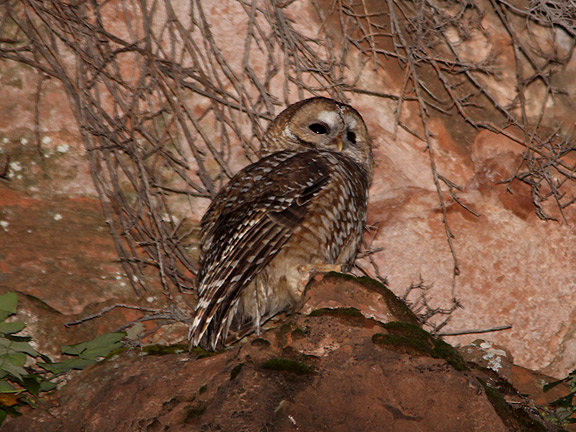
But the real prize cam about 30 minutes after sunset when a Spotted Owl rang out from the cliffs above us.  I wasn't sure my camera would pick it up, but was pleased with what I captured:


The following morning I woke up to a dawn chorus of Brewer's Sparrows very close to camp.  I walked over and stood about 20' away from 5-10 birds that were buzzing and trilling away:


A couple hours later we found ourselves at a small pond along lower Kolob Terrace Road where I was able to record a Yellow-breasted Chat from just a few feet away as it poured out all kinds of chirps and whistles:


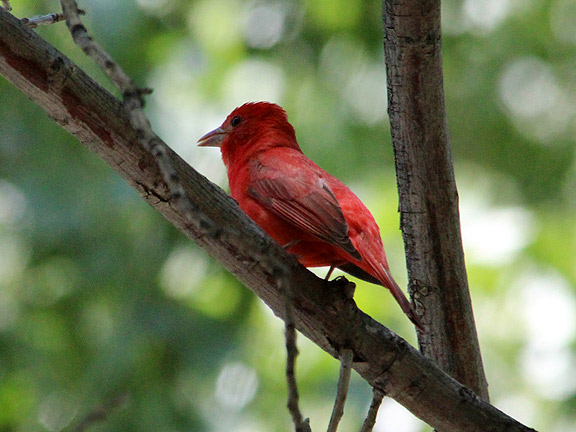
This Summer Tanager was a stable all three mornings we birded the ranch--it sand from the top of a cottonwood in the housing area almost non-stop.  I had hoped to catch the call notes of this very cool bird, but only hear one call all weekend--so I settled for this our last morning there:


I didn't expect to make this recording on this trip, but a male Evening Grosbeak came flying into the trees near me at Lytle Ranch our last morning.  It chirped every couple seconds (the hard CHIT note) while a White-winged Dove bellowed in the background:


And finally I got a mediocre recording of a Black-chinned Sparrow from the highway as we passed over Utah Hill.  I captured an awesome recording last month near Virgin--but accidentally left my camera on silent mode so actually missed the whole episode--so this was a small consolation:


And that's it.  I was very happy to add 11 songs to my collection this past weekend--and really need to sit down and go through the rest of my stuff from the past couple years to see what I can pull out.  I bet I have close to 100 species recorded--its just a matter of actually doing the footwork. 

My shabby recording make me appreciate the skill and expertise that professional recordists have.  Xeno-canto.org is full of great recordings, from all over the world--and form world class recordists.  Check it out if you have some free time--or become addicted if you want to improve those audible skills!

Labels: , , , , ,

Making Playlists with Xeno Canto

posted by Tim Avery at
on Monday, August 13, 2012 

When I visited Costa Rica in 2011 I had learned very few of the bird songs and calls of the 800+ species found there.  Nothing was more frustrating than standing in thick forest and hearing squeaks and whistles of birds I couldn't see.  For the first time in a long time I was hearing noises I couldn't identify.  I was able to records a handful of songs that I later ID'd using Xeno Canto to compare to songs in their database, but for each bird I figured out there were probably 5 that I never did.  Xeno Canto is a collection of bird songs from around the world, stored in an online database accessible to everyone.  It operates under the creative commons non-commercial 2.5 generic attribution, allowing for free sharing, copying, distributing, and transmitting for non-commercial purposes.  For finding, listening to, and learning bird songs this is the one stop shop that is the golden standard .
Before Costa Rica I had listened to numerous songs on the site, but for some reason it never dawned on me to make a playlist from the library to take with me.   The songs and calls at Xeno Canto can be downloaded, set into playlists, and loaded on your iPod like any other music.  I had created numerous playlists over the years from my Peterson CDs--often creating habitat specific playlists for learning birds quickly and easily.  Today I look back to Costa Rica and think how nice it would have been to have had my iPod readily available to listen or even playback when I wasn't sure.  For Peru there was no question that I would need to build playlists.  I had read on more than one blog that in the Amazon you will see about 1/3 the number of birds you can hear.  So being able to identify some birds by song, or bring some birds in by tape would be a necessary evil.
I started downloading songs and calls nearly 4 months ago, and only wrapped things up this past weekend.  In all I downloaded some 800 species worth of "bird music".  This was surprisingly less than a gigabyte of space on my iPod, and separated out into playlists by family groups, or groupings of closely related families.  I tried to find the best recording for many species, sticking with songs for certain species, while only downloading calls of other birds.  I prefer calls because they can be used year round and make sense--where songs are used specifically for breeding birds.  Where there was no option--or few options, I just went with what was available.  For some species only 2 or 3 recordings were available--and often those were not great.
Wading through the1000's of available recordings the majority were in fact of poor quality--but none-the-less I found certain recordists whose quality and quantity of recordings made me go back to them time and time again.  Andrew Spencer from our neighboring Colorado had perhaps the best recordings for Peru and other South American countries--I would guess that no less than 1/2 of the songs downloaded were recorded by him (I believe he is one of the top contributors to the site as well).  Jeremy Minns, Tayler Brooks, and a few others also had great recordings that I relied on when available.
In the end there was no real learning of songs or calls--it is just to much for me to take in.  Listening to the songs of 30 different woodcreepers who really all sound very similar, or Tit-Spinetails that seemingly differ by just a note here and there are almost frustrating.  The calls of dozens of tanager and finches that are just seeps and clicks make me wonder if the tapes will be helpful in the end.  I have a feeling I will resort to them nto necessarily to try an ID something I hear--but to try and call in something I know is in a certain area.

Here in the states Xeno Canto is a great tool for learning birds in areas you plan on traveling to, or for building custom playlists for those areas.  It's a hassle to flip through 800 songs when you may only need 10 or so for a specific region--building that custom list could take less than 30 minutes, and while you are building it, you can be learning the songs and calls by listening to them on the site.  I know that in the future Xeno Canto is going to be my go to resource for building playlists--I guess Peru will be a a test run to see how it works out!

Labels: , , , ,

Mock Yeah.. Ing Yeah... Bird Yeah...

posted by Tim Avery at
on Friday, December 2, 2011 

During the summer of 2007 I worked for the State of Utah Department of Natural Resources conducting riparian breeding bird surveys across the southern half of Utah.  Riparian habitats in the south vary from as low as 2000' in elevation all the way up to 10,000'.  Most of the surveys I conducted were between 3200-4500', and the vast majority of those were flanked by open desert.  The predominant habitats that bordered included juniper woodlands, sage brush, and my personal favorite (sarcasm) greasewood.  These arid and sparsely vegetated areas had a very limited array of birds that could be found.  Most were tied to the water and trees along the streams they lined, and at most locations you could predict fairly accurately exactly what species you would find.  One of the most common species at most of the locations was the ubiquitous and sometimes obnoxious Northern Mockingbird.


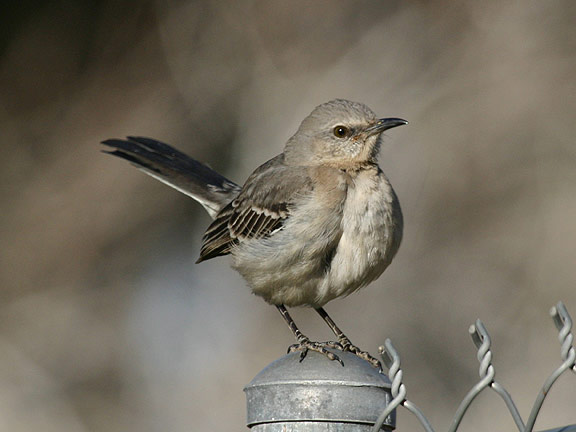
Northern Mockingbird in St. George, Utah

This common eastern songstress is also very common in the desert southwest.  Found in a variety of habitats, ranging from backyards to barren desert, the mockingbird gets its name from the fact that it mimics other birds, amphibians, and insects.  Mockingbirds are known to sing repetitively for long periods of time, making them an annoyance for many people who aren’t interested in birds.  In some cases they master man made sounds as well, in the form of car horns, alarms, and other man-made noises, only adding to their already complex repertoires.

During my surveys I often encountered double digit numbers of Mockingbirds.  One morning between Capitol Reef and Hanksville I encountered a vocal male singing from a dead cottonwood surrounded by greasewood.  I watched him for sometime and eventually pulled out my camera to record the action--the video captured is below, How many songs and calls can you identify in this barrage of notes:


Northern Mockingbird along the Fremont River in southeastern Utah

Quite the show, and quite a wonder from the bird world. Some of my fondest memories of Mockingbirds are because of their habits of mocking, and continuous singing.  Once as Colby and Tom Neuman and I birded Lucin in the north West Desert a Cactus Wren erupted into song.  The only issue is we were 300 miles north of the nearest known Cactus Wren habitats.  The culprit was a Mockingbird that apparently was well traveled enough to have been near a Cactus Wren at some point to learn that song, but now was far from where it was schooled.

The other memory that stands out is laying on the Beaver Dam Slope in southwestern Utah in the middle of the night and being able to hear the mockingbirds from several directions singing continually from their perches atop Joshua Trees under a full moon.  Often the singing would go on for hours keeping me awake--and in awe of what a cool happening I was witness to.  How many people have been in that place and done the same thing?  While other lay in beds in cities hearing trains, cars, and man made commotion I was in the middle of nowhere, silent except for the Mockingbirds.  Truly one of our coolest birds.

Labels: , , ,

Evening Grosbeak Call Types

posted by Ryan O'Donnell at
on Wednesday, May 11, 2011 


Like Red Crossbills and Pine Grosbeaks, Evening Grosbeaks (Coccothraustes vespertinus) have been described as having distinct call types that vary geographically (Sewall et al. 2004). These distinct call types also correspond approximately with subspecies that have been described based on morphology. Because of these distinct call types which correlate to geography and morphology, it has been suggested that Evening Grosbeaks may be in need of further taxonomic work, that is, that they may be candidates for future splitting. In that Sewall et al. paper, they leave northern Utah as a question mark in their map, an unsampled area between the ranges of (morphologically-defined) subspecies C. v. brooksi and C. v. warreni, where no birds were examined and no calls recorded.

Yesterday I recorded a small flock of 4-6 Evening Grosbeaks calling in the treetops above my yard in Logan, Utah. Evening Grosbeak call types are distinct enough that they can be told apart by ear, but I don't have any practice at this so I imported recordings into the software RavenLite to examine the sonograms.

Most of the calls were of Type 1. This is the call type that is given by C. v. brooksi, the subspecies which ranges from Oregon, Idaho, and Wyoming north to northern British Columbia. Here is a sonogram of a Type 1 call I recorded yesterday:

And here is a recording of Type 1 calls from Washington you can listen to:


In my recording yesterday, I was also able to pick out a few examples of Type 4 calls in my recordings, which is typical of C. v. warreni and mapped by Sewell et al. as occurring from about the Uintah Mountains, through Colorado, to northern Arizona and northern New Mexico. Here is a sonogram of one of the Type 4 calls from my yard:


And here are some Type 4 calls from Colorado you can listen to:


Sewall et al. documented both call types 1 and 4 from northwestern Wyoming and southern Colorado. It appears that both call types also occur in northern Utah. More work will have to be done to tell whether this is the result of movement of individuals, intergradation between subspecies, or overlap between reproductively isolated cryptic species.

Sewall, K., R. Kelsey, and T. P. Hahn. 2004. Discrete variants of Evening Grosbeak flight calls. Condor 106:161-165.

Labels: , , , ,


UTAH BIRDERS FLICKR POOL


    SEE MORE AND SHARE ON FLICKR