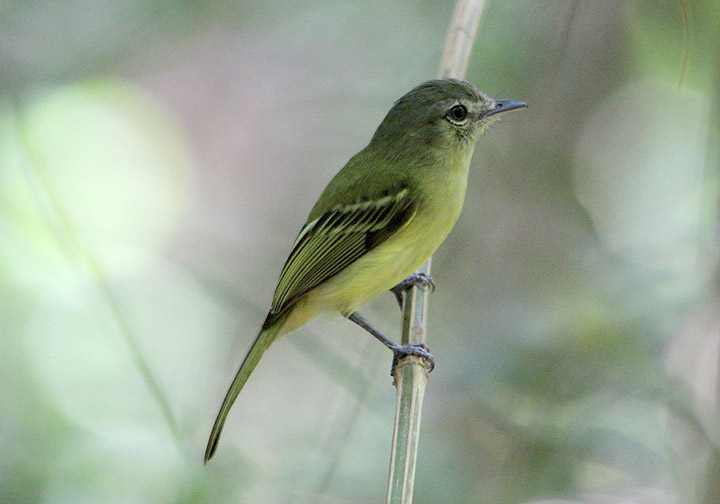
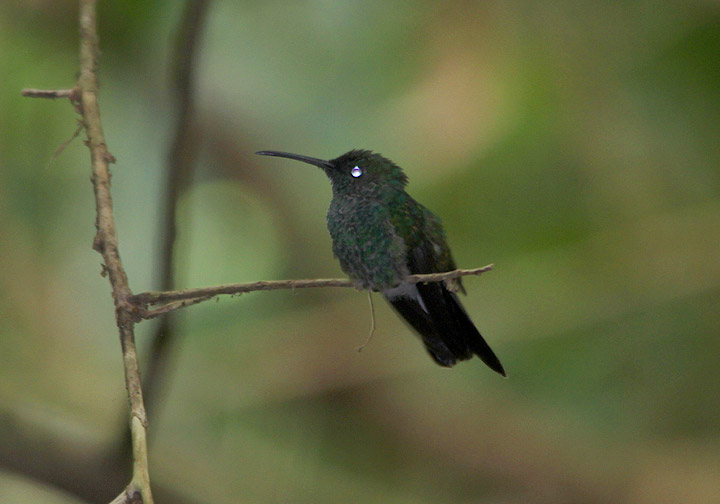
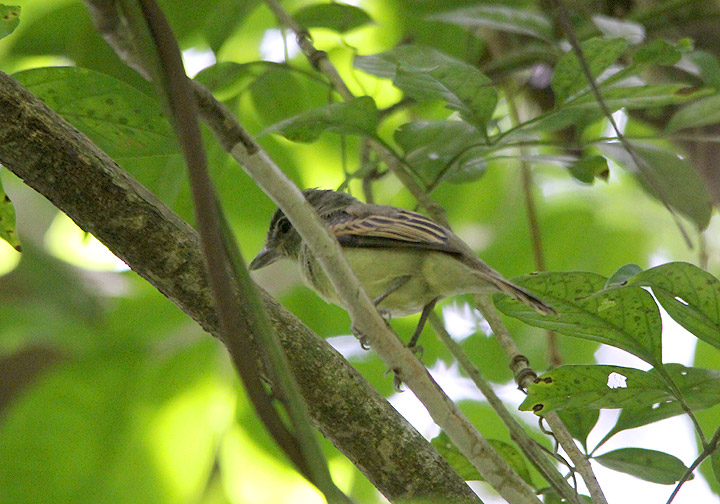
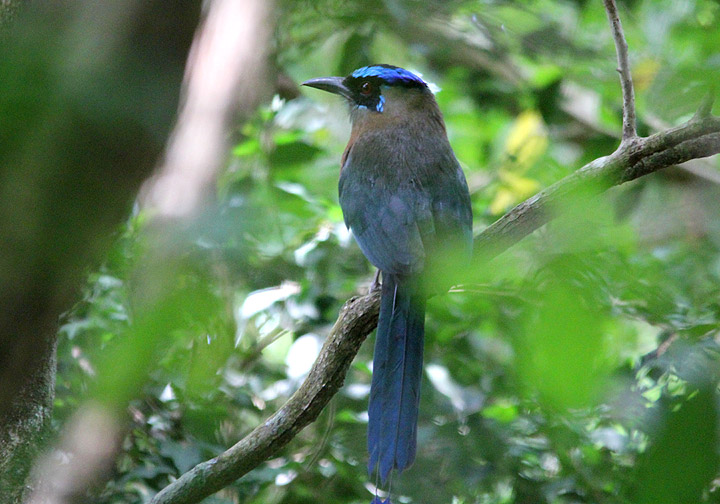
The morning of our 4th day in Panama I was up at 4:45am. I had to get ready and then drive about an hour from our hotel into the mountains and the town of El Valle de Anton to meet my guide for the day Jose Perez. El Valle sits in the bottom of the caldera of an inactive volcano. It is about 6 KM wide and surrounded by mountains/ridges that were once the rim of the volcano. The area is one of the most popular birding destinations between the canal and the western highlands, boasting a list of over 500 species. A couple trips ago I decided that on every vacation I took I would hire a guide for at least one day of birding. Nothing beats a local with knowledge of where to find what quickly and somewhat easily. I contacted Jose via Facebook and his rates for private guiding were a great deal. In any event, I made the drive in the dark and got there about 15 minutes early--Jose was already waiting for me at the Hong Kong Market on the main drag in El Valle. We dropped my rental off at his house, and then we took off towards the hills outside of town. During the drive he asked if I was okay to do some hiking and I said no problem. He explained that to get to the areas where a few birds I want to see are present we have to do a short hike…
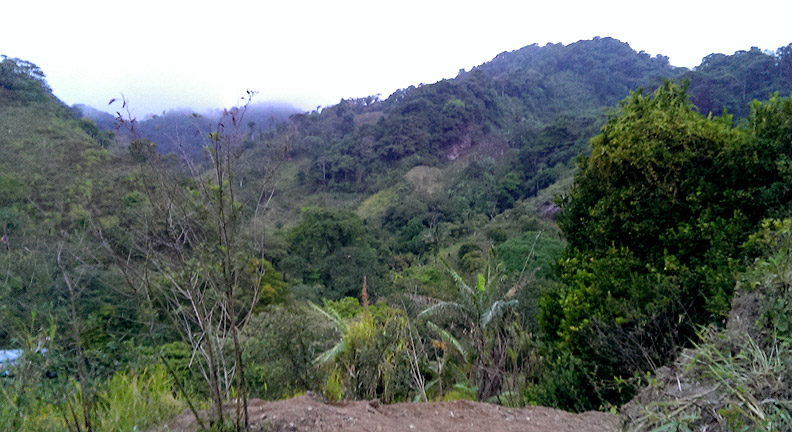
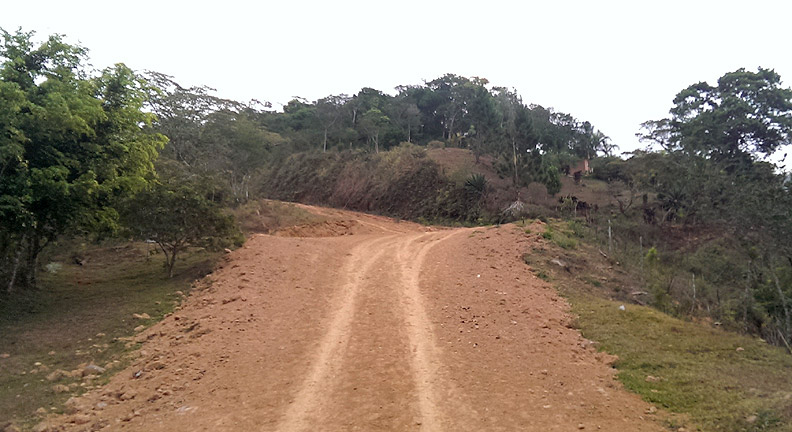
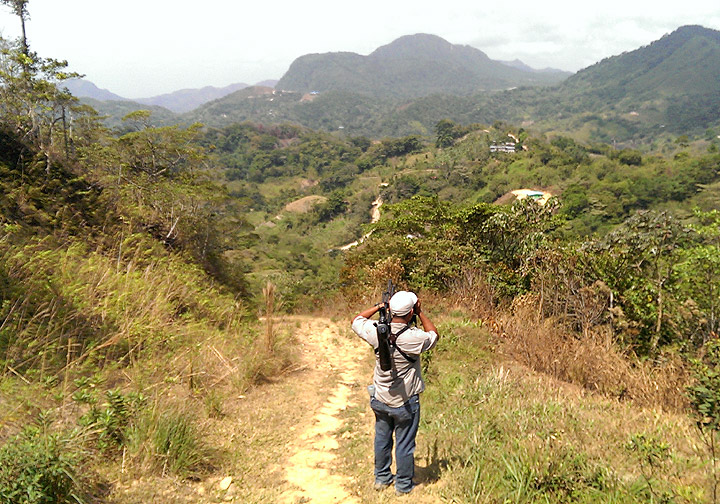
The view up from the parking area
We arrived on the outskirts of town-the way outskirts--and parked the car. Jose pointed to a road going up a hill and said,
“we have to hike to the top of that”. It was a steep dirt road, but it didn’t look like it went more than a couple hundred meters--no problem! It was early and although light, it was still not great lighting. Birds were singing everywhere, but we didn’t stop for them. I knew the majority sounded like Clay-colored Thrush, and Blue-gray Tanager, but there were plenty of sounds I didn’t recognize. We hit the trail and passed folks walking down it. Jose explained that they come into town to work every day, and hike out at the end of the day to return to their homes in the hills. The road was very steep, and it made for a tough hike. Eventually it plateaued out and the birding started. The first sighting of the day was a
BAT FALCON screaming across the morning sky. That was followed by a few
SWALLOW-TAILED KITES circling the ridge lines nearby. A flock of
BROWN-HOODED PARROTS came in and landed in a nearby tree, but the light made for terrible photo ops. The first lifer of the morning were a small troop of
BLACK-CHESTED JAYS that flew past. Despite seeing numerous flocks of this species over the following 5 days, I only managed a few crappy photos. Jose pointed out a coughing sound in the distance--
KEEL-BILLED TOUCAN. Eventually we saw a couple fly across one of the wide canyons. The road dipped down and dropped into a ravine before heading back out, topping out again, and then dropping into a wider canyon. Here the road split in 2 and Jose pointed to the hills to our left,
“that’s where we are going.” No problem!
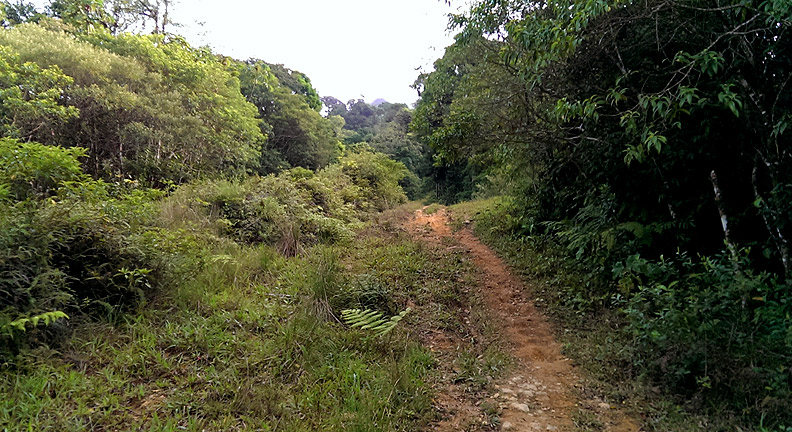
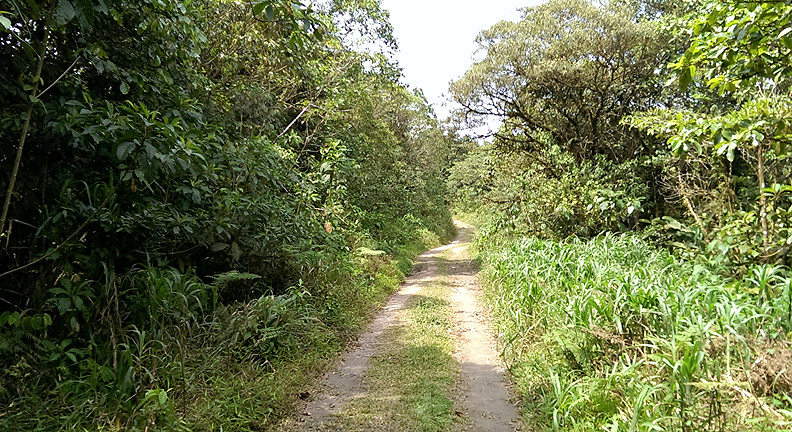
Making our way up the dirt road
At this point the bird activity exploded. I spotted a
MOURNING WARBLER skulking just off the road. Jose pointed out the calls of a
WHITE-LINED TANAGER, then a
WHITE-SHOULDERED TANAGER. Both
LESSER and YELLOW-BELLIED ELEANIA were flycatching over the road, while
RUFOUS-AND-WHITE as well as
BAY WREN chuckled from the understory.
RUFOUS-CAPPED WARBLERS were singing from various trees on the hillsides. A female
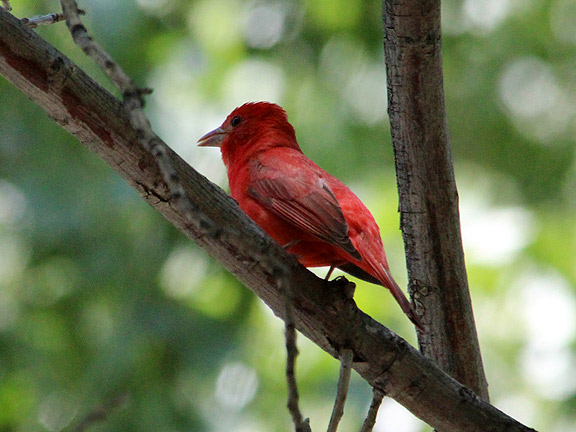
SUMMER TANAGER flew past us, and a
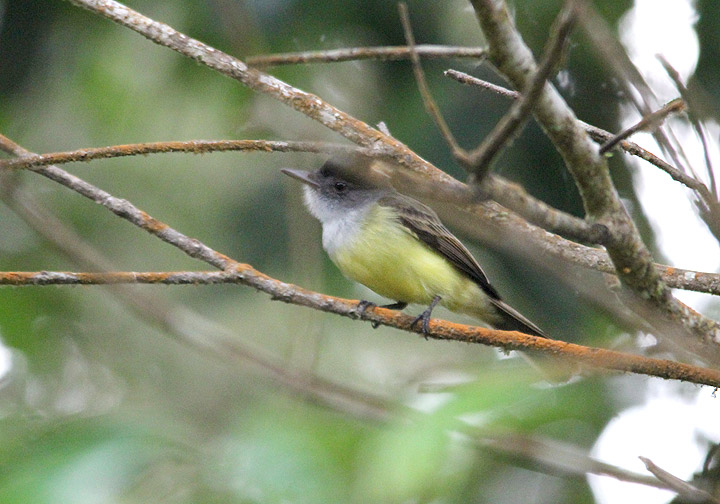
DUSKY-CAPPED FLYCATCHER landed in a tree to close to photograph. This was tropical birding at its finest.
Dusky-capped Flycatcher checking me out
We came to a draw near splitting off from the canyon we were in and Jose pointed out the song of a
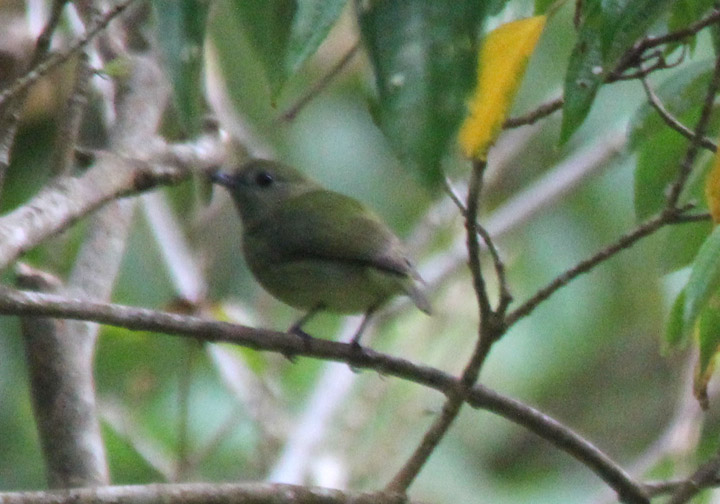
WHITE-RUFFED MANAKIN. We got several bad looks at birds flying past, and one female that posed long enough for a photo. This was typical of my past experience with manakins--zip zip gone!
Female White-ruffed Manakin in the understory
While we were looking for the manakins a
PALE-VENTED THRUSH started singing--we looked but never got eyes on the bird; strangely just moments later this was followed by a singing
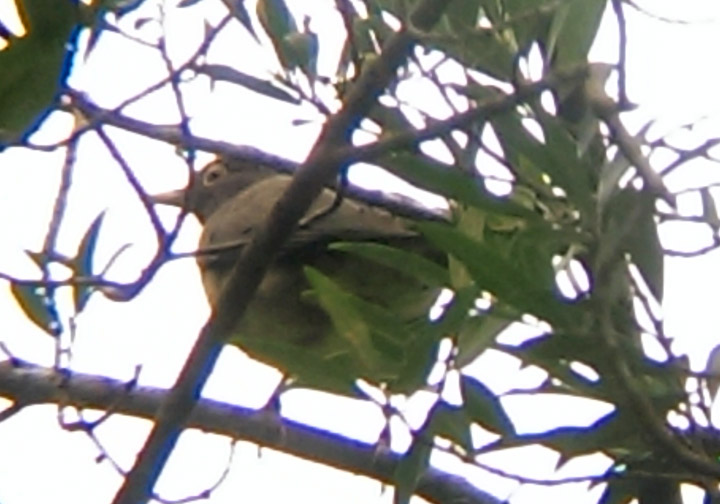
WHITE-THROATED THRUSH. This bird we were able to find and digiscope some crappy shots of before it flew off. All the while a
GREAT ANTSHRIKE sang from a nearby thicket. As if on queue to tick off the other thrush for the area, an
ORANGE-BILLED NIGHTINGALE-THRUSH started singing from the same thicket. Sensory birding overload commence!
White-throated Thrush digiscoped
We came to a split in the road, where one road meandered off to the right. To our left a road set off straight up the mountainside. There was a lot of activity here where a yard left for an open area between the forest. Tanagers were shooting left and right across the opening. Jose pointed out a
FLAME-RUMPED TANAGER that flew off before I could get a picture. A
LESSER GOLDFINCH started singing, and within a matter of minutes we had
BUFF-THROATED, BLACK-HEADED, and STREAKED SALTATOR for the 3 species saltator sweep. Then Jose pointed up the road and says,
“are you okay to go up there? That’s where the birds are.”. At this point all I could say was,
“sure, no problem!”. After all, the birding had been great thus far.
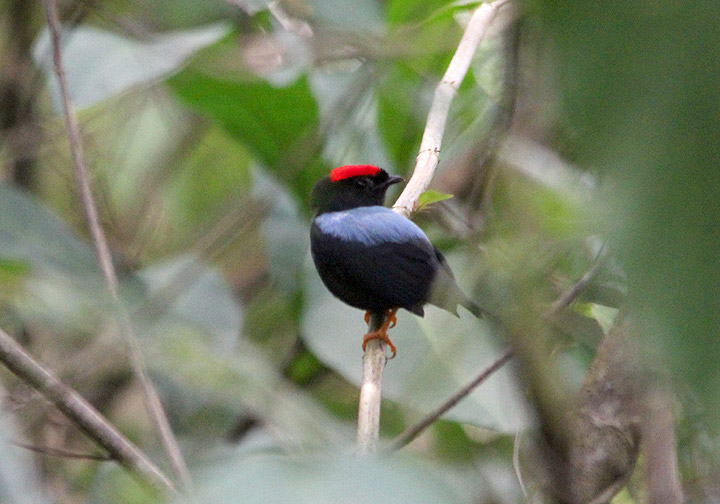
Male White-ruffed Manakin trying to hide
So up we went. It wasn’t long till Jose spotted a
WHITE-RUFFED MANAKIN male sitting in a bush on the edge of the road. While we hike a
MISSISSIPPI KITE flew over and past. The next 200 meters seemed bird-less though. It was just up, up, straight up. Eventually an
OLIVE-STRIPED FLYCATCHER sang from the trees nearby, but that was it.
The tanager section of the trail
We came to a flat area lined with some type of fruiting trees. Jose said, this is where we could get some of the specialty forest tanagers. It was quiet as we walked. For about 100 meters there were no birds, then the road started up the mountain again--straight up. Jose explained that this road was no longer used--It used to connect the road from Altos del Maria to El Valle, but a mud slide a few years ago took out the road. Now it was used by very few people, and was a great road for birding because of this. All of the sudden Jose stopped and pointed into the forest,
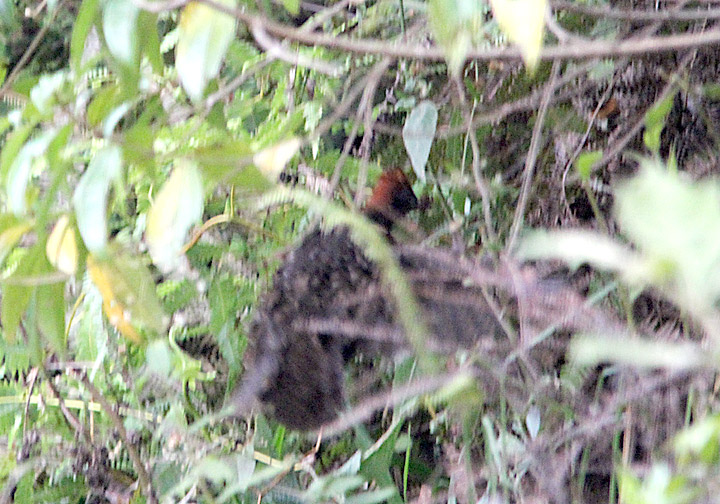
“BLACK-EARED WOOD-QUAIL!”, he exclaimed. They were singing in the forest. As we kept walking another started singing. We stopped and realized we were between two birds singing on either side of the road. Jose started whistling--his talent for mimicking birds of the jungle was amazing. Where I would have to use an iPod, he had memorized and could mimic almost every bird we heard and saw. The whistling battle was intense. Jose would whistle, then a quail here, and another there--they were getting closer. I was able to get a pretty damn good recording of this species--there are only a 1/2 dozen in Xeno-Canto, so it was a good capture:
All of the sudden one popped out of the bush on the opposite side of the road--as soon as it saw us it jumped back into the woods. The birds singing from the near side got closer and closer, until it was only a dozen or so feet away. We could see it in the understory kicking around, but when it saw us, it ran off down the hill. Jose said he figured the bird on our side would cross the road to try and get to the other male--it wasn’t even 30 seconds later when the bird on our side flew out and across. I snapped one picture as it went into the bush--somehow catching it in the frame--albeit dark and blurry.
Bad record shot of a Black-eared Wood-Quail in flight
Jose was stoked that we were able to see the quail. He froze in his steps when another odd sound came from the jungle--
”PURPLISH-BACKED QUAIL-DOVE!”, he said with an excited look. The road kept going up and eventually we got into a small flock that included
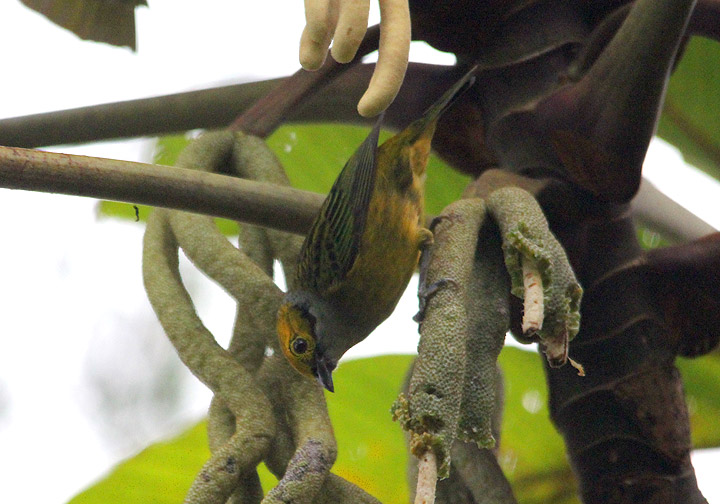
SILVER-THROATED TANAGER, GOLDEN-HOODED TANAGER, COMMON CHLOROSPINGUS (formerly the Bush-Tanagers), and
TAWNY-CAPPED EUPHONIA. That latter a lifer. There were also a few birds from up north still around, including
2 BLACK-THROATED GREEN WARBLER, and a
BLACK-AND-WHITE WARBLER.
Silver-throated Tanager feeding
About this time a
HEPATIC TANAGER flew across the road and landed on some exposed branches. I told Jose this was my current nemesis bird. I had not see it in America, Mexico, Costa Rica, or Peru, and finally had one in my binoculars. I grabbed my camera and started to lift it up when Jose exclaimed,
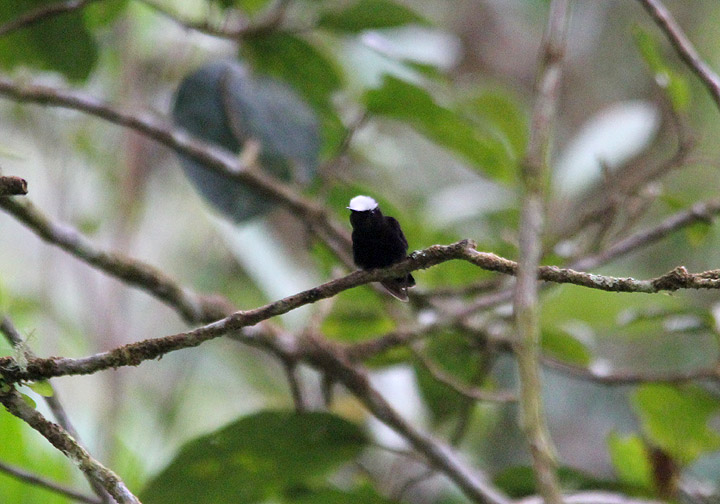
“SNOWCAP!!!”. My focus was re-shifted--this was one of my top 10 birds for the trip. Jose pointed out the sound they were making and said there were 3 or 4 birds in the understory. Eventually we saw the movement and then the birds. They were tiny and zipped by quickly. We were at a lek site that Jose said seems to be active at random, and often moves to different spots along a 200 meter section of road--today the birds were active and close. I finally got some okay shots when a bird landed in the trees--it wasn’t great but it was a lifer and a brilliant bird.
Best bad shot I managed of a Snowcap
As we stood enjoying this show, one bird flew too close to even photograph. It hovered in the flowers nearby for 30 seconds giving outstanding looks before disappearing. It was amazing. Over the next ¼ mile we had no less than
10 SNOWCAPS, and possibly more. We also picked up some other great hummingbirds like:
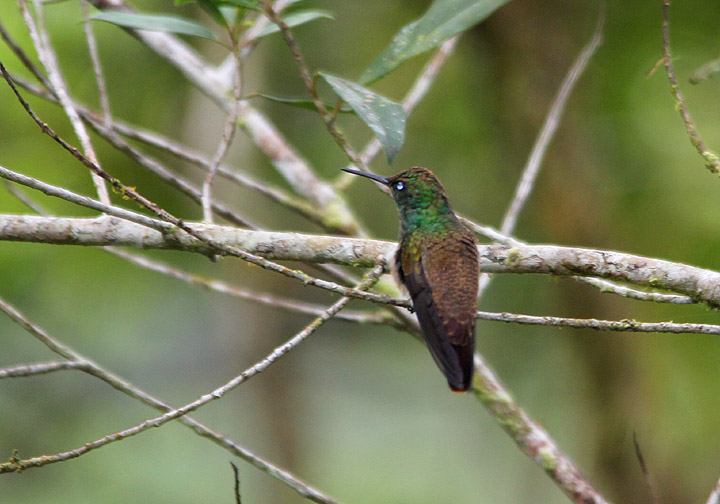
BLUE-CHESTED and SNOWY-BELLIED HUMMINGBIRDS, WHITE-TAILED and GARDEN EMERALD, and GREEN HERMIT. I had already lost count of lifers for the morning.
The not-so Snowy-bellied side of a Snowy-bellied Hummingbird
We kept on hiking and eventually got looks at a
SLATE-COLORED GROSBEAK singing from a tiny tree on a cliff above us.
A
RUSSET ANTSHRIKE was singing from the forest at the edge of a clearing near the cliffs. We walked to the edge here to try for a few birds and were rewarded when a
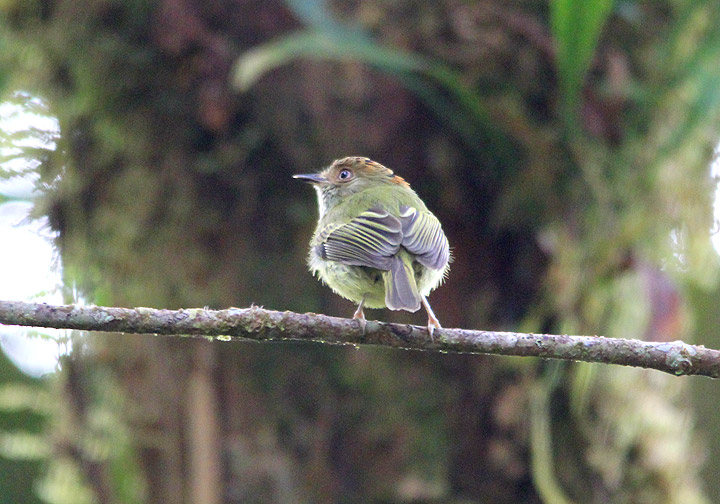
SCALE-CROWNED PYGMY-TYRANT flew in and sat in the open for a few minutes.
Scale-crest Pygmy-tyrant trying not to be seen
Jose pointed out a calling
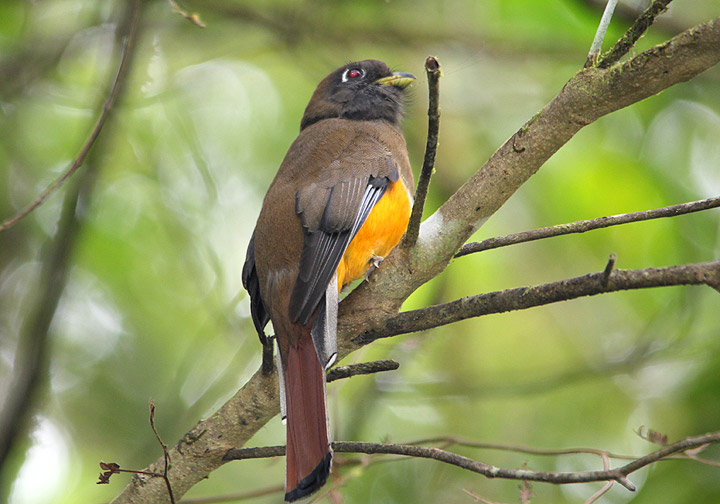
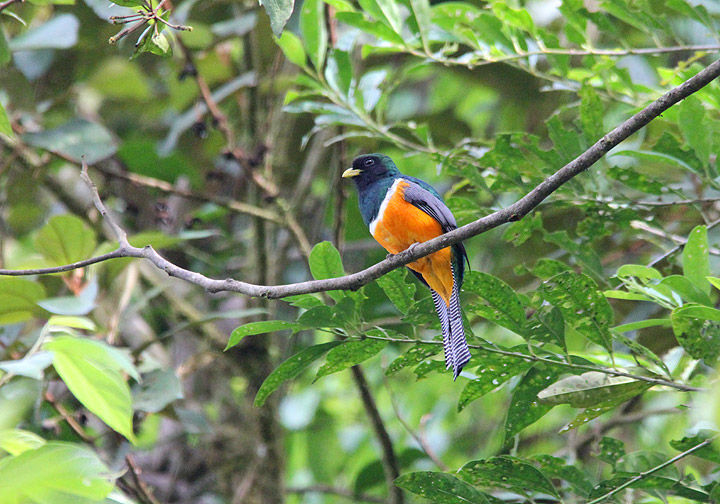
ORANGE-BELLIED TROGON from the forest, so we headed up the road to get closer. Eventually we found both a male and female sitting right above the road. The female was much more obliging, but eventually the male emerged and sat out on a limb doing his thing. My love of trogons is second only to tanagers, and this was one of those great birding moments.
Female (top) and male (bottom) Orange-bellied Trogons
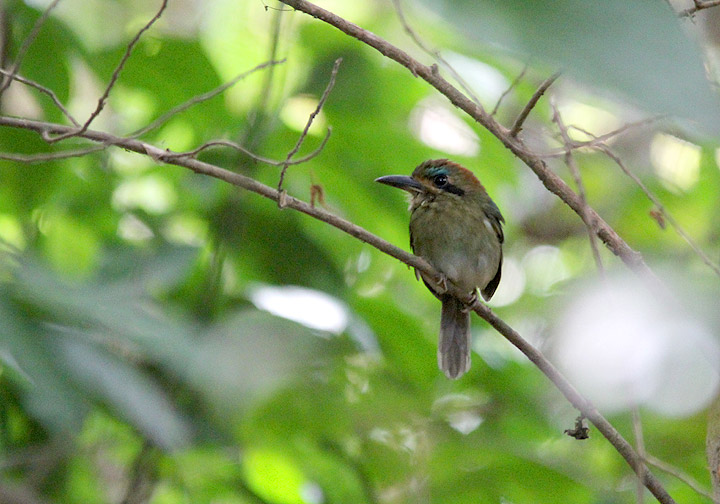
While we watched Jose pointed out a couple of calls from the trees--one was of the
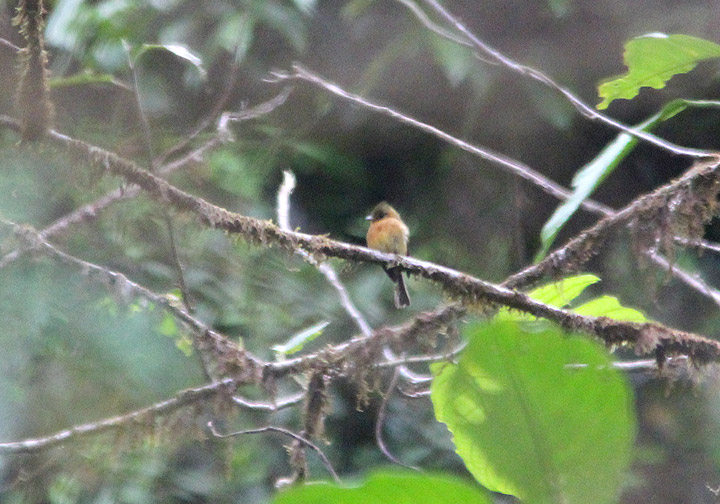
TUFTED FLYCATCHER. A really colorful little guy. Despite being a base gray, the subtle yellows, oranges, and reds give it some character. It was hard to photograph deep in the forest, but I managed a distant shot.
Distant Tufted Flycatcher in the forest
More notably, was a bird that was very close to the road that was hard to find--a
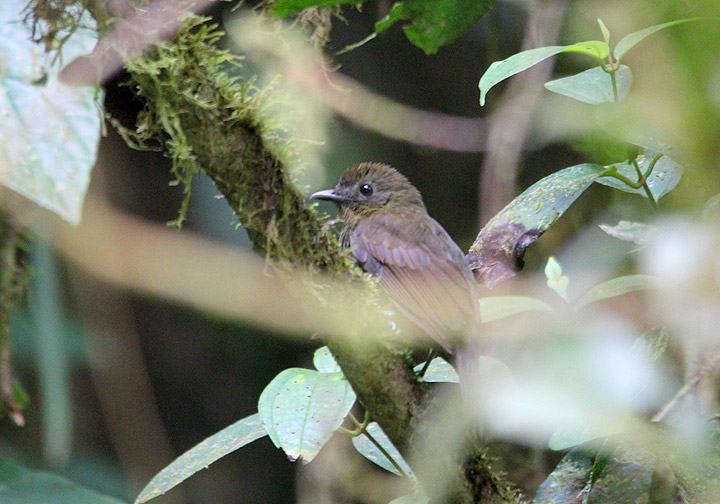
NORTHERN SCHIFFORNIS. It was singing, and with a little help from my phone it flew over us once, then back again. The second time it landed in a small opening, where I was able to snap a shot before it scampered off. Another plain bird, that was covered in subtle yellows, oranges, reds, and also greens. The most surprising thing about this species is for some reason I always thought it was the size of an empid, when in reality it was the size of a kingbird.
Subtly colorful Northern Schiffornis
The road opened up and I could see what looked like a summit ahead. It was. From here I could see down into another valley and a gravel road in good shape. Jose pointed to the right and said,
“this is Altos del Maria”. You can actually drive here, but I guess it's a paint in the ass now, something about a permit, and permission, and by the time you get up here its too late for the birding. The peak above us could be reached by a trail that was another ? of a mile long. He asked if I wanted to go to the top--and of course I said,
"yeah". How could I not want to hike to the top when I had already come all this way?
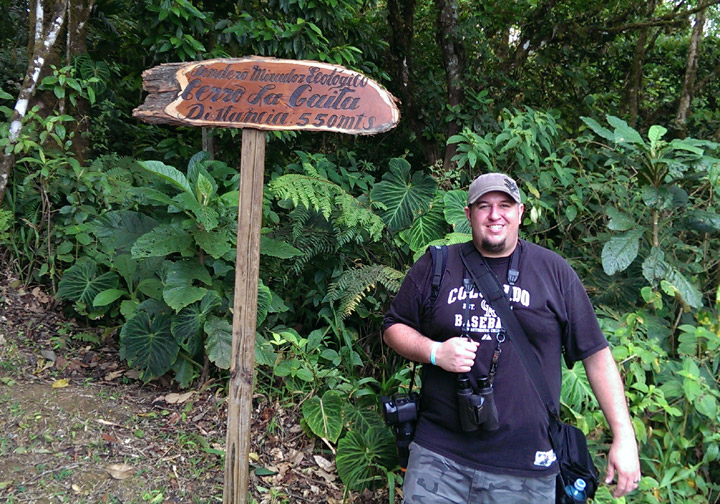
Me just below the summit of the hike
Through the forest the trial was basically cement stairs that led up and up and up.We eventually hear both
BLACK-CROWNED ANTPITTA, and BLACK-FACED ANTTHRUSH. The latter we spent probably almost 30 minutes trying to get a look at. The birds was no joke within 15’ of us the entire time but due to it’s secretive style walking on the forest floor, we managed just 2 seconds of actually seeing the bird. I fared much better recording its song.
As we continued up Jose stopped me and pointed to a call off in the trees--
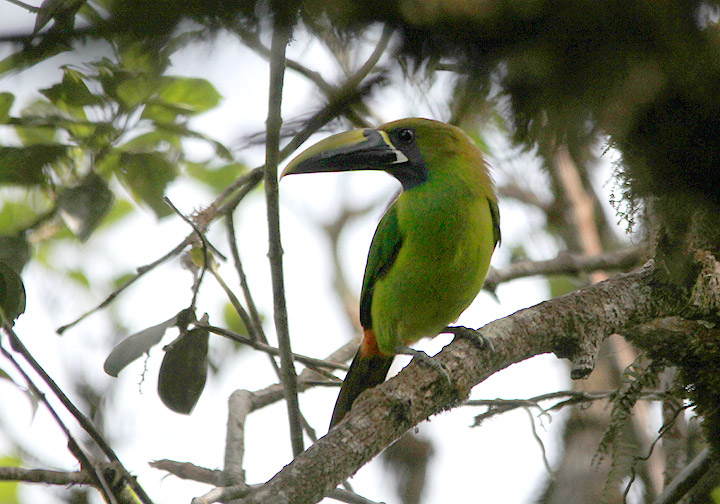
EMERALD TOUCANET! This was another top 10 species for me. I pulled out my phone and played the call a couple times and the bird flew in. It wouldn’t come any closer than about 50’ and stayed high up in the trees. The fleeting glimpses were less than satisfying. I headed up the trail to see if I could get to a better vantage point. I was about 75’ higher up and had a better view into the canopy below where the bird was. I played the call again and almost instantly it landed on an open snag in good view about 30’ away. I snapped two pictures, before it lifted off, flew right over me and down the other side of the hill--it was gone just like that. The photos turned out super dark, but with a little Photoshop magic everything turned out okay.
Heavily Photoshopped shot of an Emerald Toucanet
An interesting side note is that it has been suggested that the
Emerald Toucanet actually could be split into at least 7 species. There is some disagreement on the treatment, but in general there seems to be strong evidence that there are 7 distinct species. In central Panama there is some disagreement about which sub-species actually occurs--currently it is listed as
Blue-throated Toucanet, but according to George Angehr, author of The Birds of Panama, it is possible toucanets from central Panama actually are closer to the Purple-throated sub-species. As our science gets more and more advanced it seems that more and more species are going to be “discovered” as they are split out or suggested to be split out like this group.
Looking back down the stairs through the jungle
As we continued up the trail was got into a small group of
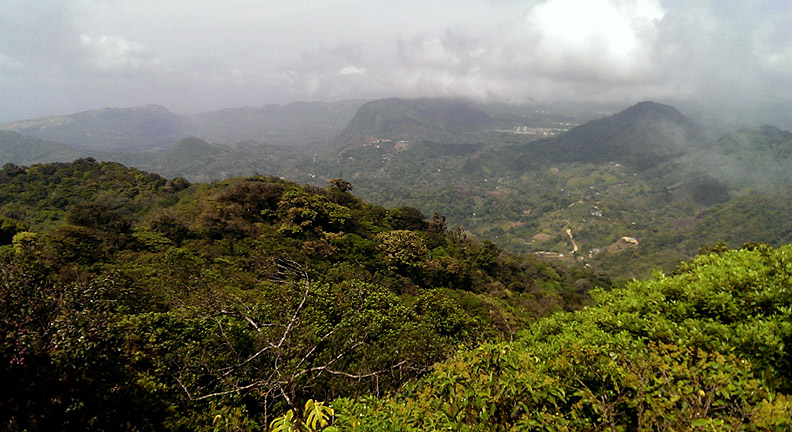
SPOTTED BARBTAILS. We could hear them calling but only ever got good looks at one. There were much fewer birds up here than below, but they were some high quality species. We soon emerged from the forest onto wooden steps that skirted the cliffs and let to a boardwalk and finally a viewpoint above the trees. The view was incredible. On certain days during the year I was told you can see both oceans form here--but the moisture-filled air below kept us from seeing the Atlantic side. We did however have an amazing view back to El Valle. We had hiked 3 miles up from where we parked and gone up almost 1,500’ in elevation.
The view of El Valle de Anton below
We watched
BROAD-WINGED HAWKS soaring above the mountains and snacked on licorice then headed back down, down, down.
Soaring Broad-winged Hawk
The trip down didn’t take long and soon we were back at the main road where the closed road started. Jose told me that there was a guy who would drive us from just below here back to the car--but when we got to his house, he wasn’t home… So we walked all the way back.
Jose ahead of me headed back down the road
We did add
SHORT-TAILED HAWK for the day, and got a good look at a soaring
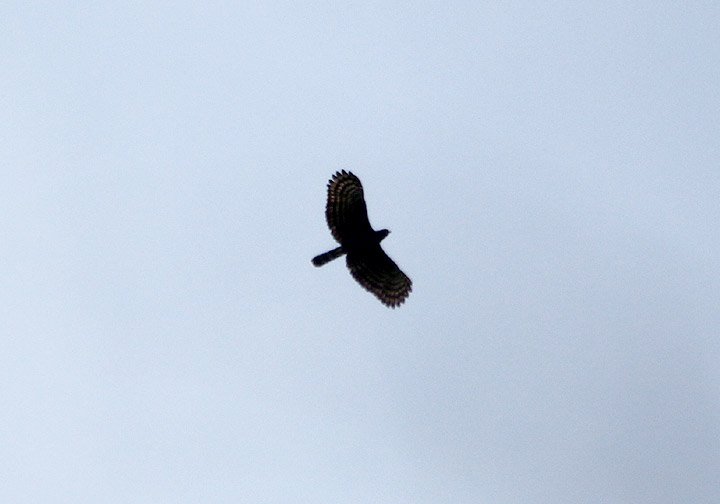
BLACK HAWK-EAGLE which Jose heard calling way up in the air before we ever saw it.
Black Hawk-Eagle high above us
By the time we got back to the car my legs were destroyed--the down, down, down was brutal on my quads, and this was my first hike of the year--but it was well worth is as we tallied 97 species and I snagged 39 lifers. I downed two bottles of water and then we ate what I can honestly say was the best Pineapple I’ve ever had--seriously amazing. I ended the hike with a stellar photo op of a
RED-LEGGED HONEYCREEPER, and a joke from Jose. He told me that as a kid they played soccer with the kids from the village we had hiked down from. He said every game, every year, all the way through school they never beat them once. He said it wasn’t till the first time he hiked over here to look for birds that he understood why! We watched the current group of kids making their way up the hill and back to their village--probably getting ready to beat the local kids from El Valle in a soccer match :)
Obliging Red-legged Honeycreeper
We headed back into town, made a couple stops, and then headed off to our next spot to look for birds. We pulled off the road and a guy emerged from the a trail with 4 people. One of the guys was obviously a guide while the other 3 were American birders--they didn’t bother to say hello and went on their way. This is so typical of most American birders I see outside of the states--for god sakes people, have a little personality, and try to be friendly when you see other birders--we have a common hobby, and it wouldn’t hurt to put the anti-social awkwardness aside for a bit. The other gentleman was a Panamanian and he had a machete--he also happened to be friends with Jose and the next little bit of our trip included some staged birding--and some very lucky birding. As we walked down the path a couple
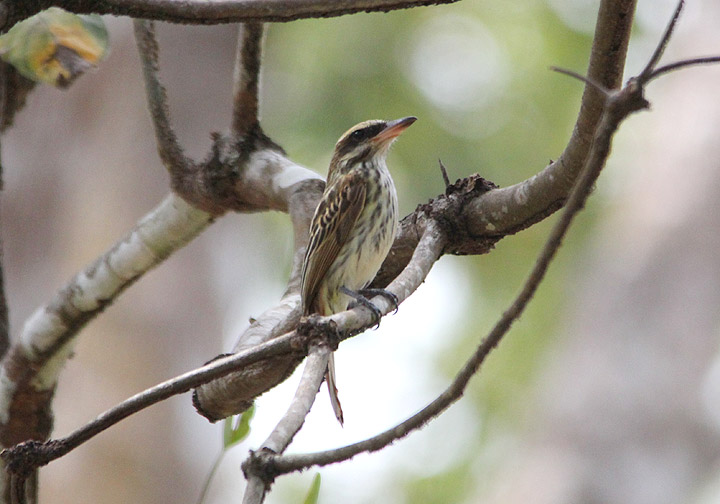
STREAKED FLYCATCHERS flew past and landed for good looks.
Once down the trail and into the woods the other gentleman knelt down and pointed up into the trees. Jose pulled me aside to a spot where we could see the prize--a
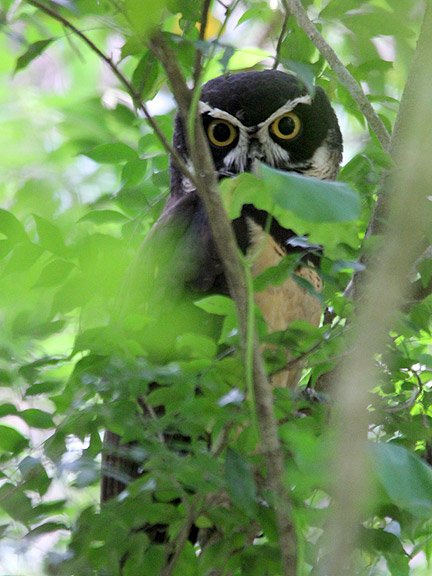
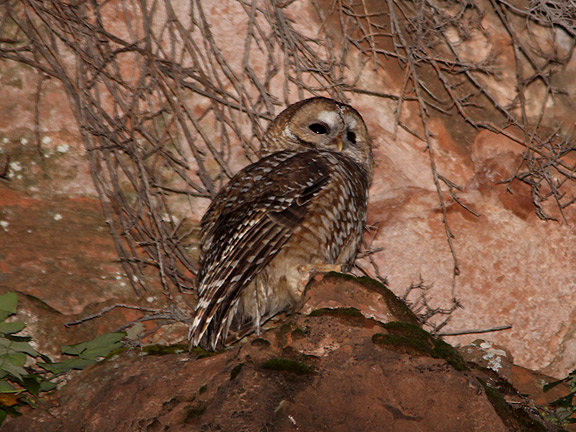
SPECTACLED OWL. This bird was found some time ago and is apparently now a popular staked out species. Just a few years ago this species wasn’t recognized to be found anywhere in central Panama, but this family group in El Valle broke the rules.
Gorgeous Spectacled Owl hiding in the forest
While we watched a
YELLOW-OLIVE FLYCATCHER came in. This was followed by
WHITE-VENTED PLUMELETEER that were harassing the owl. Finally, a
WHITE-WINGED BECARD came in to check out the commotion.
Yellow-Olive Flycatcher striking a pose
White-vented Plumeleteer in the under story
White-winged Becard overhead
Back on the trail Jose pointed out the call of a
ROSY THRUSH-TANAGER in the woods. There were
LESSER GREENLETS, CRIMSON-BACKED TANAGERS, RED-CROWNED ANT-TANAGER, and YELLOW-BACKED ORIOLE. It wasn’t long before Jose was pointing up in the trees and had a male
LANCE-TAILED MANAKIN perched nicely. We kept going and after a minute he explained this is where we could find a Tody Motmot--however the first bird we actually spotted was a
WHOOPING MOTMOT.
Whooping Motmot (I missed the tip of the tail!)
We spent the next 45 minutes wandering through the woods looking for the tiny prize bird--twice we heard it calling, and the other gentleman got a brief look at it. It was starting to see like we were not going to get this bird. We got better looks at
LANCE-TAILED MANAKIN along the way, and had another
ROSY THRUSH-TANAGER. BLACK-CHESTED JAYS moved through the trees above, while House, Plain, and
RUFOUS-AND-WHITE WREN sang from the understory.
Lance-tailed Manakin showing off those colors
Jose stopped us and said the other guy had just seen the bird and was going to loop around and try to get it between us. Within 5 minutes we were off the trail, kneeling below the limbs of trees, and looking at a
TODY MOTMOT! The tiny bird was hard to see without binoculars in the poor light of the understory, yet the other gentleman had spotted it from 60’ away without any help. He was a true expert of the local birds and their habits and knew how to find them.
Super rewarding look at a Tody Motmot
After enjoying the bird for a few minutes we headed back towards the car emerging in a yard. The gentleman who had helped us was a caretaker for this weekend home for someone with money from Panama City--he also owned the land adjacent to this property where we had seen most of the birds mentioned above--it was only the smaller Motmot we added on this other property. He took us up to the house and out on the deck where he produced a ladder and had me climb up and look down into a planter on the deck--there inside was a nesting
TROPICAL SCREECH-OWL. They had their show staged down to the details, acting surprised about these staked out birds, and then later Jose gave me the low down on them. It’s a good show, and they were awesome guides.
Tropical Screech-Owl nesting in a planter
I tipped the guy $10 for his help and we were back on our way. From here we drove through town out a place known as Las Minas--a popular birding road a few miles from town. By this point in the afternoon things had slowed a little bit. I still managed 3 lifers with
DUSKY-FACED TANAGER, SCARLET-THIGHED DACNIS, and CHESTNUT-CAPPED BRUSH-FINCH. New trip birds included
STRIPE-THROATED HERMIT and SHINY COWBIRD.
We had hoped for a Yellow-eared Toucanet here, but the heat of the day wasn’t helping. We found a small army ant swarm but surprisingly no ant birds were attending. I wondered what things were like here early in the morning.
Las Minas Trail--I need to come back here in the morning
We made a couple more stops to try for other motmots, and finished the day off at La Mesa to look for sicklebills. No new trip, or life birds, and just like that the day was over. We headed back to town and parted ways. I thanked Jose for his expertise and help. Without him I would have gotten life birds and seen a few things, but I never would have known where to go to find the things we did--and I wouldn’t have added almost 50 life birds. If you ever go birding in Panama,
reach out to Jose. He will give you a good deal and show you lots of birds. He knows the country from east to west and
can help you just about anywhere you would want to go. Of every guide I’ve had in various foreign countries, Jose was by far the most knowledgeable, and fun to bird with.
I headed back to the hotel, met Sam and relaxed for a bit before we had dinner. It had been an epic day of birding and I was ready for some relaxation!
49 life birds here / 58 total trip life birds / 171 total trip species
photos from this post:
http://www.timaverybirding.com/photos/thumbnails.php?album=1152
eBird Checklists:
Altos del María
El Valle de Anton
Las Minas
La Mesa
Sheraton Bijao Beach ResortLabels: life birds, listing, Panama, recording, Travel, tropics