Utah Birds, Utah Birding, and Utah Birders. Promoting the sharing of information, and the conservation of habitat for birds in Utah and elsewhere. We are a group of people who want to share what we know, and create a positive birding experience in Utah.

BIRDERS BLOG

a blog by and for Utah Birders

Fledgling Hawks

posted by Jerry Liguori at
on Friday, August 8, 2014 

Check out a new blog post about hawks nesting in neighborhoods if interested:
http://hawkwatch.org/blog/item/735-fledgling-hawks


Labels: ,

New HWI Blog posts

posted by Jerry Liguori at
on Friday, June 27, 2014 

I posted a few new blogs on the HawkWatch International page @

http://hawkwatch.org/blog/item/715-juvenile-cooper-s-hawks-yikes 
http://hawkwatch.org/blog/item/714-counting-hawks

Labels: ,

Some New Hawks To Review

posted by Jerry Liguori at
on Monday, June 16, 2014 

Originally posted @ http://hawkwatch.org/blog

The four birds ('click' on image to enlarge) were sent to me at various times and I can't remember who sent them (except the last hawk sent by Bill Schmoker). There was a question on their ID's so I thought I'd post them to hear some suggestions and thoughts on them. The first bird was from Texas in spring, the second was from either Utah or Colorado in winter, the third was from Georgia (not quite sure of the time of year), and the last was from Colorado in Winter. Can you help me with these ID's? I'll write a summary in a few days on what they are and why...

Labels: ,

Female Harrier in Adult Male Plumage?

posted by Jerry Liguori at
on Wednesday, June 11, 2014 

Originally posted @ http://hawkwatch.org/blog

This post is an interesting subject to explore. I was curious about an adult male Northern Harrier Peter Pyle published in Birding Jan/Feb 2014. He suggests that a male-plumaged specimen is actually an adult female in this caption: "...Although the specimen was labeled a male, it had a wing chord of 362 millimeters, indicating a small female; the label included no data on gonads, suggesting that it may have been (mis?)sexed based solely on plumage." He states in the article that he had studied this specimen before but did not mention he thought it to be a female at that time. Must be an interesting bird, right? Looking at this particular specimen (image #1), one question arises: does it make more sense to sex this bird as a male based on the fact that it has typical adult male plumage, or is it better to assume it's a female with male plumage based on a single measurement that has an overlap zone between male and female? Let's explore this a bit more and see what we can find out.

Because there has never been a known female Harrier showing adult male plumage banded in North America, housed in a museum, or reported in historical data or literature regarding nesting birds in North America, Brian Sullivan and I were very curious to explore Pyle's theory. So Brian went to the Museum of Vertebrate Zoology at Berkeley to review the specimen. We can say for sure that the bird appears it was labeled correctly as a male all along. This is good thing. Now, new birders won't be confused and wonder whether every adult male Harrier could be a female...it's hard enough to identify all the raptors out when you first start birding, so I'm glad it seems we were able to eliminate one potentially confusing ID issue! There is considerable size variation in both sexes of Harrier, and overlap occurs. Brian measured the wing chord of the male in question multiple times and the largest measurement he recorded was 352mm, which is towards the larger end for a male. Truth be told, it is more difficult to measure a "frozen" study skin than a live bird, and that could be the reason for Pyle's higher measurement. Brian had to have one of the museum staff assist him in order to measure the specimen and take a photograph of the measurement (image #2). I reviewed the literature Pyle cites in his article and found an adult male Harrier with a wing chord of 362mm in one study (JFO. K. Bildstein, F. Hamerstrom). I also reviewed measurement data on nearly 1,000 Harriers throughout North America (576 Harriers in the HawkWatch International database) and found overlap in wing chord between the sexes, and several additional males with wing chords of 362mm. In Pyle's 2008 reference alone, the wing chord range for male Harrier is listed as 322 - 360mm, female is listed as 362 - 400mm, a mere 2mm separation.

The specimen tag had some very relevant information. The weight of the bird the day it was shot was 382.5gms, easily within the male range. Brian's tarsus width measurement was on the small end for a male (right leg = 5.58, left leg = 5.84), but the legs of specimens can be slightly slimmer than live birds. A smaller looking male Harrier in the same tray as the specimen in question had a larger tarsus width: right leg = 6.35, left leg = 6.35.

Hawks From Every Angle (Princeton, 2005) states "some females show grayish remiges." However, they are not known to have remiges as gray as adult males, and Lack solid black wing tips, a black trailing edge to the wings, and white underparts. This specimen has distinct black wing tips typical of adult males. Pyle didn't show the wing tips in his article, so here is an image of the bird for clarification (see image #1) and a nice addition to the story. And, here's an example of a typical adult female that has grayish remiges (image #3), check out the banded wing tips. Interestingly, the eye is still brownish-yellow on this adult female suggesting it is only a few years old.

Pyle also says "...it is possible that adult males show some sort of polymorphism as older birds..." meaning males can be "browner" on the back or face as they age, but then he finishes by saying "...but I can't think of another example among species with delayed plumage maturation (gulls, albatrosses, boobies, etc.) in which plumage does not progress through early cycles toward a universally definitive plumage state, let alone showing sexual dimorphism as well." Several issues arise from the second part of this quote. Pyle previously stated: "browner adult males were "2nd-years" or "sub-adults." He also stated: "older females can look like males." As well as stating previously: "adult Harriers reach a definitive plumage." So, if older females (specimen Pyle refers to) look identical to what Pyle (2008, 2014) refers to as sub-adult males, how are we to know which is which in the future? And, what % of "browner males" are actually older females? If the classic brown adult female plumage is not now the definitive plumage, is the definitive plumage of every female ultimately a male plumage? Can grayer males change to browner plumage or even female plumage as they age? All of this would mean the only way to sex Harriers at all is by measurements (of which there is some overlap), unless of course it is mated pair. But, these questions are irrelevant for the time being. I credit Pyle for agreeing with Brian and I in saying "...it is possible that adult males show some sort of polymorphism as older birds..."

An interesting point to note: One might figure a bird old enough to change out of its definitive plumage might show 2 generations of feathers (as many adult females do), but this specimen only shows one, which unfortunately means there is no way to age the bird past after-hatch-year. The eyes are not present on skins of course, so we can't determine by eye color if it were a younger (brown eye) or older (yellow eye) adult female if it were a female anyway. For new birders or researchers, beware that study skins may look overstuffed, elongated (as the discussed specimen), or plumper, etc. than normal depending on who prepared it. I noticed this since I was taught taxidermy in 1988 and prepared skins for several years after. Check out these male Harriers (image #4) and male Merlins (image #5) (sexed by measurements, gonads, and plumage) that vary considerably in size due to preparation bias.

Having said all this, I am still open to the possibility of the bird being a female, since I don't know everything there is to know about raptors (not even close), and for anyone to say that have "seen it all" would be just plain silly. I would just like more evidence to point that way, and for now I don't think it does, but may very well one day…and that would be just fine with me!

Labels: ,

Assessing bird shapes in photos

posted by Jerry Liguori at
on Wednesday, June 4, 2014 

Originally potsed @ http://hawkwatch.org/blog

Something Peter Pyle wrote recently in Birding magazine gave me a good idea for a blog post. Actually, a few posts will follow on the subject, which I think will make neat lessons. Pyle was wondering if this adult male Harrier (image #1) could be sexed as a female based on wing shape [quote: "...could be an anomalous male or perhaps an older female, as also suggested by its broader wings and bulky appearance; females are larger than males in most hawks."]. This particular Harrier is in typical adult male plumage and is a breeding male (as the caption stated) paired with a typical female, so I can't find anything anomalous about this bird, and I can't find a reason to think this male would be a female (maybe the caption should have stated it was the bird on top when they copulated). I don't see this bird as "bulky" either, so I was quite puzzled by that quote alone. "Hawks From Every Angle" focuses on distinguishing the shapes of raptors in flight from all the angles, and "Hawks at a Distance" shows how to identify more distant raptors based on these principles. In these books, it states that male Harriers are shorter-winged and shorter-tailed than females, and hold their wings in a shallower dihedral, but Pyle's suggestion that females having broader-looking wings because they are larger birds is misleading, especially when looking at birds in photos. Be careful: males of several species have broader-looking wings than females, and all raptors appear stockier when seen from a side view (HFEA). Males and females of some species differ in wing beat, juveniles differ slightly from adults in shape on other species, and a so on...but accurately judging any of these differences takes years and years of field experience. For example: I categorized a distant melanistic (an extremely rare type) Harrier in flight in winter 2008 in northern Utah as a male based on shape and flight style (and banded primary tips identified it as a juvenile and not adult male). A melanistic adult male Harrier was found wintering south of Boise, ID four years later, and I believe it was the same bird as the UT bird. So did my experience pay off, or was it a different bird?

It is easy for anyone to make an error judging shape from a single photo. Photos can be deceiving since they are only a split-second snap shot in time. Often, a bird looks stockier, lankier, or more pointed-winged than normal in certain poses, and this is even exaggerated at times in photos. Here is an example: (http://jerryliguori.blogspot.com/2013/10/pointed-wings.html), and there are other examples of this topic on my blog. A bird such as a Harrier that is known for its narrow wings, can look stocky wing-on or change shape as it changes angles (images #2-7). In fact, the male (image #6) and female (image #7) look as stocky or stockier than almost any raptor in North America from these angles, but that doesn't make them Red-tailed Hawks (as an example) in Harrier plumage. Also, check out this Broad-winged Hawk (image #8), a species known for its stocky appearance that looks quite lanky in this instance. I just posted a quiz bird from CA with a similar theme: (www.hawkwatch.org/blog). So, be careful of judging single photos based on shape -- even well known birders such as Peter Pyle have made this mistake. With experience though, it becomes easier.

Labels: ,

Bald Eagle Trick

posted by Jerry Liguori at
on Friday, May 30, 2014 

Instead of reposting, thought I would share a link to a Bald Eagle ageing trick. Check it out @: http://hawkwatch.org/blog


Labels: ,

Raptor Secondary Pattern

posted by Jerry Liguori at
on Saturday, May 24, 2014 


I have been posting on the HawkWatch blog for a while but wanted to share my posts with this site, if interested in a tid-bit about secondary patterns on raptors, check out the link below:

http://hawkwatch.org/blog/item/689-raptors-pale-inner-secondaries

Labels: ,

Utah Winter Gulls Matrix Part 1

posted by Tim Avery at
on Thursday, February 20, 2014 


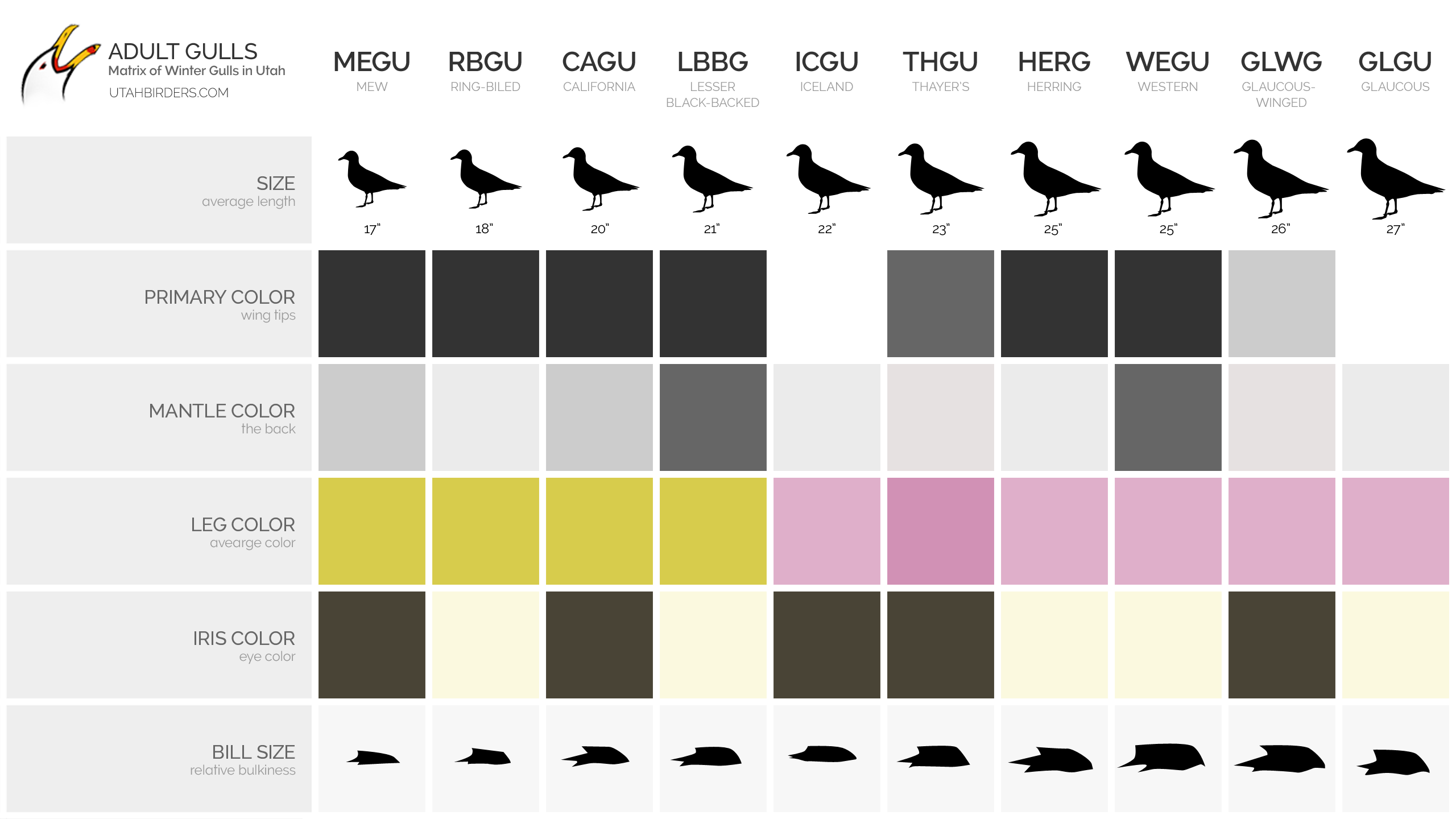
As we near the end of gulling season here in Utah, it often becomes the best time of year to find rare and uncommon gull species.  With water starting to open up and more food available, the large ocean-favoring gulls show up with more frequency, or at least become noticed more.  In a short month from now, the vast majority of these birds will be gone, and we won't seem them again till November.  There have been a few identification requests for gulls lately, so I thought I would take a second and give a crash course on the basics for helping narrow down the possibilities when you see a gull you don't recognize using a matrix.

This is only for Adult Gulls however, so I will be working on similar matrices for each other age as well.  As a disclaimer this is NOT 100% accurate in all cases.  Measurements, relative sizes, colors, eyes, bills, etc are all somewhat averages.  If you think something is drastically off or could be improved please contact me to talk about it.  I would like these to be as useful as possible.  With that said I wanted to throw some numbers around.

The best way to recognize the not so common stuff is to really know the common stuff well.  This means getting to know our State Bird--the California Gull, and its smaller relative the Ring-billed Gull very well.  I went into eBird and did some quick data compilations to show how common these two are in relation to everything else.
  
Between November and February there have been 711,265 total reported gulls in the database (rough estimate).  

This is not total number of actual birds, this is total number of birds reported--so multiple people may have submitted checklists for the same birds.  Of those, 14,643 were hooded gull species (Sabine's, Franklin's, Bonaparte's, and Little) so I removed them from the total to end up at 696,622 total white headed gulls reported during the gulling season into eBird (all time). 

California and Ring-billed account for about 680,000 of these individuals, or roughly 97.3% of all gulls reported in eBird in Utah between November and February.  

That means the other 8 species that you might encounter make up just 2.7% of all the gulls reported--roughly 16,600 individuals--still a pretty hefty number, but at least you know the odds are in the favor for the 2 most common birds.

So let's break it down a little more--aside from those two species, the other 8 most likely species you can encounter in Utah in the winter from most common to least:

Herring Gull -- 15,000 reported
Thayer's Gull -- 780 reported
Lesser Black-backed Gull -- 299 reported
Glaucous Gull -- 183 reported
Western Gull -- 176 reported
Mew Gull -- 96 reported
Glaucous-winged Gull -- 56 reported
Iceland Gull -- 29  reported

Using the matrix above, with a little practice, you can learn to narrow down the possibility of the species you are seeing based on the included attributes.  The colors in the matrix may not be exact but for most adult birds its a good starting point.  click on the above image or link below to download a high resolution version to your smart phone or iPad.

Check back soon for the matrices for 1st, 2nd, and 3rd winter birds, as well as another for hybrids.

Labels: ,

Juvenile Harlan's Tails

posted by Jerry Liguori at
on Monday, January 20, 2014 

Originally posted on www.jerryliguori.com

I just wanted to post a few tails of JUVENILE Harlan's Red-tailed Hawks since the tail can be the clinching trait for identifying juvenile Red-tails as Harlan's. However, they are not always as distinct from the other races as adults are, and can cause a bit of confusion, especially the light-morph juveniles!

What makes a Harlan's tail? Well, often the dark bands on the tail are thicker than on other races, the dark and light bands are more contrasting (but sometimes just the opposite), sometimes the banding is wavy, and each tail feather has pale blobs on the inner part of the tips creating a "spiked" look. This is not to be confused with a thin line at the tail tip, which can look like a spike of sorts that many Westerns show. Also, some juvenile Harlan's have mottling throughout the tail similar to that of adults. This is more common on light-morph juveniles, which are often different that dark-morph tail patterns in NOT showing the white blobs. Be aware that the tails of some juvenile Harlan's are nearly indistinguishable from other races, which makes ID tricky. Another trait to look for is the uppertail covert pattern. The uppertail coverts on light-morph juveniles is often mottled unlike the barred, spotted, or plain upper tails of most juvenile dark Harlan's (and most juveniles of other races).

Here are some examples -- a picture is definitely worth a thousand words. I have hundreds of examples, but these photos are a good cross section, showing every one is a bit of overkill. I was going to write an article on the subject, but it's just easier to show it here, and I think this post stands alone as a good reference for birders.

Dark-morph

Dark-morph

Dark-morph
Dark-morph

Intermediate-morph

Intermediate-morph

Dark-morph

Dark-morph


 Dark-morph

Intermediate-morph

Light-morph

Light-morph

Light-morph

Light-morph
Light-morph

 Light-morph

 Light-morph

Light-morph

 Light-morph

Labels: ,

Prairie Falcon Ages

posted by Jerry Liguori at
on Saturday, January 18, 2014 

Posted on www.jerryliguori.com

Just want to post a few pics because of a recent discussion on Prairie Falcon ageing. Sometimes it's not so easy to tell the age of a Prairie Falcon since the juvenile and adult plumages are very similar to each other. Flesh parts (cere, feet, orbital ring) on the larger falcons (Prairie, Peregrine, and Gyrfalcon) turns from pale bluish to bright yellow, but the time it takes for these parts to change color varies quite a bit, and in Gyrfalcon, it takes longer to change than in Prairie and Peregrine. In fact, oddly, many juvenile Peregrines have yellow feet (but often not ceres) by early fall. Also, the flesh parts of males tend to change quicker than on females, same with eye color of accipiters, but of course this varies somewhat individually. By the way, Prairie Falcon gets its adult plumage the first time it molts in its 2nd year.

There are plumage differences between juvenile and adult Prairie Falcons, and often it is easy to see, but sometimes it is extremely confusing. Juveniles typically have short streaks on the underbody, where adults have more rounded spots. The head on adults is more finely streaked than the plainer brown head of juveniles, and the pale spots on the back of the head are less white. The upperwing coverts have broader buffy tips, and the secondary and primary coverts are more heavily barred an adults than on juveniles. The tail of adults usually shows more complete bands looking paler overall than on juveniles.

Here are some composites of juveniles on the left and adults on the right (note how similar the two ages appear), and a head shot of a juvenile in September that is already changing color on the cere ('click' to enlarge).


Labels: ,

Krider's is a Morph of Calurus?

posted by Jerry Liguori at
on Saturday, January 11, 2014 

Many birders and banders use the Pyle guide as a standard reference. While it is a great start for most species, there are some inaccuracies that birders and banders should be made aware of. I don't make a habit of pointing out errors in other's works, but I think it is helpful and appreciated. On page 445 of Pyle's guide it says: "Krider's Red-tailed Hawk…occur as vagrants to CA-AZ. These are medium to large in size…Krider's Red-tailed Hawk is here considered a white morph of borealis (Wheeler 2003), although, based on size it may also be a morph of calurus (Dickerman 1989), or of both subspecies." This sentence piques my curiosity. Before this quote, Pyle states the breeding range for Krider's pretty accurately as "south-central Alberta-eastern Manitoba to northern CO-northwest NB, winter to Texas." So how can Krider's be a morph of calurus, or, "a morph of both subspecies"? To clarify, in Wheeler 2003 it states that Krider's is a "pale morph" of borealis, and in the 1989 Dickerman paper, he does not associate Krider's with calurus. I'm also curious about what 'size' is being referred to here, and every Red-tail race is "medium to large" in size.

The issue with "Krider's occurring from California to Arizona" is that there are no substantiated Krider's records west of the Rocky Mountains. All of the reports in that area documented with a photo have turned out to be a light-morph Harlan's (the two subspecies can look very similar to each other). So, the Krider's referenced from CA-AZ is an extraordinary claim. Of course, Krider's could or has already occurred west of the Rockies, and I suspect it will be documented sooner or later for sure. Here are some Krider's and light-morph Harlan's below for future reference (check out the juvenile and its adult plumage a few years later -- follow-up instances like this are invaluable). And a downloadable PDF of a study of Krider's hawks. During this study, we did not see a single calurus from the grasslands of eastern MT to the MN state line south to SD, but did document many Krider's breeding with typical borealis and abieticola: http://www.aba.org/birding/v42n2p38.pdf

Just a side-note, the latin name is spelled "krideri" in Pyle's text, however, "kriderii" is the proper spelling, and describing Krider's as a "morph" is unusual since it has been proposed as a race in the past, may very well be today, and is typically treated as such in literature since it has a distinct breeding range, so defining it as a light-morph variant sounds better. To be fair, I know what it's like to have your ideas questioned. I stated about 7 or 8 years ago that I thought Harlan's Red-tail could be closely related to borealis for several reasons, and was dismissed by some. But recent DNA tests (Hull, et. al. 2010) show that Harlan's and borealis are closely related, and the two are found to freely interbreed. I can't fault anyone who makes mistakes researching the entire list of species and subspecies in North America, my point is to simply help rectify and decipher some issues.


 Adult Harlan's 

Adult Harlan's 

Adult Harlan's

Adult Harlan's

Juvenile Harlan's (left) Adult (right) - Same individual

Juvenile Krider's

  Adult Krider's

  Adult Krider's

  Adult Krider's

 Adult Krider's

Labels: ,


UTAH BIRDERS FLICKR POOL


    SEE MORE AND SHARE ON FLICKR