Utah Birds, Utah Birding, and Utah Birders. Promoting the sharing of information, and the conservation of habitat for birds in Utah and elsewhere. We are a group of people who want to share what we know, and create a positive birding experience in Utah.

BIRDERS BLOG

a blog by and for Utah Birders

The Big Year—My Take

posted by Tim Avery at
on Wednesday, October 19, 2011 

I consider myself a movie buff.  I have been known to go to midnight openings for highly anticipated movies.  I generally like most movies as well.  I am not a tough critic, and for the most part enjoy movies for the art, the acting (good or bad), and the subtle things that others may not care about (music, set design, things going on in the background).  Truth be told I didn’t have the highest hopes for this movie, from the first previews, to the teasers, and the blog post reviews after opening night.  I had read the book some years ago and found it enjoyable.  I figured with the movie Hollywood would take some liberties, and try to make it interesting to the mainstream.  So this was what I went into the theatre in my head—but with an open mind to what it may actually end up being.

Now having seen the movie I can say two things. First, I see why birders have for the most part raved about it, and enjoyed it—I for one enjoyed it as well.  Secondly, the producers, writers, and directors missed a chance to make something big, and make something memorable.  Let’s talk about the second part first.


A movie about birders competing to see the most birds in a year in North America.  To your average Joe this has no appeal—I mean come on think about how absurd that sounds to someone who doesn’t watch birds.  SO Hollywood tries.  They take a book, change a bunch of facts, come up with a story that works based off the original facts, and make a movie.  They get three huge stars to play the main roles, and a supporting cast that has some pretty big names as well.  Regardless of the story, this thing should be gold.  Then opening weekend comes and the movie comes in #9 at the box office with just over $3,000,000 gross.  IT will be a miracle if it stays in the big theatres more than a week.

So what would have worked?  Does anyone remember Best in Show?  The parody of the Westminster Kennel Club’s top dog competition?  What about Dodgeball? The movie that made the “sport” more than just a playground game.  These movies were vividly different, but both immensely hilarious in their own ways.  They made fun of their subjects, but at the same time took the serious nature of the characters as a juxtaposition that made for comedy gold.  They were funny, entertaining, and successful.  They were everything the Big Year could have and should have been.


Imagine a docu-comedy about birders, where the characters are the extremes, and so serious about what they do, that you can’t help but laugh.  It’s okay to be made fun of—especially if it spreads awareness and gains popularity because of that.  Or a comedy that is just laugh after laugh after laugh at our expense.  Those types of movies would have been more geared at your average watcher, and may have been more successful.

Now some will say I am being too tough on the flick.  But thus far the sugar coated blog reviews are not an honest look at the movie.  They are reviews from the eyes of birders and that makes them lopsided.  And don’t get me wrong, I liked the movie—I found it entertaining, and I enjoyed the fun it poked.  Having done my own big year I felt some of the joy, the frustration, the pain, and excitement of the characters as they went about their journeys.  I laughed when I saw a bit of myself in each of them.  My wife by my side smirking at me from time to time as we both thought, “Man they nailed that portrayal”.  And yes in some instances they were over the top in their portrayals, but for the most part, it was pretty spot on and as hard as it may be for some of us to admit, we know some of those characters in real life.  We see those actions when we interact with other birders, and we have been through the same experiences as those in the movie. 


Perhaps the thing I found most enjoyable was the computer animated birds—some of them were stunning.  A certain woodpecker and hummingbird come to mind.  Some were equally bad, and others just ridiculous (High Island comes to mind).   Some of the actions of the birders were equally ridiculous, while others were just slight exaggerations.  At one point I saw Owen Wilson assuming the Jeff Bilsky birding stance—all rights reserved (I joke).  All in all like I have said, before, I enjoyed the movie.

The soundtrack wasn’t bad either, and the song by the Eels is a classic!  You can check it out here.

My wife, god bless her sat through it with me.  She saw the movie from the other side.  The wives of the characters, the people who deal with that craziness that ensues when birding is in full swing and the experiences we have had together and could relate to what was happening on screen.  She even told me afterwards that I had qualities of all the characters, and she had seen me do some of the ridiculous things they do. 


With that being said, if you are a birder (and I imagine if you are reading this you are), GO SEE THIS MOVIE.  Go see it before it is out of theatres and all you can do is pick it up at Redbox or on Netflix.  You should enjoy it, and you will probably have some of the same thoughts that I had.  You may even want to do a big year yourself!
Labels: , , ,

Baird's Sparrow in Salt Lake Tribune

posted by Tim Avery at
on Saturday, October 1, 2011 

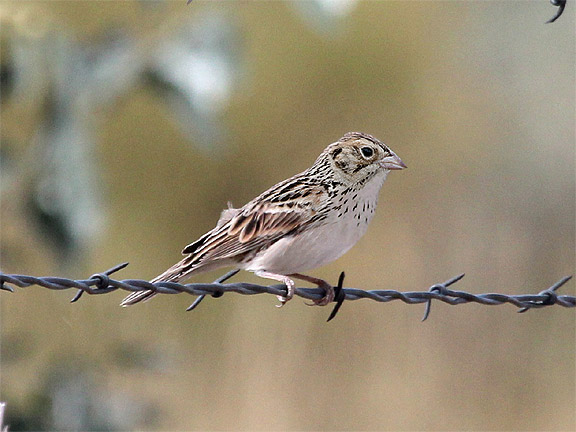
This weeks bird sighting in the Salt Lake Tribune is of the Baird's Sparrow I found a couple weeks ago at Swede Lane in Utah County. So yes this is shameless self promotion (but informational shameless self promotion).

Baird's Sparrow at Swede Lane, Utah

This species is rarely reported in Utah, but likely passes through in very small numbers each year during spring and fall migration. The southeast corner of the state would be in the general migration route, and given how little coverage the area receives, this is only one of a number of birds that probably occur more than reported passing through this vast remote region.

There have been about 7 reports of the species in Utah, although there is only one "officially accepted record"--but you know my thoughts on that. This secretive sparrow can be very hard to detect as it is--secretive. On the occasions I have come across this bird they have always been seen briefly as they moved through low brushes and grass. This individual gave me about 10 seconds perched up on the wire, after hopping from the edge of a dirt road--and before disappearing into a field with lots of low shrubs and grasses.

It's been a great year thus far with some really good birds showing up around the state. Here is a link to the article in the tribune:

Bird Sighting: Baird's Sparrow | Salt Lake Tribune

Labels: , , ,

Evening Grosbeak Call Types

posted by Ryan O'Donnell at
on Wednesday, May 11, 2011 


Like Red Crossbills and Pine Grosbeaks, Evening Grosbeaks (Coccothraustes vespertinus) have been described as having distinct call types that vary geographically (Sewall et al. 2004). These distinct call types also correspond approximately with subspecies that have been described based on morphology. Because of these distinct call types which correlate to geography and morphology, it has been suggested that Evening Grosbeaks may be in need of further taxonomic work, that is, that they may be candidates for future splitting. In that Sewall et al. paper, they leave northern Utah as a question mark in their map, an unsampled area between the ranges of (morphologically-defined) subspecies C. v. brooksi and C. v. warreni, where no birds were examined and no calls recorded.

Yesterday I recorded a small flock of 4-6 Evening Grosbeaks calling in the treetops above my yard in Logan, Utah. Evening Grosbeak call types are distinct enough that they can be told apart by ear, but I don't have any practice at this so I imported recordings into the software RavenLite to examine the sonograms.

Most of the calls were of Type 1. This is the call type that is given by C. v. brooksi, the subspecies which ranges from Oregon, Idaho, and Wyoming north to northern British Columbia. Here is a sonogram of a Type 1 call I recorded yesterday:

And here is a recording of Type 1 calls from Washington you can listen to:


In my recording yesterday, I was also able to pick out a few examples of Type 4 calls in my recordings, which is typical of C. v. warreni and mapped by Sewell et al. as occurring from about the Uintah Mountains, through Colorado, to northern Arizona and northern New Mexico. Here is a sonogram of one of the Type 4 calls from my yard:


And here are some Type 4 calls from Colorado you can listen to:


Sewall et al. documented both call types 1 and 4 from northwestern Wyoming and southern Colorado. It appears that both call types also occur in northern Utah. More work will have to be done to tell whether this is the result of movement of individuals, intergradation between subspecies, or overlap between reproductively isolated cryptic species.

Sewall, K., R. Kelsey, and T. P. Hahn. 2004. Discrete variants of Evening Grosbeak flight calls. Condor 106:161-165.

Labels: , , , ,

Happy 226th Birthday Mr Audubon

posted by Tim Avery at
on Tuesday, April 26, 2011 

Today Google celebrated John James Audubon's 226th birthday with a Google Doodle. Chekc it out below:


You can read more about it here.

Labels: , ,

Recorded Bird Song

posted by Jeff Bilsky at
on Friday, March 4, 2011 

Our results show that short playback sessions can have longlasting
and far-reaching effects on individual fitness.


I've been re-examining my thoughts about playing recorded bird song in the field. I used to say "what's another voice in the chorus?" But after reading this article, I'm starting to feel a bit differently. I was surprised at the implications of this study and thought it would be worth sharing.

I welcome comments and thoughts! Thank you.

Labels:

The Big Picture

posted by Jeff Bilsky at
on Thursday, February 17, 2011 

Part of my desire to begin writing on this blog was to of course share in some great discussions on bird specific topics but also to share information that extends beyond just birding. I consider myself somewhat of an environmentalist and to that end try to keep myself educated and aware of the environmental issues that face our planet. Birds are part of the greater picture, as are we, so at times I'll pass along articles and information and thoughts about some of these "bigger picture" concepts. I'm confident a lot of you will be as interested as I am. I felt like this brief disclaimer was needed before sharing the following articles.

First, there's this, which I just read on scientists search for 100 missing species of frogs, salamanders and caecilians and the disheartening conclusion. LINK

I also recently read about the disease afflicting bats: White-nose Syndrome. It appears to be having some pretty devastating effects. LINK

My intention is definitely not to be a downer but I understand this is some pretty heavy stuff. If you need to be cheered up just remember that spring migration (the big push of it anyway) is mere weeks away and in spite of the seemingly impossible challenges facing them, the birds will soon be back on their summer breeding grounds, singing and thriving.

Labels: ,

The Wild Within

posted by Jeff Bilsky at
on Monday, February 14, 2011 

I recently tuned in to a television program called The Wild Within. It airs on The Travel Channel with new episodes showing on Sunday nights. The host, Steven Rinella, is an outdoorsman who claims his goal is to reawaken the spirt of hunting and gathering. Here's a video that explains it.


I was almost immediately captured by it. Listening to him speak about hunting for survival and understanding the enormity of taking an animal's life offers a great perspective. I highly recommend checking it out. Some of the scenes are quite graphic but I admire the authenticity of it and of the host.

I know this strays a bit from the usual sharing of bird related topics, but I figured a lot of you might be interested nonetheless!

Labels: ,

Starlings Poisoned

posted by Jeff Bilsky at
on Thursday, January 20, 2011 

Hundreds of Starlings were found dead in South Dakota. The US Government poisoned them for crapping in the wrong spot:
LINK

They assure that the poisoned dead birds do not pose a risk to nearby animals or humans.

I'm wondering how they can be sure there's no risk. I would think if another animal ate an animal that had been poisoned there would be a risk of ingesting the same poison. That seems a little odd but who knows.

Labels: ,

Birders Rising

posted by Jeff Bilsky at
on Tuesday, January 18, 2011 

An article from Slate magazine that dissects the current state of birding and it's apparent increase: LINK

Labels:


UTAH BIRDERS FLICKR POOL


    SEE MORE AND SHARE ON FLICKR