Utah Birds, Utah Birding, and Utah Birders. Promoting the sharing of information, and the conservation of habitat for birds in Utah and elsewhere. We are a group of people who want to share what we know, and create a positive birding experience in Utah.

BIRDERS BLOG

a blog by and for Utah Birders

Panama: My Top 10 List

posted by Tim Avery at
on Tuesday, February 18, 2014 

Another trip and another list of birds I want to see. This year I am splitting the difference between Peru and Costa Rica and going to Panama.  That means a combination of species from both Central and South America, including a number of species not found in either Peru or Costa Rica.  However given my past forays to the tropics, the numbers of possible life birds here has dramatically decreased, somewhere in the tune of 230 some odd possible lifers this go around. That means that if I am able to track down 40% of these birds I will snag about 90 lifers; 50% means 115 or so lifers; and 60% would be about 140 lifers.  

That would also mean just getting 4-6 of these beauties below. Despite the decreased chances of new birds, it’s still in the tropics, which in general means the birding is incredible, and even the common stuff leaves you in amazement.  But let’s talk about the top 10 I want to see on this trip--my prize birds!

• • •

 10. Sapayoa

 Sapayoa by Dusan Brinkhuizen

 The Sapayoa is an enigma--no seriously, as its scientific name suggest, Sapayoa aenigma, “the enigma”, is a bird in its own class.  To date there is no clear relationship to other families of birds and it may just be a literal one-of-a-kind.  It’s fairly common but easy to overlook--I don’t know if I will actually see this bird, but with such an interesting back story I thought it worthy of making my top 10 for this trip.

• • •

 9. White-tipped Sicklebill

White-tipped Sicklebill by José Loiza

 By no means is this hummingbird the most colorful or brilliant patterned, but the sharply decurved and specialized bill which is used to feed specifically on the heleconia flowers is just freaking awesome.  Apparently this is all but a sure thing at Cerro Azul where I will spend the better part of my first day in the country birding.  At #9 I hope this thing is a slam dunk--because it’s an awesome bird.

• • •

 8. Black-and-yellow Tanager

Black-and-yellow Tanager Illustration by Joseph Smit

 I had to get at least one tanager on the list and this one drives me nuts, because it doesn’t look like a tanager--or I should say it doesn’t look like a Piranga--which is one reason I’m really interested in it.  It’s part of the Chrysothlypis family but currently still referred to as tanagers.  This is one of those groups that eventually might get changed all together.  Regardless, the brilliant yellow and black pattern really makes this a standout species.

• • •

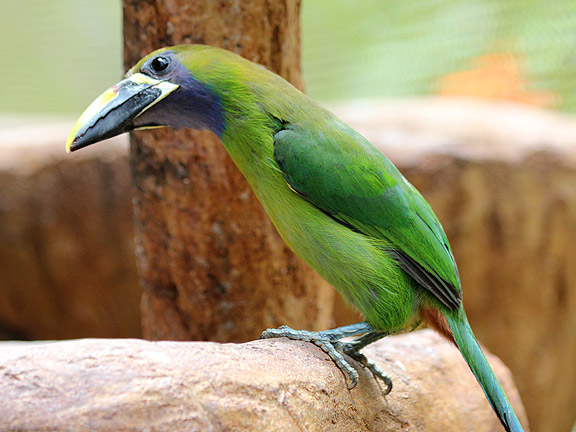
 7. Emerald Toucanet

Emerald Toucanet in Costa Rican Aviary by Tim Avery

 Toucans, toucanets, and barbets are some of my favorite tropical birds.  I’ve seen a number of species, but only got to look at this gorgeous species in an aviary in Costa Rica.  In Pananama this bird is a recognized subspecies  called the Blue-throated Toucanet--that may eventually get it’s own listing.  Regardless of that I really just want to watch these hooligans of the bird world hop around the trees and put on a show.

• • •

 6. Bran-colored Flycatcher

Bran-colored Flycatcher by Dario Niz

 Taking it back to 2011--this bird was on my first travel top 10, and I struck out then. Its name brings to mind cereal for me, and I don’t know why but that makes it interesting. It doesn’t have an interesting pattern, or bright colors, but the subtle browns, along with the streaked breast, and yellow crown make it unique.  My chances should be increased for seeing one this go around as it is found throughout the country where it is fairly common.

• • •

 5. Spot-crowned Barbet

Spot-crowned Barbet Illustration by Gossipguy

 My affinity for Barbets and Toucans continues.  This funky bird is mostly black and white, with a speckled crown, and a yellow-orange wash for a breast band. I just find the barbets to be really intriguing.  They’re not quite toucans, but close enough--the smaller size may be what really makes them interesting for me.  I’ve struggled with this family in the past, so I’m hoping for some good luck this go around.

• • •

 4. Tiny Hawk

Tiny Hawk by Keith Bowers

 Here’s yet another throwback to my first trip to the tropics--I had it on my top 10, but never really got into good habitat for a chance to see it.  However, this time around I should have better luck as it is far more widespread in Panama.  It’s tiny, and it’s a hawk. Only slightly larger than an American Kestrel, it looks sort of like an accipiter but is either all dark gray, or all rufous brown in markings and pattern—never combining the two like our North American accipiters.  This bird is a remarkable little hawk.

• • •

 3. Blue Cotinga

A not so blue immature Blue Cotinga by Dominic Sherony

 A very impressive near endemic. I am yet to see a cotinga--in 2011 I hoped to luck upon an endangered Yellow-billed Cotinga in Costa Rica--I didn’t.  This time I should have a better opportunity with this species that is far more common than that cousin. With it’s shiny blue body, and purple belly and throat this beauty would be an excellent find for this trip.

• • •

 2. Snowcap

Snowcap by Michael Woodruff

 One of the most stunning hummingbirds in the world.  Any time you can see a hummingbird that isn’t primarily green and white in coloration you should get excited.  The Snowcap is mostly purple/maroon with a “snowy” cap.  It’s a tiny and stunning hummingbird found at Anton de Valle where if the stars align I will be able to add this bird to my life list.

• • •

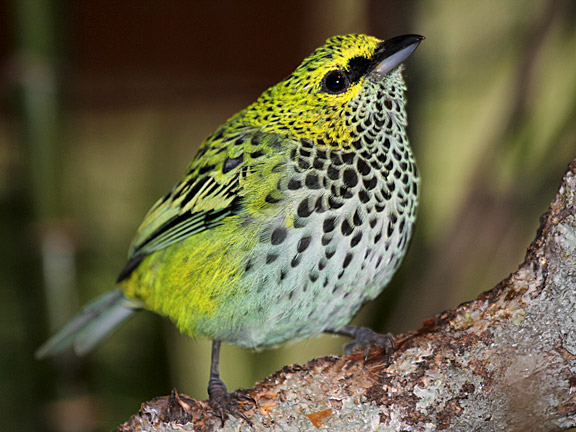
 1. Speckled Tanager

Speckled Tanager in Costa Rican Aviary by Tim Avery

Going back to 2011 when I made my first trip to the tropics and this was my #1 target bird, I had to put it back at the top of the list for Panama.  It also happens to be my favorite new world species of bird, making it a top priority to see. I saw one in an aviary in Costa Rica but not in the wild--similarly I missed its sister species the Spotted Tanager in Peru.  Our first day in Panama we will travel to Cerro Azul where Speckled Tanager are reported frequently and I believe I will have my best shot to finally lay my eyes on this gem in the wild.

Fingers Crossed and camera ready--this will probably be my last trip to the tropics for a little while, so I hope to make the most out of it and pick up as many of these birds as I can!

Labels: , , , ,

2013 Recap and The Next 10: My Utah Target Species for 2014

posted by Kenny Frisch at
on Thursday, January 16, 2014 

At the of 2012, I had been in Utah for a little over a year and felt like I had done a good job at finding birds across the state having seen 291 species in that span.  However with a closer look at my Utah list there were some glaring holes.  Some species I felt that I should have seen already but for some reason or another had missed them.  At the start of 2013, I picked the 10 species that I wanted to see the most and wrote a blog describing my New Year's resolution that I made to find those 10 species across Utah (my New Year's resolution blog can be found here: http://utahbirders.blogspot.com/2013/01/my-new-years-resolution.html).  Much to my surprise and delight, by the end of July I had already seen all the species I had resolved to see.  Here is how my first encounters with each of these species went down.

1) California Condor- Jeff Bilsky, Tim Avery and I had this magnicifent Pleistocene leftover on our way driving out of Lava Point Campground on Kolob Terrace in Zion National Park.  Someone spotted a very large bird and "condor" got called out.  I almost hurt myself jumping out of Jeff's car while it was still in the process of stopping as I was trying for my lifer views.  Sure enough flying behind the trees was the largest bird I have ever seen and an unforgettable moment: my first ever California Condor.

A treat for the soul: a California Condor. Kolob Terrace- 5/11/13

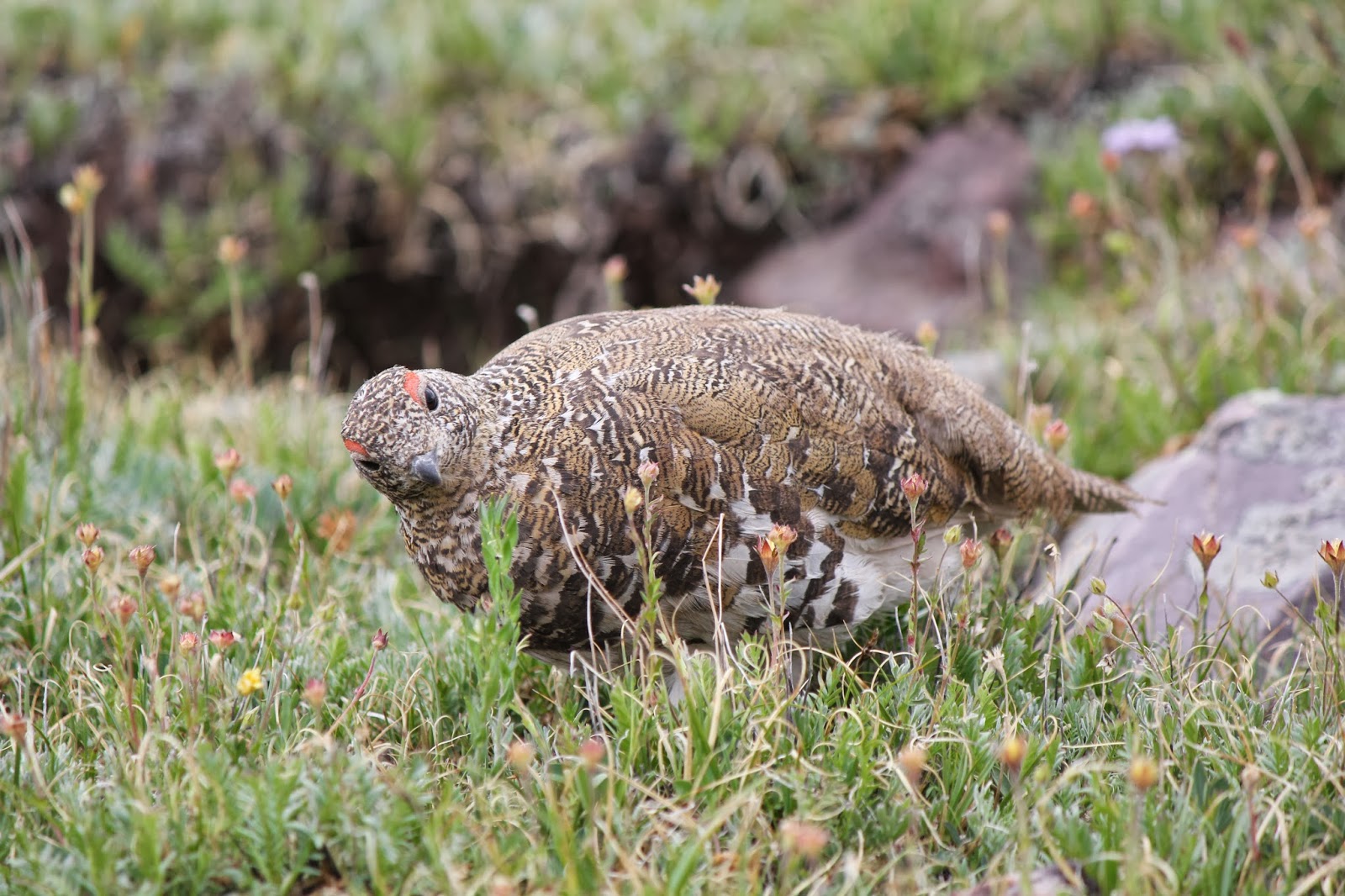
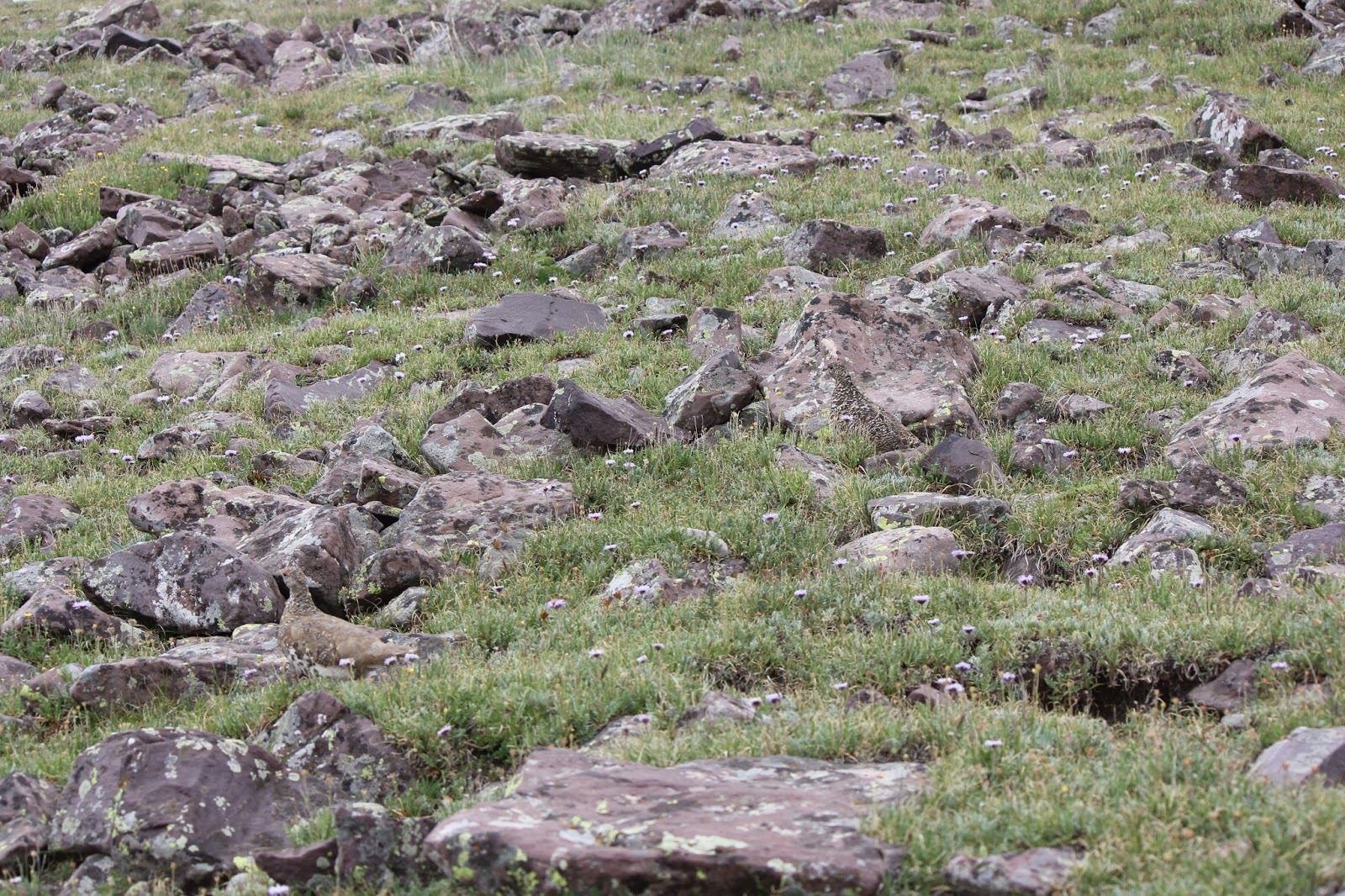
2) White-tailed Ptarmigan- This was the last of my 2013 resolution birds I saw, late in July.  Jeff Bilsky and I already had a great day of birding in the Uintas after a 3 hour drive from Salt Lake City that had us drive through Wyoming and on some rough dirt roads.  From the Bald Mountain B trailhead we had already hiked almost 3 miles and had seen awesome species up close ranging from nest Northern Goshawks to American Three-toed Woodpecker  to Gray Jays to Pine Grosbeak and nesting American Pipits.  Before summiting, we searched the flanks of the top of the mountain above treeline with no success until we had gotten 3/4ths of the way around the top.  There Jeff somehow picked out a pair of White-tailed Ptarmigan that were almost perfectly camouflaged in the lichen covered rocks.  The pair walked close by us and eventually were comfortable to feed about 10 yards away- what amazing luck and not to mention a spectacular view to boot!  Soon after we summited Bald Mountain B, 11776 feet, and made our way down the mountain.  Unfortunately we got lost on the way down and ended up having to go down a particularly steep part of the mountain to get back to my car.  Next time I will try to memorize the trail so I don't have to endure any impromptu adventures after finding a life species.

A fantastically plumaged male White-tailed Ptarmigan. Bald Mountain B- 7/20/13

The ptarmigan shows off his funky eyebrows while feeding

 A cryptically colored female White-tailed Ptarmigan

 Find the female ptarmigan

 Find the male and female ptagmigans

3) Gunnison Sage-Grouse- A lifer.  I was greatly aided in finding this species thanks to a field trip that Utah Birders helped put together.  The day before the official field trip, Jeff, Tim and I headed down to Monticello to scout for one of the handful of United States endemic species (birds found in no other country) that only lives in small areas of Utah and Colorado.  Looking for this species in the right place was essential since there are only about 120 of them left in Utah.  Driving on Hickman Flats Rd we soon came across a male displaying on the field.  Male Gunnison Sage-Grouse can be distinguished from Greater Sage-Grouse by their smaller size, ponytail instead of individual plume feathers and the different sounds they make.  Getting to watch one of the rarest birds in Utah was thrilling but also made you think about how easy it could be to lose it as a Utah breeding species.  The next morning with the rest of the field trip participants we got to watch some Gunnison Sage-Grouse on lek as the sun rose in San Juan County.  What a way to start a morning.
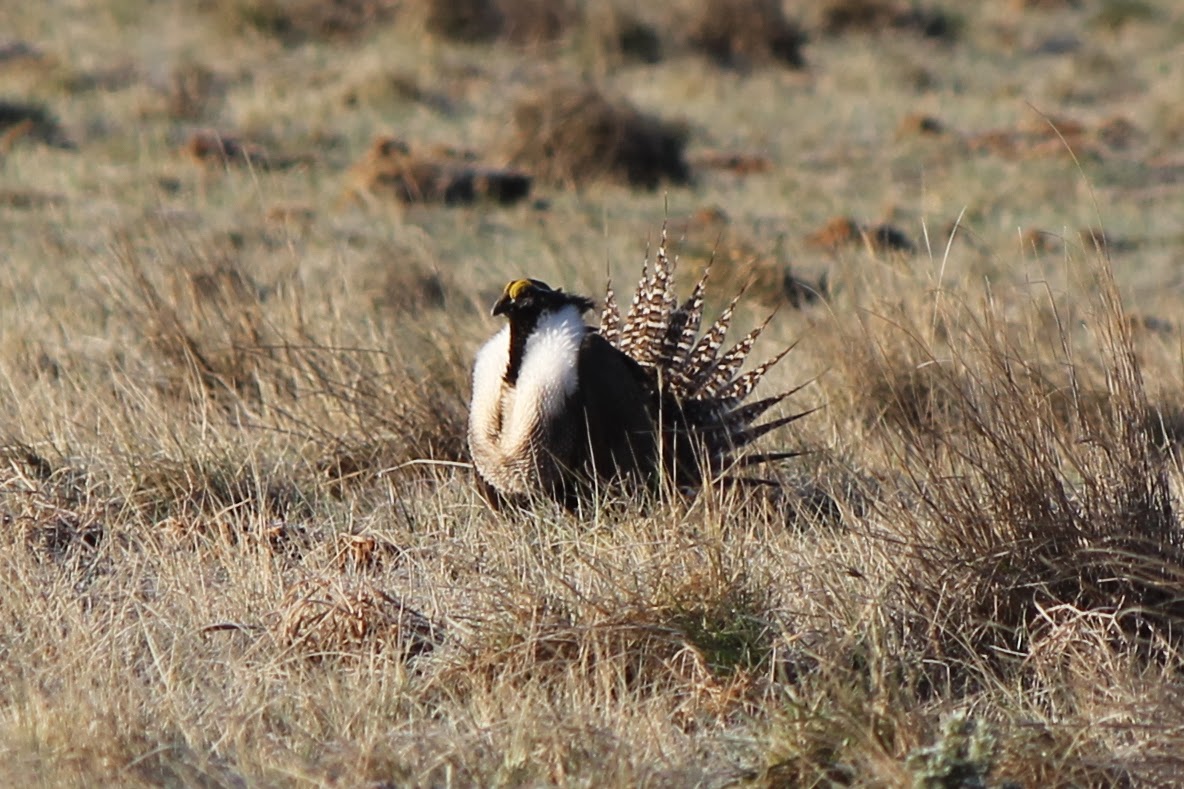
 A male Gunnison Sage-Grouse. Monticello, UT- 4/12/13

 Part 1 of the Gunnison display- Inflated air sacs

Part 2- Whipping its ponytail forward

A video of a male Gunnison Sage-Grouse displaying

Gunnison Sage-Grouse on lek at sunrise

4) Band-tailed Pigeon- This was probably the easiest species I had to find this year despite multiple trips to see it since I only needed to go about 10 minutes from my house to the house of Dick and Deedee O'Brien.  Ever friendly and inviting, they put up with for what seemed like a dozen trips to their house without success before I finally had the pleasure of viewing these large native pigeons.  Big thanks once again to the O'Briens!

Nemesis no more- my lifer views of Band-tailed Pigeons. SLC, UT- 6/2/13

5) Spotted Owl- I got to see this secretive owl the day before I saw the California Condor.  These birds were in Zion National Park and let us know about their presence by first calling, then later giving great views as the male flew up to the female with a snack and was rejected by the larger female.  It was cool having the owls so close and not having us initially see them given how well their plumage allows them to blend in.  Despite the failing daylight, these owls put on a show that I will never be able to forget from their echoing calls haunting the narrow canyon to getting to see a rare moment of owl courtship.  This was a true lifer, not just a Utah lifer for me.

The larger female Spotted Owl- Zion Canyon NP, UT- 5/10/13

A Spotted Owl calls in Zion Canyon NP

6) Black Swift- Black Swifts were relatively easy to find this year especially in the first few miles after the mouth of Little Cottonwood Canyon.  The swifts nested in this area and could be seen flying around the area around sunset getting ready to roost.  I am hoping to get much better views and pictures this year.

I swear this is a Black Swift. Little Cottonwood Canyon, UT- 7/3/13

7) Williamson's Sapsucker- This was a true lifer for me.  Tim, Jeff and I had this species about an hour after my lifer Gunnison Sage-Grouse encounter near Monticello.  While stopped to look for Juniper Titmouse in a stretch of juniper trees, we heard a soft tapping from a woodpecker.  It took us a few minutes before we found our unexpected prize- a beautiful male Williamson's Sapsucker.  I was expecting to see one of these up in the mountains in a few months but seeing in the wrong habitat only added to the excitement of this species.  Later on in the year I would get to see more of the uniquely colored male and female Williamson's Sapsuckers but these birds were in the appropriate habitat, the mountains.

Yes that's a Williamson's Sapsucker in a juniper. Monticello, UT- 4/12/13

A very different looking female Williamson's Sapsucker. Brighton, UT- 7/13/13

8) Vermilion Flycatcher- This species was the first target species I found in 2013 on a trip down to Washington County with my brother Jeff and some of his friends from Prescott, Arizona.  This sighting occurred in February by the Santa Clara River near Santa Clara and was thanks to a tip from Stephanie Greenwood.  She however had an adult Vermilion whereas we had a young adult male starting to molt into is striking adult plumage that left it looking like a Pink Flycatcher rather than a Vermilion.  Later on in May, I would get to see an adult male in Beaver Dam Wash.

 A pinkish looking young male Vermilion Flycatcher. Santa Clara, UT- 2/16/13

9) Pinyon Jay- This gregarious species was a day after I had seen the Gunnison Sage-Grouse and Williamson's Sapsucker on our first real day of the field trip.  This birds were found in some Pinyon-Juniper Habitat near Monticello and provided great looks as the flock foraged in the area.   In November, I would get even better views of a flock of these birds in great light down in Canyonlands National Park.

My first Utah Pinyon Jays. Monticello, UT- 4/13/13

A much more satisfying view of a Pinyon Jay. Canyonlands NP- 11/17/13

10) Scott's Oriole- This full lifer was both a treat to the eyes and ears.  Its colorful black, yellow and white plumage stuck out in the desert and its beautiful warbling song cut through the harshness of the desert environment.  Jeff, Tim and I had this species on the Beaver Dam Slope the same morning we saw the California Condor.

A feast for the eyes and ears- a Scott's Oriole. Beaver Dam Wash- 5/10/13

It was very satisfying working towards my resolution throughout the year.  I ended up with over 40 new Utah lifers in 2013 with 7 species being lifers I have never seen before in my life- Mountain Plover, Painted Bunting, Bar-tailed Godwit and Lark Bunting besides the others mentioned above.  Other memorable Utah lifers this past year included the Bountiful Blue Jay, the Cache Snowy Owl,  Bear River Meadows Black and Powell Lake Least Terns, the Farmington bayLittle Gull, the Ogen WMA Tropical Kingbird and the Lake Park Pacific Loon.  All have a special spot in my heart.

After my search for those species was complete, I naturally started pondering what the next 10 species I want to see in Utah for 2014.  There are very few easy birds in this next group for me to find.  Some will require special habitats, special timing, and/or just plain luck.  I am looking forward to the challenge of finding these birds as they will test me as a Utah birder.  Without further ado, here are my next 10:

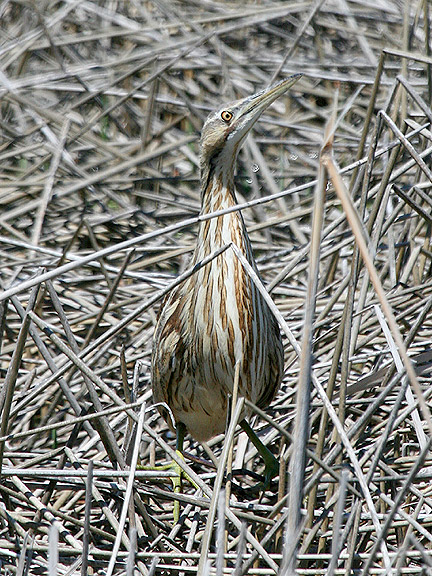
1) American Bittern- This species required both some skill and some luck.  You will need to be in the appropriate habitat and then you have to get lucky the one will revel itself to you.  My best bet to see this very secretive heron is Bear River Meadows.

 A bird that doesn't want you to see it- an American Bittern
(Photo copyright Tim Avery)

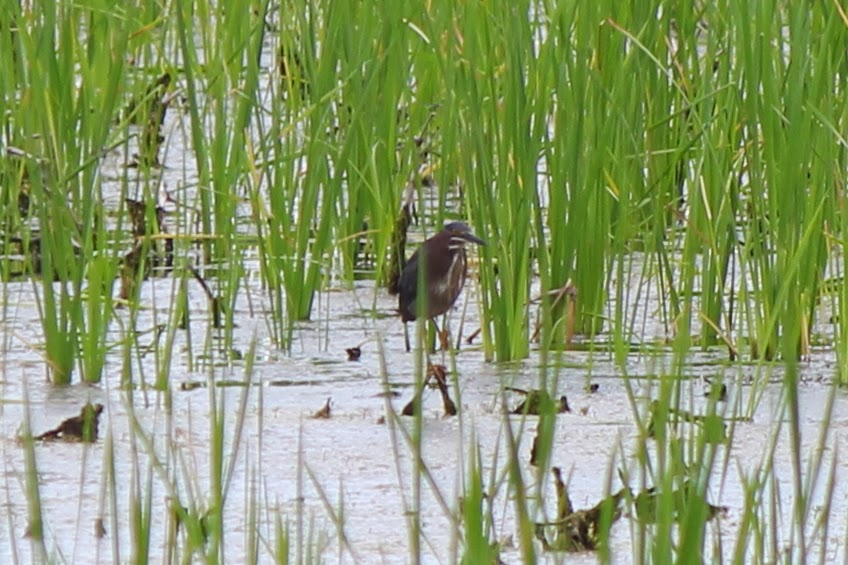
2) Green Heron- This bird could possibly be seen anywhere in the state but Washington County seems to be a relative stronghold.  I seem to see this species easily enough in other states (growing up, my grandma had a colony of Green Herons nesting in her yard), yet this is a Utah species that is giving me a hard time.


 Green Herons are never easy to get good photos of

3) Broad-winged Hawk- I tried a few times for this small buteo in the fall but missed out due to weather and poor flight conditions.  Hawkwatching at Bountiful Peak is a good bet for them but they could be seen migrating anywhere along the Wasatch front.  I might just force Jerry Liguori to find me one of these if I keep having trouble myself.

It would be nice to get Broad-winged Hawk views as close as I did in New York


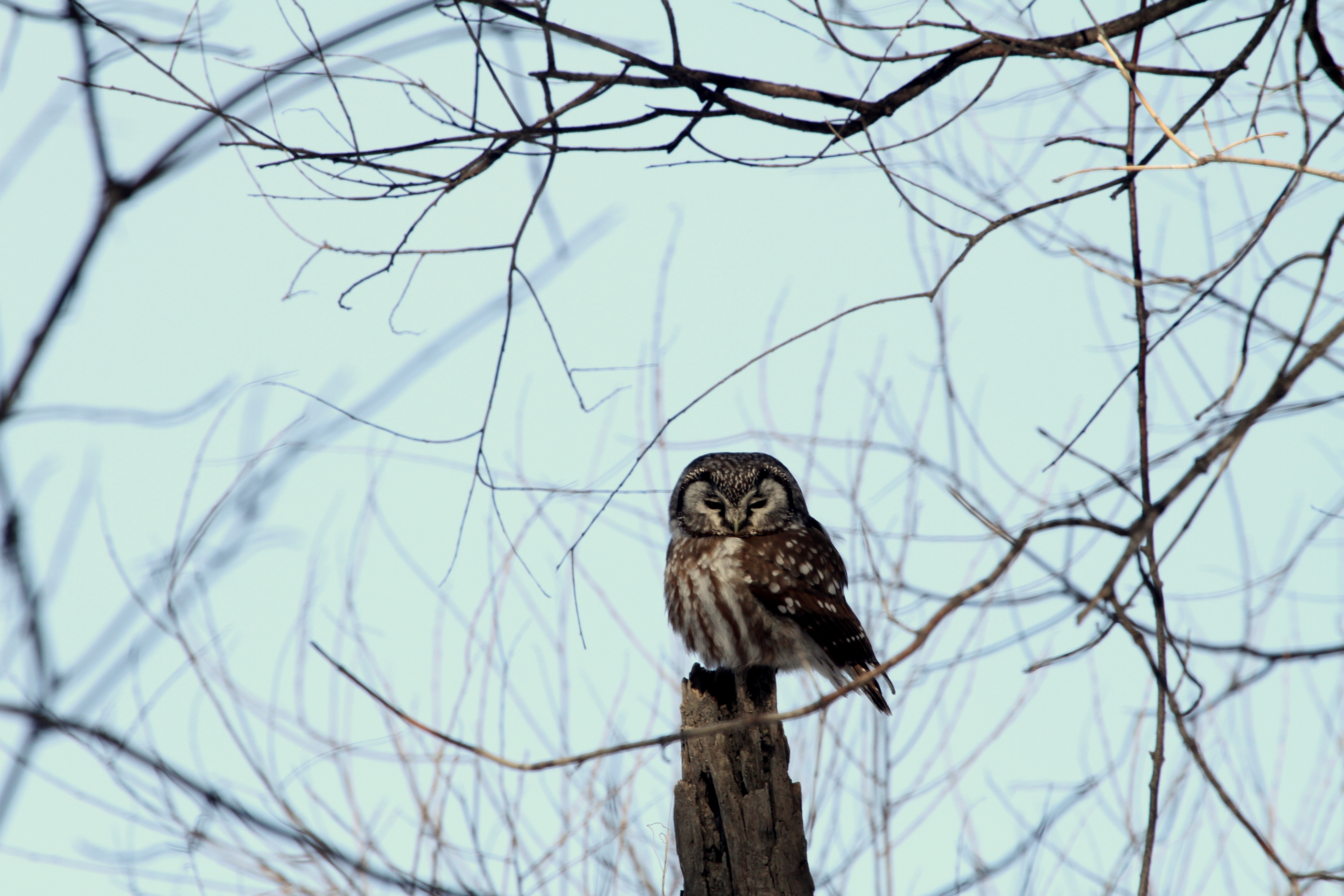
4) Boreal Owl- Surprisingly this would not be a lifer for me since I somehow managed to see one behind the famous Tavern-on-the-Green in Central Park in New York City almost 10 years ago.  It won't be that easy finding one in Utah since although they are probably breeding here (albeit in very small numbers) they prefer remote areas in the mountains that are hard to get to.  My best chance is to head up to the Uintas and hope to hear some calling at night.


 The rarest breeding Utah Owl- the Boreal Owl
(Photo copyright Dave Lambeth)

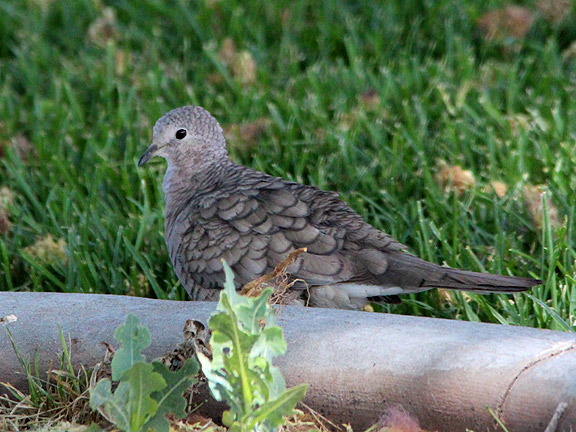
5) Inca Dove- This scaly plumaged dove is my current Utah nemesis bird since I have missed it every time I have gone to Washington County, despite looking for it in its favorite locations such as the Hurricane RV parks and adjacent neighborhoods.  Hopefully I can get one while I am down in the St George area this weekend and end my long national nightmare.

My scaly nemesis, the Inca Dove
(Photo Copyright Tim Avery)

6) Bendire's Thrasher-  Like the Boreal Owl, this bird probably breeds in the state in small numbers, however just on the opposite side of the state.  It is said to nest in the Beaver Dam Slope area of Washington County and the "easiest" way to find it may be driving the back roads of the Slope and listening for its song.  A long shot.


I'll need luck to find a Bendire's Thrasher this luck
(Photo copyright Tim Avery)

7) Tennessee Warbler- This bird seems to migrate through the area in small numbers in the fall.  To find one, you just need to look at every Orange-crowned Warbler you see and hope that you find one with white undertail coverts.  One of these times, an Orange-crowned Warbler will end up being a Tennessee Warbler and I am hoping that this will be the year for it.

It's all about the white undertail coverts for Tennessee Warblers
(Photo copyright Tim Avery)

8)  Hermit Warbler- Like the Tennessee Warbler, this bird also migrates through Utah in small numbers for a brief period in the fall but you have to go to the mountains of the Washington County area and look through mixed flocks and hope that some of the Townsend's Warblers in the flock invited a Hermit Warbler or two to migrate with them.

Timing is everything when looking for a Hermit Warbler
(Photo copyright Jeff Bilsky)
 
9) Painted Redstart- This species wants to be my nemesis bird but because it only shows up for the summer rather than live in Utah year around, it is still behind the Inca Dove for me.  I looked for this colorful songster a few times in Zion Canyon this year but ended up missing it every time.  At least I got to see one in Arizona last year.

The completely adorable Painted Redstart- Madera Canyon, AZ- 1/24/13

10) Clay-colored Sparrow-  Another species that requires looking through a similar species and trying to pick out this particular species- in this case giving a more discerning look at any Brewer's or Chipping Sparrow I see in the fall.  This will be the hardest species to identify given its close appearance to the aforementioned species and the subtle differences that distinguish them.

 A subtly different sparrow- a Clay-colored
(Photo copyright Tim Avery)

I am looking forward to the challenge that this list will present me throughout the year and hope it will bring me as much fun as last year's list brought me as it took me all across Utah in search of its many bird species.  The challenge will begin this weekend as I head down to Washington County for my first birding southern Utah birding this new year.  I hope 2014 brings everyone exciting new birds and experiences. What are you looking for this year?

See you all in the field.

Labels: , , ,

Top Ten Utah Birds pt. 2 - The Top 10

posted by Unknown at
on Thursday, December 12, 2013 


Now for the top ten!!

As a reminder, we had 63 participants which made a good enough sample size for us to be really excited about how it turned out. 174 different bird species were represented across the many lists. The variety was fun to see.

Scoring was done by giving a first place vote ten points. The second place vote received 9 points and a third place vote 8 points. All the way down to a tenth place vote receiving 1 point. If there was a tie then the bird with more total votes was bumped up.

And the top ten birds of Utah are...

#10 - Peregrine Falcon


"I started with 35 and had to beat it down to 10. Not easy! Then to put them in order. So not easy!"

• • •

#9 - American Kestrel

• • •

#8 - Greater Sage-Grouse
by Tim Avery

"Just about all my species were lifers for me after I moved out to Utah two years ago and most of them are found in habitats that were new to me before I moved to Utah, whether it be pinyon-juniper, sagebrush, desert or mountains. My top 3 are birds that are only found in a handful of states which makes them even more special.  Gunnison Sage-grouse is very range restricted and only found in Utah and Colorado. To see several of them on lek was an experience I will never forget."

• • •

#7 - American White Pelican

• • •

#6 - Black Rosy-Finch
by Tim Avery
• • •

#5 - Bald Eagle
by Shyloh Robinson

"Because I lived in the midwest previously and didn't have experience with many birds of Utah, many common birds here caught my eye  and that is reflected on my top 10. All of the birds are specifically found in the western part of the country except the bald eagle which I added because of the great numbers it gathers in here, especially at Farmington Bay. I think that the eagle is a great representative for Utah because although Utah doesn't have any bird specific to the state, Utah has many unique habitats and populations of birds, the Bald Eagles at Farmington being a great example"

• • •

#4 - Red-tailed Hawk

• • •

#3 - Flammulated Owl
by Tim Avery

• • •

#2 - American Avocet


"I have seen some rare ones in Utah, but to me this list represents what Utah birding is about and what people who come from other areas want to see.  The avocet is just so Iconic to me, that is why I put it #1.  None of these are rare by any means but to me what makes Utah birding so great."

• • •

And the #1 bird...........

#1 - Western Tanager

"I still remember the first Western Tanager I saw in real life.  I remember months before flipping through the field guide as I had just gotten into birding and thinking, wow, this is an incredible bird--it was instantaneously my favorite.  There is not a summer hike in the mountains of Utah where the two-note call of the Western Tanager or i's melodious song isn't heard.  When you see one it's an unforgettable experience for the birder and non-birder alike.  The flaming face and bright yellow body make it undeniably the quintessential Utah Bird."

• • •

I am not a statistics major so I apologize for any flaws in my logic but I thought it would be nice to give some additional stats.

Given the previously described point system here is how the top ten fared:

# Species Points %
1.Western Tanager 166 26.3%
2.American Avocet 130 20.6%
3.Flammulated Owl 107 16.9%
4.Red-tailed Hawk 86 13.7%
5.Bald Eagle 82 13.0%
6.Black Rosy-Finch 80 12.7%
7.American White Pelican 71 11.3%
8.Greater Sage Grouse 63 10.0%
9.American Kestrel 62 9.8%
10.Peregrine Falcon 59 9.4%

Percentages are based against a highest possible score not against the total points. Thus percentages will not add up to 100% but instead reflect percentage of a perfect score. For example if all 63 lists had Western Tanager as there first place bird then it could score 630 out of a possible 630.

Top ten Utah birds based on number of votes:


# Species Points %
1.Western Tanager 24 38.1%
2.American Avocet 21 33.3%
3.Flammulated Owl 15 23.8%
4.Bald Eagle 13 20.6%
5.Red-tailed Hawk 12 19.0%
6. American White Pelican 12 19.0%
7. Greater Sage Grouse 12 19.0%
8. Black Rosy-Finch 10 15.9%
9.American Kestrel 9 14.3%
10.Lazuli Bunting 9 14.3%


Percentage based on the number of lists that had the species in there top ten.

Top ten Utah birds based on the number of 1st place votes:


# Species 1st place Votes
1.American Avocet 6
2.Western Tanager 4
3.Black Rosy-Finch 4
4.Red-tailed Hawk 3
5.Greater Sage Grouse 3
6.Peregrine Falcon 3
7.Bald Eagle 2
8.American White Pelican 2
9.American Kestrel                      2
10.Golden Eagle                     2


Birds of prey made a huge showing on almost every ones list, in fact 23% of the total votes:
  

Family Votes Points
Owls44 271
Hawks 44 222
Falcons 22 166
Eagles 20 138
TOTAL 130 Votes 797 Points

             
The Corvids also made a solid showing at 4% of the total vote:


Corvids Votes Points
TOTAL 25 Votes 138 Points


Thanks again for every ones participation!

Labels: , , ,

Top Ten Utah Birds pt. 1 - The Runners Up

posted by Unknown at
on Wednesday, December 11, 2013 


The top ten are in, thank you for everyone who participated. We had 63 entries which made a good enough sample size for us to be really excited about how it turned out. 174 different bird species were represented across the many lists. The variety was fun to see.

Scoring was done by giving a first place vote ten points. The second place vote received 9 points and a third place vote 8 points. All the way down to a tenth place vote receiving 1 point. If there was a tie then the bird with more total votes was bumped up.

There were so many good birds that did not make the top ten but deserve a mention that I decided to give 20-11 first.  Here are the good birds that didn't quiet make the final ten, along with some of the things everyone said about the birds they chose and why.

#20 - Steller's Jay

"Our neighborhood scrub jays rule the feeders, scare away the cats and scream at me to hurry up loading the feeders.  It's a tossup whether the raccoon that vandalize the yard by night or the jays by day are the more arrogant.  I miss the Steller's Jay--I haven't seen them down in the valleys in years."

• • •

#19 - Western Scrub-Jay
by Shyloh Robinson

"Having spent my first 37 years in The Great Northwest, and not actively birding, I figured the list of Utah birds and my favorite birds wouldn't be hard to separate.  I have seen the vast majority of my favorites here.  But as I started paring down I realized that although they aren't my all-time favorites the finished product are birds that ""feel"" Utah to me.  Birds like the Red-Winged Blackbird and the Western Meadowlark who in a few notes ground me solidly in my new home. I can't imagine a spring without their soul stirring songs.  The Common Raven, a bird more common in forested mountains back in Seattle is suddenly seen everywhere here.  A clear indication that I truly am in a new place - the Ravens outnumber Crows.  There are birds that I had no idea existed and would never have known, except that I was trying to learn about this new environment.  The Northern Harrier, and Common Nighthawk will always be Utah to me because it was here I discovered them first.  After a few accidental discoveries I started to seek specific birds out.  The American Kestrel was my first true goal.  A few amazing experiences with this bird locked it into my heart forever.  Then the Mountain Bluebird!  Dreams of childhood were fulfilled when I saw my first ""true"" bluebird!  As a small child in Seattle I called Stellars Jay's ""bluebirds"". After being informed of my mistake I spent the next 30 years hoping to see a ""real"" one.  Altamont Utah poured flocks of bluebirds into my world.  The Tundra Swan.  Magnificence personified.  One of the few beings that make hard winters not just tolerable - but anticipated eagerly.  I believe this may be the most uplifting bird I have ever experienced.  The feeling of gratefulness upon seeing flocks of swans, and the spiritual lift they give with their hardiness and beauty is unmatched in this world."

• • •

#18 - Black-capped Chickadee

"I'm a CA transplant (6+ years) and these are the birds that, to me, epitomize my birding experience in UT. These are the "reliable" birds I'm always happy to see (well, maybe not always the Magpies!). My favorite would, of course, be last year's SNOW in Cache Co, but not really a Utah bird."

• • •

#17 - Black-billed Magpie


"What a hard list to create, a list that could alter tomorrow, but that is finally an amalgam of birds loved because of familiarity or accumulated memories or their particular subtle beauty, loved because they tug at my heartstrings in some known and yet unfathomable way. Robins lead my list in part because their quality of "commonness" has made them only more precious to me. I listen for robin calls throughout the winter, when so many other birds are absent or silent. I follow their voices to the big blue spruce up the street where I watch them join chickadees and juncos, waxwings and finches, deep inside the branches of their nightly roost--a chatter of sounds as birds arrive, a talking tree that falls silent as the birds settle into the cold and darkness. I listen for their early morning singing in the spring, when I think of them as my matins singers. I love their evensong, as they sing into the twilight, an avian vespers to end the day. They add delight to my days, connecting me to wonder, and they speak to the sky of the holiness of wild things--all because they are robins and they do robin things."

• • •

#16 - Eared Grebe
by Shyloh Robinson


"When I think of Utah birds on a broad scale, two major habitats come to mind: Great Basin and Colorado Plateau. Birds...Black-necked Stilt is a common Utah bird, especially on the GSL. And the Black Rosy-Finch is about as close as Utah has to an endemic species. Of course I could have added another 2-3 dozen species that are common/characteristic to Utah. Fun to think about."

• • •

#15 - Canyon Wren
by Tim Avery

"Although these birds occur across the western US and are common, when I think of birds in UT, I think of these birds, because they are either frequent visitors to my yard or because I associate them with AI and the AIC, which is one of my very favorite places.  I love going to AI in February to listen to the Meadowlarks sing.  It is such a lovely break from the dregs of winter.  There are many others that belong on this list too... Black-necked Stilt, American Avocet, Northern and Loggerhead Shrikes, Snowy Plovers, Yellow-headed Blackbirds, Marsh Wrens, Sage Thrush, California Quail...... the list could just go on and on and on.  We are so very fotunate to have the diversity of species we have in UT."

• • •

#14 - Mountain Bluebird

"Ranking is difficult because the best birds change for me depending on where I'm birding and who I'm introducing to birding in Utah. I tried to simplify this by ranking birds based on what someone from the eastern half of the US might see as a "western" or "Utah" bird. My list will likely be different every time I'm asked. I'm very interested in seeing the results."

• • •

#13 - Ferruginous Hawk
  
"The State is dominated by the Great Salt Lake and it's surrounding habitat. This is why my list is heavy with waterfowl and shorebirds. 75% of the world's population of Cinnamon Teal nest in the Great Basin and over 45% of North America's Pintails migrate through. The reason Chukar in #1 is that most birders you run into while out of state always ask about the Chukar. It is the Utah bird that is tops in their mind, it's the one they feel Utah is the best chance of adding it to a life-list. The southern Utah specialties are from too small of an area."

• • •

#12 - Golden Eagle

"We found a Golden Eagle nest and watched it for a couple of months until the two eggs hatched, and then as the two eaglets grew up. The greatest sight was watching the four Golden Eagles flying free across the desert and safe at the end of the nesting season. We spotted a Prairie Falcon swoop and dive to get a meal once out in the desert. It was the year of the Western Tanager invasion. The falcon got one in an explosion of yellow and orange feathers. We scoped it as it ate its meal. It was raw nature at its finest.

• • •

#11 - Lazuli Bunting

When I asked my birding instructor to name his favorite bird, he replied "I can't do that, but I can tell you that that bird is in my top 500."  It has become my favorite response when asked the same question.  On that note and as a part-time Utah resident, my list includes birds that my visitors would want to see--for the most part, birds that can't be easily found in the eastern part of the country.  An exception is the Wilson's Snipe.  Normally elusive, I love to see them perched on fence posts in Heber and Kamas in the summer.
Whew, that was hard. I finally ended up listing the ones who come before my eyeballs the most, with a million other ones left off of the list, and no nods to the everyday birds like Magpie, Crow, Robin, Starling, etc. When I think of Utah, I think first of the birds of prey.

Top Ten soon to come! Sorry you will have to be patient.

Labels: , , ,


UTAH BIRDERS FLICKR POOL


    SEE MORE AND SHARE ON FLICKR