Utah Birds, Utah Birding, and Utah Birders. Promoting the sharing of information, and the conservation of habitat for birds in Utah and elsewhere. We are a group of people who want to share what we know, and create a positive birding experience in Utah.

BIRDERS BLOG

a blog by and for Utah Birders

Red-headed Woodpecker in Utah a.k.a. Lightning Strikes Twice

posted by Tim Avery at
on Friday, January 16, 2015 

On December 27, 2004 I was one of the lucky few who were able to see a Red-headed Woodpecker at Wilson's Peach and Pecan Orchard in Hurricane, Utah.  The bird was found by Merrill Webb and although I was on my way back to Salt Lake and almost to Cedar City, I returned to Hurricane for this once in a birders lifetime rarity in Utah--or so I thought.


I saw the bird and a number of others did over the following weeks.  Fast forward almost 10 years and jump 5 miles to the east at another Pecan orchard and lo and behold what shows up but another Red-headed Woodpecker, this time found by Rick Fridell.  I didn't think I would make it down to see this bird, but no biggie since I'd seen the one 10 years ago.  But last week I was able to make it down and saw the bird--my 2nd Utah Red-headed Woodpecker.


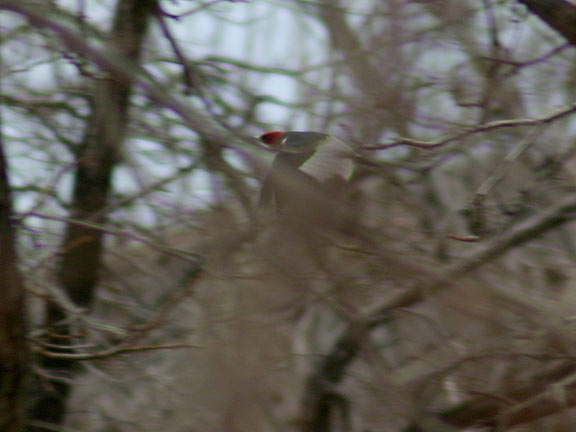
As you can see, I only captured the finest images possible of RHWO here in Utah... Okay that might be a little bit of an exaggeration... Or just a lie. These photos sucked, but I wasn't after award winning shots--just documentation!

So what are the odds that this species would show up again, in such close proximity to where one showed up 10 years ago?  The birds were definitely different--the 1st one was an adult, and this years bird was a juvenile.  Let's think of southern Utah as a haystack.  There are likely dozens of pecan orchards around the Southwest part of the state, and plenty of other fruit trees as well.  The southwest is plentiful in both these respects, so if we were to include Arizona, Nevada, and Southern California the number of orchards would explode and the haystack would be enormous.

Google Map of the current Orchards in Hurricane and La Verkin. There are actually way more nut trees in what used to be orchards but are now neighborhoods. The green dots represent the 2 locations of the RHWO sightings in the area.

As per eBird including the 2 Utah sightings, there are 8 previous reports of Red-headed Woodpecker int he desert southwest.  The number of actual historical sightings is likely higher, but for brevity lets use eBird for our sample.

All records are from the winter, and they are:

1) 12/22/1988 to 01/02/1989
Winchester Canyon Rd. at Cathedral Oaks Rd. field, Santa Barbara, California

2) 10/20/1990 to 10/28/1990
Portal, Cochise, Arizona

3) 11/04/1991
Pahranagat NWR, Lincoln, Nevada

4) 11/29/1991 to 05/02/1992
Continental Maintenance Yard, Pima, Arizona

5) 08/03/1996
Flagstaff - Highway 89 near Silver Saddle Road, Coconino, Arizona

6) 11/02/1997 to 05/05/1998
Marana Pecan Grove, Pima, Arizona

7) 12/27/2004 to 01/29/2005
Wilson's Peach and Pecan Orchard, Washington, Utah

8) 12/14/2014 to Today
Hurricane, Washington, Utah

There are also 5 outlying records from western Colorado and New Mexico:

08/14/1982
South Fork, Rio Grande, Colorado

04/23/2006
Durango, La Plata, Colorado

11/09/2007
Kirtland, San Juan, New Mexico

06/14/2011
Escalante Forks, Mesa, Colorado

06/27/2012
South Fork, Rio Grande, Colorado

East of these area the species has more outlying records, but becomes more common along the Rio Grande in New Mexico, and on the front range in Colorado.

The yellow shows the extant of "typical range, with the white border represeneting the limit. on the west in Colorado and New Mexico.

All together told there are just 13 reports in 30 years in the southwest.  The proverbial haystack.

Of the 13 records there are 2 from the same location in Colorado 30 years apart.  I'm not sure if this is the "exact" same location or a general area, so where the birds were seen could actually be a wider berth than the hot spot on eBird.  But none-the-less its still pretty impressive.  The only other location with 2 reports form the "Same" location is the 2 birds from Hurricane, Utah.  In Utah the exact distance was 5.9 miles from one orchard to the other, across rather barren desert.

There are 2 ways of looking at this. 1 is that its sheer coincidence that both birds were found at pecan orchards 5 miles apart. The other is to say its not a coincidence but the habitat is very specific and for a vagrant to show up at such a location is such proximity to another is a pattern.  No matter how you look at it, its still a needle in a haystack.  And with only 2 variables for a sample size there is no way we can realistically look at it as a pattern.  We can assert that Pecan Groves provide an ideal wintering ground for this species, based off the Utah reports and the one from Arizona.  I would wonder if some of these other locations also had pecan trees or were nearby pecan or nut orchards.

Red-headed Woodpeckers mostly eat nuts such as acorns, beech nuts, and pecans during the winter months, caching food for later use. So the attraction to nut orchards has some legitimacy.We also know that this species is migratory and winters across the southern United States. So it is most likely to show up in the winter months at a nut orchard in the southwest.  As per the previous reports 8 of the 13 are from winter months, and 7 of these were from the extreme south and west of the reports.  4 summer reports from western Colorado could be remnants of historical breeding sites, or even extralimital "non-breeding breeding" individuals.

The overall lack of sightings in the desert southwest shows that this species is essentially a vagrant to the area.  With its penchant for nuts, if it does show up an orchard is the ideal location to find one.  But the odds of it being the same location or a nearby location have to be astronomical.

Labels: , , , , ,

2015 Utah Birders Challenge!

posted by Utah Birders at
on Tuesday, January 6, 2015 

It's that time of year again--we announce this years Utah Birders Challenge.  This year we decided to step away from challenges involving photos and instead focus our efforts this year on... EBIRD!  This year's challenge is a multi-faceted challenge with several different "challenges within challenges", or as we like to call it, eBird Inception. The actual challenge is quite simple and straightforward, but we've added in a few "bonus" challenges for extra points.  Unline in years past where there is 1 clear winner, this year anyone who completes all the tasks associated with the challenge is a winner--the question is, will anyone complete all the tasks to be a winner?


So right off the bat we can tell you there are 1000 possible points up for grabs if you complete all the challenges.  What do you get if you manage to reach that goal?  We're working on a prize package and reaching out to several local companies for donations for the winners.  Besides a small prize package you will also ge the limited edition 2015 Utah Birders Challenge Sticker--we will only print one for each person who reaches the goal so it will truly be limited.  You'll also get bragging rights.  This year anyone who competes can basically brag that they beat Jeff Bilsky since he might only manage a few points from his distant new home.  Let's jump right into the challenge!


This year we want you to submit 1 complete eBird checklist for a birding location in Utah every day of the year.  It can be any location; your home, your office, your drive, a lunch break birding sessions--whatever you can manage. It must be a traveling count or a stationary count and can be as short as 1 minute.  For every day you submit a checklist you will earn 1 point, for a total possible 365 points this year, just by submitting a checklist.


Now things get interesting.  We want you to try and submit 1 complete eBird checklist this year for every county in Utah during the calnedar year.  This means there might need to be a little planning to make this possible, given Utah's large size.  For each county you submit a complete checklist, you will recieve 3.45 points, for a possible 100 points if you were to submit a checklist for every county.


But hold on you can really tack on those points if you submit additional complete eBird checklists from every county this year.  After your initial checklist, you can submit up to 10 more checklists, from different locations, for an additional 10 bonus points per county.  So if you were to submit 11 checklists each form a different location in a county you would earn 13.45 points for that county--the inital 3.45 points for the 1st list, and an additional 10 points for each different location.  If you managed to get 10 for each county you would earn an additional 290 points for the year.


Now if you've done your math you know that 365 + 100 + 290 = 755.  This means there are an additional 245 points available to each participant.  The way to earn these is simple: 5 bonus points for each eBird birding hotspot write up submitted for the Utah Birding Spots page on Utahbirders.com (http://utahbirdingspots.blogspot.com/) for up to 49 locations.  We want to see if we can get a hot spot write up for every location by the end of the year, so we can have a complete guide to Utah Birding locations, with maps, photos, links to eBird lists, and the ability for users to comments and add information going forward. We have a small portion of these hot spots done, but have a listen of almost 1300 we need information for--and no one knows those places like the birders who go there.

If you want to work on the bonus points for locations, please contact us at utah.birders@gmail.com so we can set you up to do so, and make sure folks aren't double creating locations.

AND THAT'S IT!

If you'd like to compete in this years challenge click below to sign up:


BUT WAIT... THERE's MORE!!!

For anyone interested in a side challenge just for the fun of it we are challenign you all to do a NON HOME-COUNTY BIG YEAR.  The idea is simple. Do a county big year--in a county where you don't live!  SO if you live in Salt Lake County, choose another county and do a Big Year!

There are no points, no awards, just your own personal satisfaction, and a little good humored ribbing between other birders as you try to find as many birds as possible in a county you don't live in this year--if you happen to have homes in 2 counties--choose one of the other 27 available... :)

GOOD LUCK! and GOOD BIRDING IN 2015!

Labels: , , , , , ,

Saying Bye to Bilsky

posted by Tim Avery at
on Monday, December 29, 2014 

It was December 2007 when I first met Jeff Bilsky.  He had gotten into birding over the past year and was joining me on his first CBC.  We were doing the Bountiful Quad of the Salt Lake CBC--along with another young birder I hadn’t met, Carl Ingwell.  I don’t know if any of us knew the friendships that would come out of that day, but 7 years later I can say I’m glad I went birding with Jeff and Carl that day.


The weather that year was atrocious.  Howling winds, freezing temperatures and snow! But it was a great day of birding. Perhaps the most notable sighting of that day was an Anna’s Hummingbird hanging out at the Bountiful Cemetery. This seemed so odd to me, but Jeff came up with the idea that the bird was hanging around the cemetery due to the rather nice supply of fresh flowers (albeit not in the ground) that were scattered throughout the area. This eye for detail would be something that Jeff brought on every birding trip.


That day we saw the largest flock of Bohemian Waxwing I’ve ever seen in Utah--we estimated around 1,200 birds in the flock over the Bountiful bench.  And we ended the day looking for Gulls in the midst of a blizzard.  I think Jeff and Carl spent most of the time in the car--I figured it would be the last time I ever birded with them and that I likely ruined their spirit--I was wrong.


For someone just picking up birding mid life Jeff was a natural.  By the time I met Jeff I was at an exhausted point in my Utah Birding adventures, and a new friend dred new breath into it for me.  Where I might have called it a morning, Jeff was always up to check on more bush or patch of trees.  We’ve long joked he always wanted to pish another bush before we go.  I can’t count the number of road trips, camping trips, bird chases, hikes, strolls, stakeouts, owling nights, and ridiculous birding misadventures I’ve had with Bilsky.  From continually outdoing ourselves on the Marathon Birding trip each year at the Great Salt Lake Bird Festival, to a failed Big Day attempt a few years ago,  to the creation of Gullstravaganza, and the Park City CBC Jeff has had a huge impact on birding in Utah.


It was a few years after we initially met, that Carl, Jeff, and I came up with the idea for the Utah Birders Blog.  At first it was just a place to share our thoughts on birding in Utah, but in a few short months it grew into a website, and a new birding llisterv and organization in Utah, the Utah Birders. I think at a base level we all wanted to see something different in the Utah Birding community, and it wasn’t going to happen the way things were--so we took it upon ourselves to make something the way we thought it should be--and man, it took off like we hoped and has been an amazing ride.


Outside of birding I’ve always thought of Jeff as a good friend--someone I can shoot the shit with about all things--not just birds. When I got married he was one of my groomsmen--of my friends that have come and gone over the years, Jeff has been one of the most reliable people I know.  I’ve got lots of great Bilsky stories, but I won’t share them here today--instead I’ll say this--thanks for being a good friend, and everything you’ve done for the Utah Birding Community.


This week Jeff is on his way to a new job in a new state and Utah will no longer be his home.  While it sucks as one of his friends, I wish him the best, and hope he can have a similar effect on others in his new backyard.  And of course I look forward to any ridiculousness that occurs when you’re back here for business and some birding. Good Birding Jah-Bilsky!

Labels: ,

5 Places You Should Go Birding In Utah This Year

posted by Tim Avery at
on Friday, February 28, 2014 

Chances are this weekend you are going to hop in your car and go birding--if you are of course a birder.  And if you live here in Utah you’re likely going to head out to one of the familiar places you go birding week in and week out.  Along the Wasatch front it’s probably the Causeway, or Farmington Bay--maybe Bear River, Lee Kay, or even Willard Bay.  In Utah County it could be Utah Lake State Park, River and Swede Lane, or anywhere around the south end of Utah Lake.  In St. George it could be Tonaquint Park, Springs Pond, Sand Hollow, or if you’re up for a little drive--Lytle Ranch.

This is how most days of birding go for us--the usual places to look for the usual suspects.  It also lends to the the Patagonia Effect happening--if more and more people go to said spots, the likelihood of a rarity being found increase.  It’s a science ;)

But I have a challenge for you in 2014, don’t just spend a great deal of time at the regular hotspots--this spring, summer, and fall take some time to explore some of Utah’s less popular, more out of the way, and what I would call most amazing birding locales.  Some you may have never heard of, others are just a bit out of your normal range--but they all are 5 places you should go birding in Utah this year.

• • •

Lucin
41.3482° N, -113.9050° W

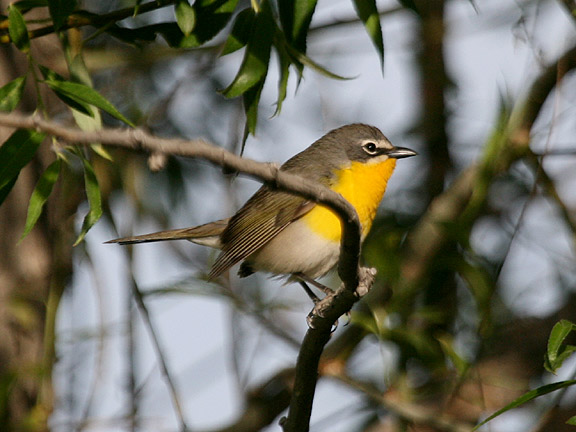
Great Photo ops for birds like Yellow-breasted Chat 

Lucin is and abandoned railroad watering station, located about 40 miles north of East Wendover, Utah, just inside the Utah/Nevada line.  A large spring surrounded by tall cottonwoods, willows, and other trees and shrubs provides a great migrant trap in the middle of the barren desert.  Lucin has a number of remarkable bird sightings, notably eastern vagrant warblers, thrushes, other songbirds.  As a migrant trap, it means birding at Lucin can be hit or miss--and if you go a couple times in a year you are likely to have hits and misses.  The misses can be painful--a half dozen birds--not species, in a few hours scouring every inch of habitat.  But the hits can be unbelievable.  Birds dripping from trees--constant movement, and colors, grabbing your attention and making you want to keep walking around the small pond in hopes of picking out something that’s been hiding amongst the throngs of birds.  The best times to go are from Mid May through early June and again from early September into October.

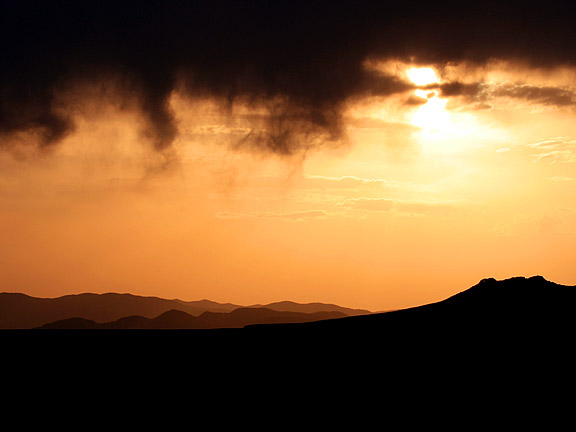
Sunset over the west desert from Lucin

You can camp just about anywhere in the desert out here, or stay in Wendover and make the 40 mile drive north on the days you go.  I like to spend a couple days hitting other migrant traps in the desert and giving yourself a chance at some turnover each day.  Lucin can be reached from the north via highway 30, or as mentioned earlier from Wendover to the south.  It takes about 3.5 hours to get there from Salt Lake.  At night the road from Wendover can turn up good number of Common Poorwills, Burrowing Owls, and Short-eared Owls.  During the day look for warblers, wrens, thrushes, sparrows, orioles, tanagers, and almost anything that migrates.  Lucin has the potential to turn up something really rare!

• • •

Dolores River/Rio Mesa Center
38.8119° N, -109.3023° W

Great Camping along the river

This place falls in the you’ve probably never heard of it column.  The Dolores River flows into the Colorado about 35 miles upstream from Moab.  By Utah standards it’s a pretty big river, and during the runoff it can be a real beast.  If you take the road to the south off Route 126 that follows the Colorado, you start off along the Delores and then drive off into the hills, only to drop back into the river bottoms, lines with thick willow patches, and plenty of Fremont Cottonwoods to attract a variety of birds.  This river is a natural migrant route, and provides lots of food, and obviously water for migrating songbirds.

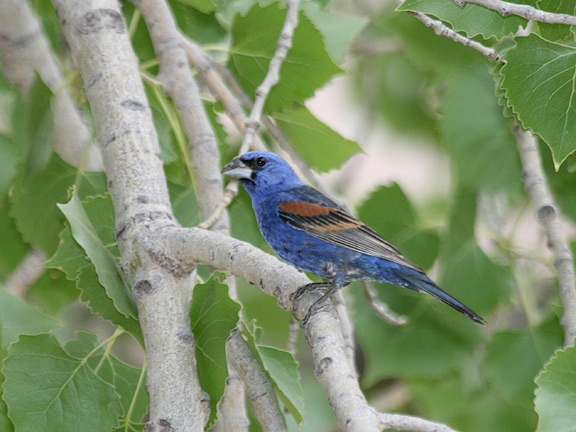
Blue Grosbeak along the rive rand super cooperative

Slightly further up River is the Rio Mesa Center which conducts bird banding and in recent years have banded a number of mega-rarities for Utah here.  Spring and fall are both fantastic here--from late April to early June and mid-august to October you could turn up just about anything here.  Yellow-billed Cuckoo, Eastern Wood-Pewee, Pacific-slope Flycatcher, and Yellow-bellied Sapsucker have all been reported from along the river here.  There are plenty of places to camp, which can mean lots of people on busy weekends.  It can also be a ghost town great for birding!

• • •

Capitol Reef National Park
38.2000° N, -111.1667° W

"Southwest" Willow Flycatcher along the Fremont River in 2007

I had mixed feelings about including Capitol Reef, but the fact is few northern Utah Birders ever venture to this lesser known park in south central Utah.  Admission is free, unlike other national parks, and the Fremont River trail, along with the Fruita Orchards provide excellent migrant trap birding.  The picnic area near the park headquarters is a great place to start birding here, with huge Cottonwoods and ample habitat for songbirds.  From May into early June and August through October this migrant hotspot could turn up just about anything as well.

Philadelphia Vireo found here in 2007 was a state 2nd for Utah

Pick a patch of trees anywhere in the park and you will find birds.  Chats, Catbirds, Flycatchers, Buntings, Orioles, and Warblers are all abound.  Rarities here are expected--including some big ones like Black-billed Cuckoo, Philadelphia Vireo, Orchard Oriole, and an impressive list of eastern warblers.  You can camp at the campground here, making it easy to access all the birding sites over a number of days!

• • •

Leidy Peak
40.7680° N, -109.8330° W


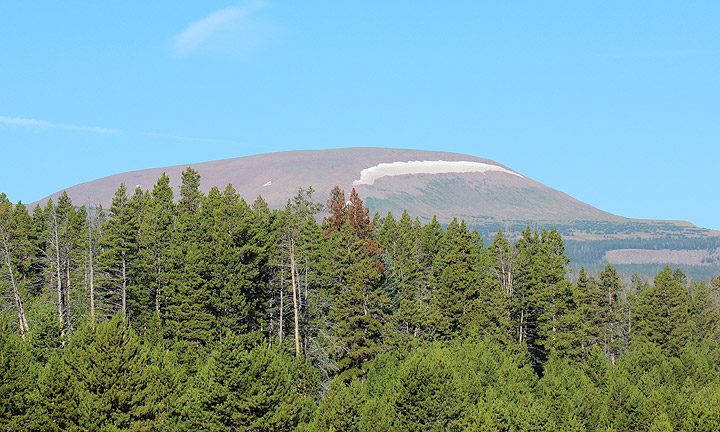
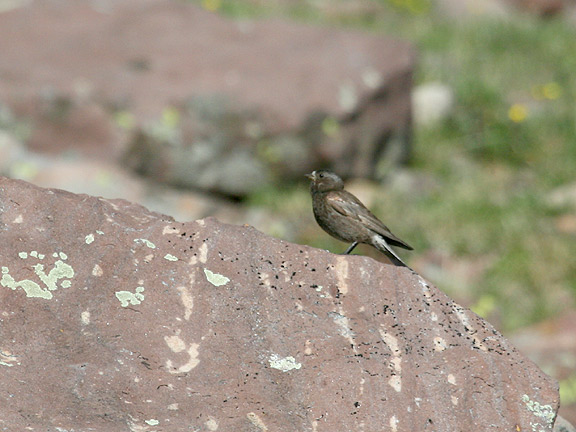
You’ve probably heard of this one, you may have even been. It’s one of the most reliable locations for White-tailed Ptarmigan in Utah--it also happens to be an epic birding location, not to be overlooked for the wide variety of species that can be seen in the vicinity.  Aside from the talus slopes where ptarmigan, American Pipits, and Black Rosy-Finches forage, the forests below leading all the way back to Vernal provide habitat for nearly 100 species of birds.  The high elevation conifer boasts Northern Goshawks, Three-toed Woodpeckers, crossbills, finches, sparrows, warblers, Gray Jay, and Pine Grosbeaks.  Through each habitat zone leading down to Vernal you can find more and more--in the mid-elevation conifer, mixed conifer and aspen, aspen, and finally shrubsteppe.

Black Rosy-Finch are fairly common here

A couple days here can provide you with some excellent birding, and camping away from crowds of people.  Hacking Lake is a good spot to camp, is is just about anywhere off the road.  It gets chilly here at night and the weather can be unpredictable.  Snow in mid August, temperatures routinely in the low 30’s at night in the summer--lightning storms that are mighty impressive--and rain and wind for hours sometimes.  But it makes for an adventure!  About an hours drive north from Vernal into the Uinta’s the peak stand just over 12,000’--the birding is best in late summer into the fall--until snow sets in and that’s it for the year!

• • •

Powell Lake (not Lake Powell)
40.3828° N, -111.9029° W


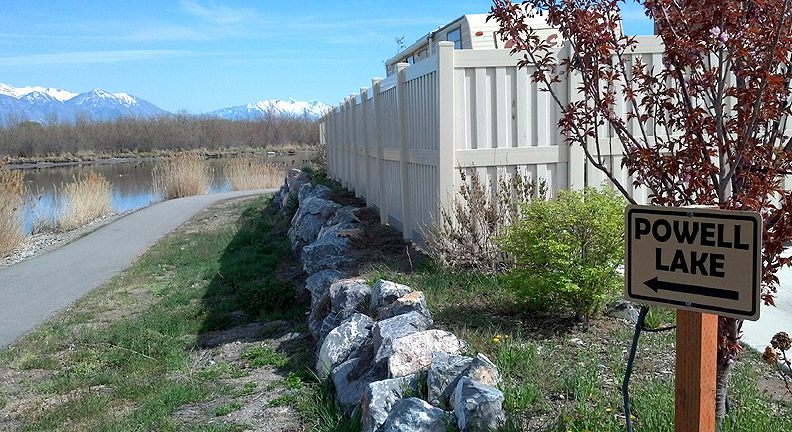
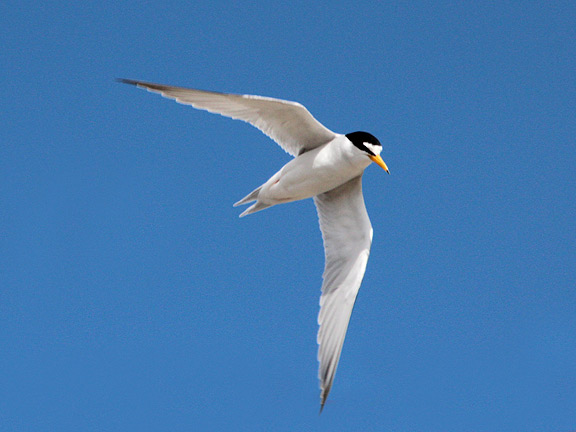
During the spring of 2013 a little known “lake” in northern Utah County proved to be one of the hottest birding locations of the year.  In the middle of a subdivision in Lehi, Powell Lake, is actually a pair of ponds split by a road.  The location along the Jordan River makes it a natural migration route and last year the birds seemed to pour in here.  24 species of shorebirds in 5 weeks, Glossy Ibis, a overly cooperative Least Tern, gulls, ducks, waders--you name it waterbird wise and it was probably found here in 2013.  It isn’t known if this is the way things have always been here, or if 2013 was a fluke--but I know that in 2014 this will again be part of my regular spring birding stops, fro the chances that something good might turn up.

Vagrant Least Tern at Powell Lak ein 2013

The photo ops are also amazing here--great light early and late in the day, and paths along much of the lakes shore.  If you didn’t check it out in 2013, I would suggest stopping by between April and mid-May to see what’s using the waterway--my hopes are lots of birds, and lots of birders!

If you're not quite sure where these places are check out this link to see them on the map.

Labels: , , , ,

2013 Recap and The Next 10: My Utah Target Species for 2014

posted by Kenny Frisch at
on Thursday, January 16, 2014 

At the of 2012, I had been in Utah for a little over a year and felt like I had done a good job at finding birds across the state having seen 291 species in that span.  However with a closer look at my Utah list there were some glaring holes.  Some species I felt that I should have seen already but for some reason or another had missed them.  At the start of 2013, I picked the 10 species that I wanted to see the most and wrote a blog describing my New Year's resolution that I made to find those 10 species across Utah (my New Year's resolution blog can be found here: http://utahbirders.blogspot.com/2013/01/my-new-years-resolution.html).  Much to my surprise and delight, by the end of July I had already seen all the species I had resolved to see.  Here is how my first encounters with each of these species went down.

1) California Condor- Jeff Bilsky, Tim Avery and I had this magnicifent Pleistocene leftover on our way driving out of Lava Point Campground on Kolob Terrace in Zion National Park.  Someone spotted a very large bird and "condor" got called out.  I almost hurt myself jumping out of Jeff's car while it was still in the process of stopping as I was trying for my lifer views.  Sure enough flying behind the trees was the largest bird I have ever seen and an unforgettable moment: my first ever California Condor.

A treat for the soul: a California Condor. Kolob Terrace- 5/11/13

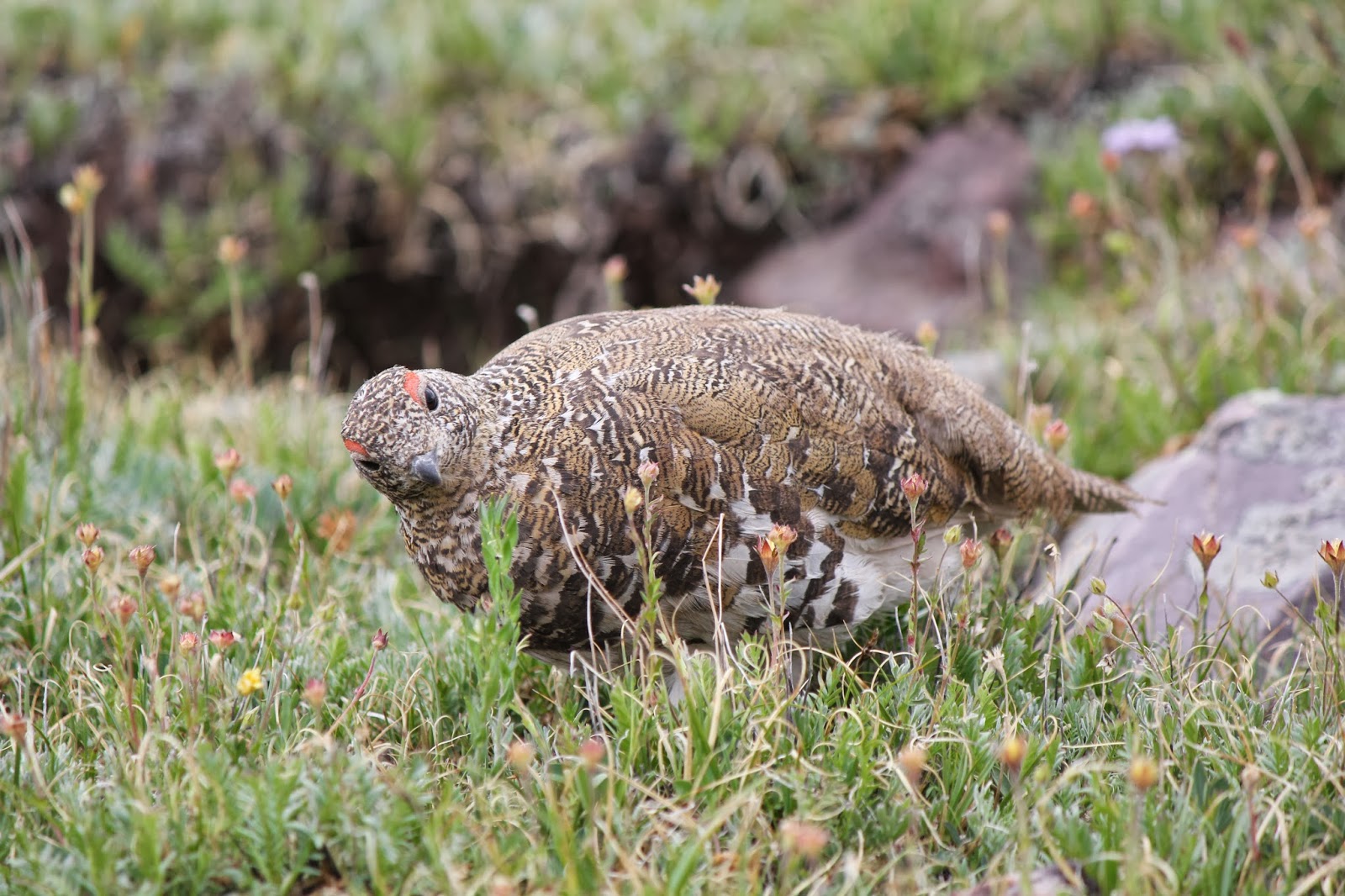
2) White-tailed Ptarmigan- This was the last of my 2013 resolution birds I saw, late in July.  Jeff Bilsky and I already had a great day of birding in the Uintas after a 3 hour drive from Salt Lake City that had us drive through Wyoming and on some rough dirt roads.  From the Bald Mountain B trailhead we had already hiked almost 3 miles and had seen awesome species up close ranging from nest Northern Goshawks to American Three-toed Woodpecker  to Gray Jays to Pine Grosbeak and nesting American Pipits.  Before summiting, we searched the flanks of the top of the mountain above treeline with no success until we had gotten 3/4ths of the way around the top.  There Jeff somehow picked out a pair of White-tailed Ptarmigan that were almost perfectly camouflaged in the lichen covered rocks.  The pair walked close by us and eventually were comfortable to feed about 10 yards away- what amazing luck and not to mention a spectacular view to boot!  Soon after we summited Bald Mountain B, 11776 feet, and made our way down the mountain.  Unfortunately we got lost on the way down and ended up having to go down a particularly steep part of the mountain to get back to my car.  Next time I will try to memorize the trail so I don't have to endure any impromptu adventures after finding a life species.

A fantastically plumaged male White-tailed Ptarmigan. Bald Mountain B- 7/20/13

The ptarmigan shows off his funky eyebrows while feeding

 A cryptically colored female White-tailed Ptarmigan

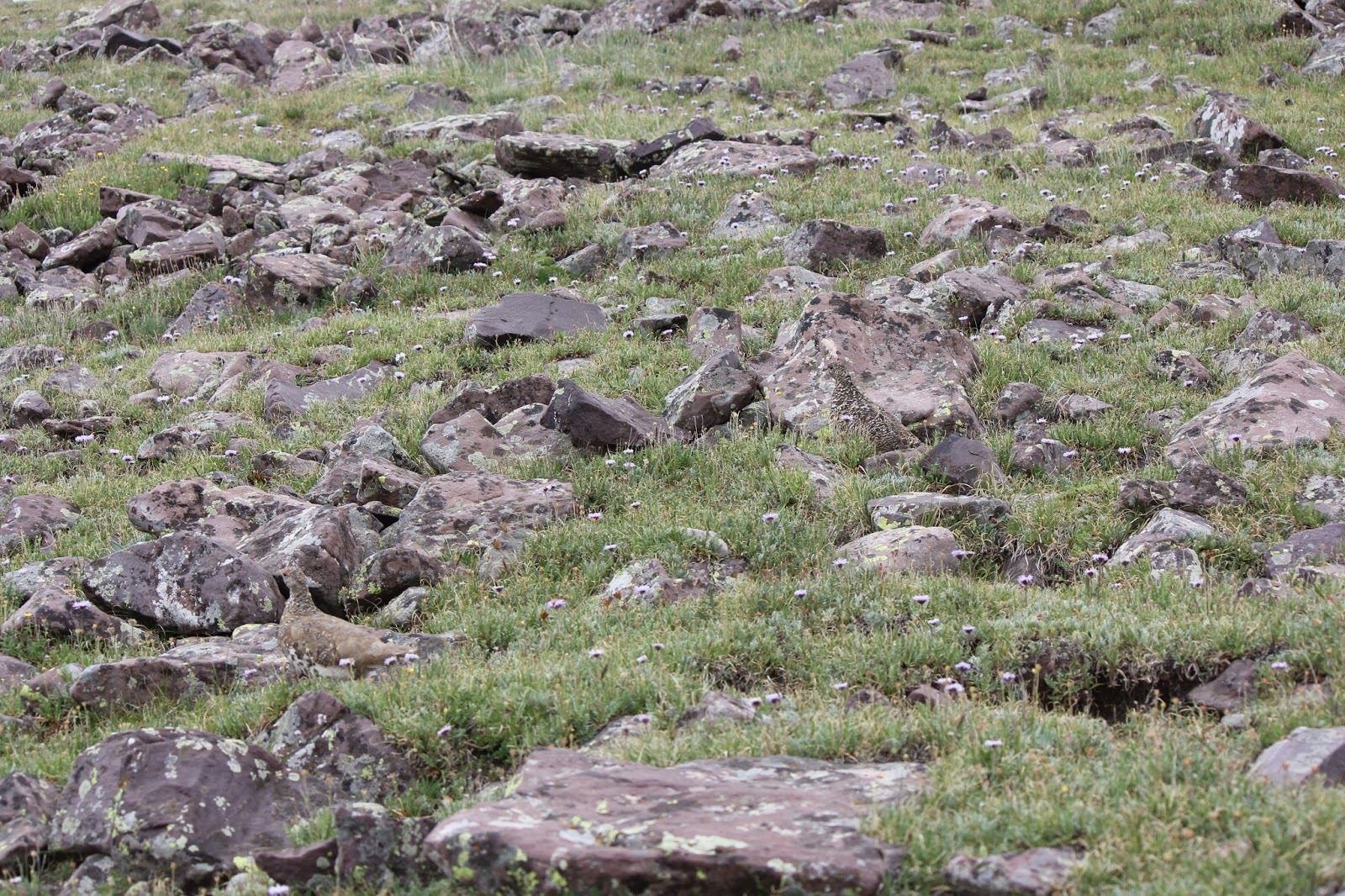
 Find the female ptarmigan

 Find the male and female ptagmigans

3) Gunnison Sage-Grouse- A lifer.  I was greatly aided in finding this species thanks to a field trip that Utah Birders helped put together.  The day before the official field trip, Jeff, Tim and I headed down to Monticello to scout for one of the handful of United States endemic species (birds found in no other country) that only lives in small areas of Utah and Colorado.  Looking for this species in the right place was essential since there are only about 120 of them left in Utah.  Driving on Hickman Flats Rd we soon came across a male displaying on the field.  Male Gunnison Sage-Grouse can be distinguished from Greater Sage-Grouse by their smaller size, ponytail instead of individual plume feathers and the different sounds they make.  Getting to watch one of the rarest birds in Utah was thrilling but also made you think about how easy it could be to lose it as a Utah breeding species.  The next morning with the rest of the field trip participants we got to watch some Gunnison Sage-Grouse on lek as the sun rose in San Juan County.  What a way to start a morning.
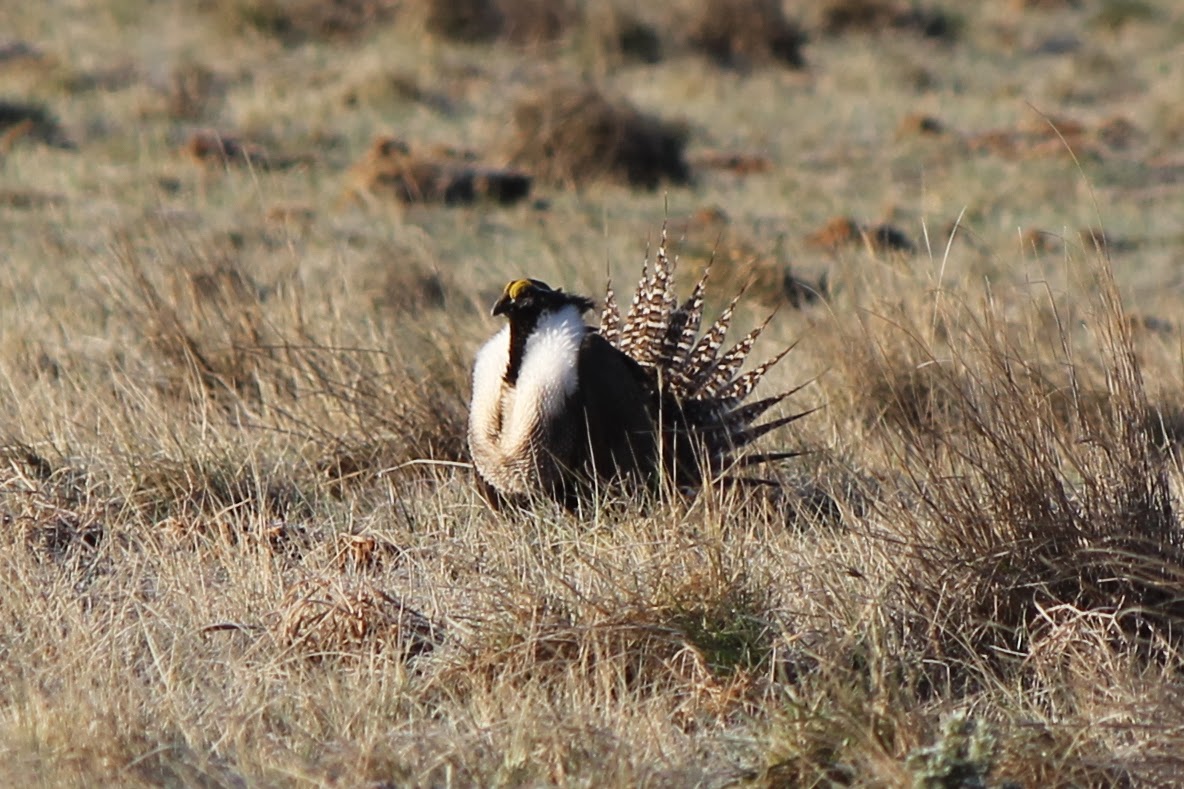
 A male Gunnison Sage-Grouse. Monticello, UT- 4/12/13

 Part 1 of the Gunnison display- Inflated air sacs

Part 2- Whipping its ponytail forward

A video of a male Gunnison Sage-Grouse displaying

Gunnison Sage-Grouse on lek at sunrise

4) Band-tailed Pigeon- This was probably the easiest species I had to find this year despite multiple trips to see it since I only needed to go about 10 minutes from my house to the house of Dick and Deedee O'Brien.  Ever friendly and inviting, they put up with for what seemed like a dozen trips to their house without success before I finally had the pleasure of viewing these large native pigeons.  Big thanks once again to the O'Briens!

Nemesis no more- my lifer views of Band-tailed Pigeons. SLC, UT- 6/2/13

5) Spotted Owl- I got to see this secretive owl the day before I saw the California Condor.  These birds were in Zion National Park and let us know about their presence by first calling, then later giving great views as the male flew up to the female with a snack and was rejected by the larger female.  It was cool having the owls so close and not having us initially see them given how well their plumage allows them to blend in.  Despite the failing daylight, these owls put on a show that I will never be able to forget from their echoing calls haunting the narrow canyon to getting to see a rare moment of owl courtship.  This was a true lifer, not just a Utah lifer for me.

The larger female Spotted Owl- Zion Canyon NP, UT- 5/10/13

A Spotted Owl calls in Zion Canyon NP

6) Black Swift- Black Swifts were relatively easy to find this year especially in the first few miles after the mouth of Little Cottonwood Canyon.  The swifts nested in this area and could be seen flying around the area around sunset getting ready to roost.  I am hoping to get much better views and pictures this year.

I swear this is a Black Swift. Little Cottonwood Canyon, UT- 7/3/13

7) Williamson's Sapsucker- This was a true lifer for me.  Tim, Jeff and I had this species about an hour after my lifer Gunnison Sage-Grouse encounter near Monticello.  While stopped to look for Juniper Titmouse in a stretch of juniper trees, we heard a soft tapping from a woodpecker.  It took us a few minutes before we found our unexpected prize- a beautiful male Williamson's Sapsucker.  I was expecting to see one of these up in the mountains in a few months but seeing in the wrong habitat only added to the excitement of this species.  Later on in the year I would get to see more of the uniquely colored male and female Williamson's Sapsuckers but these birds were in the appropriate habitat, the mountains.

Yes that's a Williamson's Sapsucker in a juniper. Monticello, UT- 4/12/13

A very different looking female Williamson's Sapsucker. Brighton, UT- 7/13/13

8) Vermilion Flycatcher- This species was the first target species I found in 2013 on a trip down to Washington County with my brother Jeff and some of his friends from Prescott, Arizona.  This sighting occurred in February by the Santa Clara River near Santa Clara and was thanks to a tip from Stephanie Greenwood.  She however had an adult Vermilion whereas we had a young adult male starting to molt into is striking adult plumage that left it looking like a Pink Flycatcher rather than a Vermilion.  Later on in May, I would get to see an adult male in Beaver Dam Wash.

 A pinkish looking young male Vermilion Flycatcher. Santa Clara, UT- 2/16/13

9) Pinyon Jay- This gregarious species was a day after I had seen the Gunnison Sage-Grouse and Williamson's Sapsucker on our first real day of the field trip.  This birds were found in some Pinyon-Juniper Habitat near Monticello and provided great looks as the flock foraged in the area.   In November, I would get even better views of a flock of these birds in great light down in Canyonlands National Park.

My first Utah Pinyon Jays. Monticello, UT- 4/13/13

A much more satisfying view of a Pinyon Jay. Canyonlands NP- 11/17/13

10) Scott's Oriole- This full lifer was both a treat to the eyes and ears.  Its colorful black, yellow and white plumage stuck out in the desert and its beautiful warbling song cut through the harshness of the desert environment.  Jeff, Tim and I had this species on the Beaver Dam Slope the same morning we saw the California Condor.

A feast for the eyes and ears- a Scott's Oriole. Beaver Dam Wash- 5/10/13

It was very satisfying working towards my resolution throughout the year.  I ended up with over 40 new Utah lifers in 2013 with 7 species being lifers I have never seen before in my life- Mountain Plover, Painted Bunting, Bar-tailed Godwit and Lark Bunting besides the others mentioned above.  Other memorable Utah lifers this past year included the Bountiful Blue Jay, the Cache Snowy Owl,  Bear River Meadows Black and Powell Lake Least Terns, the Farmington bayLittle Gull, the Ogen WMA Tropical Kingbird and the Lake Park Pacific Loon.  All have a special spot in my heart.

After my search for those species was complete, I naturally started pondering what the next 10 species I want to see in Utah for 2014.  There are very few easy birds in this next group for me to find.  Some will require special habitats, special timing, and/or just plain luck.  I am looking forward to the challenge of finding these birds as they will test me as a Utah birder.  Without further ado, here are my next 10:

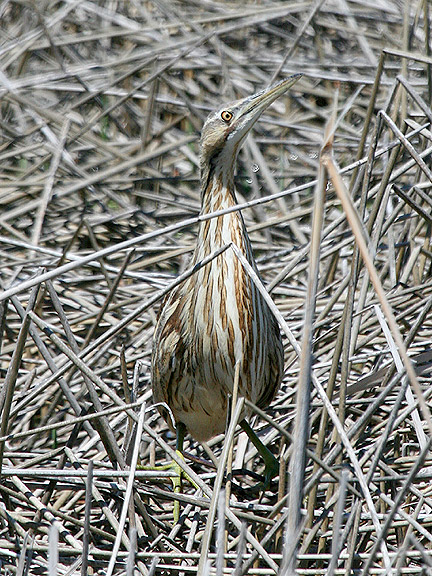
1) American Bittern- This species required both some skill and some luck.  You will need to be in the appropriate habitat and then you have to get lucky the one will revel itself to you.  My best bet to see this very secretive heron is Bear River Meadows.

 A bird that doesn't want you to see it- an American Bittern
(Photo copyright Tim Avery)

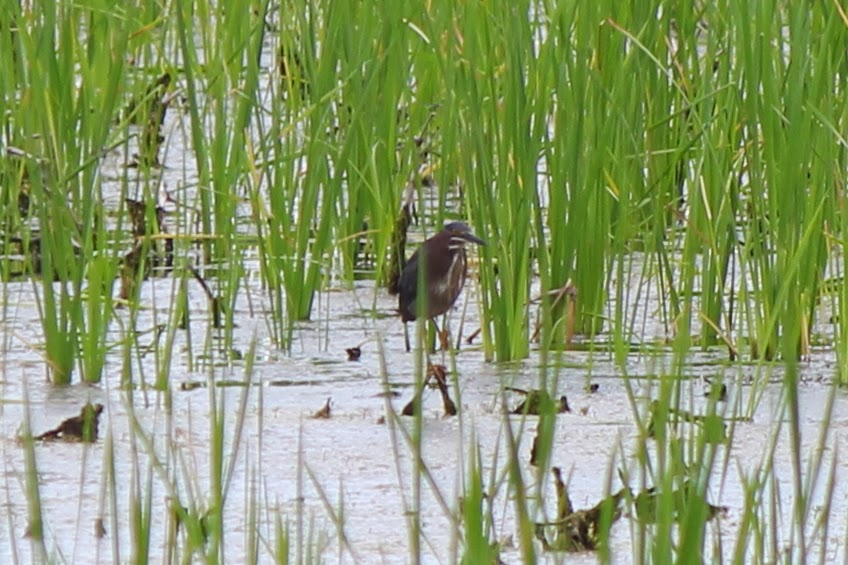
2) Green Heron- This bird could possibly be seen anywhere in the state but Washington County seems to be a relative stronghold.  I seem to see this species easily enough in other states (growing up, my grandma had a colony of Green Herons nesting in her yard), yet this is a Utah species that is giving me a hard time.


 Green Herons are never easy to get good photos of

3) Broad-winged Hawk- I tried a few times for this small buteo in the fall but missed out due to weather and poor flight conditions.  Hawkwatching at Bountiful Peak is a good bet for them but they could be seen migrating anywhere along the Wasatch front.  I might just force Jerry Liguori to find me one of these if I keep having trouble myself.

It would be nice to get Broad-winged Hawk views as close as I did in New York


4) Boreal Owl- Surprisingly this would not be a lifer for me since I somehow managed to see one behind the famous Tavern-on-the-Green in Central Park in New York City almost 10 years ago.  It won't be that easy finding one in Utah since although they are probably breeding here (albeit in very small numbers) they prefer remote areas in the mountains that are hard to get to.  My best chance is to head up to the Uintas and hope to hear some calling at night.


 The rarest breeding Utah Owl- the Boreal Owl
(Photo copyright Dave Lambeth)

5) Inca Dove- This scaly plumaged dove is my current Utah nemesis bird since I have missed it every time I have gone to Washington County, despite looking for it in its favorite locations such as the Hurricane RV parks and adjacent neighborhoods.  Hopefully I can get one while I am down in the St George area this weekend and end my long national nightmare.

My scaly nemesis, the Inca Dove
(Photo Copyright Tim Avery)

6) Bendire's Thrasher-  Like the Boreal Owl, this bird probably breeds in the state in small numbers, however just on the opposite side of the state.  It is said to nest in the Beaver Dam Slope area of Washington County and the "easiest" way to find it may be driving the back roads of the Slope and listening for its song.  A long shot.


I'll need luck to find a Bendire's Thrasher this luck
(Photo copyright Tim Avery)

7) Tennessee Warbler- This bird seems to migrate through the area in small numbers in the fall.  To find one, you just need to look at every Orange-crowned Warbler you see and hope that you find one with white undertail coverts.  One of these times, an Orange-crowned Warbler will end up being a Tennessee Warbler and I am hoping that this will be the year for it.

It's all about the white undertail coverts for Tennessee Warblers
(Photo copyright Tim Avery)

8)  Hermit Warbler- Like the Tennessee Warbler, this bird also migrates through Utah in small numbers for a brief period in the fall but you have to go to the mountains of the Washington County area and look through mixed flocks and hope that some of the Townsend's Warblers in the flock invited a Hermit Warbler or two to migrate with them.

Timing is everything when looking for a Hermit Warbler
(Photo copyright Jeff Bilsky)
 
9) Painted Redstart- This species wants to be my nemesis bird but because it only shows up for the summer rather than live in Utah year around, it is still behind the Inca Dove for me.  I looked for this colorful songster a few times in Zion Canyon this year but ended up missing it every time.  At least I got to see one in Arizona last year.

The completely adorable Painted Redstart- Madera Canyon, AZ- 1/24/13

10) Clay-colored Sparrow-  Another species that requires looking through a similar species and trying to pick out this particular species- in this case giving a more discerning look at any Brewer's or Chipping Sparrow I see in the fall.  This will be the hardest species to identify given its close appearance to the aforementioned species and the subtle differences that distinguish them.

 A subtly different sparrow- a Clay-colored
(Photo copyright Tim Avery)

I am looking forward to the challenge that this list will present me throughout the year and hope it will bring me as much fun as last year's list brought me as it took me all across Utah in search of its many bird species.  The challenge will begin this weekend as I head down to Washington County for my first birding southern Utah birding this new year.  I hope 2014 brings everyone exciting new birds and experiences. What are you looking for this year?

See you all in the field.

Labels: , , ,


UTAH BIRDERS FLICKR POOL


    SEE MORE AND SHARE ON FLICKR