President's Day weekend I had some free time. My girlfriend was leaving town, I had a four day weekend and was not on call for snow removal for the whole weekend. I was still craving warm temperature and sunshine that I had hoped my trip to Arizona would deliver, but had only experienced rain and cool temperatures. I was over all the cold temperatures and snow up here in Salt Lake City and sick of shoveling snow as well. I decided to head down to the St. George area to get me the sun and warmth that I wanted. I kept my fingers crossed and as I was getting ready to drive down the forecast called for abundant sunshine and temperatures in the 60s for the weekend. Excellent!
Joining me on this trip would be my brother Jeff, driving up from Prescott, Arizona. St. George is a convenient halfway point between Prescott and St. George plus I really think he wanted his Christmas present he hadn't gotten yet, six beers from Epic Brewery that I had handpicked myself. I think he was getting worried I was going to drink them, but either way I was glad for him to come up for the weekend. He would also be bringing two friends with him, Micah who was a birder and Caleb who wasn't necessarily a birder but knew a ton about the geology of the area since he has taken college field trips there. He shared great insight to the unique geology of Washington County.
We decided to try to meet and camp out in the Beaver Dam Slope area, so I made my way down and he made his way up. Unfortunately on google maps there are two different Lytle Ranch Roads in Washington County and he headed to the wrong one. This led to some confusion especially coupled with the fact it was around 1:30 am but I wasn't even sure about that since my phone kept switching between Mountain Time and Pacific Time- stupid Nevada! Anyways I just slept in my car that night along the side of the right Lytle Ranch Rd.
I awoke at sunrise to the beautiful scenery of the Beaver Dam Slope all around me. My brother called and told me they were on the way to the real Lytle Ranch Rd. I took the time to wander around the slope which was full of bird activity. It really set the tone for how the whole weekend was going to go. There were calling Loggerhead Shrikes and Black-tailed Gnatcatchers, singing Greater Roadrunners, Cactus Wrens and House Finches. All around me the desert was alive with bird activity.
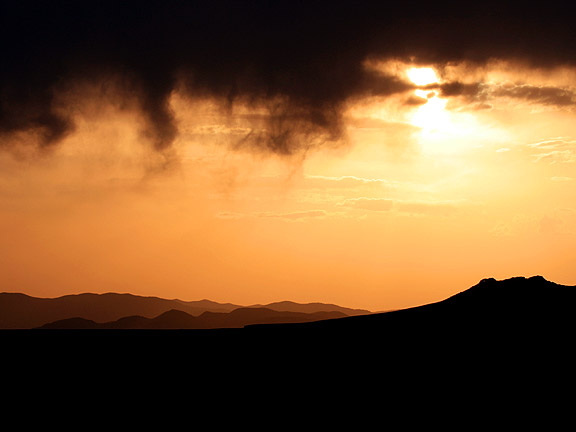
This is what I woke up to Saturday morning
This Loggerhead Shrike was the first bird I heard and saw in the morning
I found my first ever roadrunner in Utah by first hearing it
I enjoyed hearing the spastic call of Black-tailed Gnatcatchers

I saw more Cactus Wrens that morning on the Beaver Dam Slope than I had ever seen
We headed to one of my favorite birding places, Lytle Ranch, looking forward to sharing this special place with my brother and friends and they certainly were impressed. Getting out of the car, the first bird we had was a singing Verdin, but it wasn't the only species we had singing. Song Sparrows and Bewick's Wrens were also singing, giving us a good opportunity to compare their songs. A large flock of Zonotrichia sparrows and their friends let us work on our sparrow identification. The most common species was White-crowned but mixed in were at least two different Harris's and a White-throated Sparrow along with Savannahs, Songs and Lincoln's as well. Feeding in some weeds and grass made us work to see the sparrows but helped to work with identifications with less than ideal looks. A flock of juncos also let us work on subspecies identifications with Oregon, Pink-sided and Slate-colored represented.
This Verdin was the first bird we heard singing at Lytle Ranch
It was nice to compare and contrast the songs of Bewick's Wrens with Song Sparrows
The first Harris's Sparrow we had
The second Harri's Sparrow we saw
Up in a tree is not where I usually picture Savannah Sparrows
Lincoln's Sparrows let us work on their IDs with Savannah and Song Sparrows
A thirsty Western Bluebird
A 'Myrtle' Yellow-rumped Warbler takes a bath
These Western Bluebirds were a treat to watch
The pond north of the buildings provided close views of birds drinking and bathing in a shallow end. We had a 'Myrtle' Yellow-rumped Warbler bathing, along with a flock of Western Bluebirds drinking- one of the coolest sights I have ever witnessed. Nearby a male Anna's Hummingbird put on a show for us, both singing and giving display flights. I wish him luck with the ladies, I was impressed. More Black-tailed Gnatcatchers were singing and to the west, we spotted a pair of Red-tailed Hawks working on a nest along the cliff face. As huge surprise for us was a juvenile Yellow-bellied Sapsucker feeding back near where we parked the car. I have seen this bird numerous times back east, but having one here in Utah was a special experience.
A Phainopepla stands guard over his territory
This Black-tailed Gnatcatcher actually gave good views
This Anna's Hummingbird put on a good show with song and dance (well, display flight)
Stretching to get ready for a display flight
Video of the Anna's Hummingbird singing
A Yellow-bellied Sapsucker was a great surprise
We also found this cool beetle at the ranch
Our next major stop was in Santa Clara, along the river to the west of Gates Lane. Stephanie Greenwood had found a Vermilion Flycatcher here about a month ago and it is one of my
Utah birds I wanted to see this year. Upon getting there we had a stunning dark/ rufous morph Red-tailed Hawk fly directly over us giving us great views. As we walked along the river, we had both expected phoebe species, Say's and Black, and even an Abert's Towhee in a tree. I'm not used to such good views with this species. After a few more minutes, I spotted a flycatcher along the stream that's shape didn't look right for a phoebe, however it wasn't bright red like the
Vermilion Flycatcher Stephanie had, this one was pinkish. We soon realized that this was a 1st winter male Vermilion molting into adult plumage, the first bird to check off my list for the year! This means that there are two Vermilion Flycatchers in that area, possibly evidence that they bred in that area last year. An added bonus was a Cooper's Hawk flew into a brush pile, trying to capture some sparrows that were hanging out in it.
This Red-tailed Hawk impressed our group
This is probably the first Abert's Towhee I haven't seen on the ground
This molting 1st winter male Vermillion Flycatcher showed pinks and reds
This Cooper's Hawk came away empty-taloned from this brush pile
A Black Phoebe hangs out in along the Santa Clara River
We headed to the Washington Fields area to try for a Lark Bunting and White-tailed Kite, but while we missed both those species we found that spring was in the air there too. We had a singing Northern Mockingbird that gave the songs of other birds and some singing Western Meadowlarks and more Red-tailed Hawks paired up.
This mockingbird sang many of the songs of spring
We continued to Stratton Pond where many ducks were putting on their best shows to woo the females. The Greater Scaup there gave the best views I have ever had of them, acting like they were domestic ducks and hanging out near the shore. At nearby Sky Mountain Golf Course, a large flock of wigeon gave of a cacophony of calls well trying to pair up. Watching over all of their antics was a vastly bigger Mute Swan, which is one of the birds people most associate with love. A pair of Killdeer also added to the love in the air.
This male Greater Scaup was dressed to impress
The object of the male Greater Scaup's attention
This Mute Swan lorded over the American Wigeon's proceedings
American Wigeon were paired up, even with this very white-faced one
This Killdeer was standing guard for his mate
We ended the day at Quail Creek Reservoir soaking in both the birds and the scenery. An American White Pelican against a red sandstone backdrop was a crowd pleaser as were the many species of duck present. We had 10 species including all 3 species of merganser- Common, Red-breasted and Hooded. There were a few groups of Western Grebes milling about and along the shore there was a single Spotted Sandpiper. With the low sun shining on the cliffs that we facing us, we enjoyed the view for a few more minutes before calling it a day.
Quail Creek Reservoir at the end of the day (note the spot of a pelican on the far shore)
After dinner we headed back to the Beaver Dam Slope to actually camp as a group this time. During the ride we had a drive-by sighting of a Great Horned Owl. It was perched eye level 5 feet off the road on a sign. One of my best views ever of a Great Horned Owl, albeit one of my shortest ones. That night we were serenaded by two more Great Horned Owls, showing that romance happens 24 hours a day in nature. We found a nice spot on the slope to camp on and soon made a little fire. We hung out for about an hour and then headed to bed. It was nice enough at night that I didn't even need a tent; my sleeping bag and thousands of stars would suffice.
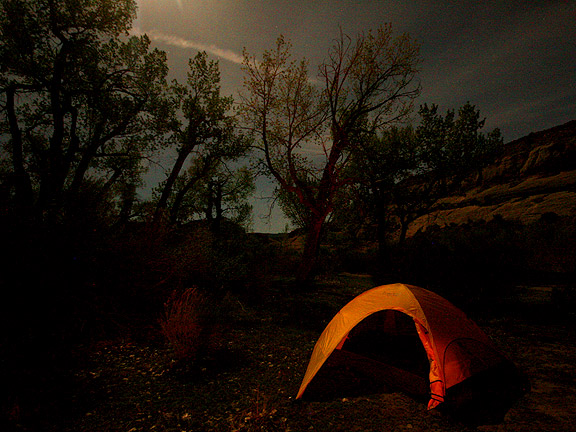
Our campfire Saturday night on the Beaver Dam Slope
The next morning we awoke to another great sunrise and more birdsong. The birds seemed interested in a nearby cattle tank and upon closer inspection we saw that the bar going over the tank was covering in bird poop. We found a bigger surprise in the cattle tank itself: four goldfish swimming around. I'm not sure why they were there, maybe to keep it clean?
Sunday morning surprise: Goldfish in a cattle tank
We headed back to Lytle Ranch, where we had almost the same birds as the day before. New this day though were some Gambel's Quail and a Great Blue Heron hanging out in the Beaver Dam Wash. It was also fun getting to see a Townsend's Solitaire feeding on some mistletoe along with paired up Phainopepla. Solitaires sure are versatile.
This fat dog greeted us both mornings and loved belly rubs
Solitaires in the desert? At Lytle Ranch, sure!
We hit up Springs Park Pond next and found the resident Snow Goose, as well as the goofy flock of American Coots that comes out begging for handouts. In the pond, the ducks were mostly paired off showing once again that southern Utah is a few weeks ahead of us. Hurry up Spring!
Lazy American Coots look for an easy meal
The Snow Goose was back again at Spring Ponds Estate
This Green-winged Teal showed off his namesake feature
This Ruddy Duck was starting to show a hint of his breeding plumage
This handsome American Wigeon was also calling when we got to the pond
Our next stop was Sand Hollow Reservoir, a new Washington County location for me and one I regretted not visiting before. It is a striking spot with red sand all around it, framed by a backdrop of mountains. It was fun looking at the sand and trying to figure out all the creature that had been there before, some natural sleuthing. We had a nice adult Bald Eagle circling the reservoir and two Tundra Swans standing out against the blue of the reservoir and the red of the sand. There were many Eared Grebes here and even a Horned Grebe whose white face and neck stuck out. There was a ton of ducks here as well of 11 different species. There was even another dark morph Red-tailed Hawk on our drive in. What a cool park!
One of two Tundra Swans at Sand Hollow Reservoir
Sand Hollow Reservoir with sand in the foreground and mountains behind
Our final spot for the weekend was Tonaquint Park. While still in the parking lot, we saw two different pairs of American Kestrels and a pair of flickers. On the way to the pond, I refound the Black-chinned Hummingbird nest near the visitor center. I initially missed it because I wasn't searching for something small enough and once again was amazing by how small it was. Ring-necked Ducks put on a show in the pond, swimming close enough to allow for good views of their ringed neck. Our final bird of the day was an Abert's Towhee, this time acting more towhee-like by hanging out in scrub on the ground.
A Ring-necked Duck actually showing its ringed neck
The smallest nest I have ever seen, a Black-chinned Hummingbird's
An Abert's Towhee in more typical surroundings
I said my goodbyes to my brother and his friends and started back to Salt Lake City. The weekend was a great success and only made me want to go back to St. George as soon as possible. But for now I will just keep my fingers crossed that spring will reach up here soon and we will start having the same amount of singing and bird activity as I had down there. And if not, I can always drive four hours to the south and jump start spring.
Sunset at 80 mph
Bonus note: The next day I found myself back in winter and at the opposite end of the state. I decided to embrace winter again and head to Cache County in search of a Snowy Owl that had been refound up there over the weekend. I got lucky and managed to view the magnificent bird, thinking that maybe I don't want winter to be quite over yet.
This Snowy Owl got me thinking that maybe I wasn't quite ready for Spring after all
Labels: spring, trip reports, washington county