Utah Birds, Utah Birding, and Utah Birders. Promoting the sharing of information, and the conservation of habitat for birds in Utah and elsewhere. We are a group of people who want to share what we know, and create a positive birding experience in Utah.

BIRDERS BLOG

a blog by and for Utah Birders

eBird Mobile iOS Beta Release First Look

posted by Tim Avery at
on Wednesday, May 20, 2015 

For those who don't have an iOs device, or just want to see what it looks like without downloading, here are the first looks at eBirds new mobile app called, "eBird Mobile" from the beta release going on right now.  The following is in the release from Team eBird:

Regular users of BirdLog will find that this app works much the same, with a few key improvements. The goal of the eBird app is to make a single, global data entry app for eBird. Using the former BirdLog code as a base, we transferred the existing functionality into the Lab’s development environment, solidified and consolidated the code, rebranded the app, performed some basic bug fixes, and made it free. Subsequent iterations of the app will focus on reworking the user interface, translations, and improving data out functionality. We have also begun development work for Android, and eBird Mobile should be available on that platform in the coming months.

What’s new with eBird Mobile?

  • Free – eBird Mobile is free.
  • Single global version – The eBird mobile app is available in a single consolidated version that works anywhere on earth.
  • Expanded languages – Offers species common names in many local language options, in parallel with the eBird web site. Four-letter quick entry based on common name and scientific name for all taxa globally, as on eBird.
  • Show rarities – Rare species are now indicated on the checklist view, prompting observers to provide more detail.
  • Refined start up screen – The ‘home page’ of the app has been reworked from a usability standpoint, making it clear how to get started entering data.
  • Continuity – App updates don’t cause you to lose existing unsubmitted lists or personal locations and startup is not delayed by taxonomic updates.
  • Data quality improvements – The app more closely matches functionality of eBird web for protocols, and prompts users to be more precise about location plotting.
  • Trip summary – Improved trip summary functionality makes keeping track of your trip list and day list fast and simple.
So here are the screenshots--I'll post a review of the app after I've tinkered with it a bit... The only thing I will say is I expected a better UI and experience right off the bat, hopefully performance is there to make up for the above...


Labels: , , , ,

Gullstravaganza 2015 Recap

posted by Tim Avery at
on Monday, February 23, 2015 

It seems like just yesterday we were wrapping up the 2014 Gullstravaganza. The crazy thing is that was 13 months ago.  2014 was one of our best gulling events--the best up till that point in variety of gulls and number of participants.  This year we decided to put all our eggs in one basket and finally just move the event to Farmington Bay WMA for its entirety instead of moving form location to location,  This likely had some advantages and disadvantages, but it made for a more relaxed event and much easier planning.

As has become the norm, we had a good number of sign ups with 33 people signing up for the event, despite a competing field trip led by Jerry Liguori and Hawkwatch International... Queue a little Seinfeld humor... "Hello Jerry!!!"


Okay, so that was ridiculous... :) In the past we have tried to plan this even when nothing else is going on, but this year we knew there were conflicts ahead of time--luckily the one we expected to cut in to ours--Snow Goose Festival--was actually a week later than expected (good for us and likely very bad for them as the geese have already started moving on...eek.).

So anyways, to the event.  After a slow start with gullers arriving we quickly realized Jerry was trying to poach our trip attendees by having his trip block the road to look at some boring BALD EAGLES.  He even went so far as to "accidentally take" one of our gullers in his car until the chap realized he'd been duped into the wrong group.  We straightened things out and eventually 23 birders were rallied to head out for the gulls! 4 more joined us shortly after for a total of 27 attendees this year.  Down from what we expected but the weather report likely caused some last minute dropouts--and those who Jerry promised photo-ops with ;)  None-the-less we were here to gull and gull we did.

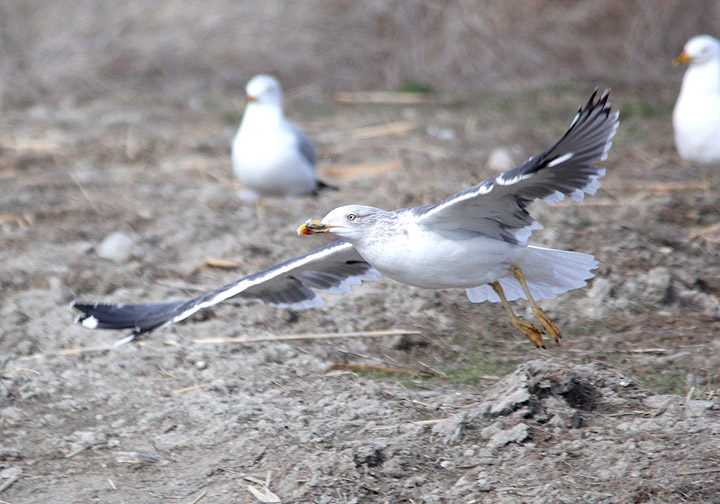
Heading into the marsh we stopped briefly to look at an adult LESSER BLACK-BACKED GULL that was hanging out at the air boat launch on Dike Road at the carp pile.  Due the the unseasonably warm weather we've had the eagles have mostly moved out, leaving the piles of fish for the gulls to take advantage of without any competition.

Adult Lesser Black-backed Gull taking flight

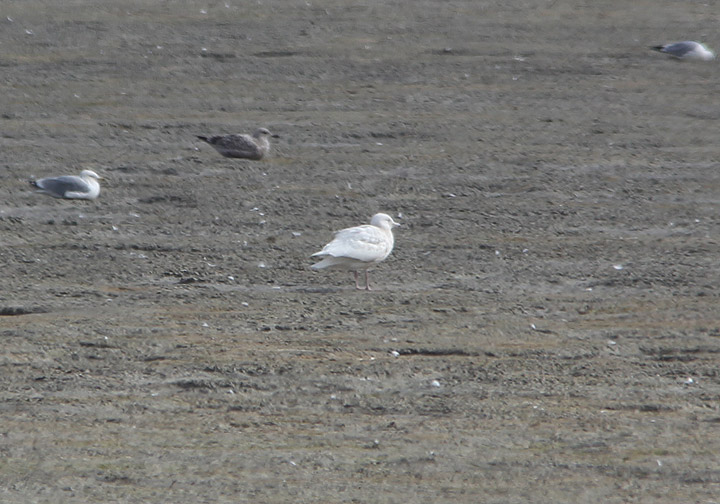
We scanned the water to the east as well where around 1250 TUNDRA SWANS were on the water, and hundreds of ducks including a few CANVASBACK were present.  Most of the winter divers were all together gone with just a few BUFFLEHEAD and COMMON GOLDENENEYE in the mix. To the end of the road we wandered setting up shop to scan a flock sitting on the mud a couple hundred yards out.  The prize in this group was a gorgeously white GLAUCOUS GULL that stood right out amongst the other gulls.

Glaucous Gull

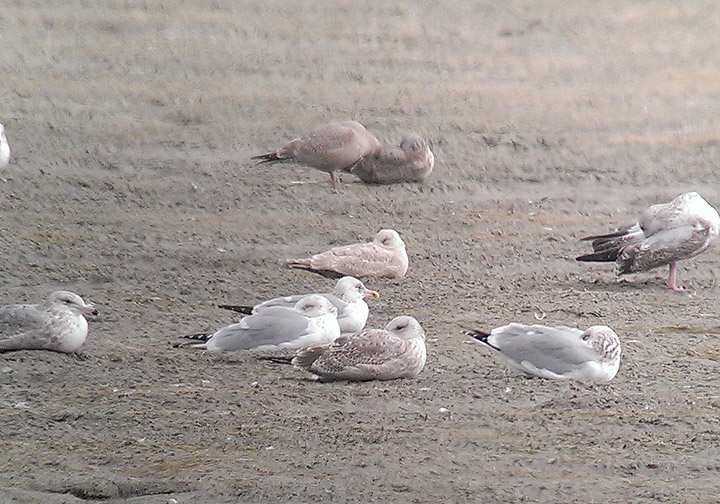
As we watched and tallied more LESSER BLACK-BACKED GULLS, a couple THAYER'S GULLS, and numerous HERRING GULLS things were looking good.  Along with just a couple CALIFORNIA GULLS and plenty of RING-BILLED GULLS we had 6 species of gulls in 30 minutes.  That's how to start a Gullstravaganza!  As we were about to pack up and head to another spot to set up for a bit, a very pale gull flew i and landed. I caught it running across the flats before it sat down and immediately ran for my scope.  This had to be an ICELAND GULL!

"Kumlien's" Iceland Gull

After a few minutes trying to get a good look at the wing tips I was 99% certain it was a Kumlien's Gull.  The bird had sat down and quickly tucked its head but it was sitting next to several Herring Gulls with a Thayer's nearby for comparison.  I assumed this had been the same bird Kenny Frisch and I found a month ago and it gave everyone long looks as it sat there until we moved on.  Everyone's scopes were trained on the bird--gull species #7 for the day in less than an hour.  The bird was a lifer for a handful of attendees--as was the Glaucous Gull.

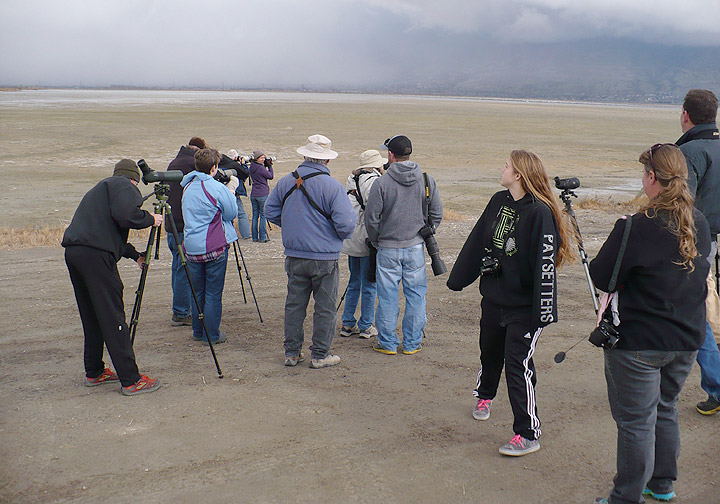
Entrepid Gullers!

About this time a squall was making its way across the lake and had ht Farmington.  The wind picked up out of the north and headed towards us, bring wind, rain, and finally snow. We convened the vehicles in the parking lot on the west side of the 4-way where I told the group it was up to them whether they stayed or left.  I didn't know what the weather was going to do, but it didn't look pretty.  What I did know is we were here to look at gulls and not going to leave quite yet.  About 10-15 birders stayed or birded around Farmington for the next hour.  We set up about 60' from the carp  pile where HERRING GULLS were starting to filter in.

Herring Gull in Flight

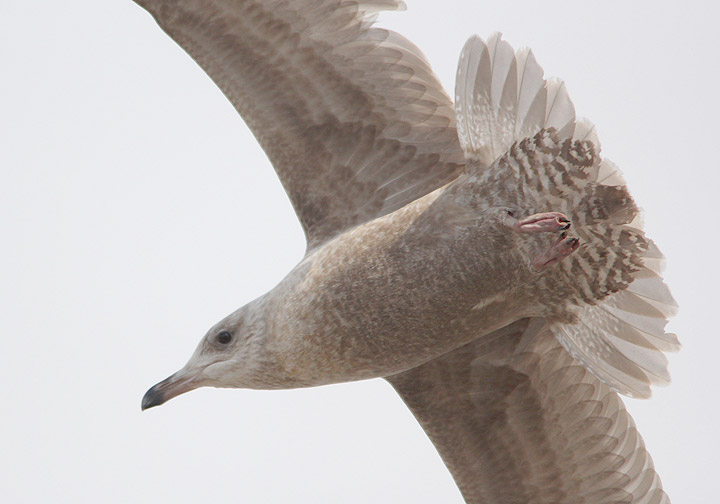
The light was fantastic as the sun kept mostly out even though it was bitterly cold.  The snow passed quickly and the birds didn't seem to mind our presence as they fed.  More birds joined the fray and eventually a couple 1st winter THAYER'S GULLS made an appearance allowing for some great up close study.

Thayer's Gull

One of the biggest surprises for the day was actually the lack of gull abundance.  In fact on the day I counted just 23 CALIFORNIA GULLS.  That is an astonishingly low count for the event, and even for Farmington Bay this time of year.  The few that were present did provide some great opportunities to study next to the massive Herring's.

California Gull

The other surprise was that by my count the Herring Gulls actually outnumbered all other gulls combined--that includes RING-BILLED GULL which typically follows California in numbers.  Herring Gulls outnumbered the others 280 to 259.  Those numbers are also a low count for the event in terms of total gulls.  Now there were several hundred (maybe even 1,000) over the dump a couple miles east that you could see swirling with binoculars.  But I didn't count them for the list since they were unidentifiable, and outside Farmington's boundary.

Ring-billed Gull

As the day wore on the group dwindled to about 10 die hard gull watchers, braving the cold, snapping photos, and talking gulls, cameras, and other things bird and birding related. This was a Utah Birders event to a tee!

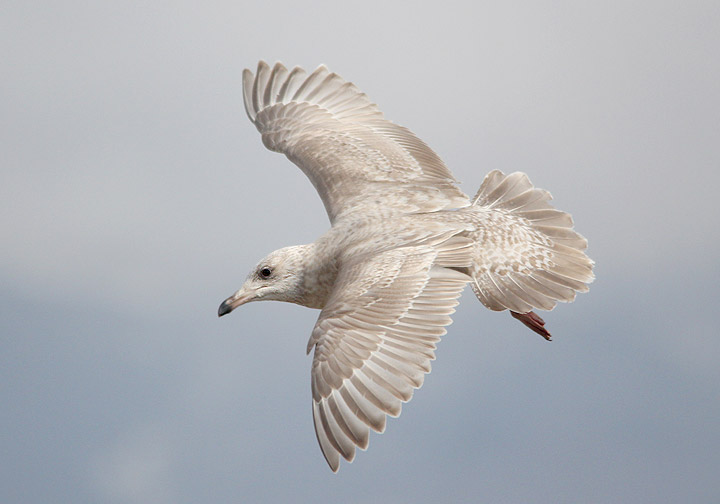
We did have a bit of excitement i the afternoon watching the carp pile as a very pale gull came flying in from the east.  Initially I thought it was the Iceland Gull and was stoked I would be getting killer flight shots.  And killer shots I did get--only the bird wasn't the Iceland Gull!


So what is it?

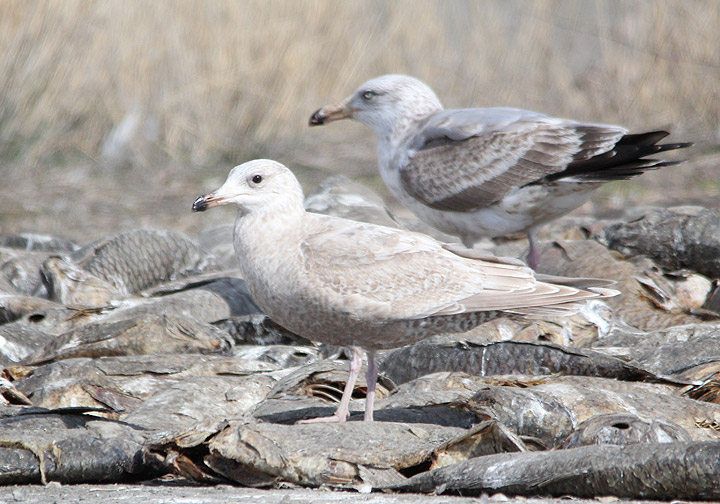
After it landed it was apparent the primaries were too dark and the bird seemed odd.  I thought about Thayer's Gull, but it was very pale, and was a hefty looking bird with a bulkier than normal bill.  Hybrids came to mind with the obvious choice for a bird this pale with a bi-colored bill being a Glaucous x Herring Gull hybrid--also known as a Nelson's Gull.

Certainly has a Herring-ish face...

I stuck to that as the name until I got home when I started to wonder if I was looking at this thing all wrong.  One of the major issues with late season gulling is that birds get bleached losing some of their color making them appear "whiter" than usual.  The bird was on the small size for the hybrid in question, but not too small. Looking at it I could see some Herring features which is why I clung to the idea of a hybrid.  I have had several others look at it and the opinions are varied.  From very bleached out Thayer's Gull, to Something with some "Herring in it", to Glaucous-winged x Herring.  Glaucous x Herring has been ruled out but the jury is out on what this bird is.  I could certainly be swayed to Thayer's Gull, albeit the lightest I've ever seen--but I feel reservatons based off seeing it next to Thayer's and Herring in the field. Regardless, it was a very cool bird.

A gorgeous gull regardless the species!

Mid-way through the afternoon we wrapped things up and called it a day!  The 5th annual Gullstravaganza was in the books with 7 species of Gull!  As always this is my favorite trip of the year, as many birders still overlook gulls, and they continually provide us with unique individuals that can make for a difficult time ID'ing.  And as usual I was stoked with the excellent turn out.  As with years in the past my mind is already turning with ideas for making next years event even better.

A big thanks to Kenny Frisch for co-leading the trip this year.  And of course a big thanks to everyone who attended, from Salt Lake, Davis, Utah, Summit, and other surrounding counties.  There were attendees from Millard County as well as Wyoming; and even one guest from Scotland (although he currently lives here).

eBird Checklist for this years event:
http://ebird.org/ebird/view/checklist?subID=S22009728

Labels: , , , , , ,

eBirding Your Home Town

posted by Tim Avery at
on Friday, February 20, 2015 

I've been tied a lot closer to home the past 6 months with the addition of a son to our family.  It's meant I don't manage to go birding for as long, or as far from home as usual.  I've still managed to do a lot of birding, but really changed my pattern.  One thing I have decided to work on is building out locations in and around Sandy, Utah creating a patchwork of personal birding location in eBird to micro list as I go about my day to day.  It's actually really simple and ends up keeping me in tune with what birds are where around my current home town.

My personal locations in blue--hotspots in red.

It started rather simply a couple years ago.  I had my house as a personal location, my neighborhood as another, and then I created a spot for a woodlot along my drive home from work.  There are two hot spots along my routes to and from work--the Sandy City Cemetery and Dimple Dell Park. I also created a location a few years ago at La Caille for the trail down to Quail Hollow Park, that is now listed as Little Cottonwood Canyon -- Mouth (incl. La Caille). Larkin Sunset Gardens also has a hotspot but I rarely make it up the road to this location.  East of I-15 and in Sandy City these are the only hot spots.  There are a couple spots long the Jordan River, and of Course the Sandy Urban Fishery.  But you get the idea, there just aren't a ton of birding spots on the map.  So I changed that.

Sandy -- Porter Rockwell Trail at 10600 South

I started by creating two spots along the Rail Trail (Trax)--one at 9000 South and another at 10600 South.  The locations were named accordingly Sandy -- Porter Rockwell Trail and Sandy -- Expo Station @ 9000 S 146 E. I decided to use the eBird naming schema for locations in a given area.  Since these were all personal I used Sandy as the location with each sub location following dashes.  Next I added Lake Hills Cemetery on State Street, and then another location along 10600 south at about 1050 East just past the Dimple Dell Rec Center.  I also had a location that I rarely used listed at the Sandy Amphitheatre, which I adjusted to Sandy -- Quarry Bend and Amphitheatre.  From here I branched out and while out and about in the past week I created 3 location along the I-15 corridor just east of the freeway.  One near 9000 south at the old Classic Fun Center where a small ditch has a marsh habitat.  I also created two locations around the Southe Town Mall.  One north of the mall along Centennial Parkway  where a tiny pond is surrounded by marsh.  And another along the freeway the length of the west side of the mall where these is an expansive marsh.

Sandy -- South Towne Center Marsh

Deciding I needed to break Sandy down even more I decided to create locations at a number of local parks: Storm Mountain Park, Lone Peak Park, Bell Canyon Park, Pebble Brook GC, Falcon Park, Flat Iron Mesa Park, and Quail Hollow Park.

Sandy -- Flat Iron Mesa Park

I didn't create spots for every park, but ones I pass or spend some amount of time at on a monthly basis.  My goal going forward is to submit at least 1 list per month at each location in Sandy, and eventually work on getting a list for every week of the year to create a full data set for these locations.  It won't be comprehensive but will give me a good overlay of the entire city!

Generally the lists contain a lot of Rock Pigeons and European Starlings--a realistic look at what most urban birding looks like.  But the lists get sprinkled with Mourning and Eurasian Collared-Doves, Americn Robins, Western Scrub-Jays, Black-billed Magpie, American Kestrel, House Finches and Sparrows, California Gulls, etc.  Just for laughs I have submitted 61 Checklists for the Sandy Ciy Cemetery--comprising exactly 14 species! With this micro birding there are far more checklists than species generally.
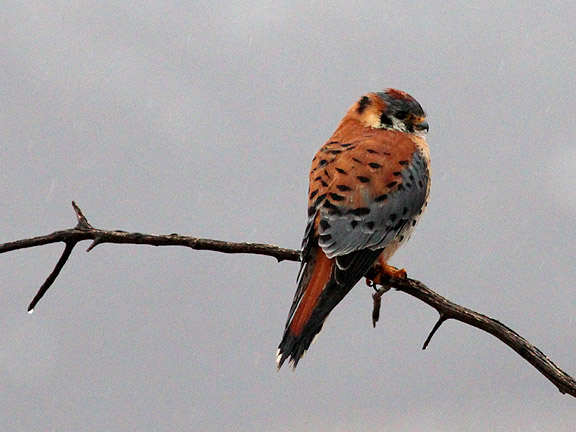
American Kestrel

On a daily basis I try to enter lists when I stop at lights or keep an eye out for birds while driving.  I also usually stop at one or two locations on the way home for a just a couple minutes to listen to what's calling. It gives me the opportunity to fit in a little birding every day away from my home and office.  It has also made me really aware of specific birds that have set up territories along the route. I have 2 spots where I know American Kestrel are on territory; 1 Red-tailed Hawk that frequents a certain woodlot; and of course the specific locations where you almost always find American Crow in the city.

American Crow

So if you can't get away from home as much as you'd like, or you prefer birding locally, without a car, on foot, bike, or scooter I suggest creating your own patchwork of local birding locations and working on micro listing your area. Not only will you provide valuable data for citizen science, but you'll really get to know the birds around you.

If you'd like me to share any of my personal locations with you just let me know--I don't suspect a lot of folks go birding at many of these places, but if more than one were interested I would certainly love to add more data from more birders!

Labels: , , , ,

eBird and the Issue with Domestics

posted by Tim Avery at
on Thursday, February 5, 2015 

So I love eBird--you know this if you've read my posts in the past.  I have a few gripes with some things they do wrong--its a fact that the software is pretty amazing, but there are some very easy ways to make improvements that will give users much more control over how they view data.  One such improvement that I haven't spoken about in the past is the ability to filter out DOMESTICS.  Love them or hate them (I'm in the latter camp) I've never seen the point in having the ability to add domestic birds into checklists; and then display that data in search results and lists for locations.  Simply put the birds ARE NOT WILD!  They are not recognized as wild species, and in my opinion they clutter things up in the data.  Some people really seem to enjoy putting them on their checklists though.  As birders we know they occur and in general know where they occur.  So why put them on checklists?

I am having trouble finding eBirds official reasoning for this, although I suspect on some level it is because they do have an impact on native wildlife; and perhaps there is some interest in local populations of domestic fowl, etc.  So I can be okay with these being available as inputs on checklists and outputs in data.  But what I would love to see is the ability at a user level to either HIDE ALL domestics in submission forms and in output data as a setting.  If I could go in and switch a toggle that says I don't want to see this; for me personally it would be an improved experience.  There could also be the ability to filter them out in data outputs.  This is actually still my biggest gripe with species maps, lists, and other data outputs.  The general lack of filtering ability.  The filters they have set in place are location, season, and year based. All great tools. But more complex filters to hide or show "spuhs", domestics, hybrids, etc would be really useful when looking at output data.  Here is an example...


I pulled up the bar chart for the Salt Lake International Center.  Right at the top of the list we have2 domestics, then a either/or (that's like Ross's/Snow Goose). A few more down is another domestic, then a spuh.  All said the list has the 197 wild species + 22 "other taxa".  These others are the domestics, the hybrids, the spuhs, and the either/ors.  It's all valuable data, but maybe I am a purist and only truly care about actual wild occurring species.

Now to be honest this isn't a bad list by any means--197 to 22 is a okay ratio.  Let's look at a bigger less manageable list--the Utah statewide bar chart. 458 Species and 168 other taxa.


Out of the first 15 "species" line items, 8 are OTHER TAXA.  Now waterfowl in general is like this since there are lots of hybrids and domestics.  But going down the list, almost every section of 15 species has 1 of these other taxa. Gulls are particularly ugly as well!


Okay so how do we take care of this.  Much like my suggestion to add the ability to toggle on or off invalid sightings on the maps page; there would be a simple filter on the bar charts or any page that has output data that would allow us to filter this other junk out. A quick redesign of the top of each table and it would be easier to read, and create a nice placement for a filter button.


I already feel better jsut cleaning up the table header :)  So lets see what would happen when you click the "Filter This Checklist" button.


You would be able to filter by time of year, date, a number of toggles for what species types you want to see, and hell, lets even throw in the ability to show invalidated reports--this will eb my life long goal with eBird I think.  So if we were to go through and turn all the species filters off except for wild like so:


The output would change and we would see the following, removing all the spuhs, hybrids and such--giving us a real total for the wild species in Utah:


And of course just for laughs if we were to go in and adjust the toggle for invalid reports the screen would change ever so slightly to now show invalid species in a red (the abundance marker would be red as well), and next to the species total would list the invalid species as well, keeping thisngs clean.


Maybe its just me, but this tool can be used in so many ways, and make eBird even better for its users.  I've seen some crazy stuff put on checklists in the past.  Park ducks and gees from an aviary. Emu and Ostrich from what are obviously farms.  Guineafowl on private property; a number of exotic ducks again on private property, or public ponds operated by private entitities.  I am a birder, and I really only have an interest in teh free flying wild stuff.  Don't get me wrong there are some free flying escapees--and I think that is a hole other classification of birds that we could add into the database--the ability to mark something as a free flying escapee on a checklist would add a new dyanamic.  Mandarin Ducks, Bar-headed Geese, Pochards, Budgies, etc.

Free Flying Escaped Bar-headed Goose in Provo

What I am getting at is I don't really care what they allow people to put into the system.  I get the importance of tracking domestics (to a certain extent); but that's not something I will ever do.  Adding more rich features to enhance the user experience of the data output will only make eBird more valuable to its users, researchers, and team eBird.

Labels: , , , ,

NEW Historical Data in eBird

posted by Tim Avery at
on Friday, September 19, 2014 

After my eBird "quality" posts last week, which started as a commentary on making historical checklists more valuable, I laughed when I logged into eBird this week and noticed "historical" was now an option for entering a checklist!


Team eBird has basically stated that to make data even more concise they've changes a few things.  Historical would be used in place of incidental, or either traveling or stationary counts.  Here is what they have to say about historical data:

The value of entering historic data into the eBird database cannot be overstated. These records help build historic perspective in the database, and allow us to look farther back in time when conducting analyses. In these cases it's good to have as much supporting documentation available for the old records as possible, and be prepared to field questions from our regional editors about the validity of the data. All eBird records are treated the same way, going through our data-vetting procedures, and historic data are no different.

Historic data entry does have a few caveats though which you can read about here.

But there is more.  Team eBird apparently also wants all counts to be either stationary or traveling.  If you are birding, or a heavy portion of what you are doing is birding, they want you to use those count types. Here is a quote directly from an email that was forwarded to me about the change:

Our goal is to encourage people to use Stationary and Traveling counts. These are the two principal types of surveys that provide the most useful data (aside from some specific surveys we may have in the drop down menu for particular projects). When we have start time, duration, distance, we can do much more with the data particularly when coupled with a yes to the question about whether all species were detected.
After looking through a large amount of data, it became clear that there are two different ways that people were using the "old" Incidental protocol. One was for historical data entry where people were simply missing values but had made an attempt to survey an area for a reasonable amount of time. The other was for current checklists. Of current checklists, we found tens of thousands of records with one or two species where people said they were answering yes to the question, are you reporting all species. This is NOT the intent of that question and we needed to address it.
The question that I'll paraphrase as "Are you reporting all birds" has a temporal component.  In order to report "yes" to the question of are you reporting all species of birds, there must be a dimension of time, otherwise the answer doesn't make much sense. If someone spends 5 minutes surveying for birds or 10 hours, there will be very different number or birds detected. The same is true for distance. If we have no information on this, it doesn't help much to have an answer of Yes to this question.

You'll now see this message near the submit button on your checklist if you select incidental--and you can't change it to "complete checklist".  This means that even if you stop for 1 minute to bird a location--and you are really birding and only see 2 species, you would submit a stationary count as opposed to incidental. It's a great  way to improve data quality.


I talked with some friends recently about dozens of old field notes from when I did field work in Wyoming. 99% of those notebooks aren't in eBird--along with 10+ years of birding before that.  I have 1,000's of historical checklists just laying around that one day I want to enter in eBird--and now there is a count type specifically for them!  To that I say hooray! I will also have to start using the stationary and traveling more often when I make a quick stop while birding.  I guess those minutes are important data not to be dismissed as incidental after all!

Labels: , ,

Making Your eBird Data More Valuable PART DEUX

posted by Tim Avery at
on Thursday, September 4, 2014 

Here is my reply to ALL the replies form yesterday post...


Wow, what a great batch of comments, first I must commend Shyloh, Mike, and Kenny for publicly sharing their views.

The 11 anonymous posters had a varied mix of feelings and thoughts, and some obviously didn't want to share their names despite such strong convictions.  I want to respond to every comment so bare with me while I go through them...


Anonymous 1:

This seems like pretty blatant trolling--you say you don't care, but the time you took to post this with your feelings shows otherwise.  You say, "I know what I saw", which is fine, but if your sightings seem questionable, and have little details, their addition to the public data poll is a bit careless.  Like I mentioned, I am okay with people using eBird to just track their personal sightings for themselves--its a great tool for that.  However, for anyone that feels this way, I highly recommend going into preferences and checking the "hide my data" checkboxes for eBird Alerts, and Top 100 under the data privacy section.  If your sightings are just for your personal use as you say they are, there is no need to have them included in these very "gamified" areas of eBird as one other commenter noted.  My last criticism of your response was not having the time to enter a bunch of lists.  You have time to go birding, you have time to enter at least one list, and you have time to comment on this blog.  So time is on your side I would argue, and the little amount of time it takes to break 1 list into 3 or 4 seems well worth it this day in age.


Anonymous 2:

Great comment.  As I mentioned to Anonymous 1 this is the logical thing to do for others, and for yourself for a multitude of reasons.

Anonymous 3:

I see the first comment got you riled.  I have to say I disagree with your first point--eBird has many uses, and personal lists are a valid reason to use the program--its unfair to tell someone to use a notebook because they don't give a shit about science when the software is available for free and their data can be invalidated from the pool.  As to your second point, I do tend to agree, but if someone doesn't use it to help with the scientific effort, their data is so minuscule in the bigger picture, that in 150 years it really won't matter.  Those "Rare" birds they report, probably were mis-identifications, so their exclusion from the data pool is probably for the better.  And as to your 3rd point--haha, spot on my friend.


Anonymous 4:

I think in general in our local area--Utah, or even just northern Utah, the majority of eBird users are aware of what sightings are legitimate, and which are questionable.  I would be lying if I said I didn't brush off a number of alert species based of the observer.  In our community there are a handful of eBirders who don't so their sightings justice by taking photos of rarities they reports, or providing any meaningful information on the sightings for both eBird and their peers.  Before eBird it was much the same with the "RBA" or just on the listserv's. In birding credibility is earned not through documentation.  If a supposed great birder never documents his/her sightings, but constantly reports rarities, it begs to question the legitimacy of the sightings.  IF other give chase and can't track down the reports, it also leaves you to wonder.  But a photo, and re-chaseable birds create reputations and credibility amongst the community.  I expect every level of birder from beginner to expert to provide the same level of documentation in eBird for the sighting to really resonate with me.  This is completely aside of the scientific aspect of eBird, but more on the who is full of shit front.


Anonymous 5:

As I mentioned before, this is an opinion, and someone who just uses it for themselves is not breaking rules or being selfish---eBird has many uses.  I do believe people who use the applications should contribute more, but by no means do they have to, and by no means are they "doing it wrong".  But they should take care to remove themselves from alerts and listing.


Anonymous 6:

This is true--however an X can denote a count that is too high for a decent estimate.  Many birders don't feel comfortable, or can't estimate high counts of birds.  It sounds crazy but I have done this exercise with people to see how they estimate, and counts are wildly off sometimes.  If it wasn't an easy to count exact count, it may be best to leave it as X--this data is still important and useful.  I always try to put a number in, and in 99.9999999% of my individual sightings there is a count, whether exact or an estimate.   It definitely adds value even with estimations though!


Mike:

Woot an name and a face!  You are nuts, a nutty nut job, blah blah blah.  Just kidding of course, I just figured a name made it easy to call you out!  In general it seems like you feel how I feel.  I'm okay with people using the program how they see fit--I love when there are more details, and it lends credibility, and its better for the data pool.

Kenny:

You really are crazy... Crazy in a good way.  I think a lot of people miss the communal aspect of eBird--whether or not you want to be part of that community, you are if you report rare birds, and take part in the Top 100.  These things are far less important that high value checklists, but they have become a big part of eBird.  You said it best though, "We should all strive to be a better part of the birding community since who can understand the highs and lows and adventures of birding best than other birders?"  Providing better data inherently makes you a better part of the community--and our growing community here is proof of that!


Shyloh:

Where do I even start with you man... You're the dude.  You make the point right off the bat, "THERE IS NOTHING WRONG WITH SELFISHLY USING EBIRD!!!"  And Like I said, I agree--use it as you see fit, its there for many different reasons, so to each their own.

At the end of the day it really doesn't matter--like I told you, they're just birds man.  But I like to think that striving for a strong community, with birders that respect one another includes some great self checking, as well as community checking--which helps build a great data pool.  If someone reports rarities often, or even not so often, but rarely produces chase-able birds, or documents their sightings it effects not only the data pool, but chasers and listers--the community.  Regardless of how people use eBird, if you report a rarity on a checklist, you should expect some level of scrutiny from others, that's just human nature, and a big part of birding--and quality documentation and information helps eliminate some of that.

I would never tell anyone "this is how you should use eBird", but I sure as hell think there are ways we can all make our checklists more valuable not only for the community but for ourselves!  And I think that is a lot of what others are getting at too--just a tad more forceful.


Anonymous #7:

Shyloh, wanted to tell you "LOL"...

Anonymous #8:

Holy moly.  I will just say this, well played sir.  You hit the nail on the head.

Anonymous #9:

This is a great point with all others aside--as volunteers, having to wade through the muck, it sucks.  Whether a user cares about listing, or conservation, or whatever, a sighting that lacks documentation makes their lives harder.  I have talked to several moderators who routinely throw out specific users sightings because they are so riddled with mistakes, and absolutely no documentation that it's better for the data pool to just remove them.  I can see eBird eventually coming up with a way to block certain users from the data pool based of reviewer recommendations because of just that.

AND NOW MY FINAL THOUGHTS...

Let's just be real about our sightings for a second--on a personal level.  In the end on either side (community/data pool versus selfishness), it comes down to do you care about being right, or thinking your right?

I personally would rather be able to look at my sighting, have documentation, and be able to say I am 100% sure of that--and so is everyone else that sees it, than have a sighting with no documentation that begs the question, is this reliable data.  Simply putting a tick mark on a checklist for a rare birds shows a lack of understanding why that bird is rare/flagged, and the importance of documentation for data quality, especially when its not just a checklist for keeping a life list, but one used for building a data set for a location.  In the end the reviewer can simply invalidate the sighting, but then it seems counter intuitive to the whole process.  I don't think its asking to much for even a crappy photo--almost everyone carries a digital camera with them, and rarely are birds so flighty that even a distant, blurry, out of focus, or partially hidden bird can't be photo'd.  It seems so simple, and useful to the whole idea of building the data pool.

One solution to this is creating user groups in eBird for different types of players in the "game".  For the selfish, I use it to keep my life list, there could be a user type where all data is separate from the community pool.  Then there could be scientific users, and typical users, so on and so forth.  You could even go to a pay model which is a whole other blog post...

No matter what reason you watch birds, if you are using eBird you have made yourself part of that community, and we're glad to have, and I hope we all can work to make the community stronger in the long run! At the end of the day every birder is different, and uses eBird for many different reasons--I just hope that everyone realizes that we can all strive to make things better!

Labels: , , , ,

Making Your eBird Data More Valuable

posted by Tim Avery at
on Wednesday, September 3, 2014 

I recently posted a response to a thread on UBIRD about historical checklists and incidental counts in eBird.  There were 3 main topics I talked about.

  1. Adding valuable sighting information to historical vagrants/rarities
  2. Splitting larger generic checklists into smaller location specific checklists
  3. Removing possibly bad data or in particular mis-identifications
The email didn't go in to a ton of detail on these topics, just my brief overview of why I felt it was important.  But I wanted to expand on that, and give a few real world examples of the issues, and what I've been doing to try and practice what I preach.  I've had a few interesting conversations about the subject, and gotten different perspectives and personal opinions on the matter.  It brought up a couple things that I thought were also worth talking about.

I talked to several people who mentioned their #1 reason for using eBird was to keep track of their sightings for themselves above all else.  The data after all was being provided free of charge by the birders/observers, and that in itself was valuable despite the quality of the data.  It would be a lie if I didn't say that was also WHY I initially started using eBird back in 2004. It was an easy way to track my own sightings, I was after all filling up several notebooks a year with lists and this was an easier way to keep those lists, and manage them.  For this reason I was quite cavalier with my locations.  I often did counts for entire days for a county, or along 100 mile section of road.  My lists were less for science than my personal needs.

There are in fact a lot of eBird users who ONLY use eBird for this very reason, and that's perfectly acceptable--it's a great tool for that--but it's also so much more.

Now I also talked to one person who mentioned that sometimes they just put in a list for a whole weekend because they wanted to keep track of the birds they'd seen, but they'd visited 10 places, seen 150 birds, and didn't want to take the time to go enter individual checklists for every place they went.  That's another one I could relate to--I've done exactly the same.  Creating and submitting checklists can be time consuming, and for some they just don't have the time to get granular. Some data is better than no data after all.

Cape May Warbler from Lytle Ranch... Less than 5 ever reported in Utah.

And yet one other person who kept very detailed lists of species seen never added details, photos, or any information to their lists.  In their opinion they were already providing high quality data, and felt that the need to add more details was benign.  In the long run there will be so much data that these details won't matter--the pictures, notes, etc. And again, I have done the same, I get it, and in some cases I whole-heartedly agree.  I have heard the argument that in 150 years someone might be looking back at some data and see a report of a Cape May Warbler in Utah with no associated data.  The report was validated but without any supporting data because I was experienced with that species.  But how would those people know who I am?  Honestly, I hope I leave some type of impact on birding in Utah in my life time, whether small or big--I would hope with a little digging someone can figure out who I was--especially in this digital age.  But I digress, I also see the flip side, and that's where this whole blog post got started.  Let's talk about those bullet points.

Adding valuable sighting information to historical vagrants/rarities.

Over the years I have slowly become more and more methodical with my checklists.  This means being more granular with locations, and more detailed with subspecies, and adding specific details about flagged sightings.  This is a personal choice, to try and make my checklists not only more valuable to researches, and those using the data for scientific purposes; but also, for other birders to be able to glean them for data, and for me personally to be able to look back and see details about a sighting all in one place.  As of the writing of this I have submitted 3226 eBird checklists for Utah.  As that number grows it becomes harder and harder to look at specific checklists with flagged sightings and remember all the details. So thus started the drawn out process of going back and adding those details.

Utah's 1st documented Bay-breasted Warbler

I started with my taxonomic life list for Utah and started working my way down.  I specifically wanted to concentrate on adding details to species with less than 25 reports ever for Utah--with more details being added to the rarest species--those typically with less than 5 reports ever.

Utah's 1st Yellow-bellied Flycatcher 

In cases where I had photos, videos, or recordings I embedded those in.  Photos linked to my website, videos from Youtube, and recordings from Xeno-canto if available.  If I felt the photos were sufficient for the report I often kept the notes short.  On some species I added a small blurb, and on others complete paragraphs of texts that I cut out of emails I pulled from the original reports, or from Records Committee Reports from some of my oldest sightings.  I didn't remember all the details from many of these reports so going back and searching in UBIRD, and other listserv archives for my original posts was really helpful.  It also saved me from writing in details that might not be as accurate otherwise.

Utah's 1st Pine Warbler

I soon realized I had hundreds of such checklists, so it was somewhat tedious--but the end results were lots of photos added into the data pool, and some detailed (and not so detailed) write-ups of species that otherwise were originally note-less.   In all so far I've added details for 36 species, on 52 checklists.  Some of the more notable were details for eBird Utah's first Western Gull, Pine Warbler, Eastern Meadowlark, Sharp-tailed Sandpiper, Cape May Warbler, Yellow-bellied Flycatcher, Gilded Flicker, Bay-breasted Warbler, Black-billed Cuckoo, and Little Gull..  Despite the time that went into it, it was fairly easy to do, and well worth it.

Splitting larger generic checklists into smaller location specific checklists

I recently flipped through a field notebook from one of my summers working in Wyoming during college.  I had 1 or 2 checklists for most days.  One list was the survey I ran that morning, and the other was the rest of the birding that day.  In some cases I drove over 100 miles on these days and went through every typical habitat type found in western Wyoming.  In eBird these lists would look ridiculous--but none-the-less I have a few.  Luckily most of my college years checklists from Wyoming are not in eBird yet. But I have dozens form the early years of eBird that I did enter like this.  Some are an entire day count for 16 hours at a lake in the Uinta's.  The checklist covers shrubsteppe, aspen, conifer, and mountain reservoir habitats though.  I probably traveled 10 miles during the day and the list could be broken down more.  These are hard though, because some of the birds cross habitats, and I don't remember what was in which necessarily.  For these it's really best to just leave as is--its 1 checklist out of 1,000's, in the bigger picture that data is "close enough" that it won't look too out of place--and if it is the reviewer can invalidate the list.

Blue Grosbeak from 12,000' in the Uintas??? I think not.

But what about a 40 mile drive from Vernal to Hacking Lake in the Uinta's?  It looks odd when a checklist has both Blue Grosbeak and Pine Grosbeak together.  Or Red Crossbill and Lesser Goldfinch.  Or Dark-eyed Junco and Marsh Wren (in August).  During the early years I did this often--one checklist for the entire length of a road.  The best recommendation is going through and removing the species that don't fit the greater picture, and breaking them out into a separate list at a better location for them.  Or break it down in to as many lists as you feel comfortable doing.  In this case I broke 1 list into 5.  Vernal, the lower section of Sagebrush, Aspen Forests, Conifer Forests, and finally Hacking Lake.  It's still not perfect, but it fixes one bad list.

Pine Grosbeak should never be on the same list as Blue Grosbeak in Utah...

One of the most common offenders of this is the "Antelope Island State Park" checklist submission.  There are numerous hot spot points for the park, but many folks do one list for 5 or 6 visited spots.  This means you have Snowy Plovers and Godwits on the island.   Others mistake the causeway spot for the whole park and then you end up with Warblers, Tanagers, and Orioles on the causeway.  I tend to do a list for the causeway and each major location I go to on the island.  Sometimes I leave with 7 checklists--but its super granular and useful.  This is one thing I have made a better effort at in recent years and try to be as specific as makes sense for the places I'm going.  With apps like BirdLog it now makes it easier to avoid this, allowing you to quickly create a new list on the fly while in the field as you go from habitat to habitat, or location to location.

Removing possibly bad data or in particular mis-identifications

This is one of the hardest for most people to do--myself included.  Going back and looking at lists and saying, that's not right, or I'm just not sure anymore, can be difficult for most birders.  I went back and removed a number of my old Short-billed Dowitcher reports and changed them to Dowitcher sp.  I did leave ones that had photo evidence, but ones without were mostly changed.  I went back and took Least Bittern off an Ouray list I had form my younger years.  At the time others were reporting them, and I thought I saw one.  But looking back and having seen that species since it was a no brainer to remove it.  In some cases if it doesn't seem right, its safer to just change it outright.  Leave a note, change it to a spuh, with details about why you changed it.  But if you aren't sure this is a good way to clean up old lists.

Dowitcher sp? Or one of each?

There are some that I probably should change, but I can't bring myself to do it.  Sometimes you believe so much in a sighting you had, despite lack of evidence, experience, etc, you just stick with it.  You very likely are correct with your belief, and in many cases the data has already been invalidated in eBird, so for your personal use what does it matter?  It's all about finding the right balance for how you use eBird.

Whether your a hard-core eBirder, a casual user, or just someone who keeps basic lists via the awesome resource, there are things we can all do to make our lists more useful--for everyone.  And I'm sure there will be more ways in the future, and things will change, and improve.  eBird has come along way in the last 10 years, and so has the quality and amount of data.

How do you personally make your checklists more useful?  Share below, and help others improve the data they're submitting!

Labels: , , , ,

Top Ten Utah Birds pt. 2 - The Top 10

posted by Unknown at
on Thursday, December 12, 2013 


Now for the top ten!!

As a reminder, we had 63 participants which made a good enough sample size for us to be really excited about how it turned out. 174 different bird species were represented across the many lists. The variety was fun to see.

Scoring was done by giving a first place vote ten points. The second place vote received 9 points and a third place vote 8 points. All the way down to a tenth place vote receiving 1 point. If there was a tie then the bird with more total votes was bumped up.

And the top ten birds of Utah are...

#10 - Peregrine Falcon


"I started with 35 and had to beat it down to 10. Not easy! Then to put them in order. So not easy!"

• • •

#9 - American Kestrel

• • •

#8 - Greater Sage-Grouse
by Tim Avery

"Just about all my species were lifers for me after I moved out to Utah two years ago and most of them are found in habitats that were new to me before I moved to Utah, whether it be pinyon-juniper, sagebrush, desert or mountains. My top 3 are birds that are only found in a handful of states which makes them even more special.  Gunnison Sage-grouse is very range restricted and only found in Utah and Colorado. To see several of them on lek was an experience I will never forget."

• • •

#7 - American White Pelican

• • •

#6 - Black Rosy-Finch
by Tim Avery

• • •

#5 - Bald Eagle
by Shyloh Robinson

"Because I lived in the midwest previously and didn't have experience with many birds of Utah, many common birds here caught my eye  and that is reflected on my top 10. All of the birds are specifically found in the western part of the country except the bald eagle which I added because of the great numbers it gathers in here, especially at Farmington Bay. I think that the eagle is a great representative for Utah because although Utah doesn't have any bird specific to the state, Utah has many unique habitats and populations of birds, the Bald Eagles at Farmington being a great example"

• • •

#4 - Red-tailed Hawk

• • •

#3 - Flammulated Owl
by Tim Avery


• • •

#2 - American Avocet


"I have seen some rare ones in Utah, but to me this list represents what Utah birding is about and what people who come from other areas want to see.  The avocet is just so Iconic to me, that is why I put it #1.  None of these are rare by any means but to me what makes Utah birding so great."

• • •

And the #1 bird...........

#1 - Western Tanager

"I still remember the first Western Tanager I saw in real life.  I remember months before flipping through the field guide as I had just gotten into birding and thinking, wow, this is an incredible bird--it was instantaneously my favorite.  There is not a summer hike in the mountains of Utah where the two-note call of the Western Tanager or i's melodious song isn't heard.  When you see one it's an unforgettable experience for the birder and non-birder alike.  The flaming face and bright yellow body make it undeniably the quintessential Utah Bird."

• • •

I am not a statistics major so I apologize for any flaws in my logic but I thought it would be nice to give some additional stats.

Given the previously described point system here is how the top ten fared:

# Species Points %
1.Western Tanager 166 26.3%
2.American Avocet 130 20.6%
3.Flammulated Owl 107 16.9%
4.Red-tailed Hawk 86 13.7%
5.Bald Eagle 82 13.0%
6.Black Rosy-Finch 80 12.7%
7.American White Pelican 71 11.3%
8.Greater Sage Grouse 63 10.0%
9.American Kestrel 62 9.8%
10.Peregrine Falcon 59 9.4%

Percentages are based against a highest possible score not against the total points. Thus percentages will not add up to 100% but instead reflect percentage of a perfect score. For example if all 63 lists had Western Tanager as there first place bird then it could score 630 out of a possible 630.

Top ten Utah birds based on number of votes:


# Species Points %
1.Western Tanager 24 38.1%
2.American Avocet 21 33.3%
3.Flammulated Owl 15 23.8%
4.Bald Eagle 13 20.6%
5.Red-tailed Hawk 12 19.0%
6. American White Pelican 12 19.0%
7. Greater Sage Grouse 12 19.0%
8. Black Rosy-Finch 10 15.9%
9.American Kestrel 9 14.3%
10.Lazuli Bunting 9 14.3%


Percentage based on the number of lists that had the species in there top ten.

Top ten Utah birds based on the number of 1st place votes:


# Species 1st place Votes
1.American Avocet 6
2.Western Tanager 4
3.Black Rosy-Finch 4
4.Red-tailed Hawk 3
5.Greater Sage Grouse 3
6.Peregrine Falcon 3
7.Bald Eagle 2
8.American White Pelican 2
9.American Kestrel                      2
10.Golden Eagle                     2


Birds of prey made a huge showing on almost every ones list, in fact 23% of the total votes:
  

Family Votes Points
Owls44 271
Hawks 44 222
Falcons 22 166
Eagles 20 138
TOTAL 130 Votes 797 Points

             
The Corvids also made a solid showing at 4% of the total vote:


Corvids Votes Points
TOTAL 25 Votes 138 Points


Thanks again for every ones participation!

Labels: , , ,


UTAH BIRDERS FLICKR POOL


    SEE MORE AND SHARE ON FLICKR