Utah Birds, Utah Birding, and Utah Birders. Promoting the sharing of information, and the conservation of habitat for birds in Utah and elsewhere. We are a group of people who want to share what we know, and create a positive birding experience in Utah.

BIRDERS BLOG

a blog by and for Utah Birders

Annotated List: Birds of Utah (1874)

posted by Anonymous eBirder at
on Saturday, February 19, 2011 

I am blown away right now!

Last night, we headed down to Moab, for a vacation with friends. On the way down, we tried for the Curve-Billed Thrasher that was reported in Castle Valley just outside of Moab. We had no luck with the Thrasher, but did see a Spotted Towhee, Dark-eyed Juncos, Common Goldeneye, Common Merganser & Great Blue Heron. The Thrasher was reported at a feeder in Castle Valley; birdlife was sparse at the feeder because a Kit Fox was hanging out below it. I was honestly more excited about the Kit Fox than I would have been for the Thrasher.

Tonight we were shopping around town and I dragged everyone into my favorite bookstore, "Back of Beyond Books." I found a bird checklist from the year 1874: "Annotated List of Birds of Utah (1874)." I'm totally stoked about this checklist!!! Tonight I've been looking through it & I think it's so neat to see what birds were reported as common & uncommon in the year 1872 (the year they took the data for the checklist). It's also really interesting to try and figure out the names of the birds from 140 years ago. Some of them I can figure out, like "Long Crested Jay. Common. Found only in the mountains. Resident," which I'm sure is a Stellar's Jay. Some I'm not sure of, like, "Yellow Bird. Common. Permanent resident," which was found with the finches, sparrows, buntings, etc. It's also interesting to note that "Cow Bunting," which I believe is a Brown Cowbird was not very common in the state in 1874; probably because cows weren't that prevalent. Lark Buntings were also "Abundant. Everywhere on plains and benches."

What an awesome find. I might scan it & send an eCopy to people that want to take a look at it. Let me know if you'd like to check it out.

Carl

Labels: , ,

The Big Picture

posted by Jeff Bilsky at
on Thursday, February 17, 2011 

Part of my desire to begin writing on this blog was to of course share in some great discussions on bird specific topics but also to share information that extends beyond just birding. I consider myself somewhat of an environmentalist and to that end try to keep myself educated and aware of the environmental issues that face our planet. Birds are part of the greater picture, as are we, so at times I'll pass along articles and information and thoughts about some of these "bigger picture" concepts. I'm confident a lot of you will be as interested as I am. I felt like this brief disclaimer was needed before sharing the following articles.

First, there's this, which I just read on scientists search for 100 missing species of frogs, salamanders and caecilians and the disheartening conclusion. LINK

I also recently read about the disease afflicting bats: White-nose Syndrome. It appears to be having some pretty devastating effects. LINK

My intention is definitely not to be a downer but I understand this is some pretty heavy stuff. If you need to be cheered up just remember that spring migration (the big push of it anyway) is mere weeks away and in spite of the seemingly impossible challenges facing them, the birds will soon be back on their summer breeding grounds, singing and thriving.

Labels: ,

The Wild Within

posted by Jeff Bilsky at
on Monday, February 14, 2011 

I recently tuned in to a television program called The Wild Within. It airs on The Travel Channel with new episodes showing on Sunday nights. The host, Steven Rinella, is an outdoorsman who claims his goal is to reawaken the spirt of hunting and gathering. Here's a video that explains it.


I was almost immediately captured by it. Listening to him speak about hunting for survival and understanding the enormity of taking an animal's life offers a great perspective. I highly recommend checking it out. Some of the scenes are quite graphic but I admire the authenticity of it and of the host.

I know this strays a bit from the usual sharing of bird related topics, but I figured a lot of you might be interested nonetheless!

Labels: ,

The Crossley ID Guide: A Review

posted by Tim Avery at
 

There is a new birding guide on the market this week and it is certainly making waves on listservs, blogs, and review sites around the U.S. The guide is The Crossley ID Guide: Eastern Birds. The author has said that the book is revolutionary. Some critics have said that is hogwash. Many people have praised it; thus far it is definitely causing a stir both ways. I have to admit when I first heard about this guide a year or so ago I was skeptical. Some of the initial plates I saw left me shaking my head. As more hype was built I thought it was a little messy. Each plate was filled with lots of pictures of the birds. It seemed hectic, and in some cases crowded. I didn’t see the positive in it, it was just too overwhelming.


Then this past week when the book launched I saw a video the Crossley put out to speak about the book, and it finally made sense to me. This book is not geared for the seasoned birder. It isn’t a "field guide" so much as an at home reference, or a learning guide. Looking more into it and thinking back to my early days I realized this is the perfect guide to give someone that is going to get into birding. It is trial by fire so to speak. When you look at a plate like the one below you see multiple images of the bird, in a somewhat natural setting (the background have all been photoshopped into the pictures):

Lesser Scaup

These plates show the bird in different poses, in different plumages, at different angles, and in flight. It gives an idea of what the bird might actually look like in the field from different distances, and vantage points. I still think some work could have been done to improve on the quality of the plates and the organization, but the idea is there and as a first try it truly is somewhat revolutionary and here is why.

Guides with a single pose, or single drawing of a bird, with no reference to where the bird is and how it fits into its habitat are missing something. They are great for looking at field marks—however field marks are something that we as birders have come up with. How many birders in the field see something and say, well based off that field mark that bird is a so and so bird. Most advanced and intermediate birders don’t do that, and I haven’t met a lot of beginners that do that either. When it comes to learning birds and what they look like this guide hits it on the head. Give this bird to any 10 or 11 year old that is just getting into the hobby and they will be able to learn species quickly and have a good idea what to look for when they go into the field. It’s a learning tool and in my opinion might be the single best for learning birds before ever stepping foot into the wild to look for them.

The downside is that I do not see this as a field guide. It isn’t right for a field guide, as it shouldn’t be dragged into the field with you. In general I will always say look at the bird first, look at the guide later. Seeing the bird in real life and being able to study it will be very helpful in IDing it later if you are unsure. Trying to use any book in the field often leads to more confusion than confirmation when you are trying to identify something. Peterson and Sibley are far better field guides, and are what you should take with you if you feel the need to have a guide in the field. That is when those subtle details that these guides show come in handy.

As for the Crossley ID Guide, a western version is on the way in the future, and it will be interesting to see what happens with it. If you are a pro, then this book probably isn’t for you, but if you feel you are still learning or have a ways to go it may be worth picking up just to help with learning birds before you go afield. Seeing pictures and poses that you will actually see of these birds adds a new dimension to the bird guide book, and I am sure innovations will be on the way. It does need some work, but I like the idea, and even in this first try I feel it has something great to offer.

Blackburnian Warbler

So pick up a copy of the eastern version today, so you can be ready for those eastern warblers when they start coming through on their way north in May!

Labels: , ,

Feeding Birds at the Bird: Part 2

posted by Tim Avery at
on Sunday, February 13, 2011 

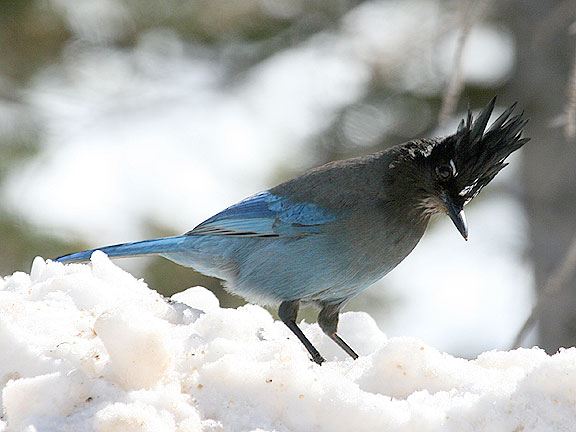
After setting up a couple feeders at Snowbird last night I decided to see if anything had stumbled upon them yet. When I arrived at the feeders they looked as full as yesterday so I moved on and did my regular birding loop of Alta on the bypass road. After doing that and not finding any birds I headed back to the feeders, pulled off the road, and parked the car to sit and wait. It didn't take long for a Steller's Jay to show up, followed by a Mountain Chickadee, and then another, and another Steller's Jay. The birds were not using the feeders, but instead picking seed up I spilled the day before. So I made the decision to pull down one of the feeders, emptying its contents on the snow below the other feeder. After a few minutes the same birds returned. I spent a little while photographing before I took off, here is one of the jays:

Click the photo above to view more.

The traffic was a bit annoying, but didn't seem to bother the birds. I think the food on the ground will be a little more effective than that in the feeder, but both are nice to have. Now let's see if the Rosy-Finches can find their way to this new spot!

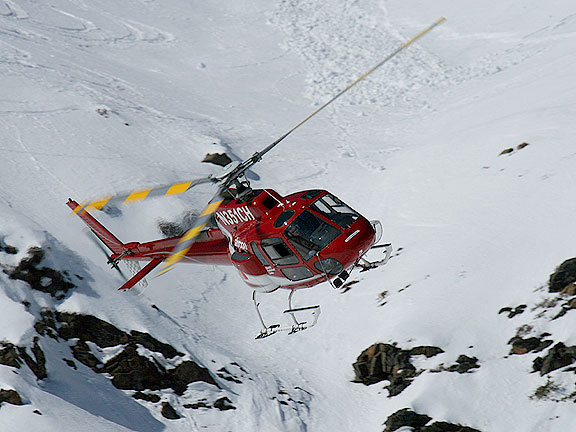
Oh yeah, I did see one other bird while I was up there... It was the rare and infamous "whirly-bird". Pretty cool photo opportunity being in the right place at the right time.

Click the photo above to view more.

Labels: , ,


UTAH BIRDERS FLICKR POOL


    SEE MORE AND SHARE ON FLICKR