Utah Birds, Utah Birding, and Utah Birders. Promoting the sharing of information, and the conservation of habitat for birds in Utah and elsewhere. We are a group of people who want to share what we know, and create a positive birding experience in Utah.

BIRDERS BLOG

a blog by and for Utah Birders

Not a pitfall, but interesting

posted by Jerry Liguori at
on Monday, October 31, 2011 

Do you know what is interesting about this bird?

Take a look at the enlarged version ("click" to enlarge). Is it something about the plumage? Something else entirely, what could it be? This bird was photographed today (10-31-11) along the Wasatch foothills in Salt Lake City, Utah.

Any responses are welcome.

Labels: ,

Really Bad Photos of Really Good Birds

posted by Tim Avery at
 

Whenever a really great bird is reported and accompanied by great photos I am envious. From time to time I am able to get great photos of rare birds, but more often than not, my best shots are of birds that are more common. It is undoubtedly easier to get great photos of common birds--more abundant, more accustomed to people, and easier access provide better opportunities for such photos. I have on occasion revisited a sighting of a rarity on multiple occasions in hopes of better photos. Most of the time however, it is a spur of the moment sighting and the photos I take are the only ones I get. There have been brief encounters, lasting mere seconds, and fleeting glimpses of birds moving through the tree tops. Usually I don’t even start shooting until I am sure of the ID, or unless the ID is so questionable and I need photos to take a second look. So in turn the vast majority of the photos I have of “rare” or “out of range” birds are, well--bad. Here are some really bad photos of some really good birds.

 
King Eider 
Miller Beach, Indiana - November 2006 

 I sweat to you that is an Eider! This is probably the worst of the worst of the bunch. The flyby was spotted by myself and a handful of other Indiana Birders coursing the south shore of Lake Michigan on a cold November day. The large sea duck was as unexpected as any bird might have been, but was the 5th or 6th report from the area over the years. Bad light and 300 yards of water between us and the bird made for this incredibly horrible record shot!

 
Red-throated Loon 
East Canyon Reservoir, Utah - November 8, 2007 

Not the worst of the worst--actually fairly identifiable from the picture. The bird was several hundred yards away, but the distinct pattern really stands out. The quality of the photo leaves something to the imagination but for rare migrant loons on Utah mountain reservoirs its enough for validation.

 
Reddish Egret 
Fish Springs NWR, Utah - August 2007 

What do you get when you take a picture through a 60X eye-piece with a 6 megapixel point-and-shoot camera, at a bird way too far away to photograph on a windy summer afternoon? This record shot of a Reddish Egret. I took a number of shots, but nothing came out nearly as awesome ad this shot. Other were graced with views at less than 50 yards away--I was not so lucky!

 
Ruddy Turnstone 
Bear River MBR, Utah - August 2007 

This might actually be the best of the bunch. Easily identifiable, and very colorful. But it was taken in crappy light, at well over 100 yards away. It was my first and only Ruddy Turnstone in Utah--a state nemesis bird that I haven’t seen in state since this. The bad photo remains the only I have of any Ruddy Turnstone--and a welcome addition to my gallery.

 
Sharp-tailed Sandpiper (Pectoral on the left) 
Antelope Island Causeway, Utah - October 2007 

When a 1st state record is at hand any picture is better than none. After the initial shock of seeing the rufousy washed bird in the company of a number of Pectoral Sandpipers, I snapped off a handful of distant shots of the bird. Poor light and distance were the culprit here--but none-the-less, just enough detail for a 1st! Several others were able to relocate the bird the following day although no other photos were captured.

 
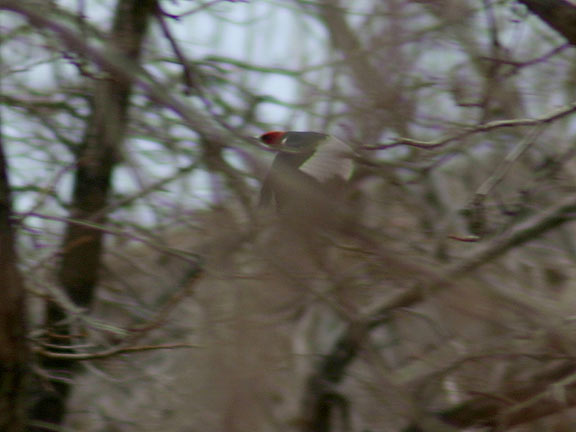
Red-headed Woodpecker 
Hurricane, Utah - December 2004 

No question as to the identity here. Even a terrible record shot of this bird is unmistakable. Flying through the trees at an orchard in southern Utah, this was one of the best looks I had at the only modern report of Red-headed Woodpecker from Utah. Others managed some great shots, but at the time I was happy with what I captured using a 300MM $50 lens and my 1st generation DSLR. I also got a perched shot that is equally as bad--in fact worse in terms of focus, but the red head is blazingly obvious!

 
Gilded Flicker 
Beaver Dam Slope, Utah - April 23, 2010 

Possibly one of the worst record shots. The details in the photo are murky and were a last ditch effort to get some type of documentation for the woodpecker that has been sparsely reported in southwestern Utah, with very few photos for vindication. The birds (yes 2) flushed from a water tank in the desert and flew directly away from my wife and I. I took to foot chasing them through the Cholla and Joshua Trees, snapping this shot before they disappeared. Sometimes even the worst shot is just that--the worst shot!

 
Kirtland’s Warbler 
Chicago, Illinois - May 2008 

What do you do when you are in Chicago in May birding Lincoln Park as migrants duck and dodge through the trees and you spot the rarest native wood warbler found in North America? After the initial freak out you try to get a picture of course... But umm... What if you don’t have you camera because it was a business trip and the birding was just supposed to be a casual after work stroll? Luck for me I had my point-and-shoot. I wasn’t dumb enough to go without at least some type of camera. But handholding binoculars, and trying to digi-binoc in the waning evening hours doesn’t make for an easy task. When all was said and done I managed two shots that were barely identifiable for this record shot--one of only 3 reports ( believe) from the lake front in Illinois.

Some times we capture the worst shots of some of the greatest birds. It’s part of remaining a birder and keeping photography as a secondary when in the field. It’s always best to spend as much time identifying the birds and studying them to make sure what you see is what you think it is, only going to the camera when you feel confident or need that reassurance. Using photos to identify birds later leads to all kinds of pitfalls, and can be one of the most frustrating experiences to go through--been there and done that!

This is only a small sampling of some of my bad photos of good birds... Maybe down the road I will post some more.

What are some of the worst photos you’ve taken of good birds?

Labels: , ,

Raptor Pitfalls #1

posted by Jerry Liguori at
on Saturday, October 29, 2011 

There are pitfalls in all aspects of bird identification, and raptors are certainly no exception. I want to share some pitfalls from time to time (or as often as I can) that I overhear birders falling into. This discussion is in regards to juvenile Goshawks being known as the only accipiter in N.A. to have markings on the undertail coverts. Yes, Goshawks almost always show this, but some juvenile Sharpies and Cooper's Hawks can show streaking on the undertail coverts (see CH photos above, "click" to enlarge).

 In Cooper's Hawks, this occurs on birds in the West much more often than on birds in the East. Out West, Cooper's tend to be more heavily marked underneath as well. Also, there are juvenile Goshawks that are lightly marked on the underbody and lack markings to the undertail coverts. Just a note to be made aware of, and something my buddy Pete Gustas and I have talked about recently.

Labels: ,

Sea Ducks

posted by Tim Avery at
on Thursday, October 27, 2011 

It's now been about a month since an overly cooperative Harlequin Duck showed up at the Antelope Island Causeway.  The bird in question is the first chase-able long staying Harlequin Duck in Utah in more than a decade.  Even more surprising was than in mid October the individual was joined by ANOTHER Harlequin Duck.  The 2 birds have now become something of a sure thing at the first bridge allowing for fantastic looks, and great photo opportunities.  One of the birds has began to transition into alternate plumage--and if it sticks around would be the first male with such plumage seen in Utah.

Harlequin Duck at Antelope Island Causeway, September 2011

The birds have provided most birders from across northern Utah the opportunity to add a species to their state list, and to enjoy a bird not normally seen in Utah--and never for such a long period of time.  Utah is no stranger to "sea ducks" though; scoters and Long-tailed Ducks are an annual part of early winter birding in Utah.  With November right around the corner we are approaching the height of sea duck season in the state, and that means the best time to find and see these uncommon visitors is here.

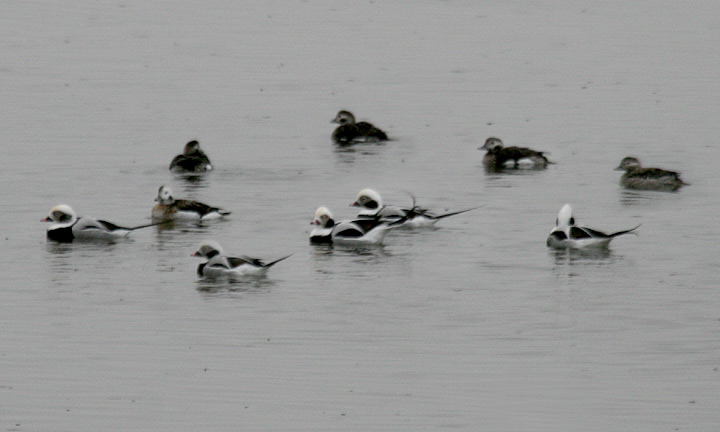
10 of 18 Long-tailed Ducks seen at
Antelope Island Causway in November 2007

Long-tailed Ducks are one of my favorite members of the waterfowl family.  This species can be quite varied in plumage, including blackish, brownish, reddish, and whitish individuals.  Most have some combination of those colors--but the prized sight for most birders is the adult male in alternate plumage from which the species received its name (the old name, "Oldsquaw" is perhaps one of the most  interesting names for a bird, and one that many were sad to see go).  Long-tailed Ducks are the most common of the sea faring species you will encounter in Utah.  More often than not it isn't just one or two birds gracing the causeway in November--but often time 5,6, 10, or a dozen birds.  On November 11, 2007 I saw an astonishing 18 along the causeway which seems to be the highest single day total for Utah (that November saw numbers in the teens all month).

Surf Scoter coming into land at Antelope Island Causeway

Surf Scoters come in as the second most common sea duck found in Utah.  Usually single birds or pairs are encountered, but flocks of up to 4 are reported from time to time.  By far the most common Scoter you may encounter in Utah.  All three scoters are fairly uncommon, but most years there are multiple reports from around the state.  These species can show up on any open body of water, but the causeway does seem to get the most reports--it in turn also gets the most coverage by birders.  Adult males  in alternate plumage of any of the 3 are extremely rare--meaning most are browns, grays and white of females and juveniles.

White-winged Scoter in flight at Antelope Island Causeway

White-winged Scoter are next in line.  Long bodies, white wing patches, and a striking bird in flight.  Easy to identify because of the patches they usually show up one at a time--although pairs are not out of the question.   Occasionally, mixed groups of scoters can be found allowing for direct comparison to the other species.

Black Scoter at Antelope Island Causeway

Black Scoter is the rarest of the scoters in Utah.  Almost always found by themselves, there are reports of multiple birds on the same day, but usually not together.  Usually very dark looking,with a unique shape, this species is easy to separate from the other members of the family.  Adult males in alternate plumage are stunning jet black with orange bills, and very rare in state.

White-winged Scoter, Surf Scoter, and Long Tailed Duck
at Antelope Island Causeway 

Over the next month as you visit lakes, reservoirs, and the Great Salt Lake be on the lookout for these wandering ducks.  If you aren't up for the causeway, there are a number of reservoir loops you can take in northern and southern Utah on a given day to maximize your chances for finding these birds, along with loons, grebes, and other waterbirds.  Often times 5 or 6 lakes in a day might turn up a few treats.  I created  a weekend reservoir map for Utah last year that has two pages.  The first is northern and Central Utah, while the second page is southern--you can take a look here if you need some ideas:

Utah Weekend Reservoir Map

This doesn't show all the lakes in Utah, but gives you a few ideas if you wanted to give it a try.

Labels: , ,

The Imperial Woodpecker

posted by Jeff Bilsky at
on Wednesday, October 26, 2011 


This is a fascinating glimpse at the now presumed extinct Imperial Woodpecker. Make sure you check out the video footage.

Link to Article

Labels: ,


UTAH BIRDERS FLICKR POOL


    SEE MORE AND SHARE ON FLICKR