Utah Birds, Utah Birding, and Utah Birders. Promoting the sharing of information, and the conservation of habitat for birds in Utah and elsewhere. We are a group of people who want to share what we know, and create a positive birding experience in Utah.

BIRDERS BLOG

a blog by and for Utah Birders

Birds are Beautiful

posted by Jerry Liguori at
on Sunday, August 21, 2011 

Most birds are beautiful, almost unreal in their plumage pattern. However, some are just downright ugly. Look at the beady eye, wrinkled head, and strangely-shaped bill of this Black Vulture...c'mon, the bird is hideous.

Any comments on the most beautiful or ugliest bird you can think of are welcome.

Labels:

Flocking up for Migration

posted by Tim Avery at
on Friday, August 19, 2011 


It's the middle of August and if you have been out birding lately, you may have noticed a number of species "flocking up" for fall migration. In particular some very easy to see and abundant species found along the Wasatch Front and the Great Salt Lake are gathering in somewhat staggering numbers. This ritual takes place each fall as the birds prepare, or are on their way south for the winter.


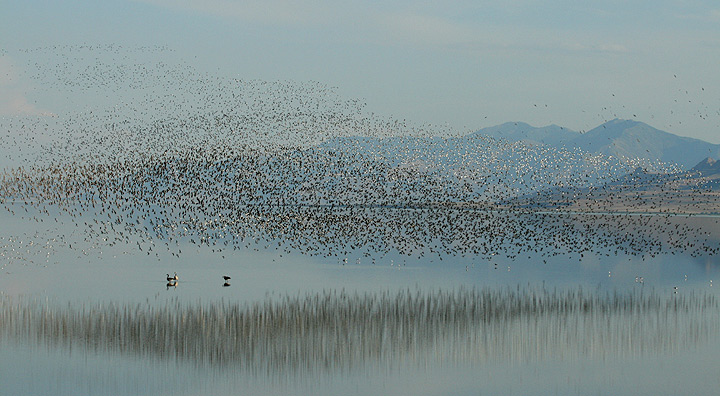
Wilson's Phalarope flocking up on the Great Salt Lake

Wilson's Phalarope can be found right now along the Antelope Island Causeway in what could be described as unimaginable numbers. So many birds, as far as the eye can see that it almost doesn't seem real. 500,000; maybe a million birds all within viewing distance of the road does seem unimaginable, but it's real, and happens each year.

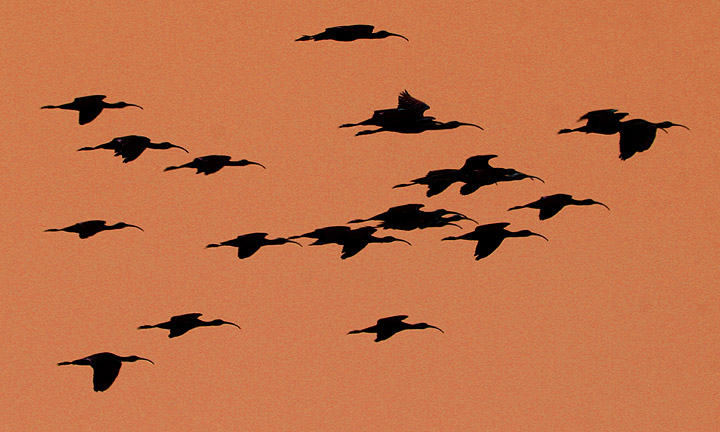
White-faced Ibis flocking up on the south shore of the Great Salt Lake

White-faced Ibis are typically found around the edges of fresh water marshes this time of year, anywhere with food will suffice. If you were to drop by the south end of Utah Lake you might see hundreds or thousands in flocks devouring everything in sight, getting ready to lift off and head south. Often this time of year, one can visit the Salt Lake International Center in the evening, and see flock after flock of ibis leaving the Great Salt Lake area and heading south out over the Salt Lake Valley. It's kind of a cool experience to watch.

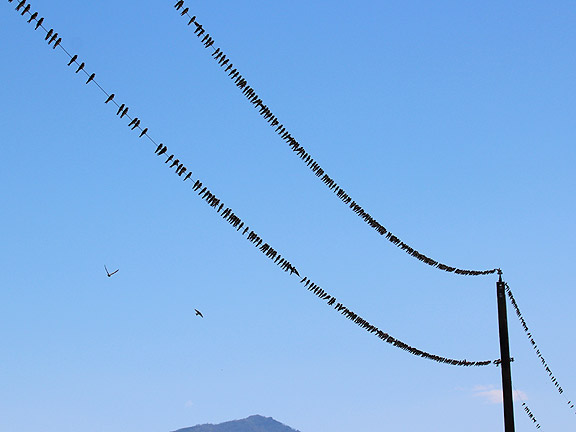
Bank Swallows flocking up in Utah County

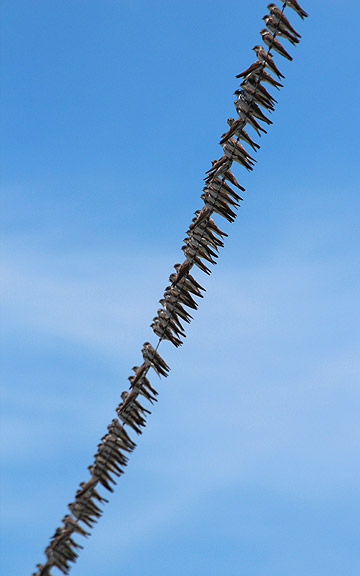
Bank Swallows are very particular about where they nest. During the breeding season, unless you visit a colony, this species can be hard to find in Utah. During migration they are far more common and often seen in flocks of 1,000's of birds. Along the Antelope Island Causeway and other roads with a high density of insects for the taking you may see fences, power lines, and road barriers covered in swallows as they rest between forays to feed. Just yesterday I saw close to a 1,000 on a random side road in Utah county where most of the year any swallow would be hard to find.

Bank Swallows flocking up in Utah County

So why do these birds flock up? There are a couple of theories that are widely believed to be true. For starters some believe that when in flight, the shape a flock makes may make be more aerodynamic than a single bird in flight, saving energy for individuals as the mass moves together. Another common belief is that safety comes in numbers. It is true that if you are alone on a journey you may be a far easier target, than 1 in a 1000 traveling together. Yet a third theory is that it may be easier for a larger group of birds to find food than an individual. With more mouths and eyes in search of food, it could make it easier to find the energy filled fuel these birds are in need of for their trips.

What are some of your favorite "flocking" experiences with birds?

Labels: , , ,

Birding the Atlantic Coast 1: Dismal Swamp and North Carolina's Outer Banks

posted by Ryan O'Donnell at
on Tuesday, August 9, 2011 


Last week I took a short trip with Craig Fosdick to do some pelagic birding off the coast of North Carolina. We arrived on Thursday night and were anxious to start the birding. After a quick stop to drop off some gear at the hotel, we headed straight to the Great Dismal Swamp, a famous birding location in southeastern Virginia. Although it was hot - 98F and very humid - some birds were still active. My first lifer of the trip was a singing Acadian Flycatcher, the first of several that day. Not much longer, we spotted a few of one of my most wanted species for the trip: Prothonotary Warbler. Other typically eastern birds were seen and heard, including a Wood Thrush, several Yellow-billed Cuckoos, several Carolina Wrens, and many Eastern Wood-Pewees. For the full list from eBird, click here. We went to bed early in preparation for more birding on Friday morning, along the 3 hour route to Hatteras, where our pelagic trips would start on Saturday morning.


The next morning, our first stop was at the Palmetto-Peartree Preserve. This private land is a preserve for the endangered Red-cockaded Woodpecker, our target species of the stop, and is also excellent habitat for Brown-headed Nuthatches. We got a little lost from a poorly-drawn map, but still managed to find both of these species near the Preserve, although at the time we thought we were in the preserve. I saw my lifer Prairie Warbler the day before at the Great Dismal Swamp, but got good looks at a few more here. One of the highlights of the trip for me was seeing my lifer Southern Leopard Frog here, a species that is closely related to the one on which I'm writing my dissertation. Here is a link to all the species we saw at this location.


We stopped at a few more Outer Banks birding locations on the way down to Hatteras, and I picked up my lifer White Ibis and Tricolored Heron at the Bodie Island Lighthouse Pond and then my lifer Piping Plover at Pea Island NWR. It was another early bedtime in preparation for the boat trip the next morning, the main point of our trip.


(To be continued . . . )

Labels: , ,

Roughies From Above

posted by Jerry Liguori at
on Monday, August 1, 2011 


The best way to tell dark-morph from light-morph Rough-legged Hawks from above is that dark birds have all-dark tails (with or without narrow, whitish bands), and light birds have a white base to the tail. Simply...only light birds have the white tail base on top. However, a few light-morph birds have very limited white to the topside of the tail. Note the tail pattern of the light-morph bird on the bottom left compared to typical light-morph tails (middle and right).

I added some dark-morph photos above the light birds per request of Robert. Note the dark topside to the tail on the middle (adult female) and right (juvenile), and the narrow but bold white tail bands on the adult male (left).

Here is a gorgeous photo of a dark juvenile (top) that was taken by my friend Vic Berardi....check out the paler smudgy bands on the top of the tail shown by some dark juvs, and the pale primary "panels" or "windows".

Labels: ,

The Best Time of Year

posted by Jeff Bilsky at
on Thursday, July 21, 2011 


Just in case you're wondering whether or not you should go for a hike in the mountains this weekend...

Labels:


UTAH BIRDERS FLICKR POOL


    SEE MORE AND SHARE ON FLICKR