Utah Birds, Utah Birding, and Utah Birders. Promoting the sharing of information, and the conservation of habitat for birds in Utah and elsewhere. We are a group of people who want to share what we know, and create a positive birding experience in Utah.

BIRDERS BLOG

a blog by and for Utah Birders

Gullstravaganza 2014 Recap

posted by Tim Avery at
on Sunday, January 12, 2014 

Two months ago we started looking at dates for this years Gullstravaganza.  Needless to say it was a busy winter and there were a limited number of dates open or that seemed like they would work best for our now annual outing--in it’s 4th official year.  We wanted to shoot for the latter half of February, after the carp-kill at Farmington Bay--it makes gulling easy and brings the birds in close.  But with other commitments and a lack of available dates we settled to have it in early January this year, not knowing how well we would do, we just hoped for the best.

A week before the trip 7 species of gull were reported at the usual Salt Lake County gulling hotspots--a good sign for us.  The bad part was only about a ⅓ as many people had signed up as the previous year--the early January date might have been a crowd killer.  But as the week went on the list grew and by 1:00am Saturday morning there were 36 names on the sign up--and we officially had “the crowd” we were hoping for.  And with such a group we decided to break out a special edition sticker for the trip as well as a new, 2014 Utah Birders Sticker!

The 1st Utah Birders Stickers of 2014

Early on the the 11th, I met up with fellow trip leaders Jeff Bilsky, and Kenny Frisch to do our usual day-of pre-scouting.  We changed the format of the trip in 2014 following the lead of Colorado and their “Gullapalooza” trip, which happens in the afternoon.  Gulls after all are pretty lethargic, and don’t tend to move around too much, especially when feeding--so afternoons would be ideal.  Plus asking folks to stomp around in the snow and ice in the middle of January on a cold morning for gulls often seemed a stretch in my mind--if its even a few degrees warmer and people can get their day going the afternoon might work out a little better.

In any event we started our day with a stop at Decker Lake where there were few gulls and nothing noteworthy--we found a dead 1st winter Thayer’s Gull on the shore, not the best signs for a trip that looks for birds like this.  At Decker Lake we were shocked to find less than 100 gulls, making us wonder, “where were the birds?”.  As expected Lee Kay Ponds was frozen solid, and the although there was a HERRING GULL guarding a dead carp on the ice, the only other gulls were about 1,000 birds out over the dump.  A pair of PEREGRINE FALCONS were hunting the starlings over the dump as well, providing quite a show.

We made one last stop at Saltair, where again there was an obvious lack of gulls and anything noteworthy.  A NORTHERN SHRIKE near the entrance to the park was a nice consolation, but we were gearing up for Gullstravaganza--and there were NO GULLS!
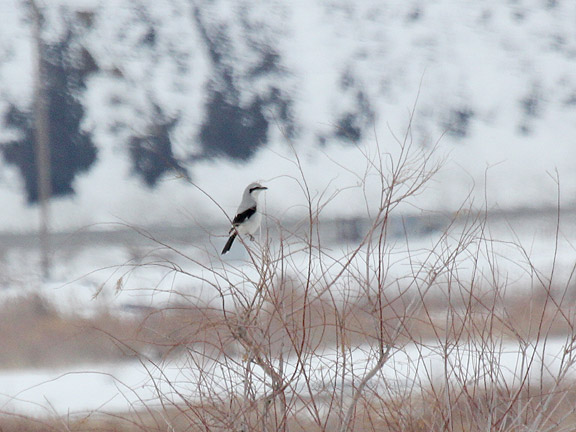
Northern Shrike at Saltair

We decided to drive to the International Center to see if there were birds there, but there weren’t--so we looped back to Decker Lake for one last pass.  Luckily some gulls had showed up here and a live THAYER’S GULL was present.  At Lake Park it looked like gulls were starting to filter into the main pond so things appeared on the up-and-up.  And Stephanie Greenwood was a big help, stopping by Farmington Bay to let us know that if all else failed there were a “few” gulls there, including some first year birds, which always make for a good time.

To the trip…

The group started rolling into the meeting location at Lake Park just before noon.  By 12:20pm we had 35 people and decided we had to move out so we headed to the main pond at Lake Park to see what gulls were there.  I guess the “pouring in” we saw a little earlier ended at about 200 birds, and by the time we got there, they were far out on the ice. We had to trek it to the west side of the pond and in the process lost 3 of our group to the cold and wind--I’ll be honest it was pretty miserable right off the bat.  Once in a great spot to scan from we quickly found a 1st winter THAYER’S GULL in the small flock.  Mike Hearell spotted a LESSER BLACK-BACKED GULL, and I picked out a 3rd winter WESTERN GULL, unfortunately the birds were sitting mostly and hard to pick out.  Every once in a while the birds would pick up and resettle further out, losing a few birds that flew off.  The Thayer’s flew right over, giving everyone a great look.

1st winter Thayer's Gull photo by Jonathan Wilkinson

Checklist for Lake Park
http://ebird.org/ebird/view/checklist?subID=S16338032

Aside from Gulls Jeff found 3 CACKLING GEESE here for an added bonus.  Back at the cars the three that left had their spots filled by 6 that showed up a few minutes late.  We packed back into the cars and headed towards Decker Lake where it looked like we might be spending most of our trip at this point.  Once there we scuttled everyone to the hill overlooking the east leg--on the north shore there was a guy with a pickup truck and the bed was full of loaves of bread.  He was feeding the ducks and gulls and the flurry of birds made for tough scanning.  That combined with a pair of PEREGRINE FALCONS that showed up and were putting on a show!
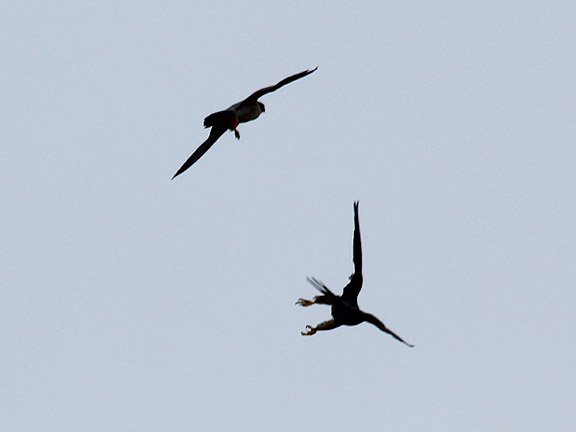
Pair of Peregrine's photo by Tim Avery

Peregrine Falcon photo by Jonathon Wilkinson

Eventually things calmed down a little and Kenny found an adult MEW GULL sitting relatively close to shore and we set up scopes for everyone in the group to see.  It was a lifer for a quite a few so that was exciting.  A couple times it flew and gave everyone great views in the air as well.
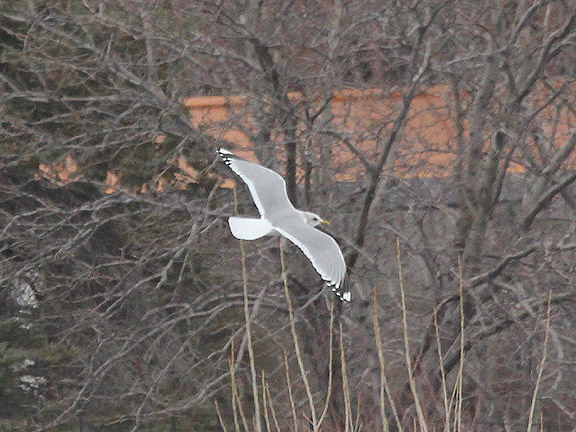

Mew Gull in flight taken by Tim Avery

Mew Gull taken by Jeff Cooper

After a while our group who added one more with Jeff Cooper had exhausted the gulls here--despite around 1,000 gulls, there just wasn’t much mixed in.

Utah Birders scanning for Gulls at Decker Lake

We decided to offer to go up to Farmington Bay for those who wanted, as that gave us our best chance for more gulls.  Some of the group split off here and headed home--while about 25 continued on to Farmington to see what we could find there.

Checklist for Decker Lake
http://ebird.org/ebird/view/checklist?subID=S16338059

At the 4-way parking area at the end of the road we could see gulls to the south and east--but the “heat waves” coming off the water were distorting everything pretty bad.  What we could see is an adult THAYER’S GULL pretty close in, and to the east what looked to be an adult WESTERN GULL and perhaps an adult LESSER BLACK-BACKED GULL--but maybe it was just the lighting…

We started hiking to the east and pretty soon it was apparent that the bird in the distance was an adult WESTERN GULL and it was super cooperative.
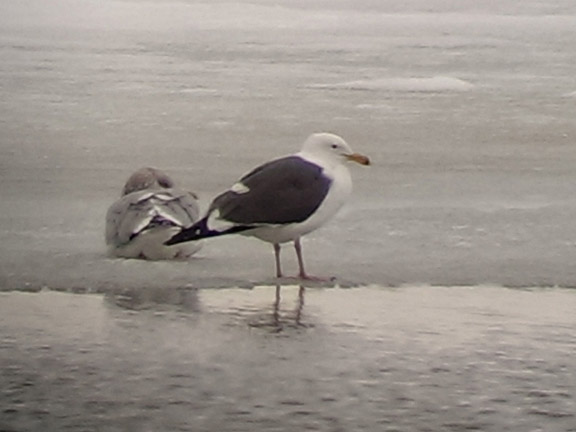
Western Gull digiscope at Farmington Bay

We also verified the LESSER BLACK-BACKED GULL, but it wasn’t quite as close in.
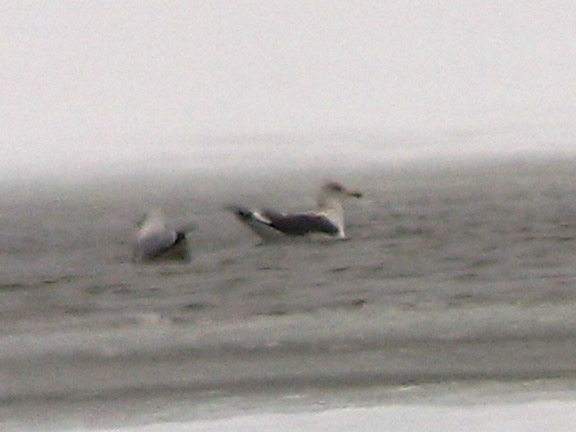
Lesser Black-backed Gull digiscope at Farmington Bay

Another adult THAYER’S GULL sat very close and allowed for great viewing as well.

Thayer's Gull taken by Jeff Cooper

Further east we could see there were hundreds of gulls on a canal/stream where there was some open water.  We had to hoof it a ways but eventually got within 300~ yards and could scan fairly easily.  Some in the group had spotted another LESSER BLACK-BACKED GULL in the water which I found after a minute of scanning.  AS I kept going, I spotted another, and then another, and then another!!! There were 4 adult LESSER BLACK-BACKED GULLS on the stream!  Incredible.  But we weren’t done yet--on the other side of the road where the stream flowed to the other side there were more gulls.  Kendall Watkins spotted our second adult MEW GULL of the day, lounging with a few HERRING GULLS.  And just a hundred or so feet from it was yet another Lesser Black-backed Gull--6 at Farmington Bay at once, and 7 on the day!

Utah Birders ending the day at Farmington Bay, photo by Janice Gardner

We spent a couple hours scanning birds until the cold started to get the most of us so we headed back in.  It was getting close to dark and the group had whittled to about a dozen of the craziest and die hard birders out there.  I applaud the entire group that came today--all 42 folks for putting up with the cold, the wind, and this big dude from Salt Lake who for some reason just can’t get enough of these gulls.

Farmington Bay photo by Brenton Reyner

Checklist for Farmington Bay
http://ebird.org/ebird/view/checklist?subID=S16338113

Just like that another Gullstravaganza is in the books.  This year beat our previous best of 36 birders by 6--something we still have a hard time contemplating, given its the middle of winter and we’re looking at gulls!  But it’s awesome and I thank those who came out to support this much underrated family of birds!  We had people from all over the state here this year.  The Allan’s joined us form Millard County while Kevin (I believe) from Torrey came a short 200 miles to take part in the trip.  There were birders from Cache, Weber, Box Elder, Summit, Davis, Salt Lake, and Utah Counties as well.  And there may have been other places represented as well.

In 2013 our 36 participants tallied just 4 species during the trip, and 4,500 individual gulls--and impressive number of birds, but depressing showing of species. After that trip, other birders added 2 more species at Farmington Bay where we didn’t go--so an unofficial 6 for the day of.
http://utahbirders.blogspot.com/2013/02/gullstravaganza-2013-recap.html

In 2012 weather put a damper on our trip, and only 11 people (of 27 expected) braved the miserable icy and rainy conditions, for 6 species of gull--the highlight being a Glaucous-winged and Lesser Black-backed.
http://utahbirders.blogspot.com/2012/01/gullstravaganza-2012-recap.html

In 2011 during our first official Gullstravaganza we ticked off 6 species of gull, when 24 birders joined us--the highlight was a 1st winter Iceland Gull which the entire group got to see.
http://utahbirders.blogspot.com/2011/01/call-is-gullstravaganza.html

Prior to when we called it Gullstravaganza, I led a trip in December 2009 where we had 7 species + 1 hybrid.  Before that we did 2 more gull trips, but I can’t find the lists for them or any reports.  What I can say is that since 2008 between 6 or 7 gulling trips in the winter we have tallied an impressive 10 species of gull in Utah.  The list would be stellar anywhere in the United States, but in landlocked Utah it’s even more impressive.  In all we also raised $150 in donations for Great Salt Lake Audubon.

For next years event we are going to revamp thinks a little more--as we do each year, and hopefully then we can finally have an 8 gull species event!

Here is a complete list of this years gulls:

2 Mew Gull
2 Western Gull
7 Lesser Black-backed Gull
6 Thayer’s Gull
28 Herring Gull
220 Ring-billed Gulls
1,450 Californa Gulls
1 Hybrid Western X Glaucous-winged Gull

Labels: , , , , , ,

Krider's is a Morph of Calurus?

posted by Jerry Liguori at
on Saturday, January 11, 2014 

Many birders and banders use the Pyle guide as a standard reference. While it is a great start for most species, there are some inaccuracies that birders and banders should be made aware of. I don't make a habit of pointing out errors in other's works, but I think it is helpful and appreciated. On page 445 of Pyle's guide it says: "Krider's Red-tailed Hawk…occur as vagrants to CA-AZ. These are medium to large in size…Krider's Red-tailed Hawk is here considered a white morph of borealis (Wheeler 2003), although, based on size it may also be a morph of calurus (Dickerman 1989), or of both subspecies." This sentence piques my curiosity. Before this quote, Pyle states the breeding range for Krider's pretty accurately as "south-central Alberta-eastern Manitoba to northern CO-northwest NB, winter to Texas." So how can Krider's be a morph of calurus, or, "a morph of both subspecies"? To clarify, in Wheeler 2003 it states that Krider's is a "pale morph" of borealis, and in the 1989 Dickerman paper, he does not associate Krider's with calurus. I'm also curious about what 'size' is being referred to here, and every Red-tail race is "medium to large" in size.

The issue with "Krider's occurring from California to Arizona" is that there are no substantiated Krider's records west of the Rocky Mountains. All of the reports in that area documented with a photo have turned out to be a light-morph Harlan's (the two subspecies can look very similar to each other). So, the Krider's referenced from CA-AZ is an extraordinary claim. Of course, Krider's could or has already occurred west of the Rockies, and I suspect it will be documented sooner or later for sure. Here are some Krider's and light-morph Harlan's below for future reference (check out the juvenile and its adult plumage a few years later -- follow-up instances like this are invaluable). And a downloadable PDF of a study of Krider's hawks. During this study, we did not see a single calurus from the grasslands of eastern MT to the MN state line south to SD, but did document many Krider's breeding with typical borealis and abieticola: http://www.aba.org/birding/v42n2p38.pdf

Just a side-note, the latin name is spelled "krideri" in Pyle's text, however, "kriderii" is the proper spelling, and describing Krider's as a "morph" is unusual since it has been proposed as a race in the past, may very well be today, and is typically treated as such in literature since it has a distinct breeding range, so defining it as a light-morph variant sounds better. To be fair, I know what it's like to have your ideas questioned. I stated about 7 or 8 years ago that I thought Harlan's Red-tail could be closely related to borealis for several reasons, and was dismissed by some. But recent DNA tests (Hull, et. al. 2010) show that Harlan's and borealis are closely related, and the two are found to freely interbreed. I can't fault anyone who makes mistakes researching the entire list of species and subspecies in North America, my point is to simply help rectify and decipher some issues.


 Adult Harlan's 

Adult Harlan's 

Adult Harlan's

Adult Harlan's

Juvenile Harlan's (left) Adult (right) - Same individual

Juvenile Krider's

  Adult Krider's

  Adult Krider's

  Adult Krider's

 Adult Krider's

Labels: ,

Ageing Adult Red-tails by Tail Bands?

posted by Jerry Liguori at
on Saturday, January 4, 2014 

Originally posted @ http://jerryliguori.blogspot.com

I've received several emails asking me whether Western Red-tailed Hawks in their first adult plumage have multiple tail bands, whereas older adults have unbanded tails. I asked where that notion came from? It turns out it's published in the 2008 Pyle guide. I wish it were that easy, but the truth is that tail patterns of adult Red-tails of every age vary from being completely banded to unbanded. Before we look at examples of this, let’s dissect the issue. First, I'm curious  how this was determined? What specimens or live birds were reviewed? There are millions of Red-tails out there, so a very large sample size from a broad geographic range is required to make such a statement. Is this proposed tail pattern true for dark and light-morph birds? How about males and females? Why were the other races/types of Red-tail that show tail bands not treated or commented on? Also, can we review the study birds to fact-check the identifications to race, or was that assumed? These type of questions should be posed for any study. The statement about tail bands just seems arbitrary and poorly researched. If there’s one thing I’ve learned, it's to question things you read or hear until fact-checked, as there are inaccuracies in literature that have been propagated over the years, even in texts written by the 'top experts.' It is impossible to reach the entire birding community to fix a mistake once it's published. Everyone makes mistakes, but I find it irresponsible when authors publish theories and assumptions as fact that results in misinformation ingested by the birding community and thereafter very difficult to purge. Have you ever discussed an ID with someone where you had facts to support your stance, but their stance was "so-and-so said so?" I hope the younger generation of birders gets on-board with taking the time to research things properly and publish only what is supported with real data and verifiable examples.

I think it's the responsibility of all birders to share information if it corrects an error. However, it's also requisite to be absolute before attempting to challenge literature. A friend sent me a few excerpts from the Red-tailed Hawk section of the Pyle Guide and I was horrified at the misinformation in there -- to see so numerous mistakes in one species account is alarming! If one of North America’s commonest birds is poorly treated, I cringe to think of the validity of the other species accounts.

Here's one I wasn't even aware was in the Pyle guide:
http://jerryliguori.blogspot.com/2013/07/wing-molt-in-raptors.html. 

I will address the inaccuracies in Red-tailed Hawk section in various blog posts since there is not enough room here to do it, as well as problems with other raptor species throughout Pyle's Guide so birders are aware of them. Hawk banders especially need to use caution since they are responsible for the data they submit to the BBL. If you smell a rat, "Unknown" for age/sex is proper and always acceptable.

Check out these Red-tails in their first adult plumage (labeled 2nd-year) that lack multiple tail bands, and various others at least one year older (labeled After-2nd-year) with obvious tail bands…and thanks for reading. By the way, if you want to age Red-tailed Hawks correctly, note either retained juvenile feathers (preferably flight feathers) for SY/TY, or 2 generations of adult feathers for ASY/ATY. Sometimes it is possible to age buteos as 3rd or 4th-year in fall, but that is difficult without extensive practice, and sometimes inaccurate in certain cases. Eye color can be helpful as a hint (and does match up well on the birds below), but NEVER takes the place of flight feather ages. And remember, NEVER age adult Red-tailed Hawks based on presence/absence of tail bands!

 2nd-year
  2nd-year
  2nd-year
  2nd-year
  2nd-year
  2nd-year
  2nd-year
  2nd-year
 2nd-year
 After-2nd-year
 After-2nd-year
 At least 8 years old (known nester)
 After-2nd-year
 After-3rd-year (aged after January 1st)
 At least 12 years old (known nester)
 At least 11 years old (known year-round resident)
 At least 6 years old (known nester)
 After-2nd-year
 After-2nd-year
 After-2nd-year
 After-2nd-year
 After-2nd-year
 After-2nd-year

Labels: ,

2013 Salt Lake County Big Year

posted by Unknown at
on Wednesday, January 1, 2014 

As the year 2013 began I tried to exercise some restraint in my birding radius. It is possible to spend a lot of travel time and gas money running all over the place looking for birds.  There are also work responsibilities that should not be procrastinated forever in the name of a bird that is far away, or will take to much time to track down.  I live in Sandy and I told myself I would try and just chase the county birds. I failed in that goal a few times. A good birds like a Snowy Owl can show up in Ogden and I can't help but to twitch my way up there to see it.

So as the year progressed I slowly developed the goal to do a County big year. It was a small goal compared to those who do big years for the state and see 300+ birds for the year, but it was a goal I thought was doable.  I never could have done it without the many very talented birders out there who were willing to post there good sighting in ebird  or on the google group Ubird.  A lot of the hard to find rare birds I chased down by following your leads, so thank you to everyone out there who likes to share. My number this year was not possible without the communal nature of Ubird and ebird so I can't express enough my appreciation to everyone out there, thank you for all your help.

In addition to the specific rarities I chased ebird indirectly gave me a lot of good birds. I had a list of hard to find birds for the county and I looked up the historical data on ebird. In this way I learn where to go for what birds and what the chances were of seeing these species. To say that I love ebird is an understatement. I spent years birding here and there with no connection to the other birders out there, so when I found Ubird and ebird it was a huge game changer for me, so forgive me for continually plugging them both. I have in turn tried to give back by posting sighting I think are of value on Ubird and also quickly posting my ebird checklists so others may benefit as I have.

It was difficult to decide which birds to include here as rare birds for the county. Many are obvious but some birds that some might not consider to be rare were hard for me to find and I may have only seen them once or twice, so a number of those I have included.

Here is a google map with the sightings, descriptions, and location of my rare Salt Lake County birds this year. There is also a link, in every bird mentioned, to the photographs and checklists of each species.  https://mapsengine.google.com/map/edit?mid=zLxdN-B6-fSA.k61JejvaHVbE

Thanks to an ebird report by Rachel LeBlanc I was able to chase this bird down the next day. The bird stuck around for a couple of weeks after it was first spotted.

Ross's Goose

I focused heavily this year on the gulls. Between Lee Kay ponds, Lake Park, and Saltair, a lot of rare gulls can show up in the county and I wanted to get as many of them on my year list as possible.

Rare gulls this year were:
  1. Heerman's Gull
  2. Mew Gull
  3. Western Gull
  4. Iceland Gull
  5. Glaucous-winged Gull
  6. Glaucous Gull
A beautiful adult Mew Gull was spotted by Stephanie Greenwood. I went looking the next day and it was enjoyed by many over a few days. This was the second of two Mew Gulls I saw this year in the county but this was the best look I have ever had of one.

Mew Gull


One of two I saw this year.


Glaucous-winged Gull

This Dunlin was found mixed in with some Dowitchers on a spring bird festival field trip. A group of 20+ were the only people that I know of to see this bird in the county this year.  This spot is closed to the public the other 364 days of the year so it was a good opportunity to bird a great area that you just can not get into.

Dunlin

One of the best places to bird in the county is in Farmington Bay. The Salt Lake County side is south west of the four way stop and accessible on foot part of the year. It is open for the hunters but is closed the rest of the time. I had some rare ones after a few long walk both in the early spring and fall including:
  1. Semipalmated Sandpiper
  2. Black Tern
  3. Common Tern
  4. Trumpeter Swan
  5. Eurasian Wigeon
Lee Kay ponds is a great place to bird and where I picked up a huge portion of my county birds.

  1. Long-tailed Duck
  2. Red-throated Loon
  3. White-throated Sparrow
  4. Common Tern
  5. Semipalmated Plover
  6. Ash-throated Flycatcher
  7. Harris's Sparrow
  8. Lapland Longspur
  9. Some of the Gulls previously mentioned
First reported and found by Bryant Olsen. Very rare bird. I saw it the next day and many times after that since it stuck around for a very long time. A lot of birders got to enjoy this bird.


Red-throated Loon

First of two I saw in the county this year. The second one I saw was seen three days later at the Salt Lake International center. This bird is not that rare in the state but it seems to be quite rare in the county.


Ash-throated Flycatcher

 Found by Rachel Leblanc, I ran out to see this bird the day it was found. I also went back the next morning to enjoy it some more. It stuck around for a week. This bird is usually only found briefly during fall migration up on some of the big reservoirs with Common Loons. We usually have one or two reported in the state annually so getting this bird at this spot and in the county was a major bonus.

Pacific Loon

Saltair can be hit or miss but if your timing is right you can get some rare birds out there. From the Marina to Lee Creek a bit further East I had a good handful of rare birds including:

  1. Iceland Gull
  2. Western Gull
  3. American-Golden Plover
  4. Sanderling (rare in Salt Lake)
  5. Black Tern
  6. Northern Mockingbird

Millcreek canyon lent a few rare birds last winter. Rare birds were:

  1. Pacific Wren
  2. Varied Thrush
  3. Northern Pygmy-Owl
After an ebird report my son and I went after this bird the next day. After a really long walk in the biter cold we got great satisfying views of this bird ready to start lunch with a recently caught mouse in its talons.

Northern Pygmy Owl

This was a good year to find redpolls and there were consistent sightings further north but sightings in the county were sporadic. I gave this bird more effort than any other this year.  I chased every SLC sighting of a common redpoll but they seemed to be at a feeder with a flock of goldfinches one minute and then gone the next. I searched feeders and potential area high and low. One of my spots was near a feeder only about 50 yards within the county line and it was there that I finally found one, and on my birthday! Great birthday bird!
I chased a pair of these woodpeckers after the Obrien's found and reported them. I spent a lot of time this year looking for these guys in there habitat. I thought I would go the year without seeing them despite my best efforts. I was happy when they were found and the best part is they hung out in this area (Tanner Park) through the end of the year.

Lewis's Woodpecker

Southern side of the valley:

 Pulling into my driveway on a crazy stormy spring day I happened upon a male and female Common Grackel in my driveway. What a shocker yard bird! I thought I was lucky with the weather blowing them in until later on June 23rd I saw a female flying out of my backyard. After that I tracked them and there nest down a few blocks from my house in a neighbors backyard. I invited anyone who was interested to come and see them. They remained in the area and reared there young until the middle of July when they left the area. I really hope they continue to nest hear year after year. These were the only Common Grackles seen in the county this year.

  Common Grackle

Little Cottonwood Canyon Black Swifts- Only spot in the county one can find this species. The best way to find them is at dusk as they fly into there waterfall homes high up in the cliffs. This is the most fascinating bird I have ever heard of and it is very difficult to see. Studying about this bird is fascinating and I highly recommend it.

On the Jordan River across from the ebay building is the best place in the county to find the beautiful and rare Blue Grosbeak. That being said I had no luck until the 8th time I went there looking. They nest somewhere in the area. After finally seeing them I saw them again in the same spot two weeks later and then again surprisingly further south at Jordan Narrows. Then late summer I had another sighting on the ISSR property. Even though I got lucky with a bunch of sightings this is still a rare county bird. I also had my only American Bittern of the year in the Marsh here.

Blue Grosbeak

There had been a few reports of Northern Waterthrushes throughout the state and I knew they were moving through the area. I spent sometime thinking of where in the county I could find the best habitat to look. Draper Wetland Park, to me, seemed the most likely location to start and I was not disappointed. There were a few other ebird reports of this species, one of which was at the Salt Lake International Center in the fall, but this was the only one I saw this year.

I first spotted a Grasshopper Sparrow in the dry grass hills south of Herriman in spring with my son. I went back a few days later and walked through more of there habitat over a couple of miles and I was able to count 7 singing and establishing territories throughout this area. They seem fairly common in this grass fields of the area but none were reported anywhere else in the county on ebird.

Grasshopper Sparrow

I missed a few birds this year but the big miss that, despite my best efforts, I never could find was a Barn Owl. I didn't think it would be a hard one to get and that might have been part of the reason I missed it. I spent a lot of time looking for it as the year was coming to an end with no luck. That will just have to be the one that got away.

There were other birds that may be considered rare that I have left off but narrowing this list down was difficult and if I did it again I might leave some birds off the list and others I might add. For this reason I think an entire list of all the birds I saw in the county this year in the order I saw them would be fun.

2013 Salt Lake County total: 256


1 Sharp-shinned Hawk 64 Belted Kingfisher 127 Sandhill Crane 190 Yellow Warbler
2 Mourning Dove 65 Peregrine Falcon 128 Western Grebe 191 Black-headed Grosbeak
3 Northern Flicker 66 Marsh Wren 129 Bushtit 192 Ruffed Grouse
4 American Kestrel 67 Evening Grosbeak 130 Burrowing Owl 193 Virginia's Warbler
5 Western Scrub-Jay 68 Clark's Nutcracker 131 Tree Swallow 194 Bullock's Oriole
6 Black-capped Chickadee 69 Mountain Chickadee 132 Lincoln's Sparrow 195 Spotted Sandpiper
7 European Starling 70 Red-breasted Nuthatch 133 Greater Yellowlegs 196 Common Tern
8 Cedar Waxwing 71 Long-eared Owl 134 Great-tailed Grackle 197 Black-throated Gray Warbler
9 Dark-eyed Junco 72 Eared Grebe 135 Caspian Tern 198 Brewer's Sparrow
10 House Finch 73 Downy Woodpecker 136 Red-breasted Merganser 199 House Wren
11 Lesser Goldfinch 74 Ruby-crowned Kinglet 137 Savannah Sparrow 200 Flammulated Owl
12 House Sparrow 75 Red-naped Sapsucker 138 Chukar 201 Black-chinned Hummingbird
13 Canada Goose 76 American Crow 139 Canyon Wren 202 Gray Flycatcher
14 Eurasian Collared-Dove 77 California Quail 140 Band-tailed Pigeon 203 Cordilleran Flycatcher
15 American Robin 78 Ring-necked Pheasant 141 Say's Phoebe 204 Plumbeous Vireo
16 American Goldfinch 79 Golden Eagle 142 Turkey Vulture 205 Swainson's Thrush
17 Rock Pigeon 80 American Avocet 143 Black-necked Stilt 206 Green-tailed Towhee
18 Black-billed Magpie 81 Northern Pygmy-Owl 144 Long-billed Dowitcher 207 Dusky Grouse
19 Spotted Towhee 82 Brown Creeper 145 Bonaparte's Gull 208 Willow Flycatcher
20 Song Sparrow 83 Bohemian Waxwing 146 Fox Sparrow 209 Warbling Vireo
21 Merlin 84 American Dipper 147 Cassin's Finch 210 Sage Thrasher
22 Steller's Jay 85 Varied Thrush 148 Franklin's Gull 211 Pinyon Jay
23 Townsend's Solitaire 86 Virginia Rail 149 Great Egret 212 Rock Wren
24 Gadwall 87 White-throated Sparrow 150 Long-tailed Duck 213 Black-bellied Plover
25 Mallard 88 Western Screech-Owl 151 Cliff Swallow 214 Dunlin
26 Northern Shoveler 89 Pine Siskin 152 Common Loon 215 Northern Mockingbird
27 Green-winged Teal 90 White-breasted Nuthatch 153 Osprey 216 Common Yellowthroat
28 Ring-necked Duck 91 Juniper Titmouse 154 Willet 217 Yellow-breasted Chat
29 Greater Scaup 92 Wilson's Phalarope 155 Long-billed Curlew 218 Common Poorwill
30 Lesser Scaup 93 Short-eared Owl 156 Snowy Egret 219 Common Grackle
31 Bufflehead 94 Prairie Falcon 157 Barn Swallow 220 Northern Waterthrush
32 Common Goldeneye 95 Loggerhead Shrike 158 Lesser Yellowlegs 221 MacGillivray's Warbler
33 Barrow's Goldeneye 96 American Tree Sparrow 159 Marbled Godwit 222 Western Wood-Pewee
34 Pied-billed Grebe 97 Western Gull 160 Swainson's Hawk 223 Wilson's Warbler
35 Bald Eagle 98 Pacific Wren 161 Red-necked Phalarope 224 Gray Catbird
36 American Coot 99 Tundra Swan 162 Northern Rough-winged Sw 225 Sora
37 Killdeer 100 Gray-crowned Rosy-Finch 163 White-faced Ibis 226 American Bittern
38 Ring-billed Gull 101 Northern Goshawk 164 Blue-winged Teal 227 Olive-sided Flycatcher
39 White-crowned Sparrow 102 Hairy Woodpecker 165 Vesper Sparrow 228 Hammond's Flycatcher
40 Northern Pintail 103 Ferruginous Hawk 166 Clark's Grebe 229 Eastern Kingbird
41 California Gull 104 Golden-crowned Kinglet 167 Forster's Tern 230 Grasshopper Sparrow
42 Herring Gull 105 Wild Turkey 168 Violet-green Swallow 231 Williamson's Sapsucker
43 Thayer's Gull 106 Mountain Bluebird 169 Snowy Plover 232 Common Nighthawk
44 American Wigeon 107 Yellow-headed Blackbird 170 Solitary Sandpiper 233 White-throated Swift
45 Canvasback 108 Mew Gull 171 Least Sandpiper 234 Black Swift
46 Redhead 109 Lesser Black-backed Gull 172 Western Sandpiper 235 Blue Grosbeak
47 Hooded Merganser 110 Black Rosy-Finch 173 Short-billed Dowitcher 236 Rufous Hummingbird
48 Great Blue Heron 111 Cinnamon Teal 174 Bank Swallow 237 Red Crossbill
49 Northern Shrike 112 Western Meadowlark 175 Red-throated Loon 238 Calliope Hummingbird
50 Common Raven 113 Great Horned Owl 176 Wilson's Snipe 239 Nashville Warbler
51 Horned Lark 114 Glaucous Gull 177 Lark Sparrow 240 Ash-throated Flycatcher
52 Red-winged Blackbird 115 Wood Duck 178 Western Tanager 241 Townsend's Warbler
53 Brewer's Blackbird 116 Hermit Thrush 179 Brown-headed Cowbird 242 Cassin's Vireo
54 Northern Harrier 117 Common Redpoll 180 Broad-tailed Hummingbird 243 Sanderling
55 Red-tailed Hawk 118 Ross's Goose 181 Blue-gray Gnatcatcher 244 Pectoral Sandpiper
56 Rough-legged Hawk 119 Northern Saw-whet Owl 182 Western Kingbird 245 Black Tern
57 American Pipit 120 American Three-toed W-pkr 183 Lazuli Bunting 246 Semipalmated Sandpiper
58 Ruddy Duck 121 Neotropic Cormorant 184 Chipping Sparrow 247 Clay-colored Sparrow
59 Horned Grebe 122 Double-crested Cormorant 185 Orange-crowned Warbler 248 American Golden-Plover
60 Yellow-rumped Warbler 123 Eurasian Wigeon 186 Pine Grosbeak 249 Lewis's Woodpecker
61 Cackling Goose 124 American White Pelican 187 Dusky Flycatcher 250 Snow Goose
62 Common Merganser 125 Black-crowned Night-Heron 188 Semipalmated Plover 251 Pacific Loon
63 Cooper's Hawk 126 Trumpeter Swan 189 Baird's Sandpiper 252 Heermann's Gull
253 Glaucous-winged Gull
254 Iceland Gull
255 Lapland Longspur
256 Harris's Sparrow

Here is a google map with the sightings, descriptions, and location of my rare Salt Lake County birds this year. There is also a link, in every bird mentioned, to the photographs and checklists of each species. https://mapsengine.google.com/map/edit?mid=zLxdN-B6-fSA.k61JejvaHVbE

Labels: , , , ,


UTAH BIRDERS FLICKR POOL


    SEE MORE AND SHARE ON FLICKR