Utah Birds, Utah Birding, and Utah Birders. Promoting the sharing of information, and the conservation of habitat for birds in Utah and elsewhere. We are a group of people who want to share what we know, and create a positive birding experience in Utah.

BIRDERS BLOG

a blog by and for Utah Birders

2015 Marathon Birding Recap

posted by Tim Avery at
on Tuesday, May 19, 2015 

As I left my house at 5:00am it was in a down pour... Things were not looking good.  As I picked up my cohort Jeff in downtown Salt Lake, it was a torrential down pour... things could only get better.  The drive into Davis County was wet wet wet.  And as we got breakfast it seemed to get even wetter. Finally arriving at the Legacy Events Center to meet out group the rain was still coming down; but it seemed to have lightened a little--and to the west there was a shimmer of hope that the clouds would part and the weather might turn for the better. We kept our expectations reasonable--the rain could definitely damper our efforts--it was probably snowing above 8,000' so our mountain birding could definitely be rough.  This was going to be a wet and wild Marathon Birding Trip.

Everyone that ended up going on the trip was on time and in the vehicles; but 2 participants didn't show up, and we wasted 15 minutes waiting and trying to get a hold of them--in the end we left late, and without the 2 no-shows.  In the parking lot the first birds of the day were a flyover flock of WHITE-FACED IBIS; and singing AMERICAN ROBIN, HOUSE FINCH, and RED-WINGED BLACKBIRD. We wasted no time making our way to Glover Lane, where birds were singing as if it were sunny and warm. COMMON YELLOWTHROAT and YELLOW WARBLER were heard quickly. Sitting in the middle of a wet field was an easy to watch BLACK-CROWNED NIGHT-HERON, while the ponds at the end of the lane provided the usual share of waterfowl and waterbirds--we were underway and I personally didn't mind the rain since the birding was off to a good start.

At Farmington Bay the gates were locked as usual and it took a few minutes to get in.  We were greeted by a GREAT EGRET in the pond to the east, as well as COMMON GOLDENEYE, and 100's of VIOLET-GREEN SWALLOWS.  Behind the restrooms 2 WOOD DUCKS were nice to get out of the way.  We snagged both SORA and VIRGINIA RAIL calling from the reeds, and CASPIAN and FORSTER's TERNS overhead. At Egg Island Overlook a very wet SWAINSON'S HAWK posed  for the group int he small trees. Scoping form here we picked out a small group of 7 RED KNOTS to the southwest--a fortuitous find as we would have none at the causeway later.  We quickly nabbed our waterfowl needs and got a bonus PEREGRINE FALCON before turning around and heading out.  Along the way we added LONG-BILLED DOWITCHER, WILSON'S PHALAROPE, and SANDHILL CRANE. We were glad to get both NORTHERN SHOVELER and AMERICAN WIGEON which have been surprisingly difficult in the past. As we left a singing LINCOLN'S SPARROW at the restrooms was a bonus that eventually gave everyone great looks--and for the first year in many we struck out on Blue-winged Teal.
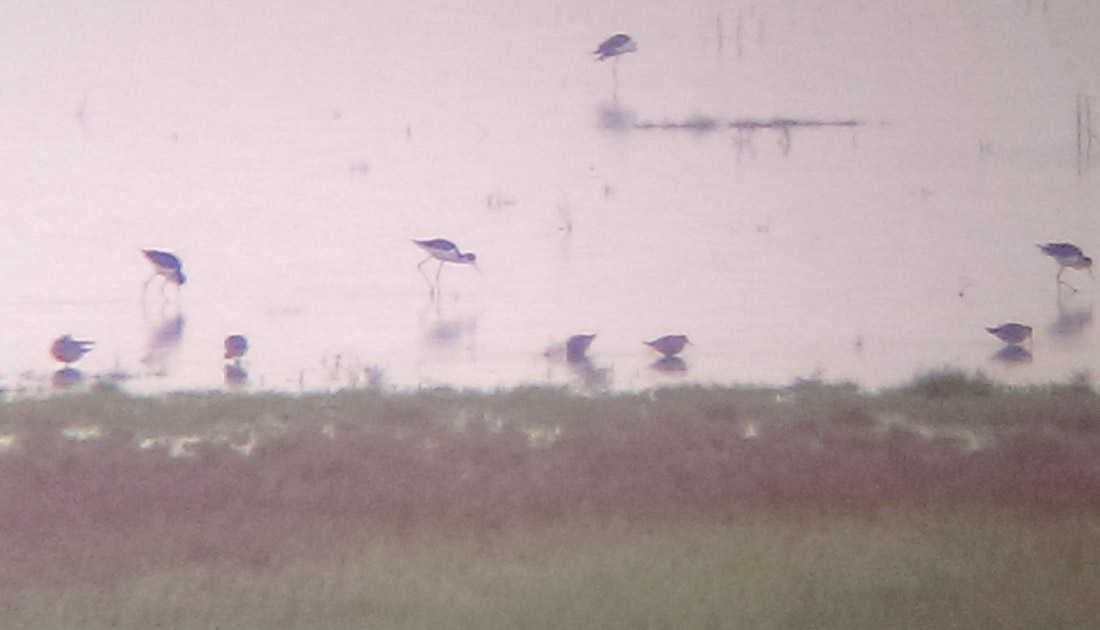
Red Knots at Farmington Bay

Heading towards the freeway we snagged CALIFORNIA QUAIL, which is never a sure thing so was technically a bonus bird for the day.  Like every year adjusting our route, this year we threw in a loop the opposite direction of our trip--heading to Bountiful Pond, we hoped to maximize our migrant lists by hitting 2 migrant traps instead of just.  It was rewarding as we were able to also add CATTLE EGRETS along Legacy Parkway--where 1,000's of WHITE-FACED IBIS filled every field. The group only had to scan one flock to get lucky enough to pick out a GLOSSY IBIS for the day.

Glossy Ibis photo by Rachel LeBlanc

At Bountiful Pond we waded in ankle deep water through the flooded orchard hoping for migrants. There wasn't as much as expected but we did star to pick things out slowly. YELLOW-RUMPED WARBLER, BULLOCK'S ORIOLE, WILSON's, & MACGILLIVRAY'S WARBLERS were found. Several GREEN-TAILED TOWHEES were seen along the path around the west side of the pond. A BARN OWL flushed from the trees, while overhead swallows twittered about.  On the water we snagged COMMON MERGANSER and CLARK'S GREBE.  Feeling we'd exhausted the trees we left 15 minutes behind schedule for the day--but on time given we left 15 minutes late at the onset.
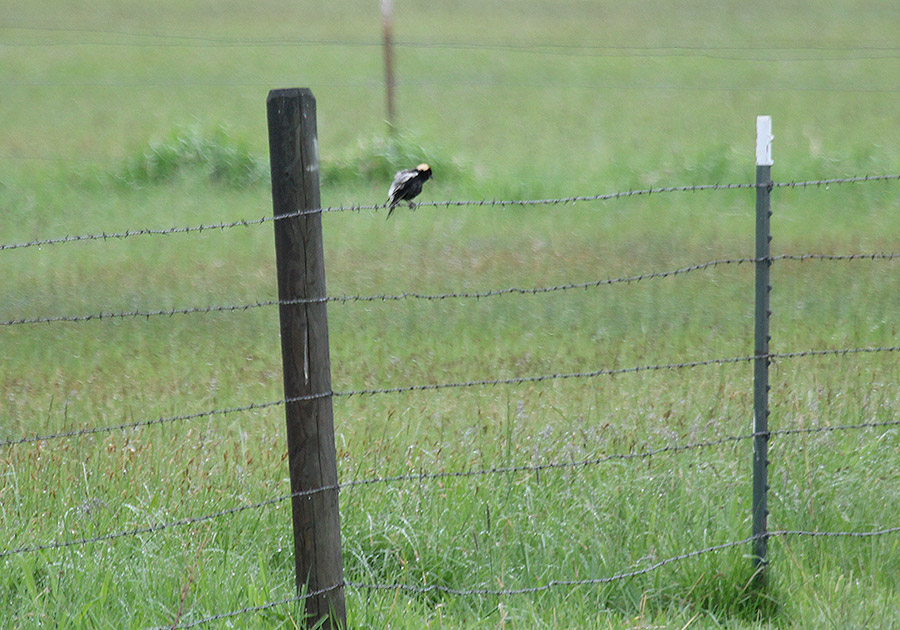
Bobolink at Shick Lane

The drive to Kaysville went quick, and we netted 2 BOBOLINK and WILSON'S SNIPE at Schick Lane, before adding GREAT-TAILED GRACKLE at Jensen Nature Park. And just like that the rain subsided--the clouds parted and the sun graced us with its presence. The rest of the morning would be spent at Antelope Island, birding in ideal conditions.  On the causeway we quickly pinned down 2 AMERICAN GOLDEN-PLOVER, 4 WHIMBREL and a SNOWY PLOVER amongst the 1,000's of BLACK-BELLIED PLOVER and SANDERLINGS. 10's of 1,000's of RED-NECKED PHALAROPE dotted the water. We couldn't find any turnstones or dunlins; and not a peep in the whole bunch. But a 3rd cycle LESSER BLACK-BACKED GULL was a bonus--as was an AMERICAN PIPIT along the beach. We plowed through our needs and headed to the end of the causeway where 2 PURPLE MARTIN were drifting over the last bridge.  At the marina we had 5 more including several gorgeous males that flew past at eye level.
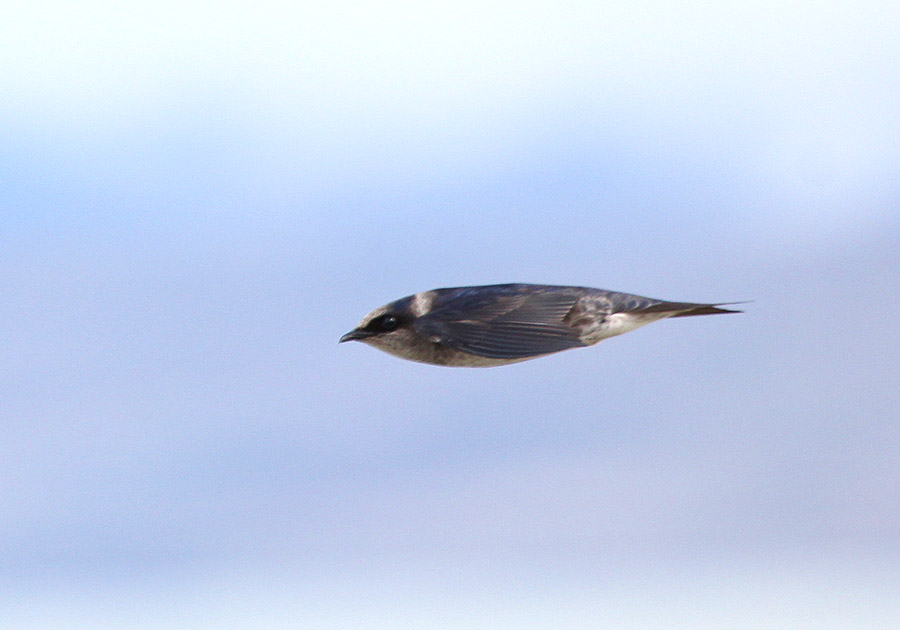
Female Purple Martin at AIC

Tim's Car photo by Rachel LeBlanc
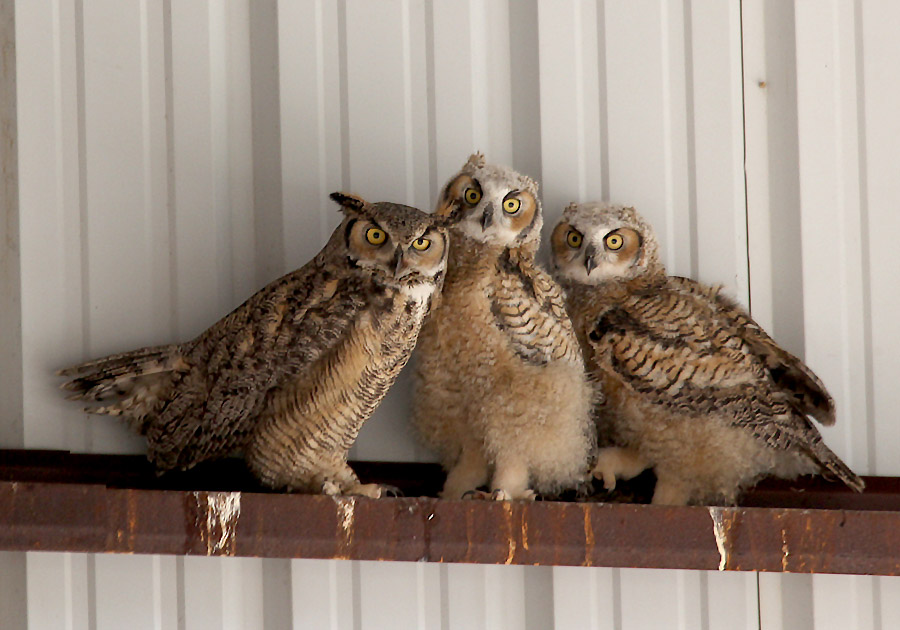
On the island CHUKAR, ROCK WREN, and LOGGERHEAD SHRIKE came quickly. At Lady Finger Point we flushed a CANYON WREN from the rocks, and a singing NORTHERN MOCKINGBIRD were nice additions. Another flyby PURPLE MARTIN made 8 for the day. Along the loop road we added SAGE THRASHER, GRAY FLYCATCHER, and a surprise BLACK-THROATED SPARROW. That was followed by BURROWING OWL and BLUE-GRAY GNATCATCHER as well as the usual LARK and BREWER'S SPARROW. And yet another flyby PURPLE MARTIN made 9 for the day.  We finished up the north arm of the island with HORNED LARK and SAY'S PHOEBE, as well as the usual GREAT HORNED and BARN OWLS at the corrals.

Great Horned Owls at Antelope Island

The drive to Garr Ranch was punctuated with a quick stop for GRASSHOPPER SPARROW which was perched up and singing on arrival. At Garr Ranch we ran into a fallout--kicked off with PURPLE MARTIN number 10 for the day. WILSON'S WARBLERS were dripping form the understory.
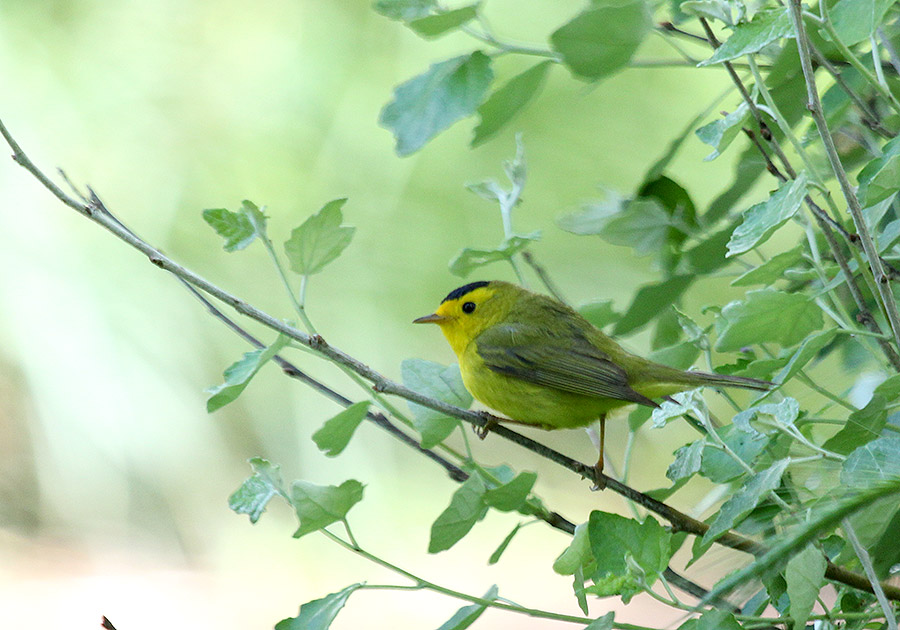
Wilson's Warbler at Garr Ranch
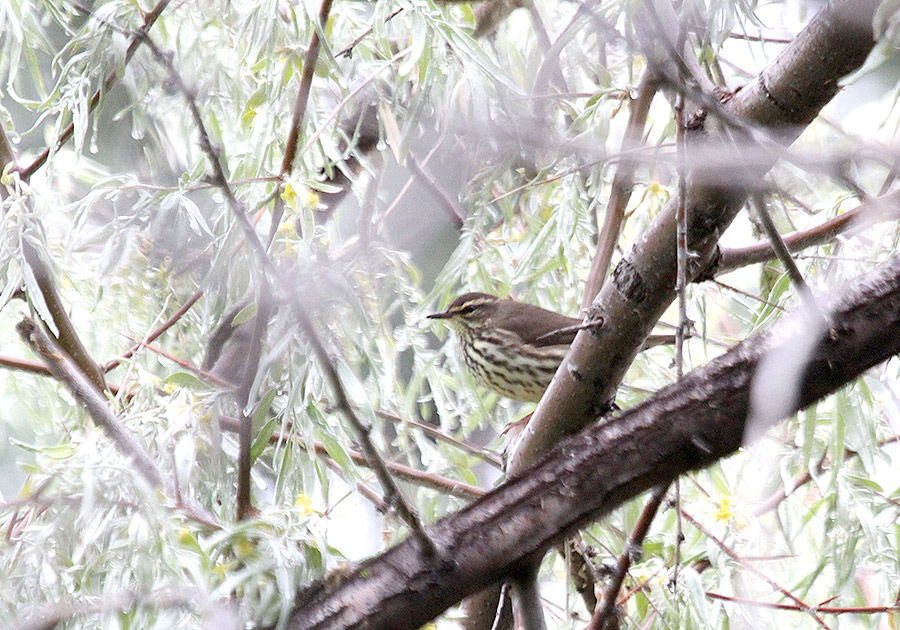
Various other warblers flitted about, and we were fortunate to find the NORTHERN WATERTHRUSH along the fence line at the east end of the spring. Our only RED-BREASTED NUTHATCH of the day would be here--PINE SISKIN, WESTERN TANAGER, LAZULI BUNTING and WARBLING VIREO were also nice additions. We did a clean sweep of the Utah empids with all 5 regularly occurring species found around the ranch grounds. After making the rounds we opted to head out knowing we'd done very well at the ranch and were already past 130 species for the day. The drive out netted our NORTHERN HARRIER for the day, and in Layton we saw plenty of AMERICAN CROWS.

Northern Waterthrush at Garr Ranch

On our way to get lunch in Ogden we added a pair of WESTERN SCRUB-JAY which is usually a miss for us--and after a short lunch stop we headed to Birdsong Trail at the mouth of Ogden Canyon.  Here with a little coaxing we picked up YELLOW-BREASTED CHAT and FOX SPARROW for the day as well as BLACK-HEADED GROSBEAK and BLACK-CHINNED HUMMINGBIRD. Overhead our first TURKEY VULTURES were a pleasant sight. Heading into the canyon, Mike suggested stopping at "The Oaks" to see if we could get a catbird and Calliope Hummingbird at their feeders. We had no such luck with those birds, but as we were getting ready to leave a small buteo emerged form the trees across the road and circled.  Everyone looked and someone quickly yelled out Swainson's Hawk! But that wasn't right, the dark bird was very "broad-winged", and the pattern was just off.  I fumbled to grab my camera as I stuttered that I thought it looked like a BROAD-WINGED HAWK.  All eyes were back on the bird as it circled overhead.  After getting my camera and finally focusing the bird made its way up up up eventually being dive bombed by a SHARP-SHINNED HAWK, as they both circled amongst the WHITE-THROATED SWIFTS overhead. A quick check of the field guide and it sunk in that we really did have a dark-morph Broad-winged Hawk.  To gloat just a little (and for comfort confirmation) I sent the picture to Jerry Liguori with no text--his response was to excitedly ask WHERE??? This was definitely the bird of the day for me.
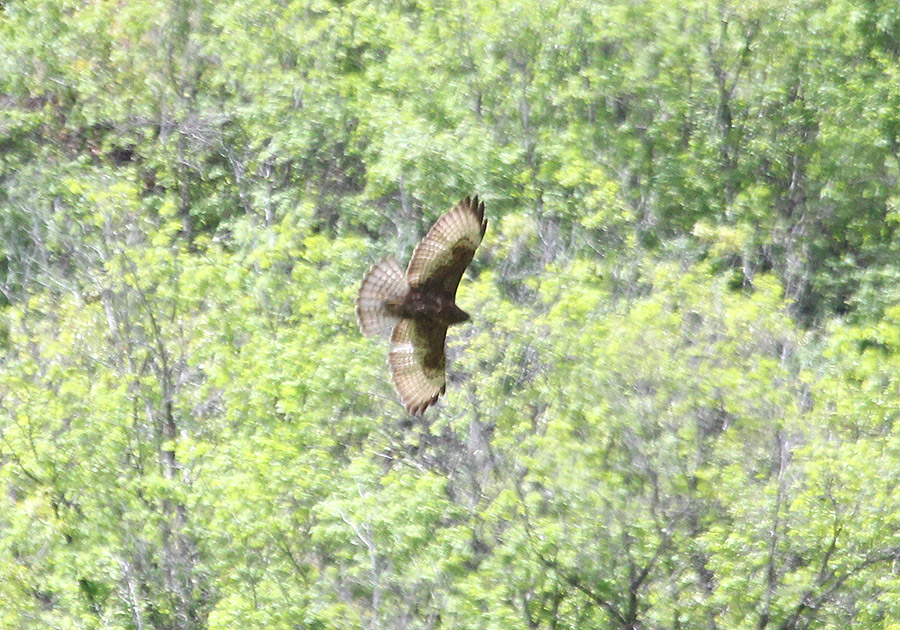
Dark morph Broad-winged Hawk in Ogden Canyon

Getting our wits about us we continued. At Pineview we added a BLACK-THROATED GRAY WARBLER before hitting Jefferson Hunt Campground. Here CEDAR WAXWING were added and finally OSPREY as we headed eastward towards Monte Cristo.  This was the first year SR-39 had been open so we took advantage of a new route through the mountains. As I tallied the birds from the day we sat at 149.  The car started guessing what 150 would be.  Mike was confident that it would Mountain Bluebird, while a few of us ventured that Northern Flicker would be next.  The radio from Jeff's car crackled, "NORTHERN FLICKER". We cheered and eventually saw one ourselves. The next bird to follow--MOUNTAIN BLUEBIRD.
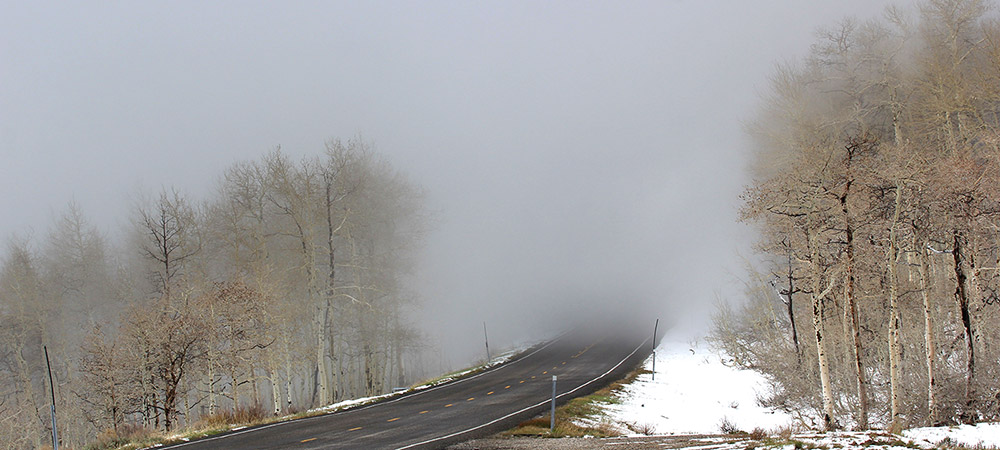
The road to Monte Cristo

Making our was up the mountains we eventually hit gray skies, then thicker clouds. We picked up DARK-EYED JUNCO, followed by DOWNY WOODPECKER and RED-NAPED SAPSUCKER in the same tree!  Then we hit the clouds--literally, we drove into the fog and were greeted with snow and hail as we continued on.  This could make things difficult. We had a small but reliable list of birds we needed to get up here--and with this weather it would be difficult. As we parked across from the entrance to Monte Cristo Campground the fog lifted enough to see around us--but all was quiet.  I reluctantly ditched my flip-flops for hikers as it was even cold for my taste.  We did pick up a calling MOUNTAIN CHICKADEE, but not much else.  I heard what sounded like a chortling Pine Grosbeak; and a couple times it sounded like American Three-toed Woodpeckers called.  But we couldn't pin anything down.  Eventually a few people did hear CLARK'S NUTCRACKER (and we'd all see one 10 minutes later as we drove off the mountain); but the birding left a lot to be desired.

Jeff's Car 12 hours in to the day

Back in the cars we descended to the east and out of the clouds. We added CASSIN'S FINCH on the way down, but no other montane species.  Monte Cristo was a bust and cost us a few species.  Had the weather been different it probably would have been a great addition to the trip. We stopped in Woodruff briefly to look for Common Grackle to no avail.  Driving along SR-16 south towards the Wyoming border through Deseret Ranch we picked up CANVASBACK for the day. We decided to cross the border and check out Woodruff Narrows Reservoir. VESPER SPARROW was picked up along the road in and at the lake we had RING-NECKED DUCK. Our other targets in the sage and on the water were missed, and we slowly made our way back towards Utah, stopping briefly in Evanston to pick up food for our last few hours on the move. Back in Utah we checked an old Ferruginous Hawk nest but there were none present.  All in all our big loop to the east had been a waste.  A few years ago we changed the route to leave the long drive up Logan Canyon, and down through Wyoming out.  It was too much driving--too little birding--and in the end we could get more species spending more time int eh field closer to home. I think that holds true with this years experiment; its hard to say how much different things would have been on a sunny day; but on this day it was a miss.
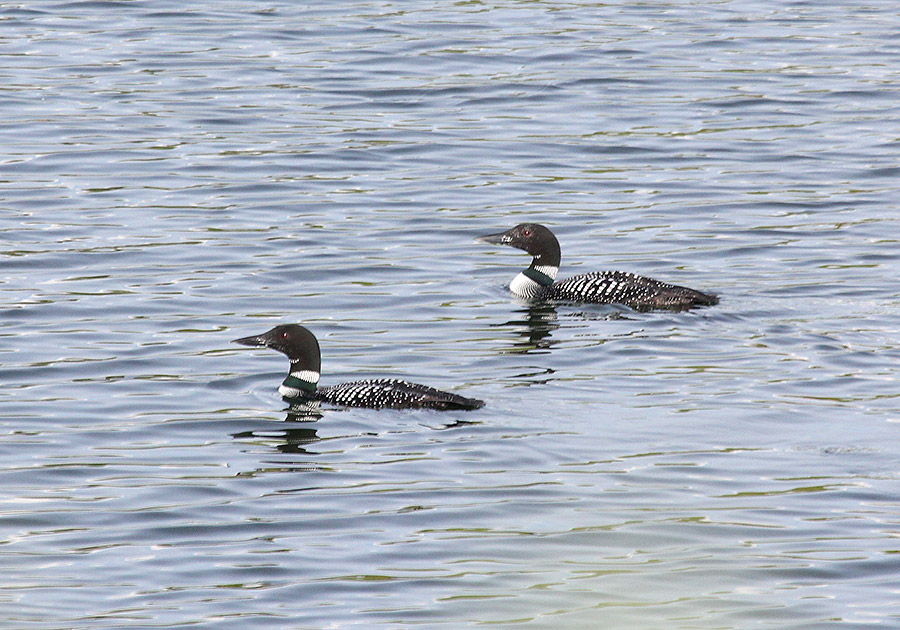
Common Loon at Echo Reservoir

Down Echo Canyon we decided to stop at Echo Reservoir. Here we picked up COMMON LOON and PLUMBEOUS VIREO for the day, before making our way towards Henefer adding both GOLDEN and BALD EAGLES along I-84. We were getting short on daylight and I knew we could add at least one more songbird for the day with AMERICAN DIPPER at Jeremy Ranch Road.  That was it though--we exhausted our last spot for Gray Catbird for the day without seeing one--and Swainson's Thrush really aren't back yet so that was another miss. Looking at our list we sat comfortably at 165 species for the day--we would have no problem at least tying our previous best.

Heading up East Canyon to look for nocturnal birds several in the group had a BLACK-CAPPED CHICKADEE for the day. I was a little worried when Ruffed Grouse wasn't on its usually booming log--it took a short hike but eventually we flushed a RUFFED GROUSE from some high grass making it 167 for the day, what we ended with last year.  A few minutes later we called in a FLAMMULATED OWL for 168 and a new Marathon Birding record.  Try as we might we couldn't get another Flammy to come in nearby; and no poorwills were heard calling.  We might end up stalling with +1.  At our next stop there were flammy's calling but we tried for other owls which we needed for the day.  I heard a couple of screeches from the woods after doing a NORTHERN SAW-WHET OWL whistle for a bit--and it was a couple minutes later when one finally whistled back making it 169.
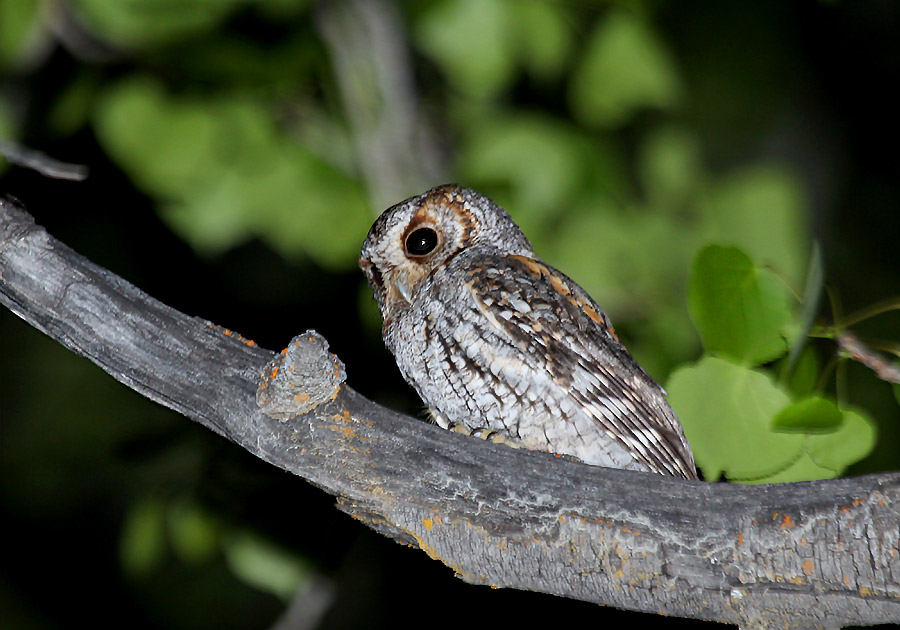
Flammulated Owl from East Canyon

At Big Mountain Pass it took a little coaxing to get a COMMON POORWILL to respond making it 170 species on the day--and we still had time to burn.  But given the long day, and great numbers we opted not to stop and try for screech-owl and instead head back to Farmington.  We forgot to check the odometer, but the trip should have covered 305 miles or there abouts for the day. We got back right at 11:00pm for 16 hours and 45 minutes of Marathon Birding through 7 counties (+1 in Wyoming). I was honestly shocked what we were able to see given the weather--it actually helped keep a lot of birds down probably which made picking up migrants easier than in the past.

It always amazes me how this trip transforms every year.  After 10 years looking back its crazy to think that in the past we struggled to get 130 species on this trip. Each of the last 3 years we have topped 160 and as we keep refining 175 or 180 doesn't seem that far off.  We never know how the trip will go, or what we really will see ad the unpredictability of migration, due to the rising and falling water levels of the GSL, the hit or miss nature of passerine migration in mid-May, and what routes will be open to drive. Every year we talk about adjusting the route a little bit and making subtle changes to get the most out of the day. So we'll have to wait and see what next year brings.  As always thanks to Jeff for co-leading this trip; and Mike and Taylor for driving--the 2 extra sets of eyes has really mad ea difference.  And especially thanks to the 6 hardy birders who showed up despite the horrendous conditions--it paid off!

Labels: , , , , , , , , , ,

2014 Park City Christmas Bird Count

posted by Unknown at
on Tuesday, December 16, 2014 

Courtesy of Dale Provost

We had a great count this year as birders bundled up on the coldest day in two weeks to assist in Park City’s 4th CBC. With a little snow on the ground and cold winds, birders were joined by a small high school group from the Oakley School and recorded a Park City CBC record, 65 species. The warm weather over the past weeks has left most bodies of water unfrozen; so many waterfowl and gull species were viewed.

This year’s highlights included Wood Ducks, a Prairie Falcon, Golden-crowned Kinglets, Ruffed Grouse, American Tree Sparrows, a lone Killdeer, and great views of Bald and Golden Eagles.

Special thanks goes to all our drivers and anyone who allowed us to view their feeders and backyard birds.

Nate Brown

Labels: , ,

2013 Park City CBC Recap

posted by Tim Avery at
on Thursday, December 26, 2013 

Saturday, December 21st, the Utah Birders held our 3rd Annual Park City CBC.  This year 9 birders took part during the blustery winter day in Park City and unofficially tallied 52 species.  The day started with the group meeting first thing at Kneader’s in Newpark for a little breakfast, before we split into groups and headed out to scour the 8 sections of the count.  Four teams comprised of 2’s or 3’s headed out to the 4 main quadrants--City, Mountain, Canyon, and Lake to get the day started.

The Lakes

Kenny Frisch and I took the lakes portion of the count, which is mostly spent scanning the hopefully open water of the 2 reservoirs that lie in the count circle.  We started the day off taking I-80 east to Wanship to check the Weber River below Rockport Reservoir.  In Wanship a TOWNSEND’S SOLITAIRE was perched in the tallest pine in town.  At the river were numerous AMERICAN ROBINS and a few MALLARDS, but no other waterbirds.  3 MUSKRAT were sitting out in the open, while a BALD EAGLE flyby provided excellent looks.

Bald Eagles were prevalent this year on the count

From Wanship we headed towards Rockport where we had a NORTHERN SHRIKE just below the dam.  The reservoir was frozen solid so no waterbirds.  At the inlet we picked up an AMERICAN DIPPER, and a small flock of CANADA GEESE were the only for the count.  Above the reservoir we saw several BALD EAGLES along the river.

American Dipper at Rockport

Next we headed over to Jordanelle to scan the north arm--if it were open.  Luckily it was and there were a number of waterbirds present.  Plenty of COMMON GOLDENEYE and COMMON MERGANSER.  Several GADWALL, LESSER SCAUP, and BUFFLEHEAD along with the usual Mallards rounded out our waterfowl effort.  We scored three species of Grebe with 5 WESTERN, a PIED-BILLED, and the best bird of the day, 2 very late HORNED GREBES.

Terrible record shot of 2 Horned Grebe at Jordanelle

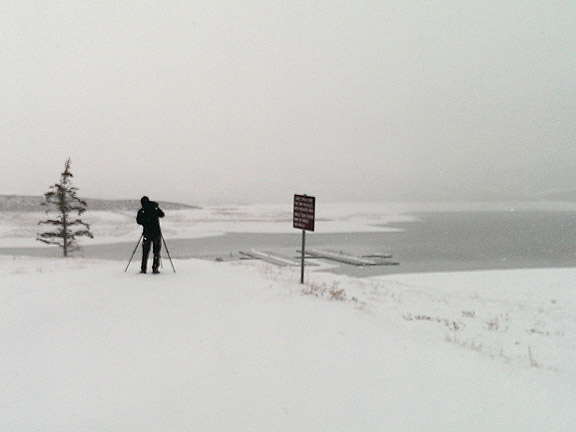
The fog and snow made it difficult to san everything very well, but we figured we covered most of what was expected.  We were done with the lake pretty early, so headed over to Deer Valley Resort to check the ponds where a pair of BARROW’S GOLDENEYE were present with a Common Goldeneye and pair of Ring-necked Ducks.  We decided to run through South Snyderville Basin to check the warm springs, adding GREEN-WINGED TEAL to the count for the day. With some time left we made a quick drive north to The Preserve, but didn’t add any birds--just a couple of bull ELK.

Rocky Mountain Elk at the Preserve

The City

Alex Peterson recaps the city portion of the count:

We left the morning rendezvous point and headed east along the I-80 frontage road (Highland Dr) and the Swaner Preserve watching the posts for raptors.  Right before we reached the Old Ranch Road turn, we were rewarded with an AMERICAN KESTREL swooping down on a vole and then enjoying its earned breakfast on a post right next to the road.  An amazing start to our Park City CBC--which we only captured with memories.  We then headed along Old Ranch Road, turning into the Trailside Drive neighborhood to observe some feeders.  Many feeders were empty or frozen over; but we found three terrific feeders that were a hot bed of activity.  Besides the innumerable doves and starlings, we were rewarded with both MOUNTAIN and BLACK-CAPPED CHICKADEES.  We also counted some Mallards in the neighborhood ponds.  Despite the usual odd looks from the locals, we braved onward especially after one gentleman rewarded us with a vigorous #1 sign with his middle finger.  With that encouragement, we then headed past Trailside Park and over into the Silver Summit area neighborhoods.  Again, many empty feeders, but those that had seed not only rewarded the birds, but also us with plenty of activity.

Heading back to Old Ranch Road we crept slowly along counting the water birds (mostly Mallards, but also American Coot, RING-NECKED DUCK, and the only AMERICAN WIGEON of the count.  We also found a number of raptors including RED-TAILED and ROUGH-LEGGED HAWKS on posts in the preserve.  Following Old Ranch Road to the end (and counting the chickadees on the way), we entered into the neighborhoods of Southwest Snyderville.  Regretfully only a couple of feeders in this area, but we continued to count the doves, magpies, starlings, robins, and mallards.  To finish our morning, we entered into the Canyon Resorts neighborhoods where we were rewarded with a WESTERN SCRUB-JAY and a friendly Canyon employee who kindly shared his diverse vocabulary and hand gestures when he was momentarily delayed by our bird counting efforts.  Not to end on a disparaging note, we also counted a BELTED KINGFISHER calmly perched alongside Hwy 224 by St. Mary's as well as a GREAT BLUE HERON.

The Mountains

Stephanie Dolmat-Connell and her husband Conor participated in their first ever Park City Christmas Bird Count (second CBC overall).   Recap from Stephanie:

We were given the mountain region and were tasked with finding as many species of birds as possible.  This sounds like a manageable task until you consider that we are fairly amateur birders that still have to reassure each other that we are, in fact, looking at a bird and not a bird stick or a bird tree or a bird rock.  But we set off determined to do all we could in the name of citizen science.  We headed first to Summit Park to see the infamous feeder off of Matterhorn Drive.  The owners of these several feeders, which gave me several ideas for my own yard, were very nice and even put out peanuts to bring in the STELLER’S JAY, among DOWNY and HAIRY WOODPECKERS, a NORTHERN FLICKER, both Mountain and Black-Capped Chickadees,CASSIN’S FINCHES, PINE SISKIN, and DARK-EYED JUNCOS.

Steller's Jay from the mountain section of the count.

We moved on to Pinebrook and found one friendly Chicago couple with several feeders with more siskins and finches, but not much else movement.  Driving by Utah Olympic Park gave us our three raptors of the day, including a ROUGH-LEGGED HAWK and a SHARP-SHINNED HAWK along with an American Kestrel.  Moving southward on 224 to the golf course gave us some American Coots and some Common Goldeneyes.  All in all, we saw 18 different species and had a fun time reassuring each other that a robin was a robin and that we'll get better at IDing in the future.  Thanks to the crew for helping us with IDs and for a great morning of birding.

Rough-legged Hawk from the Mountain section.

The Canyons

The canyons group covered the area north of I-80, which this year didn't turn up a lot of birds.  In 2012 the feeders in the neighborhoods in this area produced some great finds--but with a typical winter it was quiet on the canyons front.

The afternoon...

After the morning we met at the Cafe Rio in Newpark to look over checklists and see what we had missed in the morning.  Several participants had to take off, so we regrouped and as one large team decided to head back to Jordanelle where hopefully with more visibility we could find a few more species of waterbird.

As we approached the entry station, a COYOTE ran across the road in front of us and then along side.  The 4th mammal species of the day

Coyote at Jordanelle

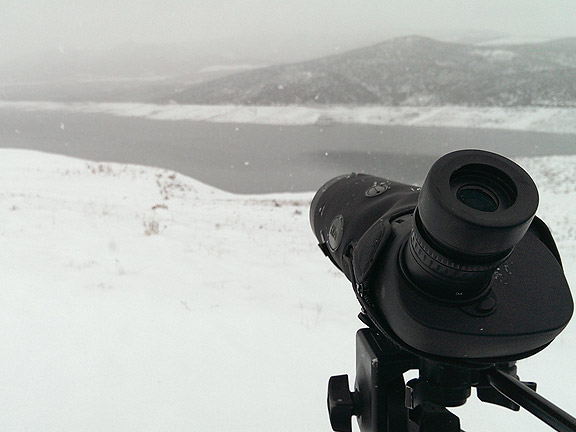
Scanning the north arm from the parking area, we didn’t add any new birds but did find a 3 HORNED GREBE, and a BARROW’S GOLDENEYE we had missed here earlier.  Alex spotted a pair of BALD EAGLES  in the trees on a far beach that no one else was even scanning, upping our total for the day.

Kenny scoping at Jordanelle

From the reservoir, we headed north into the developments on the northwest side of the lake.  There was a pond here we were alerted to by Nate who had seen good birds here in previous years.  On the way we had a mixed flock of RED-WINGED BLACKBIRDS and AMERICAN ROBINS, that also included one BREWER’S BLACKBIRD.  Along the road everyone in the group got great looks at our 2nd NORTHERN SHRIKE of the day.

Scoping at Jordanelle

At the entrance to the development we had a good view of a sliver of the reservoir that was open but had ice around the edge connected to the main body of the lake.  2 BALD EAGLES were sitting on the ice and in a tree here, while a huge flock of waterfowl sat in the small opening of water.  Scanning through them revealed 2 NORTHERN SHOVELERS, new for the day.  While we were there a flock of CEDAR WAXWING flew by, another new species for the day.

We made our quick stop at the pond Nate told us about, but didn’t add anything new for the day.  We headed back towards Park City--at the Silver Summit Exit, Kenny spotted 2 GOLDEN EAGLES in the distance, and the underpass housed a few ROCK PIGEONS.  We headed towards Pinebrook to check a  feeder out that Stephanie had told us about at lunch.  The feeder had both PINE SISKIN and CASSIN’S FINCH when we arrived, but not much else.  To end the day we headed to the feeders at the south end of Matterhorn in Summit Park.

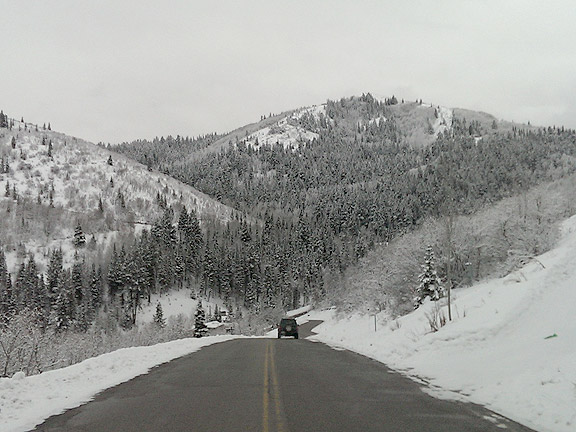
Driving into Summit Park

As usual the birds were flocking.  New for the day was a calling RED-BREASTED NUTHATCH, and we did get “Oregon”, “Pink-sided” and “Slate-colored” Dark-eyed Juncos.  While we watched a new count bird flew over in a pair of CLARK’S NUTCRACKERS.  In all 6 ended up passing over while we watched.

As the count came to an end we all parted ways, excited about what we might be able to do next year in expanding the count and upping participation.  Our obscure count nestled in Summit and Wasatch County has a lot of possibilities--but it needs some love from the birding and local community to really help it grow.  We were excited to have 4 locals take part this year and share their knowledge of the area--if we can double that next year 60 species for the count could be a real possibility.

As usual we had our miss list, which includes some shockers:  Song Sparrow was perhaps the biggest miss, while White-crowned Sparrow still eludes us for the count.  No Ruby-crowned Kinglets or Yellow-rumped Warblers.  No Western Meadowlarks, and again no game birds.  No California Gulls, no owls of any kind, and no Killdeer or Snipe.  

Thanks to Connor and Stephanie Dolmat-Connell, Alex Peterson, Nate Brown, Sarah Crane, Jeff Bilsky, Kenny Frisch, and Carl Ingwell for helping make this count a success again.  As long as we keep hitting 50 species a year, I think we’re doing pretty good!

Labels: , , ,

1st Ever Park City CBC Recap

posted by Tim Avery at
on Wednesday, December 21, 2011 

It was a great day to be a Utah Birder!  We kicked off our first ever Park City CBC event with 14 participants on what started as a freakishly cold morning and turned into a beautiful day.  Let me start by just saying thank you to everyone who took part in our inaugural CBC for Park City.  The people are what makes an event like this so much fun.  It's a strange place to go without a CBC for so long, especially given the population and proximity to Salt Lake.  When we chose Park City these were just a couple of the reasons that helped guide our decision.  Perhaps more interesting was the fact that Park City rarely generates any reports of birds during the winter months.  The occasional feeder report, a tourist mentioning something from the slopes, or a a random report form Summit Park usually make up the annual mix.  But surely there must be more to his area in the winter months, and the CBC was a perfect way to start finding out more.

Park City CBC Count Circle

The count circle was centered near US-40 and I-80.  This allowed us to go west to Summit Park, east to Rockport Reservoir and Peoa, and south to the north half of Jordanelle Reservoir.  To the north we didn't do a whole lot of research, or really any birding, so that will be for future CBCs.  In any event this gave us a great variety of habitats and for future events will be very easy to break into smaller quadrants.  This year we opted to try a different approach as the majority of the group had never birded in the Park City area.  We decided to load up in a few vehicles field trip style and use this year to scout the entire count circle, and allow everyone to get a better feel for the most common birds in the area.  Kim Roush and her husband who are quite familiar with the area set off on their own to check out some private areas, as well as search for some local specialties  I think most of the group would agree that this worked out fairly well as everyone got to see the vast majority of the birds we encountered.

To the birds!

I hit the mountains early--about 5:30am and I was in Summit Park whistling for Saw-whet and Pygmy Owls like a mad man.  I was shocked having two cars pass me on Matterhorn Drive in the pitch black.  Surely they thought I was a mad man--why in the hell is this guy standing on the edge of the road in the middle of the night in the middle of nowhere?  Well the mad man in the middle of nowhere thing panned out in the form of one NORTHERN PYMGY-OWL who gave into my whistling and responded with a few short toots, and a rapid chatter before going silent.  What a great 1st bird for the CBC.  It would be the only owl that I was bale to find.  I drove the lower section of Jeremy Ranch Road hoping for a Great Horned Owl, then around Snyderville Basin through the marshes and grasslands thinking maybe a Barn or Short-eared may appear.  The temperature gauge in my car read 7 degrees at 7:00am.  In the first light of the day I managed to turn up my only 3 other species in a small flock of Mallards, a couple American Robins, and 2 fly-by RING-NECKED DUCKS.

At 7:30 I met with the rest of the group and we organized into our respective vehicles then headed out. We drove through the neighborhoods are Park City looking for feeders, and songbirds. Lots of House Finches, and Black-capped Chickadees followed, and slowly we picked up Siskin, Juncos, Scrub-Jays, and doves.  There seemed to be chickadees everywhere in the morning.  One flock led us to our only Sharp-shinned Hawk perched low in a bush on a hillside.  More chickadees led to Mountain Chickadees and goldfinches.  The species diversity was slim, but the abundance was quite impressive.  We spent some time looking for open water on a number of ponds around the city.  Time after time we struck out on the water.  All was frozen, and any that might have been open we weren't able to get looks at.  Mid morning we headed west out of the city towards Summit Park to get away from the hustle and bustle of the cars, and into the action with the mid-elevation conifer species.

Summit Park provided our fill of the birds we expected--but also quite a few more cars than normal.  On the way up we ran into the Beyer's who were in search of the Pygmy-Owl without luck.  We added several TOWNSEND'S SOLITAIRE, HAIRY WOODPECKER, RED-BREASTED NUTHATCH, and STELLER'S JAY.  There were lots of siskin and juncos as well--Carl and Eric Peterson found a GRAY-HEADED JUNCO; I can't remember another winter report form northern Utah so that was an awesome find. On the drive back towards Park City we added our only Red-tailed Hawk of the day just off I-80 near the tubing hill at Jeremy Ranch.  After a brief lunch we packed back in the cars and headed out around Swaner Nature Center.  The fields were empty, and the birds were few and far between.  Then we found a pond with some open water and things got a little better.  Aside from the Mallards on the water, we added Canada Goose, American Wigeon, more Ring-necked Ducks, Redhead, Green-winged Teal, Common Goldeneye, and American Coot.  While we watched the waterfowl we had both GOLDEN and BALD EAGLES fly over in a matter of minutes.  This stop added the most species for the day and was a welcome kickoff to the afternoon.

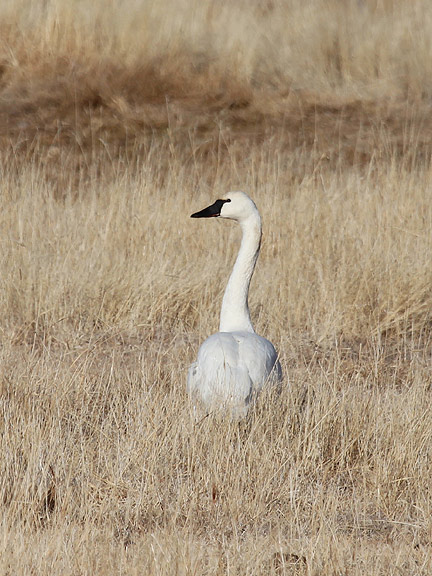
Tundra Swan in Peoa was a great find for the day

We continued to the east and then south to Jordanelle which was completely free of ice.  This surprise didn't add a lot of species--but did make for a nice break to scan the open water.  11 BUFFLEHEADS were a highlight, as well as 1 CALIFORNIA GULL (the only of the day).  A huge raft of Coots, several Canada Geese, and Common Goldeneye rounded out the birds that we picked out. We kept going east to Peoa, where we added our first Kingfisher of the day along the Weber River.  A couple hundred yards further along the road, Carl spotted a lone Swan in a small creek.  WE flipped around to take a look.  At first glance the bill looked massive and like it may be a Trumpeter.  But once in binocular and then after some closer looks it was just a TUNDRA SWAN--still a great bird for an odd location, and our only of the day!  We ended the day at Rockport State Park and then on the Weber River below.  At the entrance station near the inlet we had a beautiful NORTHERN SHRIKE and another Kingfisher. We tried up and down the east side of the lake for titmouse without any luck.  Another Solitaire and Bald Eagle did give us some great looks.  Rockport was a different story from Jordanelle in that it was 98% frozen.  There were several small patches of water which didn't have much on it.  In the middle of the lake on the ice was a small flock of Canada Geese accompanied by a few GADWALL and American Wigeon.  As we drove, Carl again spotted what he thought was a grebe.  After pulling over we confirmed it was a WESTERN GREBE on a small piece of open water.  Morse surprising, and sad however, was a single COMMON LOON stuck on the ice in the middle of the lake.  We watched as it tried to flap several times along the ice to get to water.  Unfortunately, I don't think there is much hope for this late loon.

The last new bird of the day was a female HOODED MERGANSER in the same location, but on a big chunk of open water.  It was our 48th species of the day and a great way to end this first CBC.  The Roush’s added ROUGH-LEGGED HAWK, GOLDEN-CROWNED KINGLET, and AMERICAN DIPPER to top 50 species for the day.  As with most CBCs the surprise were great, and the misses were kind of shocking.

White-crowned Sparrow, Cassin's Finch, Ruby-crowned Kinglet, Yellow-rumped Warbler, Western Meadowlark, Great Blue Heron, Loggerhead Shrike, Cooper's Hawk, and Barrow's Goldeneye among others.

A complete list from the day  follows:

Canada Goose        
Tundra Swan        
Gadwall        
American Wigeon        
Mallard        
Green-winged Teal        
Redhead        
Ring-necked Duck        
Bufflehead        
Common Goldeneye        
Hooded Merganser        
Common Loon        
Western Grebe        
Bald Eagle        
Sharp-shinned Hawk        
Red-tailed Hawk  
Rough-legged Hawk    
Golden Eagle        
American Kestrel        
American Coot        
Killdeer        
California Gull        
Rock Pigeon        
Eurasian Collared-Dove        
Mourning Dove        
Northern Pygmy-Owl        
Belted Kingfisher        
Downy Woodpecker        
Hairy Woodpecker        
Northern Flicker        
Northern Shrike        
Steller's Jay        
Western Scrub-Jay        
Black-billed Magpie        
Common Raven        
Black-capped Chickadee        
Mountain Chickadee        
Red-breasted Nuthatch
Golden-crowned Kinglet
American Dipper      
Townsend's Solitaire        
American Robin        
European Starling        
Cedar Waxwing        
Song Sparrow        
Dark-eyed Junco        
Red-winged Blackbird        
House Finch        
Pine Siskin        
American Goldfinch        
House Sparrow      

Labels: , ,

Announcing the 2011 Park City CBC

posted by Tim Avery at
on Monday, November 28, 2011 

Utah Birders Park City Christmas Bird Count 
Sunday, December 18, 2011
8am - 5pm


We are pleased to announce the first ever Utah Birders Park City Christmas Bird Count and invite you to participate! The Christmas Bird Count (CBC) is a census of birds performed annually in December and January by volunteer birders. The purpose is to provide population data for use in science, especially conservation biology--though many people participate just for fun.

The 2011 Park City CBC will take place on Sunday, December 18, 2011 starting at 8am and going until 6pm (or until there are not more birds to be seen). We will split up into several teams to cover areas from Jordanelle north to Jeremy Ranch and from Summit Park east to Rockport and Peoa.


We will begin meeting at 7:30am in Park City at the Whole Foods at 1748 West Redstone Center Drive If you take exit 145 (Kimball Junction) on I-80 then go south the store is just east of hwy 224 just south of the interstate:

http://wholefoodsmarket.com/stores/store-locations/?storeabbr=PKC#map_top

The Whole Foods will be providing a fruit tray for us to snack on before we head out for the day--you can also purchase other items for breakfast while we chat before heading out.  We will hand out checklists, maps and any other materials as well as breaking into teams if needed.

Each team will be led by a member of the Utah Birders that will help identify the species encountered and share some information about the birds along the way. For those interested we will meet at 6:00pm after at a location TBD to compile all the checklists and share stories from the day. 

The cost to participate is $10 per person or $25 for families of 3 or more. $5 will go to cover the cost from the National Audubon Society. From that you will receive a copy of the report the following spring detailing findings form CBCs across the country. The other $5 will go to our local charity that the Utah Birders sponsor. 

If you have any questions feel free to contact us at utah.birders@gmail.com or call Carl at 801-688-5017, Jeff at 801-842-4013, or Tim at 801-440-3035.


We hope to see you on the 1st ever Park City CBC!
The Utah Birders

Labels: , , ,

Northern Pygmy-Owl Surprise

posted by Tim Avery at
on Tuesday, December 14, 2010 

I went to lunch on Tuesday not expecting anything different from my usual Tuesday. That was until I saw a post come across birdtalk about a flock of Evening Grosbeaks still coming to a feeder in Summit Park. I don't know why, but I am a sucker for that species--so I took an extra hour at lunch and headed up I-80 to go see what I could find.

As I made my way to the area the birds we reported there were no grosbeaks. However, the chorus of Mountain and Black-capped Chickadees, along with Red-breasted Nuthatch, Brown Creeper, and Golden-crowned Kinglet got me thinking about an owl being around. I started to imitate a Northern Pygmy-Owl, and almost immediately I was in a whistling duel with a bird just off the road. My whistle must have been on point today, because after about 2 minutes the bird flew into sight and set up for me to watch. I shot a couple of pretty cool videos with my cell phone--surprisingly way better quality than what my point and shoot gives!


Here is another video from a different angle:


And of course I had to take a few shots--I have never managed a shot of one before, and these were by far the best looks I have ever had at one.

All photos link to a gallery on my website.


Northern Pygmy Owl. Copyright Tim Avery

I ended up watching the owl for about 45 minutes before I had to take off and get back to work. In that time it moved to about 5 different perches, and if you look at the gallery, you will even see it enter an old flicker cavity. What a great consolation prize for missing the grosbeaks... Oh, except I had a flyover of between 25-30 Evening Grosbeaks before I left. That and a Northern Goshawk made for a nice afternoon at Summit Park.

Labels: , ,


UTAH BIRDERS FLICKR POOL


    SEE MORE AND SHARE ON FLICKR