Utah Birds, Utah Birding, and Utah Birders. Promoting the sharing of information, and the conservation of habitat for birds in Utah and elsewhere. We are a group of people who want to share what we know, and create a positive birding experience in Utah.

BIRDERS BLOG

a blog by and for Utah Birders

2013 Park City CBC Recap

posted by Tim Avery at
on Thursday, December 26, 2013 

Saturday, December 21st, the Utah Birders held our 3rd Annual Park City CBC.  This year 9 birders took part during the blustery winter day in Park City and unofficially tallied 52 species.  The day started with the group meeting first thing at Kneader’s in Newpark for a little breakfast, before we split into groups and headed out to scour the 8 sections of the count.  Four teams comprised of 2’s or 3’s headed out to the 4 main quadrants--City, Mountain, Canyon, and Lake to get the day started.

The Lakes

Kenny Frisch and I took the lakes portion of the count, which is mostly spent scanning the hopefully open water of the 2 reservoirs that lie in the count circle.  We started the day off taking I-80 east to Wanship to check the Weber River below Rockport Reservoir.  In Wanship a TOWNSEND’S SOLITAIRE was perched in the tallest pine in town.  At the river were numerous AMERICAN ROBINS and a few MALLARDS, but no other waterbirds.  3 MUSKRAT were sitting out in the open, while a BALD EAGLE flyby provided excellent looks.
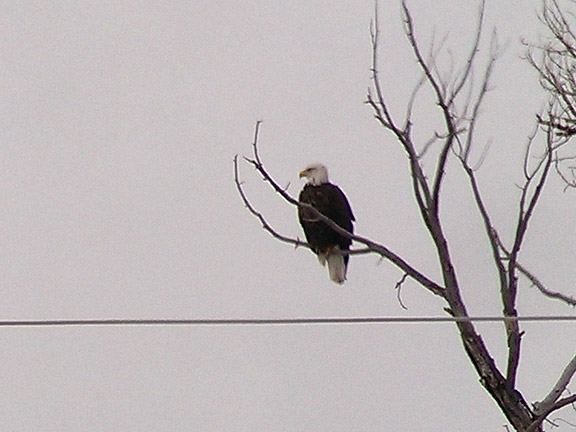
Bald Eagles were prevalent this year on the count

From Wanship we headed towards Rockport where we had a NORTHERN SHRIKE just below the dam.  The reservoir was frozen solid so no waterbirds.  At the inlet we picked up an AMERICAN DIPPER, and a small flock of CANADA GEESE were the only for the count.  Above the reservoir we saw several BALD EAGLES along the river.
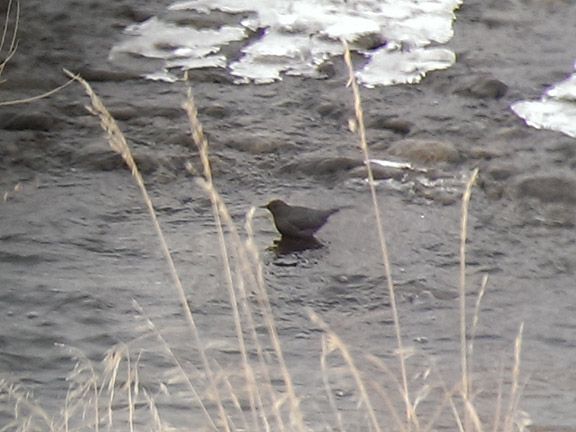
American Dipper at Rockport

Next we headed over to Jordanelle to scan the north arm--if it were open.  Luckily it was and there were a number of waterbirds present.  Plenty of COMMON GOLDENEYE and COMMON MERGANSER.  Several GADWALL, LESSER SCAUP, and BUFFLEHEAD along with the usual Mallards rounded out our waterfowl effort.  We scored three species of Grebe with 5 WESTERN, a PIED-BILLED, and the best bird of the day, 2 very late HORNED GREBES.

Terrible record shot of 2 Horned Grebe at Jordanelle

The fog and snow made it difficult to san everything very well, but we figured we covered most of what was expected.  We were done with the lake pretty early, so headed over to Deer Valley Resort to check the ponds where a pair of BARROW’S GOLDENEYE were present with a Common Goldeneye and pair of Ring-necked Ducks.  We decided to run through South Snyderville Basin to check the warm springs, adding GREEN-WINGED TEAL to the count for the day. With some time left we made a quick drive north to The Preserve, but didn’t add any birds--just a couple of bull ELK.
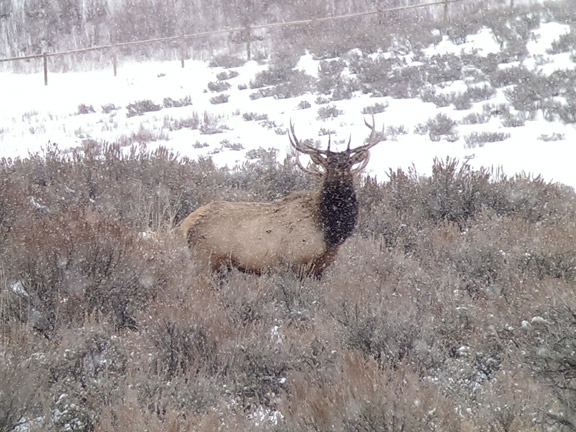
Rocky Mountain Elk at the Preserve

The City

Alex Peterson recaps the city portion of the count:

We left the morning rendezvous point and headed east along the I-80 frontage road (Highland Dr) and the Swaner Preserve watching the posts for raptors.  Right before we reached the Old Ranch Road turn, we were rewarded with an AMERICAN KESTREL swooping down on a vole and then enjoying its earned breakfast on a post right next to the road.  An amazing start to our Park City CBC--which we only captured with memories.  We then headed along Old Ranch Road, turning into the Trailside Drive neighborhood to observe some feeders.  Many feeders were empty or frozen over; but we found three terrific feeders that were a hot bed of activity.  Besides the innumerable doves and starlings, we were rewarded with both MOUNTAIN and BLACK-CAPPED CHICKADEES.  We also counted some Mallards in the neighborhood ponds.  Despite the usual odd looks from the locals, we braved onward especially after one gentleman rewarded us with a vigorous #1 sign with his middle finger.  With that encouragement, we then headed past Trailside Park and over into the Silver Summit area neighborhoods.  Again, many empty feeders, but those that had seed not only rewarded the birds, but also us with plenty of activity.

Heading back to Old Ranch Road we crept slowly along counting the water birds (mostly Mallards, but also American Coot, RING-NECKED DUCK, and the only AMERICAN WIGEON of the count.  We also found a number of raptors including RED-TAILED and ROUGH-LEGGED HAWKS on posts in the preserve.  Following Old Ranch Road to the end (and counting the chickadees on the way), we entered into the neighborhoods of Southwest Snyderville.  Regretfully only a couple of feeders in this area, but we continued to count the doves, magpies, starlings, robins, and mallards.  To finish our morning, we entered into the Canyon Resorts neighborhoods where we were rewarded with a WESTERN SCRUB-JAY and a friendly Canyon employee who kindly shared his diverse vocabulary and hand gestures when he was momentarily delayed by our bird counting efforts.  Not to end on a disparaging note, we also counted a BELTED KINGFISHER calmly perched alongside Hwy 224 by St. Mary's as well as a GREAT BLUE HERON.

The Mountains

Stephanie Dolmat-Connell and her husband Conor participated in their first ever Park City Christmas Bird Count (second CBC overall).   Recap from Stephanie:

We were given the mountain region and were tasked with finding as many species of birds as possible.  This sounds like a manageable task until you consider that we are fairly amateur birders that still have to reassure each other that we are, in fact, looking at a bird and not a bird stick or a bird tree or a bird rock.  But we set off determined to do all we could in the name of citizen science.  We headed first to Summit Park to see the infamous feeder off of Matterhorn Drive.  The owners of these several feeders, which gave me several ideas for my own yard, were very nice and even put out peanuts to bring in the STELLER’S JAY, among DOWNY and HAIRY WOODPECKERS, a NORTHERN FLICKER, both Mountain and Black-Capped Chickadees,CASSIN’S FINCHES, PINE SISKIN, and DARK-EYED JUNCOS.

Steller's Jay from the mountain section of the count.

We moved on to Pinebrook and found one friendly Chicago couple with several feeders with more siskins and finches, but not much else movement.  Driving by Utah Olympic Park gave us our three raptors of the day, including a ROUGH-LEGGED HAWK and a SHARP-SHINNED HAWK along with an American Kestrel.  Moving southward on 224 to the golf course gave us some American Coots and some Common Goldeneyes.  All in all, we saw 18 different species and had a fun time reassuring each other that a robin was a robin and that we'll get better at IDing in the future.  Thanks to the crew for helping us with IDs and for a great morning of birding.

Rough-legged Hawk from the Mountain section.

The Canyons

The canyons group covered the area north of I-80, which this year didn't turn up a lot of birds.  In 2012 the feeders in the neighborhoods in this area produced some great finds--but with a typical winter it was quiet on the canyons front.

The afternoon...

After the morning we met at the Cafe Rio in Newpark to look over checklists and see what we had missed in the morning.  Several participants had to take off, so we regrouped and as one large team decided to head back to Jordanelle where hopefully with more visibility we could find a few more species of waterbird.

As we approached the entry station, a COYOTE ran across the road in front of us and then along side.  The 4th mammal species of the day
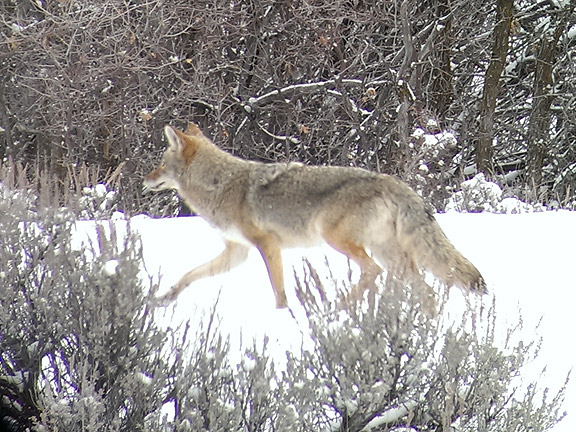
Coyote at Jordanelle

Scanning the north arm from the parking area, we didn’t add any new birds but did find a 3 HORNED GREBE, and a BARROW’S GOLDENEYE we had missed here earlier.  Alex spotted a pair of BALD EAGLES  in the trees on a far beach that no one else was even scanning, upping our total for the day.
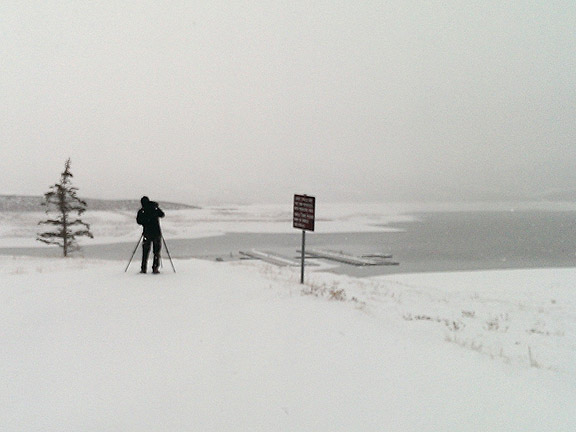
Kenny scoping at Jordanelle

From the reservoir, we headed north into the developments on the northwest side of the lake.  There was a pond here we were alerted to by Nate who had seen good birds here in previous years.  On the way we had a mixed flock of RED-WINGED BLACKBIRDS and AMERICAN ROBINS, that also included one BREWER’S BLACKBIRD.  Along the road everyone in the group got great looks at our 2nd NORTHERN SHRIKE of the day.
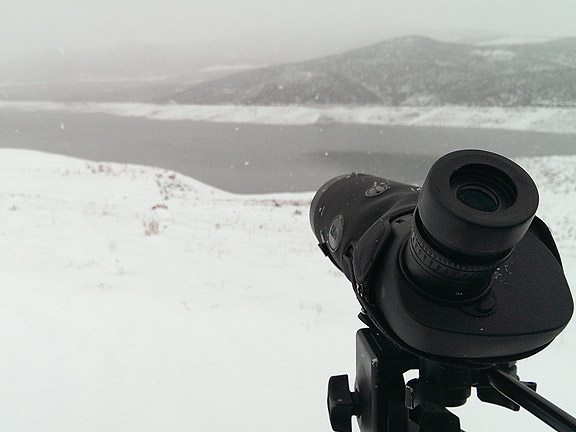
Scoping at Jordanelle

At the entrance to the development we had a good view of a sliver of the reservoir that was open but had ice around the edge connected to the main body of the lake.  2 BALD EAGLES were sitting on the ice and in a tree here, while a huge flock of waterfowl sat in the small opening of water.  Scanning through them revealed 2 NORTHERN SHOVELERS, new for the day.  While we were there a flock of CEDAR WAXWING flew by, another new species for the day.

We made our quick stop at the pond Nate told us about, but didn’t add anything new for the day.  We headed back towards Park City--at the Silver Summit Exit, Kenny spotted 2 GOLDEN EAGLES in the distance, and the underpass housed a few ROCK PIGEONS.  We headed towards Pinebrook to check a  feeder out that Stephanie had told us about at lunch.  The feeder had both PINE SISKIN and CASSIN’S FINCH when we arrived, but not much else.  To end the day we headed to the feeders at the south end of Matterhorn in Summit Park.
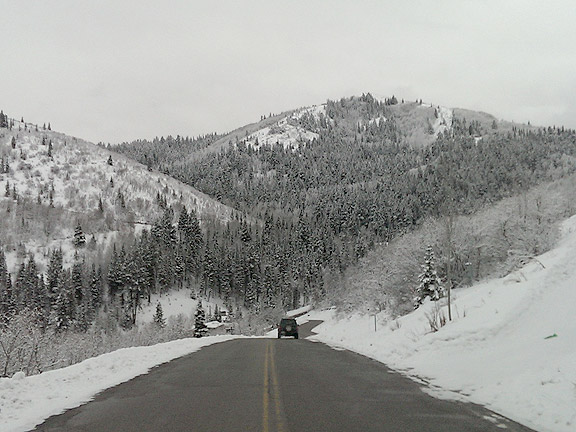
Driving into Summit Park

As usual the birds were flocking.  New for the day was a calling RED-BREASTED NUTHATCH, and we did get “Oregon”, “Pink-sided” and “Slate-colored” Dark-eyed Juncos.  While we watched a new count bird flew over in a pair of CLARK’S NUTCRACKERS.  In all 6 ended up passing over while we watched.

As the count came to an end we all parted ways, excited about what we might be able to do next year in expanding the count and upping participation.  Our obscure count nestled in Summit and Wasatch County has a lot of possibilities--but it needs some love from the birding and local community to really help it grow.  We were excited to have 4 locals take part this year and share their knowledge of the area--if we can double that next year 60 species for the count could be a real possibility.

As usual we had our miss list, which includes some shockers:  Song Sparrow was perhaps the biggest miss, while White-crowned Sparrow still eludes us for the count.  No Ruby-crowned Kinglets or Yellow-rumped Warblers.  No Western Meadowlarks, and again no game birds.  No California Gulls, no owls of any kind, and no Killdeer or Snipe.  

Thanks to Connor and Stephanie Dolmat-Connell, Alex Peterson, Nate Brown, Sarah Crane, Jeff Bilsky, Kenny Frisch, and Carl Ingwell for helping make this count a success again.  As long as we keep hitting 50 species a year, I think we’re doing pretty good!

Labels: , , ,

Black Friday... Birding!

posted by Tim Avery at
on Monday, December 2, 2013 

The day after Thanksgiving is a great time to get out and shop till you drop.  Spend lots of money, help boost companies end of year revenue, and stimulate the economy... It's also a nightmare to those of us who look at the whole things as the epitome of American gluttony--its sadly disgusting in many respects and speaks volumes about our society.  So this year we decided instead of joining other in our community partaking in this "Event", we would do a sort of anti-Black Friday--where instead of trying to trample our neighbors for that flat screen, we would go birding and be as far away from the commotion as possible.

As a disclaimer I will note that I did go to Home Depot and Shopko before making my way to the field trip--my haul: 2 four-mode headlamps and 4 strings of Christmas lights.  Hardly stuff worth fighting over, which is why I waited till the crowds dispersed.  In any event the trip began with 12 of us meeting up at the Wal-Mart on Foothill and Parley's Way--of all places we thought it a tad bit ironic, but also a bit clever. The group was quite varied and included several young Utah birders, including Kendall Watkins and Brenton Reyner, as well one of Utah's youngest and brightest birders, Ivan Richardson, 10, from St. George, along with his dad Tom.

Utah Birders scanning the ducks at the Jordan River

To get started we headed to the Jordan River, Redwood Trailhead at about 2300 South.  Here the group got great looks at both species of Goldeneye, with an exceptional count of 25 BARROW'S GOLDENEYE.  Other waterfowl included, Bufflehead, Green-winged Teal, Mallard, Gadwall, Ruddy Duck, and Canada Goose.

eBird Checklist:
http://ebird.org/ebird/view/checklist?subID=S15799637

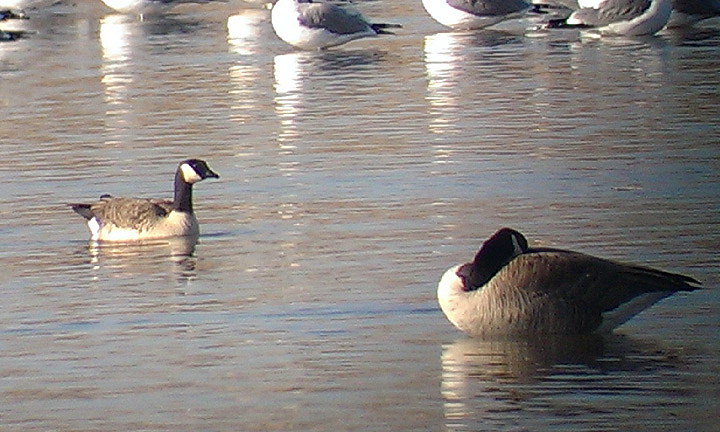
From the river we hopped a short drive over to Decker Lake where we picked up a COMMON MERGANSER along with the usual California and Ring-billed Gulls, as well as plenty of Mallards and domestic Geese.  There were about 100 CANADA GEESE on the grass near the parking area, including the hybrid Canada X Grayleg that has been around at least the past 2 winters.  As we were getting ready to leave geese started pouring in, and as we watched them we picked out a couple CACKLING GEESE in the air.  We waited till the landed and found 2--while we were watching them 3 more came in for a count of 5 CACKLING GEESE.

Cackling Goose (left) with Canada Goose at Decker Lake

eBird Checklist:
http://ebird.org/ebird/view/checklist?subID=S15799687

After getting our fill of these geese it was onward to Lake Park in hope of more geese, perhaps some gulls, and maybe, just maybe the Pacific Loon that had been present the week before.  Well there were few geese (by Lake Park standards), almost no gulls, and the loon I would say its safe to assume is gone.  We did however pick up a pair of HOODED MERGANSERS on the river behind the IHC building.  They were accompanied by a handful of Common Mergansers.  We also watched a PRAIRIE FALCON hunting in a large field to the west of there, providing great looks for the group.

Prairie Falcon coming in for a landing at Lake Park

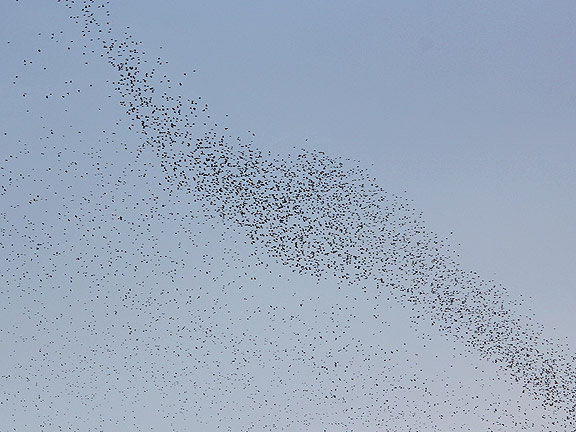
At the west pond we did add a lone RED-BREASTED MERGANSER for the 3 species sweep for the day.  The only other thing of note was an enormous flock of EUROPEAN STARLINGS, perhaps 5,000 birds that came form the west and flew over us, murmurating, as they headed east.

Just a portion of the European Starling flock over Lake Park

eBird Checklist:
http://ebird.org/ebird/view/checklist?subID=S15799725

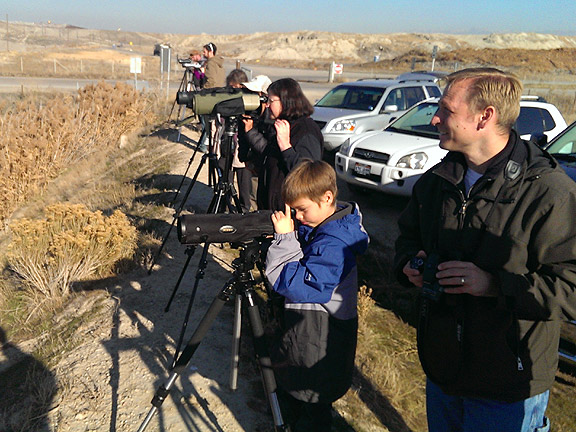
The next stop was Lee Kay Pond which was inundated with Gulls, approximately 2,500~ mostly on the west pond--the best viewing was from the east, but it put us at an extreme distance.  From the entrance to the middle pond we scoped the birds and picked out a couple HERRING and THAYER'S GULLS form a distance.  The Thayer's was a lifer for Ivan so that was quite exciting.  

Utah Birders Ivan and Tom Richardson scanning the gulls at Lee Kay Ponds

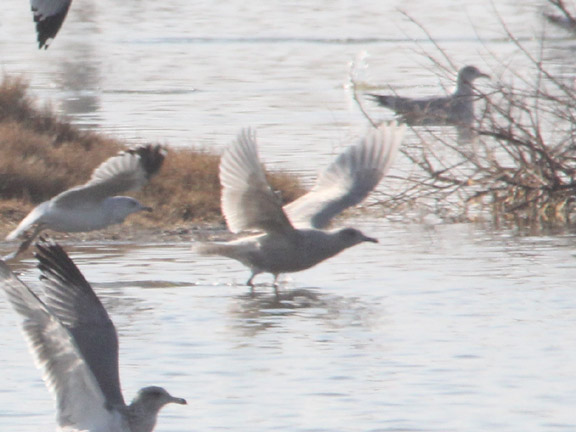
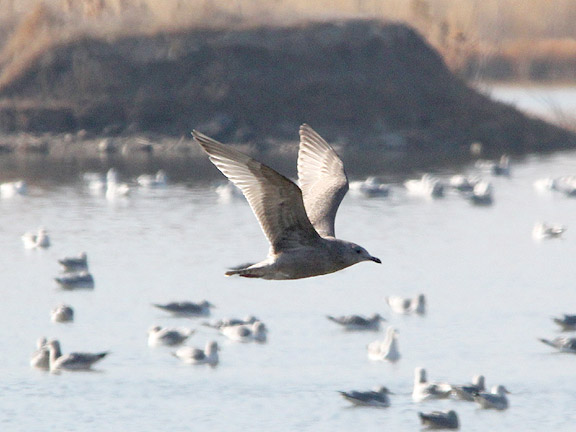
After giving it a good while we drove the road along the middle pond where we spotted more HOODED MERGANSERS.  We looped back to the west pond, closer to the flock to try scanning a little closer while we still had some good light.  We weren't out of the car 5 minutes when Kenny shouted that he had an ICELAND GULL.  I took a quick look through his scope and excitedly hollered for everyone to come over.  That's when we went into crisis mode--no one could get the bird in a scope, besides Kenny's and trying to get everyone on the bird was like a nightmare.  Finally, as a stroke of luck would have it the bird emerged form the throngs of gulls and sat in the open for everyone to see nicely--a life for many on the trip, including Ivan who had now picked up one of Utah's hardest to get gull species.

Iceland Gull taking flight--the highlight of the day and lifer for many.

Eventually a THAYER'S GULL flew right over us proving excellent looks for the entire group.  This was followed by the Iceland Gull taking off and flying to the west beach where it landed and began preening.  We drove down and spent a few more minutes watching it before continuing on our way.

Thayer's Gull flyby at Lee Kay Ponds

eBird Checklist:

We made a quick drive up 7200 West with nothing of note--bird wise and otherwise.  We made a quick stop at the International Center to refuel and grab snacks.  A quick check of the ponds there revealed a few gulls, ducks, and geese, but nothing of note.

7200 West eBird Checklist:

SLIC eBird Checklist:

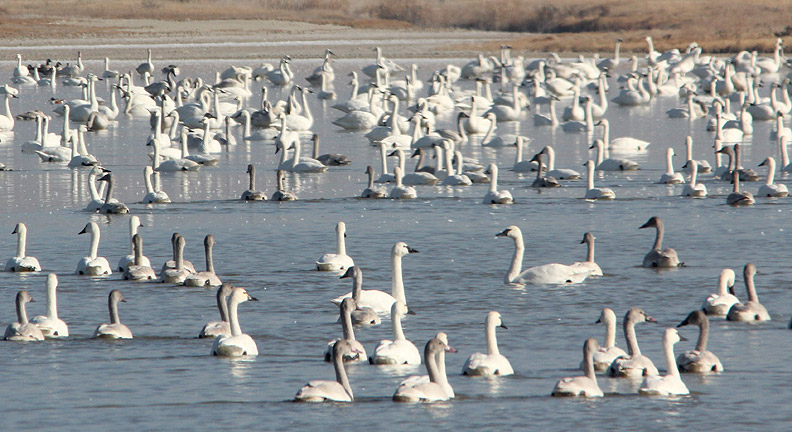
After our short break we drove the frontage road along I-80 towards Saltair.  Our stop here was at Kennecott's Inland Sea Shorebird Reserve--a private mitigation wetland that provides much needed protection to both habitat and birds on the south shore of the Great Salt Lake. The target bird here was Tundra Swan (among others), which this time of year can number in the thousands.  As our luck would have it there were about 1,000 TUNDRA SWANS present, and we spent the better part of an hour watching them from various distances, with different lighting and back drops.  It was a highlight for many on the trip.

Small portion of the Tundra Swans at the ISSR

We also added both GOLDEN and BALD EAGLE and had NORTHERN HARRIER and several ROUGH-LEGGED HAWKS.  No shrikes, but several in the group did get short looks at a small flock of AMERICAN TREE SPARROWS that passed by the vehicles.

eBird Checklist:

Our final stop of the trip was at the Great Salt Lake State Park marina to scan the gulls along the shoreline.  We hoped the Heermann's Gull from the previous week was still present but with great lighting we quickly found that it was not.  We spent some time just relaxing and talking while scanning, bring the trip to a quiet end.

eBird Checklist:

We did however have one more sighting of note, as we made our way back to the Wal-Mart we passed Parley's Gulch where form the interstate were able to pick out 2 LEWIS'S WOODPECKERS remaining on the poles along the bike path.  A great end to a great trip.  

eBird Checklist:

Thanks to everyone who took part and made for a great day of birding some of the lesser visited places in the county--the south shore is often overlooked as a a birding hot spot but it definitely is one of the best places along the lake to look for waterbirds.  

Labels: , , , , ,

Birding Utah Canyons in Winter

posted by Oliver Hansen at
on Wednesday, February 13, 2013 


Stansbury Mountain Range - Tooele County, Utah

Winter can be a spectacular time for birding. First, there aren’t any leaves on the trees, making finding birds a little bit easier than during the foliage filled spring, summer, and fall seasons. Second, the amount of open water is greatly reduced making looking for waterfowl quite easy at times. Third, there are birds that come visit us in Utah that if you want to find in the Summer, you’d have to travel up to Northern Canada or Alaska. Last is the solitude. You can get out your cross country skis or some snowshoes and travel for hours without seeing another person.


Me looking at some Rosy Finches

The last week of December I found a small flock of Gray-crowned Rosy-finches a few miles up South Willow Canyon. A great find for me. Last winter birding in Utah County I saw a few flocks of several thousand rosy-finches on the West benches of Timpanogos, but they were too far away for me to identify to species so I didn’t count them for my personal list. This was my first up-close and personal encounter with this species – a new County bird, State bird, and Life bird! Another bonus was that this species has only 2 other records in ebird for Tooele County – and one of those was from 1975!


Gray crowned Rosy-finches

As the New Year rolled around I returned over and over again to the same location to try and locate the flock with no luck. I really want to get this species for my 2013 list. No luck so far. The road is paved about 3 miles up the canyon and is regularly plowed to a winter forest service gate. On a few Saturdays and occasionally after work I’ve actually hiked past the gate a few miles. Snowshoers and Cross-country skiers had left a good packed snow trail on the road past the gate which made for semi-easy hiking. There are miles and miles of exposed cliffs and steep rocky/muddy hills were rosy-finches love to hang out in winter. Unfortunately, there are dozens of other canyons close by that might only take a flock 2 minutes to get to, but for me would take hours. Maybe I’ll get lucky one of these trips.


Miles and miles of solitude

One trip did reward me with a small flock of mountain chickadees and red-breasted nuthatches. Another trip I saw a downy woodpecker excavating a hole in a willow tree and several Townsend's solitaire. The birds are very few and far between. I’ve been amazed at the feeling of solitude while hiking for hours up a snow-filled canyon and not seeing or hearing a single other animal for miles.


Creek in South Willow Canyon

Another bird I’ve had difficulty finding this year is American Dipper. Living in Provo, I could drive 4 miles from my house to the mouth of Provo Canyon and pick one of 4 or 5 parking lots, walk 20 feet to a bridge, and almost be guaranteed a dipper. Tooele County is a little different. There are almost no paved and plowed roads that go up any of the nearby canyons. South Willow is paved for about 3 miles, but the creek is pretty far from the road near the mouth of the canyon and is mostly underground or frozen.


Snowshoes makes winter birding much more enjoyable

After acquiring some fancy new snowshoes yesterday, I had to take them on a test drive. I hiked about a mile past the gate in South Willow Canyon to what is normally a nice picnic area in the summer to find several feet of snowpack. I was able to get a lot closer to the creek with my snowshoes (I was still sinking in a good foot because of how much powder there was!). The moment I got to the creek I could hear the familiar song of an American Dipper and spotted him singing away on a rock in the creek. So much more rewarding to find a dipper after a nice hike than peaking over a bridge at a parking lot. Unfortunately, I only had my little point and shoot camera so no great pics.

Can you spot the Dipper?

Little Cottonwood Picnic Area - South Willow Canyon


Have you had any great winter birding experiences this year?

Labels: , , , , , ,


UTAH BIRDERS FLICKR POOL


    SEE MORE AND SHARE ON FLICKR