Utah Birds, Utah Birding, and Utah Birders. Promoting the sharing of information, and the conservation of habitat for birds in Utah and elsewhere. We are a group of people who want to share what we know, and create a positive birding experience in Utah.

BIRDERS BLOG

a blog by and for Utah Birders

Birding and botanizing the stansbury Range

posted by Oliver Hansen at
on Monday, June 3, 2013 

 Arrowleaf Balsamroot at the top of West Canyon

I've been working with a handful of high school students on documenting the wildflowers in the Stansbury Range. It's a citizen science project that involves hiking around the mountains taking GPS-tagged photos of plants. Think of it like ebird for flowers on a very miniature scale but with plants - and GPS Coordinates instead of hotspots. Although the focus of our project is about photography and flowers, the biology teacher in me can't help sneaking in teaching about birds, mammals, herps, insects, ecology, geology, natrual history, hiking/wilderness ethics, etc.

On Friday we hiked up West Canyon below the Onaqui Benchmark just west of Grantsville. Onaqui Benchmark (not to be confused with the Onaqui mountains to the south of the Stansbury Range) is the high point of the northernmost group of peaks in the Stansbury Range.
 
West canyon starts out in Sagebrush, slowly transitions to Pinyon/Juniper, and then higher up into Aspen/Pine. This creates a nice diversity gradient of both flowers and birds. Near the mouth of the canyon there are HORNED LARKS, LARK SPARROWS, BREWERS SPARROWS, LONG BILLED CURLEWS, nesting RAVENS, SWAINSON'S and RED-TAILED HAWKS, and many other species you'd expect to find in rural Utah (doves, starlings, etc.) Two weeks ago on my way out of the canyon I was able to see a BURROWING OWL hunting at dusk.

In the middle portion of the canyon is full of GREEN-TAILED TOWHEES, SPOTTED TOWHEES, AM. ROBINS, DUSKY FLYCATCHERS, B.G. GNATCATHERS, WARBLING VIREOS, BUSHTITS, JUNIPER TITMOUSE, and other P.J. specialties.

Mountain Bluebird

 The upper portion of the canyon passes through Aspen/Pine and the normal mountain birds can be seen and heard: RB NUTHATCHES, RC KINGLETS, SWAINSON'S & HERMIT THRUSHES.
 
On Friday we were about half way up the trail when one of the students started yelling something about a dead owl on the trail. I was a few yards ahead of the group and turned around to see what all the commotion was about. This is what the "dead owl" was:


 Dead Owl?

It was a COMMON POORWILL roosting on the trail. Such a cool species. Here are some more shots:


And here are a few flower pics to end the post:


Arrowleaf Balsamroot

Larkspur

Indian Paintbrush  

Phlox
 

Labels: ,

Happy Birthday Dad- Thanks For All the Birds!

posted by Kenny Frisch at
on Thursday, May 9, 2013 


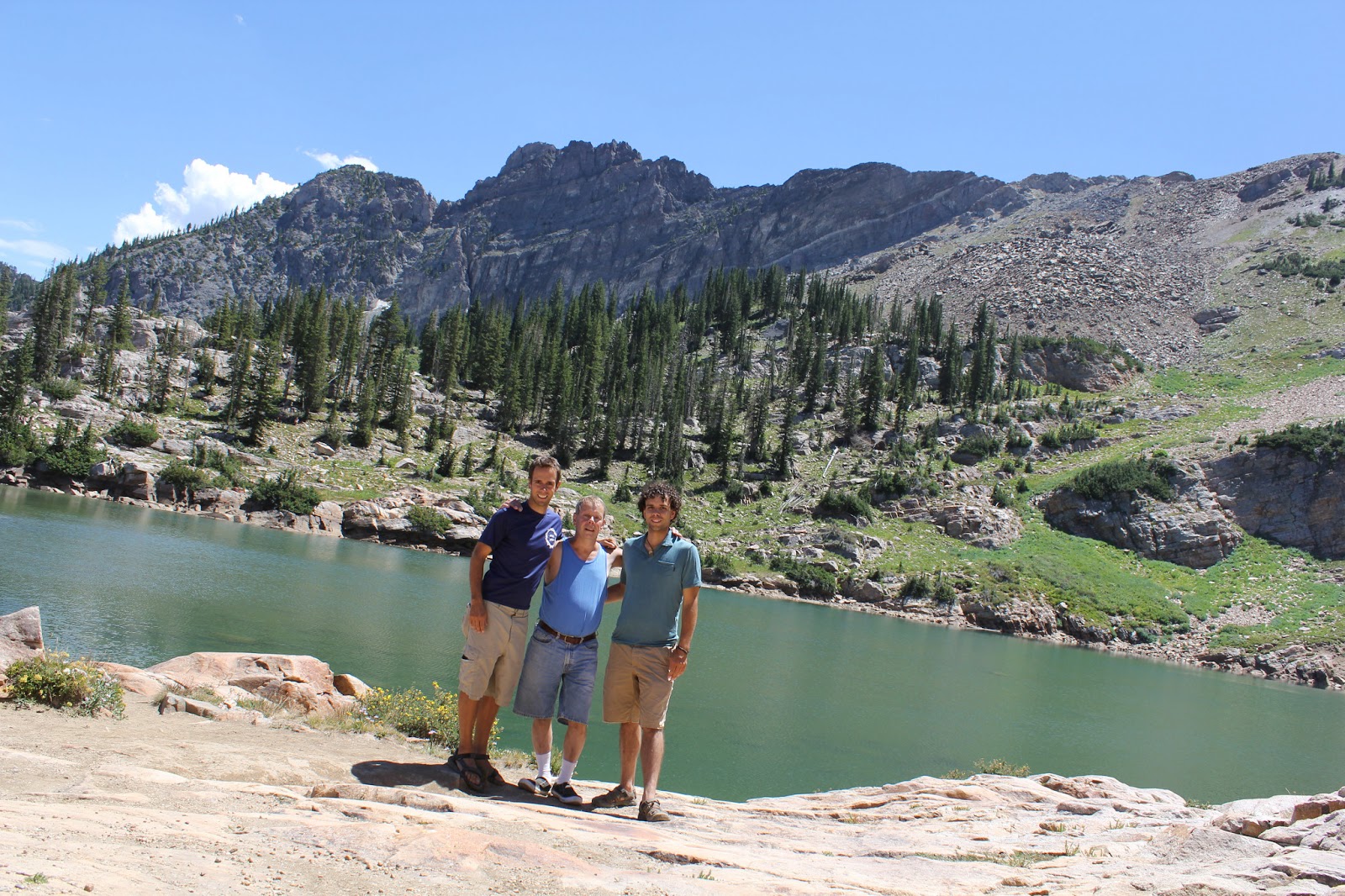
 Me, my Dad, and my brother Jeff at Cecret Lake right after we saw a Peregrine Falcon

May 10th is a special day for me.  It is the birthday of one my biggest birding influences, my dad.  He always supported my love of birds since I was a child.  He bought me my first two pairs of binoculars to help me get better views of birds.  He helped me to buy my first film and digital cameras and grow my passion for birds through photography.  He would buy me bird books to help me learn more about birds. And he would always kept our bird feeders stocked, even in the middle of winter in Western New York when we would have several feet of snow on the ground, just to keep birds near our house.  He was always there to support me.

When I moved out to Utah, he offered to come along and how could I refuse him.  He didn't even mind when we made several birding stops along the way including stops to try just for a pair of sparrows: Eurasian Tree Sparrow in Illinois (successful) and LeConte's Sparrow in Kansas (unsuccessful) and also stop at Cheyenne Bottoms in Kansas as well.  He was there to share in my first birding experiences in Utah, whether it was seeing a Black-billed Magpie as our first Utah bird or going to the Great Salt Lake Marina and looking at Eared Grebes and the other birds there.

It also happens that his birthday falls on one of the best migration days every spring.  Back in Rochester, I could expect to see almost 20 species of warblers and have a 100 total species in just a morning of birding.  Out here, May 10th is right in the middle of migration as well and although I would be lucky to get half as many warblers, 100 species is still possible on that day.

When I'm in St George for his birthday this year, even though we are 2000 miles apart, we will probably get to share a genus of birds: nighthawks.  He will be attending a Rochester Red Wings baseball game (yes our minor league team has a bird name) and be able to see Common Nighthawks flying through the stadium lights going after the insects attracted to them.  I will be listening for another nighthawk, the Lesser, when I am down on the Beaver Dam Slope.

So I want to wish a very Happy Birthday to my father Jeff, even if I can't be there in person,  and to thank him again for everything and for nurturing my love of birds since I was a child.  If not for him I wouldn't love birds the same way as I do now and I wouldn't be out here in Utah.  I am lucky to have such a great dad!

Labels:

My 10,000th Photo Upload

posted by Tim Avery at
on Friday, April 19, 2013 

When I was 13 my dad gave me his 1970's Pentax SLR with a 200mm lens.  It was my first real camera, and one that in the 70's was top of the line.  It was all manual, and made me learn how to actually use a camera, and not just point and shoot.  At 200mm it was hardly the ideal weapon for taking pictures of birds, but as a budding birder it was the perfect companion to at least try.

The first Camera I ever used to photograph birds--a Pentax K1000 with a 80-200mm lens.

It weighed a ton--not literally, but it was all metal--the way things used to be made--not the plastic junk with some metal pieces we get today.  I remember thinking it was a really good camera because of how heavy it was.  For a 13 year old shooting pictures with an SLR was a pricey hobby.  I could pick up 4 rolls of film at 200 or 400 ISO with 24 shots per roll for anywhere between $6-10.  It would cost another $12 to get the photos processed afterwards.  So if we went camping for a weekend I could easily spend $25 just for a handful of pictures--all of which by my current standards would end up in the trash can.

I bought more of these 4 packs as a kid than I care to remember.

But I loved it.  The first birds I remember photographing with it were Rufous Hummingbirds at a makeshift feeder my dad made out of a Coca-Cola can and a margarine bowl, that hung from the window cover on our family trailer.  We would go camping and fishing on the Indian reservation north of Roosevelt multiple times every summer, and come July and August the hummingbirds were abundant.  Trying to capture them in flight was the ultimate challenge for me, and one of those memories ingrained form my childhood.

Rufous Hummingbird at a makeshift feeder taken with a Pentax K1000 and 80-200mm lens.

A couple years later with the help of my parents I bought my first SLR, a Canon EOS Elan IIe, and a Tamron 70-210mm lens with a Quantaray 2x teleconverter.  Again, it wasn't the ideal tool for taking pictures of birds, but it was a workhorse Camera I used to take pictures of everything--including my only trip to southeast Arizona in 1998.

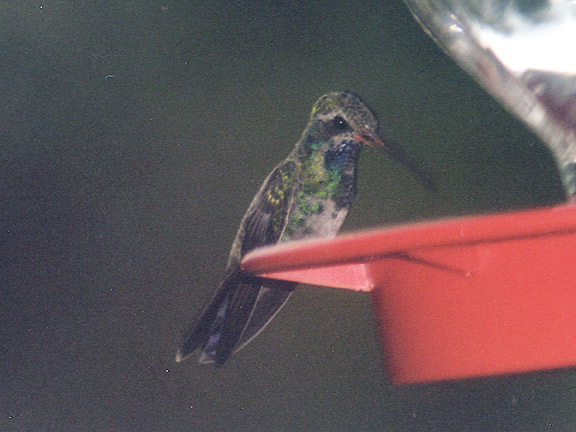
Broad-billed Hummingbird in Arizona taken in 1998 with a Canon EOS Elan IIe film camera.

I had that SLR from 1997 until it was stolen from my car one day while birding in Parley's Gulch in 2004.  I wasn't so upset about the camera being stolen, only that it had pictures of one of the only Flammulated Owls ever seen on the Great plains--luckily that year I also got my first ever digital point and shoot and managed to get a few shots with that camera as well.

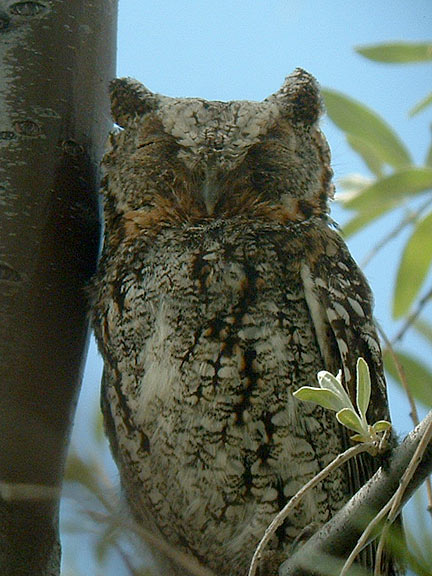
Flammulated Owl at Chico Basin Ranch, Colorado in 2004. At the time this was only the 2nd report of this species from the Great Plains.  This was taken with a Fujifilm 3.2 megapixel camera through a spotting scope.

When the insurance money for my camera came, I doled out a little extra and picked up the Canon EOS Digital Rebel, which had been out less than a year.  I think I paid close to $1000 for that camera, and picked up a 70-300mm lens to go with it.  It was an incredible step forward in technology, and image quality, and opened up a whole new world for me.  I took it on its inaugural voyage with a road trip to Oregon, where I went photo crazy.  Never had I been able to take photo after photo after photo, and not have to worry about paying for more film or printing. It was amazing!

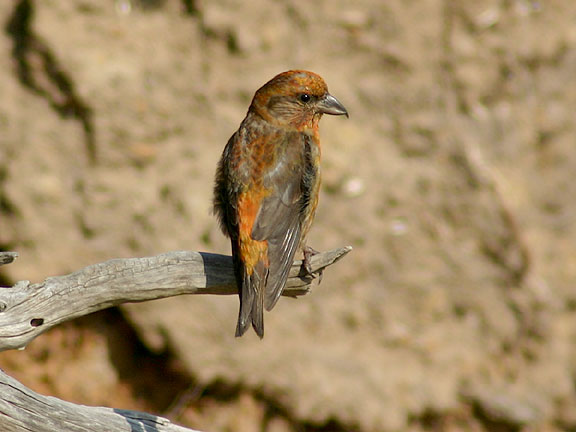
Red Crossbill taken at Cape Arago State Park, Oregon in 2004, with a Canon Digital Rebel (1st gen), and a 70-300mm lens--a major leap in technology for me.

The following winter I took it with me to Duluth, Minnesota to photograph Great Gray Owls that were irrupting in greater than normal numbers.  You wouldn't know it by the image quality, but the photos were taken with a $150 mostly plastic lens--to this day these are some of my favorite photographs.


Great Gray Owl at Sax-Zim Bog, Minnesota in January 2005, taken with my first Canon digital SLR and an inexpensive $150 mostly plastic 70-300mm lens.

After that trip my dad bought me a Canon 100-400mm lens near graduation time--with the expectation that I pay him back for the lens, which there was no way I could afford as a college student.  He never made me pay pay back... Its one of those things that I look back and think how wonderful my parents were to me, giving me the opportunities in life to do the things I wanted to.  They knew at that point I was interested in wildlife photography as a career, and wanted to help me how they could.  Although it never panned out, it became one of my greatest passions and something that without their help I probably would never have been as into it as I am.

House Wren taken in July 2005 in southern Wyoming, with a 100-400mm Canon L lens.

Since then I think I have gone through 4 or 5 digital SLR bodies, I still have the 400mm lens and will never get rid of it, but have switched mostly to a Sigma 150-500mm lens--my second big Sigma lens--for my day to day bird photography.  

Bearded Mountaineer photographed near Cusco, Peru in August 2012 using a Canon t3i and a Sigma 150-500mm USM lens, with a Canon Speedlite 580EX II Flash.

For the last year I have watched as my photo collection on timaverybirding.com climbed past 9,000 images and slowly crept in on number 10,000.  This week I finally uploaded my 10,000th photo.  I didn't choose number 10,000, and had all but forgotten about it while I was out photographing this week.  I then noticed the photo counter on my site said 10,009.  I went in and looked--surprised by what shot it actually was.  It wasn't necessarily a special photo I had hoped to upload as number 10,000, but now that its done, I won't soon forget.

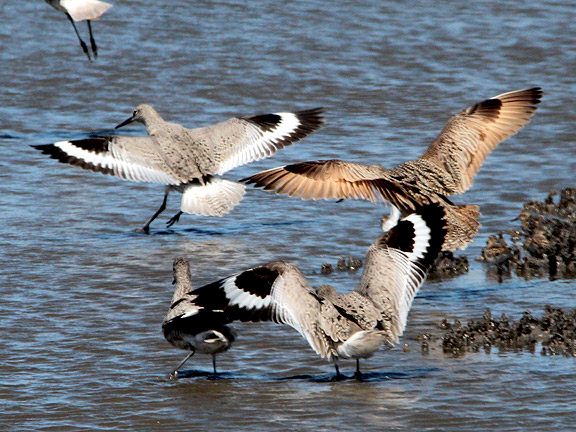
Willets and Marbled Godwit coming into land.  The 10,000th photo uploaded to timaverybirding.com.

From humble beginnings almost 20 years ago, to a Marbled Godwit with a couple of Willets at a pond in Lehi on a windy Thursday afternoon.  Those 10,000 shots are cut down from a much larger number of images.  Going back to my first DSLR I estimate I have taken nearly 400,000 images in digital format in the past 10 years.  That means that of the original images taken only 2.5% ever reach the web. 


My cameras through the years...

Another way to look at that is if I were to have bought all the film for that in 24 exposure ISO200 film in 4 packs at an average of $8 per pack, I would have bought 4167 four packs of film, and spent $33,336 on buying the film.  Breaking it down even more, that is 16,668 rolls of film... and to get that processed at an average of $3 a roll at Costco, would have cost $50,004.

So in just 10 years to be able to have captured the images I did I would have had to have spent $83,340 on a hobby. Wow.  Now granted, I never would have had the machine gun trigger finger I have with my current setup, and I would have been much more conservative with my use of film.  That means I likely wouldn't have put together the collection I managed to at this point in my life.

This includes photos of about 484 species of North American Birds, 155 species from Peru, 143 species from Costa Rica, and 42 species from Mexico--there is some overlap from country to country, but all in all I have taken pictures of about 750 species of birds.


Aside from the birds there are hundreds of photos of mammals, reptiles, amphibians, butterflies, dragonflies, and other insects.  And almost 1,000 pictures of scenery, sunsets, weird weather, the moon, and various other wonders of our world.  Not to mention all the adventures with my lovely wife over the past 5 years.  Memories to last a life time, and at a fraction of the cost that film would have translated to.

Memories to last a lifetime at a fraction of the cost.

So here is to the next 10,000, who knows what that will be and where it will happen.  All I do know is I can't wait to get there and see what stories happen along the way.

Labels: , ,

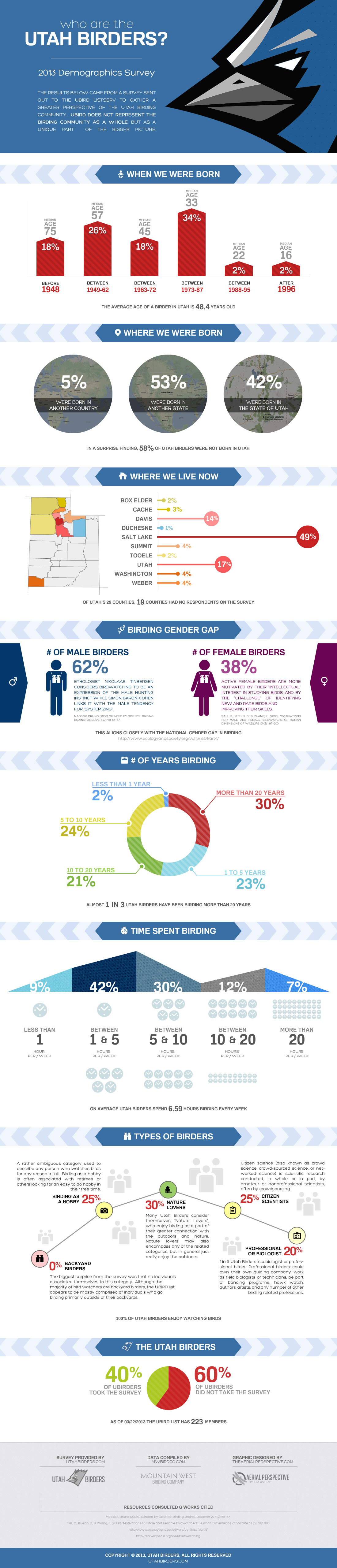
Who are the Utah Birders?

posted by Tim Avery at
on Friday, March 22, 2013 

Labels: , ,

Other Things With Wings

posted by Tim Avery at
on Monday, July 2, 2012 

I remember some years back out birding with Colby Neuman and a group of birders from Cornell.  It was during the AOU convention at the University of Wyoming in Laramie during the onset of fall migration.  We had driven out into the middle of nowhere to a spot that the day before was loaded with migrant Calliope Hummingbirds visiting the flowers along the road--it was the last place you would expect to see a hummingbird.  But there they were, zipping left and right from flower to flower and sitting on the barbed wire fence.  While I was amused with the hummingbirds I noticed the Cornell guys staring at the ground through their binoculars and wondered what in the hell they were doing.  I could have swore they were looking at dragonflies--no that couldn't be possible, there were Calliope Hummingbirds in the middle of the prairie--why would they be looking at dragonflies?

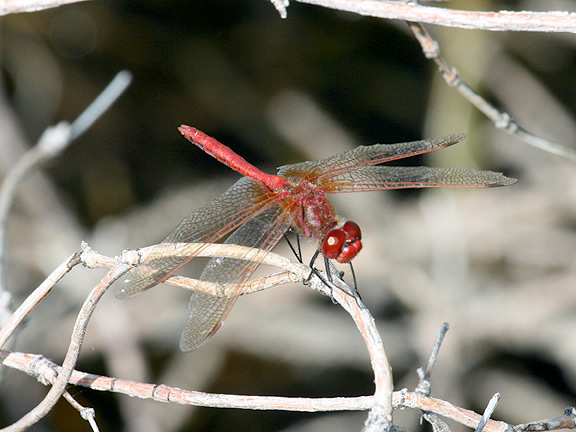
Red-veined Meadowhawk near Laramie, Wyoming

As it turns out, they were looking at dragonflies and the reason was simple, this species of "meadowhawk" was not found in New York!  A meadow huh? Meadowhawk? That's right they were dragonfly watching, and they knew the names of the dragonflies.  Now, I have always considered myself very aware of everything natural around me.  I knew there were different species of bees, butterflies, and dragonflies, but it had never occurred to me to look at them closely before.  I would take a photo if it were interesting, but aside form that, they were just sort of a side note to my time outdoors--like the flowers, trees, and rocks.  So now my interest was piqued, and for the remainder of the day as we made stops for birds the "dragonflying" (if we can call it that) continued.  I didn't think much of it at the time--I was in the midst of my Utah Big Year and when I got home it was the start of one of the best fall migrations I remember--dragonflies were cool but not as cool as the birds.  It was almost a year later when I was at Antelope Island watching a warbler along a creek when all of the sudden I really started noticing the dragonflies.  They were everywhere, and they were easy as hell to photograph.

Clockwise from top left: Lance-tailed Darner, Twelve-spotted Skimmer,
Western Pondhawk, & Saffron-winged Meadowhawk

This was all about the same time that I started to notice butterlfies a little more.  I used to give Colby a hard time because he would get caught up looking at a butterfly while we were birding--and now I was doing the same--damnit another field guide I have to pick up.  By the end of 2008 I had guides to both dragonflies and butterflies and while birding you were just as likely to catch me trying to figure out what kind of Fritillary I was looking at as you were to find me admiring the subtle plumage of a Brewer's Sparrow.

Clockwise from top left: Common Buckeye, American Snout,
Great Purple Hairstreak, and Queen

I now think about all the years spent in the midwest where I didn't pay much attention at all to the insects.  What did I miss?  What will I likely never have the chance to see again?  Why didn't I notice these things at the time?  Was it because I was so focused on bird?  More importantly, how did it take me so long to connect the dots, and realize that I wasn't just interested in birds, I also had an interest in other things with wings?  It is frustrating to think about, but I like to think that the last few years I have made the most out of it.  I am no master of ID when it comes to the non-avian flying creatures, but I give it a shot--just this weekend I spent a couple hours photographing butterflies while the birding was slow.

Clockwise from top left: Relict Fritillary, Western Sulphur,
Common Sootywing, and Greenish Blue

I can't imagine being able to identify every butterfly, dragonfly, or any other flying insect--there are just too many and some of the complexes make the empids look like a cake walk.  IF insects aren't your thing though, you can take another route--how about flying mammals?  I have always found bats fascinating--but harder than hell to photograph.  A couple years ago my wife's parents had dozens of these winged creatures flying over their neighborhood during the summer.  I took the opportunity to learn to shoot photos of moving targets in the dark.

Big Brown Bat

I definitely wouldn't say I am hooked on bats, but they are interesting and equally tough to learn.  So next time you find yourself out and about, and maybe the birding ain't so great, take a minute and see what other flying creatures might be nearby--you never know what you might find!

Is it a Fly is it a Bee? Strange weird things with wings!

You can check out all my other non bird related wildlife photos on my website through this link! If you notice anything not identified correctly, don't hesitate to let me know!

Labels: , , , ,

Soundtrack to a Moose

posted by Jeff Bilsky at
on Sunday, May 6, 2012 

Yesterday, while hiking around Washington Park and Terrace near Mountain Dell in Salt Lake County, I stumbled on a moose. I was able to get some great video that captured not just the moose, but an amazing cacophony of bird sounds as well. Just thought I'd post for any who want to pick through and try to identify everything that is singing and calling in the background. It was an amazing spring day to be in the mountains. Hope you're all enjoying yourselves out there.


Labels: ,

A Bird of a Different Feather

posted by Tim Avery at
on Monday, March 5, 2012 

This past Sunday I planned on getting out birding and running amok around northern Utah County and southern Salt Lake County with fellow Utah Birders Jeff Bilsky and Carl Ingwell.  But the plans fell through and I found myself awake at 7:30 am on a Sunday morning and wasn't sure birding was the right direction to start my day.  I mean don't get me wrong--any day birding is a good day--but I just wasn't feeling the bug at the moment, so I opted to do something different.  As the Yellow-rumped Warblers shipped in the yard, and American Robins sang up and down the block, I turned on the broiler, washed my hands and grabbed my chefs knife--it was time to make salsa. Say what? That's right--salsa.  Over the years I have crafted many a variety of the spicy condiment, and every once in a while I make a large batch to bottle and use for a few months so I don't have to make any.  Truth be told I can't stand store bought salsa--the thought of Pace Picante makes me gag. So every couple months my kitchen becomes a mini salsa factory.

Getting Prepped

The first time I made my own salsa was 4 or 5 years ago--and it was hot. Literally, so hot I could only eat a little at a time.  Since then I have retooled, changed, and updated my batches to come up with a flavor that is sweet, spicy, smokey, and savory.  Its a mix of chunky and sauce--it's the perfect blend to go along with chips, in a taco, or even on eggs. So anyways, while my tomatoes, peppers, and garlic were roasting I watched the Flickers chase the starling away from the suet.

Roasting the Goods

 Juncos came and went and the House filled with the aroma of peppers and garlic.  After the salsa was made and bottled, I decided I needed to name it--and being a birder, a bird name is the obvious choice.  There are so many birds that are evoked just by looking at the colors of salsa.  Oranges, reds, greens, and yellows bring to mind the most vibrant of birds.  But let's be honest, no one wants a wimpy "Wilson's Warbler Salsa".  Salsa has heat and can be "fierce", so it needs a name that represents that.  When I think of a fierce bird with red on it, I think of the Red-tailed Hawk--and thus, Redtail Salsa was born.
The Label

By the time I designed a label, got them printed, and adhered them to the bottles it was dark, and any chance of birding for the day was lost--aside from the feeders and a few short drives around Sandy and Cottonwood heights.  But that's okay--as today I can go birding, and enjoy a few scoops of Redtail, perhaps while I watch a  Red-tailed Hawk.  When you're a bird nerd, you can tie just about anything into birds and birding--even salsa!

The Finished Product

Labels: , , ,

A kind of continuation of my last post.

posted by Anonymous eBirder at
on Tuesday, January 17, 2012 

I love the places that birding takes me:

Cemetery. Grafton, Utah (2012)

B/W Rabbitbrush. Just outside of Virgin, Utah (2012)

Blooming Yucca in Canyonlands National Park (2010)

A goofy self-portrait on a transect just north of Craig, CO (2011).

One of my transect points in Canyonlands National Park (2010)

Labels: ,

A Competition for Utah Birders

posted by Ryan O'Donnell at
on Friday, January 13, 2012 


The birders of Cache County and the Bridgerland Audubon Society hereby challenge the rest of the state to a competition: We bet that we can find more bird species in Cache County than you can in your county in 2012.  Here are the terms of the challenge:

1. eBird is the scorekeeper.  Only observations entered into eBird count towards the challenge.  (This facilitates scorekeeping and encourages birders to use eBird to log their birding.)

2. All eBird observations for the county are included, regardless of who the observer was.  (If you want to win, it will help to encourage other people in your home county to use eBird!)

3. In order to ensure fair standards for counting rare species, at least one observation of any species on the state review list must be either accepted by the state Bird Records Committee or thoroughly and unambiguously documented (photographs, audio recordings, detailed written description) in an eBird checklist.

4. Some counties have more birds or more birders than others.  In order to make the competition as fair as possible, the winning county will be the one that has the highest percentage of its lifetime eBird list (1900-2011) detected in 2012.  For example, if at the end of the year Utah County has documented 260 species, and Washington County has documented 262, Utah County would be the winner because that is a higher percentage of their 309 species so far (84%) than it is for Washington County (76% of their 345 species).  Under-birded counties have a distinct advantage here: for example, I think it would be easy for Piute County to top their 158 species so far in eBird! Also note that there is no handicap for the number of eBird users: the more people in your home county who use eBird this year, the more likely your county is to win!  

5. The prize:  In addition to bragging rights, registered birders in the winning county get a free guided day of birding by the registered birders in each of the losing counties.  Date will be at the losers' discretion, but must be offered sometime between the first of January and the end of March, 2013.  (Note that if you register, you are committing to help lead a trip if your county loses!  You don't have to be an excellent birder to help lead the trip - just help the other birders registered in your county show the winners around some of your favorite local birding spots.)  As a bonus, the Cache County Birders may be assembling some kind of trophy for the winning county . . . stay tuned for details.

6. In order to be eligible for the prize, individual birders must register for the contest before the end of January, 2012.  If you don't register, you can still help your home county win by submitting your observations to eBird, but you won't be eligible to go on the trips if your county wins.  Only counties with at least one registered birder are eligible to win.  (Email me, Tsirtalis_at_hotmail.com, with your name and home county to register.)

This challenge is designed with these goals in mind: 1) to be fun!,  2) to encourage more birders to enter data into eBird, especially by residents of Utah's under-birded counties (it'll be easier for you to win!), 3) to encourage birders to document their rare sightings with the Utah Bird Records Committee for archival record keeping of the rarest observations, and 4) to create a fun social event next year where birders from around the state can show off the hotspots of their home county to the birders of the winning county.  Will you take the challenge?!

Sincerely,
Some of the Birders of Cache County and the Bridgerland Audubon Society:
Ryan O'Donnell
Craig Fosdick
Connie McManus
Robert Schmidt
Mike Taylor
Leah Waldner


Labels: , ,

Neat Sightings...I guess

posted by Jerry Liguori at
on Wednesday, October 5, 2011 

Thought I'd share some sightings. Every October I see a fair number of Common Loons (above left) migrating along the Wasatch and the Goshute Mountains, so keep an eye out for them. Some people are puzzled by this, but if you spend time along the ridge during fall and spring migration, you will see some neat sightings or views of birds that you don't see in the valleys.

The photo in the middle (above) is part of the Rosy Finch flock of about 500 birds that spent a month or so below Grandeur Peak along the shoreline trail last winter. They were difficult to find unless something happened to scare them up, even though they were right above the trail only about 50 ft.

The photo above right is of a dragonfly in flight. I didn't think much of it, but a friend filled me in that there aren't too many dragonfly photos of them in flight. So, I thought I would share it. I have a few more interesting photos to share down the road.


Labels: , ,

Congrats!

posted by Anonymous eBirder at
on Sunday, June 12, 2011 

Just wanted to send a quick congratulations to a great birder, friend, and blogger. This weekend Mr. Tim Avery married his beautiful bride Sam. The ceremony was wonderful, and outdoors :). Congrats, Tim!

Labels:

Issues with Blogger

posted by Tim Avery at
on Tuesday, May 17, 2011 

Last week Blogger had some database issues and in a 24 hour period lost all posts and comments that were created. This was about the time Ryan O'Donnell posted about Evening Grosbeaks and Carl Ingwell about Rainy Day Birding. Both posts disappeared for a while but came back. However, comments on both those posts as well as Jerry Liguori's post on Krider's were ALL lost and have not reappeared. If you posted comments and would like to post them again, please feel free to.

Sorry for any inconvenience that this may have caused, unfortunately we can't control much in terms of what happened in this instance as it was an issue outside our control.

Thanks for your continued support!

The Utah Birders

Labels:

The Monkey Wrench Gang (the amended version)

posted by Anonymous eBirder at
on Thursday, March 3, 2011 

I'd just like to personally thank Mr. Tim DeCristopher. Mr. DeCristopher put civil disobedience back in the national spotlight, and called much needed attention to the subject of global climate change. Thank you, Tim.

On the eve of Tim's verdict, the state of Utah is locked in a fierce debate about the designation of wild lands. One side is arguing for the development of such lands, which will surely see more natural gas, oil shale, and oil development. One side is arguing for the wilderness that my heart constantly yearns for. It shouldn't be too hard to figure out which I'd prefer.

I grew up in the Uintah Basin, where natural gas development should be a major issue right now (I doubt it is). Scientists have found unsafe levels of ozone in the air; Greater Sage-Grouse habitat is being fragmented, which will ultimately put the species in more danger than it already is; and natural gas companies are pumping carcinogens into the groundwater in a process known as "fracking" (Hydraulic fracturing).

Our own legislature is arguing against the wild lands designation. Governor Gary Herbert says that the designation of wild lands in Utah will be an economic disaster. I disagree. I think that the true economic disaster will be the destruction of the wild lands he doesn't want to protect. The true economic disaster will be extinction of native species, human cancers, erosion, global warming, etc.

I'm truly surprised that more Utahns don't support the wild lands bills, and I wish that the ones that do would be more vocal about it. Tim DeCristopher did something that I wish I had the balls to do.

Please write in support of wild lands designation in the state of Utah. Actually, please write your legislators about anything you feel passionate about. Please rally. Please practice civil disobedience. Please do something to save the planet.

Thanks again, Tim.

Labels: , ,

1 Month in the Books

posted by Tim Avery at
on Monday, January 10, 2011 

It's been just over a month since we started the Utah Birders Blog and we are averaging 1.3 posts per day. Thanks to Jerry Liguori, Carl Ingwell, Jeff Bilsky, Ryan O'Donnell, and Tim Avery for the time and effort into creating the posts we have had thus far. Hopefully a few others will start adding some content as well as the new year moves along.

Of course a huge thank you to everyone participating in the discussions. We have had some great information sharing happening here and we want to continue that as well.

Good Birding and Blogging

The Utah Birders

Labels: ,

Blackbirds Radio Interview

posted by Jeff Bilsky at
on Thursday, January 6, 2011 

Here's a link to a great interview with Cornell Lab scientist Kevin McGowan who analyzes the incident in Arkansas. LINK

Labels: , ,

Whooping Cranes Found Dead

posted by Jeff Bilsky at
 

Some more unfortunate news; 3 Whooping Cranes were found dead in Georgia: LINK

Labels:

Austin, Texas - Wild Basin

posted by Jeff Bilsky at
on Wednesday, December 15, 2010 

Well, I'm traveling again for work. Right now I'm in Texas, and luckily I was able to escape from work long enough to do some birding this afternoon. I'm in Austin and did a quick search on ebird for local birding hot spots. I selected a place called Wild Basin. It is just on the outskirts of Austin and appears to be an area that was saved from the "progress" of development - and thankfully so. It was a nice place to hike around for a bit and forget about work and everything else. I had no real agenda other than that, but thought maybe I'd see a local specialty and whatever else might be wintering there. I saw Kinglets and Hermit Thrushes. I found a Field Sparrow and lots of Chipping Sparrows and Orange-crowned Warblers. In the waning minutes of my visit, I came across a Black-Crested Titmouse and uttered an expletive-filled exclamation. It's amazing that such a thing as witnessing life can fill the human spirit with such a rush. This wasn't about a tick mark or a list, this was about seeing that in this little valley, surrounded by houses and cars, and the machines and mechanisms of humanity, lived something that millions of years of evolution and science - and whatever other words we want to try to use to describe it - placed right there. This is life. This is what it's about. Get some!

Labels: ,

Giant Stork that ate Hobbits?

posted by Jeff Bilsky at
on Friday, December 10, 2010 

From the If I could travel in time to build up my life list file comes this almost unbelievable submission.

Labels:

Birding on the road

posted by Jeff Bilsky at
on Tuesday, December 7, 2010 

While this blog is dedicated to Utah birding, I find myself currently outside of Utah. My job requires a decent amount of travel and this week, Hutchinson, Kansas is the place to be. Every time I travel I see it as an opportunity to see what birds are around. Once you've become a birder it is nearly impossible to stop looking. I can't count the number of times I've looked up in the middle of talking to clients or co-workers to have them wonder what I'm looking at. "Surely it can't be those birds?!" Well, I'm not about to stop looking because one things we birders do well is multi-task. "Don't worry, I heard what you said and I'm even taking notes, but I'm still going to look at the Red-tailed Hawk". Speaking of Red-tailed Hawks, I counted 28 total on the 48 mile drive from the Wichita Airport on KS 96-W to my hotel in Hutchinson. Tomorrow, I drive back to the airport. I can't wait to count again. And I can't wait to count on Thursday, when I'm back home in Utah, headed to the office on I-15...

Labels: , ,

Welcome!

posted by Utah Birders at
 

Welcome to Utah Birders Online! This is going to be a multi-user blog to talk about, birds, birding, bird-finding, and pretty much anything wild bird related in Utah!

Labels:


UTAH BIRDERS FLICKR POOL


    SEE MORE AND SHARE ON FLICKR