Utah Birds, Utah Birding, and Utah Birders. Promoting the sharing of information, and the conservation of habitat for birds in Utah and elsewhere. We are a group of people who want to share what we know, and create a positive birding experience in Utah.

BIRDERS BLOG

a blog by and for Utah Birders

Birding Peru part 1 - Lima & Miraflores

posted by Tim Avery at
on Wednesday, September 5, 2012 

August 19, 2012 - Arrival in Lima...

My first view of South America... In the Clouds.

From 35,000' all you could see of Peru was clouds--well clouds and peaks of the highest points in the Andes rising above.  This was our introduction to South America as our plane neared Lima.  We descended through the clouds into fog and then finally could see the Pacific Ocean below, the dunes along the Peruvian coast to the east, and finally that shacks and shanties as we approached the airport.  It was a gloomy morning on the coast, I guess it is like this most of the winter making the place seem quite inhospitable.  Once on the ground it was about an hour from deplaning to get through customs, grab our bags, and find our driver.  In the car we sped through the streets of Lima towards a suburb called Miraflores.  Lima was a dirty city, at least from the parts we visited--not the kind of place I would want to spend too much time in.  The first birds I spied from the car were ROCK PIGEONS, followed by WEST PERUVIAN DOVES and then finally EARED DOVES. The 3 were abundant throughout the city. 
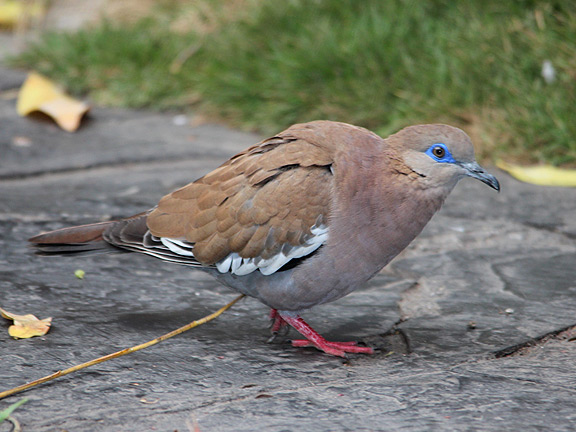
The West Peruvian Dove is superficially similar to our White-winged Dove

We dropped from the dirty side streets down tot eh coast along a highway, here the power lines and light poles were lined with NEOTROPIC CORMORANTS.  It seems like 3 or 4 birds to a light pole was the rule.  I saw my first BELCHER'S and KELP GULLS here flying alongside the roadway.  BLACK VULTURES could be seen soaring and occasionally mixed in with the cormorants.  Aside from these common birds there wasn't much else along the road.  Finally we headed up a side road back onto the bluffs above the coast, we had arrived in Miraflores where we would be staying.
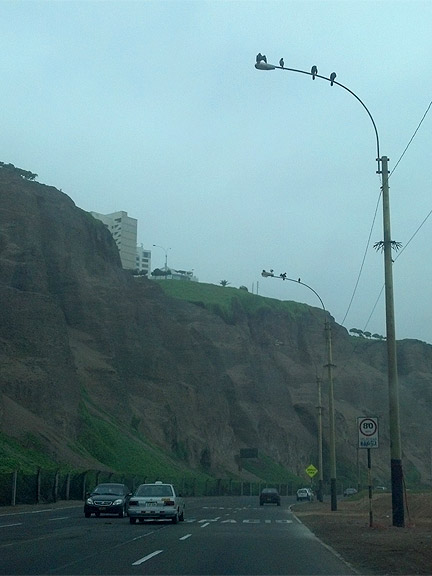
Light Posts lines with Cormorants in Lima.

In Miraflores you could tell you had entered a nicer area of the city.  It was cleaner, there were some nicer cars, and people walking dogs--most of which were wearing doggy-coats.  WE finally pulled into an alley that came to a dead end--to the left was an apartment building that rose 5 or 6 floors above the street, and to the right was a 12' cement wall surrounded by trees, and flowering bushes.  As I emerged from the car I could hear the chattering of parrots or parakeets.  It took a couple seconds to find several PACIFIC PARROTLETS at the top of trees a block or so away, but a welcome sight.  This species isn't native to Lima but is well established in many areas.  Inside the gates we flushed several WEST PERUVIAN DOVES and BANANAQUITS could be heard calling in the trees above.  I could hear other birds calling but wanted to get checked in and put my bags down.
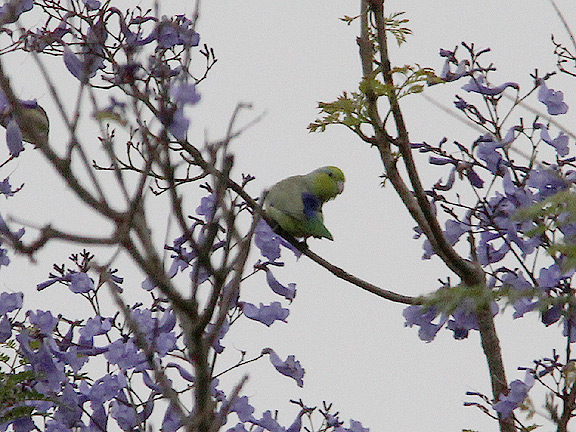
The best shot I managed of a Pacific Parrotlet high in a tree.

We were staying at a bed and breakfast called Second Home Peru.  It was located on the cliffs overlooking the Pacific and was highly touted on Trip Advisor--more importantly it wasn't a major chain.  One unexpected "ah ha" moment of the trip happened at the airport when we met our driver for our time in Lima Mr. Fernandez.  I had fully expected most of the people we came into contact to speak some English--being that we would mostly be dealing with people in the travel, and tourism industry who relied on Americans and Europeans for much of their livelihood.  This assumption couldn't have been more wrong.  Mr. Fernandez who was a great driver didn't speak any English, but we were able to make due with my limited Spanish--over the following two weeks I probably doubled my vocabulary and became way more comfortable with most of the everyday talk needed.  In any event at the B&B the woman at the front desk also spoke no English, so it a took a couple minutes to get everything taken care of.  Finally we were led upstairs to our room, where Sam promptly dove into bed and took a nap.  I on the other hand got my camera put together, grabbed my binoculars and headed out on the balcony--there were birds to be seen.
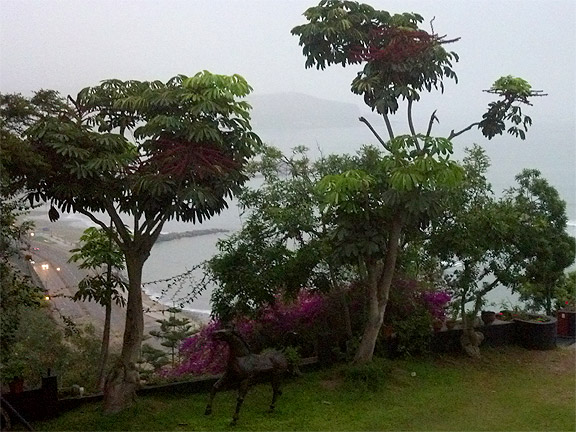
View from the Patio towards the Pacific Ocean.

The view from the balcony was amazing--too bad the fog made for a misty and somewhat limited view of what you could actually see.  BLACK VULTURES were perched on many of the buildings and trees from where I could see.  They were the most abundant bird of the high cliffs.  Below on the highway along the coast I could make out NEOTROPIC CORMORANTS, BELCHER'S GULLS, KELP GULLS, and in the distance on the water were  INCA TERNS and PERUVIAN BOOBIES.  A pair of PERUVIAN PELICANS coasted by at one point, and even further out on the water I could make out specks of 100's of birds I couldn't ID.  I turned my attention to the trees where a VERMILION FLYCATCHER popped out against the gray sky.  I had hoped to see the "sooty" morph found here--birds that are a smoky gray-brown from head to toe, and was surprised that my Vermilion here was a typical male.  It was only a couple of minutes before one of the "sooty" birds popped up on a dead limb--a cool bird, but it can't shake a stick at a typical males beautiful and striking plumage.
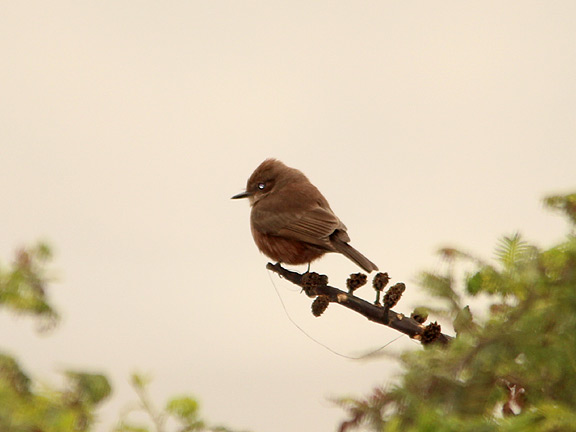
"Sooty" morph Vermilion Flycatcher in Miraflores.

A TROPICAL KINGBIRD flew in to the picture followed by a BLUE-GRAY TANAGER--both birds I was familiar with from my last trip to Costa Rica.  I decided to head to the courtyard to see what I could find there, as the trees along the cliffs weren't turning up anything new.  In the courtyard I was greeted by a LONG-TAILED MOCKINGBIRD that had no intentions of allowing me to take a photograph.  Above me I caught a glimpse of an AMAZILIA HUMMINGBIRD flying from flower to flower--it never got close for good pictures and was the only hummer I saw on the coast.  A pair of bright yellow finches landed in the trees, when I got my binoculars on them I thought they looked like SAFFRON FINCHES even though that species only occurred in the north.  A quick check of the field guide revealed they had a feral population in Lima.
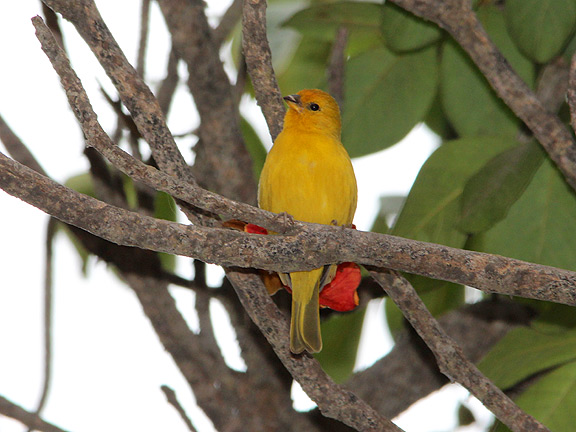
Saffron Finch posing in the garden of our bed and breakfast.

A few RED-MASKED PARAKEETS made a pass and a HOUSE WREN popped up on the wall singing like crazy.  A pair of HOODED SISKIN flew over landing in the trees for a moment before departing. I headed back to the lawn overlooking the coast and spotted a pair of HARRIS'S HAWKS circling over the bluffs.  A few BLUE-AND-WHITE SWALLOWS were now flying along the apartments to the north of us, and a couple RUFOUS-COLLARED SPARROWS appeared on the edges of the lawn.  It was early in the afternoon and I had pretty much exhausted the birding on the property. I woke Sam up and we caught a cab into the city to the Museo Larco where they have a treasure trove of Incan relics.  The gardens on the grounds provided most of the same birds from the morning.  We decided to eat at the museum since it was safe and we were there already.  As we sat in the  open air portion of the restaurant a small COLLARED WARBLING-FINCH appeared on the patio, the only of the trip--too bad my camera was back in our room!
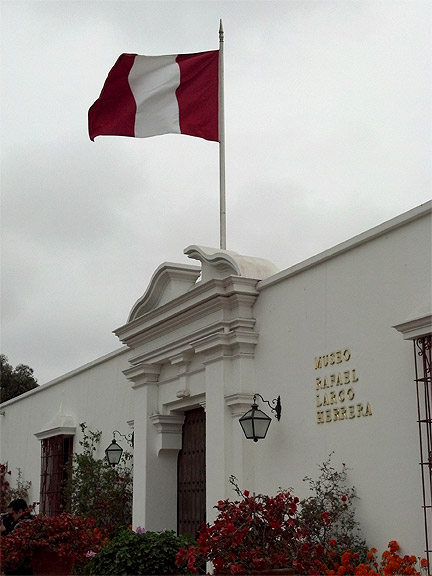
The Museo Larco in Lima is a must visit for tourists.

Our first day in Lima came to an end as we relaxed in our room, and caught up on some much needed sleep from our overnight flight.  The following day we would head down the coast to visit the Pacachamac Ruins, Pucusana Fishing Village, and the Pantanos de Villa marshes--I fell asleep thinking about the possibility of seeing my first ever wild penguins the next day.

14 life birds today / 14 total trip life birds / 26 total trip birds
Photos from Lima and Miraflores Birding on TimAveryBirding.com

Labels: , ,

Yard Lists

posted by Anonymous eBirder at
on Saturday, September 1, 2012 

For the past four years, I've been keeping a yard list (through eBird) at my Sugarhouse home.  Every once in a while I get curious and take a look at the species I've recorded here.  So far I've tallied 65 species.  Some of my favorites are:  Tundra Swans, Western Wood-Pewee, Dusky Flycatcher, Western Kingbird, Plumbeous and Warbling Vireo, 6 species of Warbler, Green-Tailed Towhee, Brewers and Lark Sparrows, and Western Tanagers.  It's been a pretty great house for birding, and I don't think it's too shabby for the middle of Sugarhouse. 

Crummy picture of a Western Wood-Pewee & House Sparrow on a power line in my backyard

What is your yard list like, and where do you live?  I'd be interested to hear from others that keep yard lists in the foothills, near the lake, etc. 

Time to go check the backyard. 


Labels: ,

It's Official

posted by Anonymous eBirder at
on Thursday, August 16, 2012 

Sunset from the Causeway, where a new 200 yard
hunting buffer was approved by the state today.

The 2012-2013 Waterfowl Guidebook recommendations, which included the 200 yard buffer along Antelope Island, were passed unanimously this morning.

 I guess we can all celebrate now, and what better way to do so than taking a trip to the Antelope Island causeway.  I'll be leading a field trip with the Great Salt Lake Audubon to the causeway this Sunday; talk about good timing.  More details about the field trip can be found here.

Labels: , , , ,

Making Playlists with Xeno Canto

posted by Tim Avery at
on Monday, August 13, 2012 

When I visited Costa Rica in 2011 I had learned very few of the bird songs and calls of the 800+ species found there.  Nothing was more frustrating than standing in thick forest and hearing squeaks and whistles of birds I couldn't see.  For the first time in a long time I was hearing noises I couldn't identify.  I was able to records a handful of songs that I later ID'd using Xeno Canto to compare to songs in their database, but for each bird I figured out there were probably 5 that I never did.  Xeno Canto is a collection of bird songs from around the world, stored in an online database accessible to everyone.  It operates under the creative commons non-commercial 2.5 generic attribution, allowing for free sharing, copying, distributing, and transmitting for non-commercial purposes.  For finding, listening to, and learning bird songs this is the one stop shop that is the golden standard .
Before Costa Rica I had listened to numerous songs on the site, but for some reason it never dawned on me to make a playlist from the library to take with me.   The songs and calls at Xeno Canto can be downloaded, set into playlists, and loaded on your iPod like any other music.  I had created numerous playlists over the years from my Peterson CDs--often creating habitat specific playlists for learning birds quickly and easily.  Today I look back to Costa Rica and think how nice it would have been to have had my iPod readily available to listen or even playback when I wasn't sure.  For Peru there was no question that I would need to build playlists.  I had read on more than one blog that in the Amazon you will see about 1/3 the number of birds you can hear.  So being able to identify some birds by song, or bring some birds in by tape would be a necessary evil.
I started downloading songs and calls nearly 4 months ago, and only wrapped things up this past weekend.  In all I downloaded some 800 species worth of "bird music".  This was surprisingly less than a gigabyte of space on my iPod, and separated out into playlists by family groups, or groupings of closely related families.  I tried to find the best recording for many species, sticking with songs for certain species, while only downloading calls of other birds.  I prefer calls because they can be used year round and make sense--where songs are used specifically for breeding birds.  Where there was no option--or few options, I just went with what was available.  For some species only 2 or 3 recordings were available--and often those were not great.
Wading through the1000's of available recordings the majority were in fact of poor quality--but none-the-less I found certain recordists whose quality and quantity of recordings made me go back to them time and time again.  Andrew Spencer from our neighboring Colorado had perhaps the best recordings for Peru and other South American countries--I would guess that no less than 1/2 of the songs downloaded were recorded by him (I believe he is one of the top contributors to the site as well).  Jeremy Minns, Tayler Brooks, and a few others also had great recordings that I relied on when available.
In the end there was no real learning of songs or calls--it is just to much for me to take in.  Listening to the songs of 30 different woodcreepers who really all sound very similar, or Tit-Spinetails that seemingly differ by just a note here and there are almost frustrating.  The calls of dozens of tanager and finches that are just seeps and clicks make me wonder if the tapes will be helpful in the end.  I have a feeling I will resort to them nto necessarily to try an ID something I hear--but to try and call in something I know is in a certain area.

Here in the states Xeno Canto is a great tool for learning birds in areas you plan on traveling to, or for building custom playlists for those areas.  It's a hassle to flip through 800 songs when you may only need 10 or so for a specific region--building that custom list could take less than 30 minutes, and while you are building it, you can be learning the songs and calls by listening to them on the site.  I know that in the future Xeno Canto is going to be my go to resource for building playlists--I guess Peru will be a a test run to see how it works out!

Labels: , , , ,

Tonight's RAC meeting.

posted by Anonymous eBirder at
on Wednesday, August 8, 2012 

The RAC meeting this evening went very well, and I didn't have to do that much speaking.

Brittany Badger, Shyloh Robinson and I arrived at 6 PM.  When we got there, we found that Kris Purdy and Paul Higgins were already there waiting for the meeting to start (Thanks for coming, everyone!).  I filled out a comment card, we did some minor catching up with Kris and Paul, and we patiently waited for the meeting to begin. 

The Antelope Island Buffer was discussed when the RAC discussed the new 2012/2013 waterfowl guidebook.  Our proposal for a no-shooting buffer was a new rule that was introduced into the new guidebook.  After the changes to the guidebook were introduced, the RAC asked for public comment concerning the issue.  I stood up to the microphone and stated that the Utah Birders were in support of the new guidelines proposed, and most notably we agreed with the 600 foot buffer proposed along the Antelope Island Causeway. 

After the guidelines were introduced, and comments were made by the public and by the RAC, and the issue was then voted on by the RAC; they voted unanimously to approve the guidelines, which included our proposed 200 yard buffer along the causeway.  Members of the RAC were then asked to comment on the vote, and one member stated that he was very happy that hunters and birders worked together to solve a complex issue concerning both parties. 

I am still in shock.  I'm overjoyed that we worked together to come to a compromise that will work out for all parties concerned.  I'm happy with the help and support I received from the birding community, and the hunting community as well.  This really wouldn't have been accomplished without teamwork and compromise. 

It's a humbling experience to feel like you've made a difference in the world, and that you've done something positive for conservation.  This has been a great learning experience and I'm glad that I had the chance to experience it. 

I forgot to thank many of those that have worked with me.  In addition to those I thanked on the previous post, I'd like to thank:  Jeff Richards and the Utah Waterfowl association, the Utah Airboat Association, Jay Banta and the Backcountry Hunters and Anglers, Kris Purdy, Paul Higgins, Don Paul, and another HUGE thank you to Jeff Gordon and the American Birding Association.

Labels: , , , ,


UTAH BIRDERS FLICKR POOL


    SEE MORE AND SHARE ON FLICKR