Utah Birds, Utah Birding, and Utah Birders. Promoting the sharing of information, and the conservation of habitat for birds in Utah and elsewhere. We are a group of people who want to share what we know, and create a positive birding experience in Utah.

BIRDERS BLOG

a blog by and for Utah Birders

Birding for a Shared Solution

posted by Kenny Frisch at
on Sunday, October 6, 2013 

On Saturday, October 5th, almost 40 birders gathered together to participate in a field trip and to receive a different kind of outdoor education.  Yes, birds were discussed along with their identifications and life histories but this trip was about something that bigger that would harm all of the birds and habitats that they need to live in:  The West Davis Corridor.

For people who don't know what the West Davis Corridor is, it is a unnecessary highway that is trying to get built in some of the most critical habitat that Utah has to offer.  It would be a highway that would raised from 14 to 30 feet in places and would be built through or right next to Utah birding hotspots around Farmington Bay and areas north.  The project would cost taxpayers $600 million and force many people to leave their homes which would be torn down to build the highway.  The Army Corps of Engineers has also recently blasted the project saying that "We believe the Locally Preferred Alternative does not represent the least environmentally damaging practicable alternative".  They have also said that Great Salt Lake wetlands "have been extensively altered during the past century to the degree that very few undisturbed habitats remain." and that the Corps "believe this underscores the importance" for UDOT to avoid and minimize "further impacts to the portions of the GSL ecosystem that remain rather than using these facts to justify focusing on avoiding impacts to the built environment."

The proposed West Davis Corridor

The field trip also brought to light the Shared Solution. It would create ways to maximize and enhance existing roads and mass transit, and move the same amount of traffic as the West Davis Corridor and possibly even more.  The field trip was led by Utah Birders in conjunction with many other groups: Utahns for Better Transportation, FRIENDS of Great Salt Lake, Farmington Ranches Homeowners Association, Breathe Utah, the National Audubon Society, Utah Audubon Council, Great Salt Lake Audubon, Utah Physicians for a Healthy Environment, Great Salt Lake Yacht Club, Utah Waterfowl Association, Wasatch Clean Air Coalition, Utah Rivers Council, Western Wildlife Conservancy, Utah Airboat Association, Bike Utah, Utah Mud Motor Association, and CleanAirNow! It also brought to light the Shared Solution- which would call for no highway to be built

The field trip focused on 3 areas that would be affected by the West Davis Corridor: Farmington Bay, Kay's Creek Nature Conservancy, and Jensen Nature Park.  Participants got to not only see some awesome birds, but the unique habitats they need to survive and the damage that would be done to them if the corridor got built.

The first stop of the day was Farmington Bay where we met at the Great Salt Lake Nature Center.  Despite temperatures around 30 degrees and frost on the plants, almost 40 people showed up.  Carl Ingwell gave a short talk to the group before the birding commenced, telling of the damages that would occur around this area if the highway was built. The highway would pass about 1/2 a mile east of the Nature Center and even closer than that to the north- it would only be around 400 feet from the north end of Glover Pond!  Both the physical pollution and noise and light pollution would be harmful to the birds of which hundreds of species use the area for breeding, migrating and wintering.

The birding started out strong with many birds being seen in the ponds just north of the nature center.  American Avocets were feeding along with Lesser Yellowlegs.  A flock of Wilson's Snipe flew in and only gave views to a few before hiding in the marsh grasses not to be seen again.  Several species of ducks including Green-winged Teal were using the ponds foreboding addition species that will soon be joining them.   The cold morning as well as the early morning sun made for great views of birds both in binoculars and in spotting scopes.  We next hiked one of the trails to a blind and got nice views of a Snowy Egret and a Red-tailed Hawk.  The area had many goldfinches visiting sunflowers as well as White-crowned and Lincoln's Sparrows and juncos using the brushy areas. The ebird checklist can be seen here: http://ebird.org/ebird/view/checklist?subID=S15329586.

Some of the birding group at Kay's Creek

Our next stop was the Kay's Creek Nature Conservancy on Schick Lane near where there were breeding Bobolinks this year.  There we met Maunsel Pearce of the Nature Conservancy who told us of the direct impacts that West Davis Corridor would have on their land where they have counted over 100 species of birds. The West Davis Corridor would be built right across the road from the conservancy and much of their land is in the projected affected zone.  The land offers pristine wetlands, fields and ponds and Kay's Creek flows right through it offering a riparian zone for migrating birds.  Even as we got out of the cars you could tell the good health of the site by all the raptors hunting in the area- Red-tailed Hawks, Sharp-shinned Hawk Northern Harriers and American Kestrels. 

 One of the many raptors at Kay's Creek- a juvenile Red-tailed Hawk

Maunsel led us back to a pond on the property.  The walk took us parallel to Kay's Creek and its double row of trees where migrants like Yellow-rumped Warblers and Ruby-crowned Kinglets could be heard and Hermit Thrushes seen.  The pond itself held some Pied-billed Grebes and Marsh Wrens.  While at the pond I walked to the far side to look for other birds when I saw an odd bird I couldn't place fly at me.  My initial thought was an odd Belted Kingfisher but Carl soon called out what the bird actually was: a gorgeous Lewis's Woodpecker, my first in Davis County.

And unexpected migrant Lewis's Woodpecker

The woodpecker took off into the distance towards an area that would be torn down if the Cooridor were to be built.  In the air there was a flock of Barn and Tree Swallows, a flyover American Pipit and some Turkey Vultures.  As we headed back to the cars a dark morph Red-tailed Hawk started soaring across the street as if to mark where the highway would go.  The check list for Kay's Creek can be found here: http://ebird.org/ebird/view/checklist?subID=S15329731

Now just imagine a 30 foot highway in the background

Our final stop of the day was Jensen Nature Park which was originally going to have the West Davis Corridor right through the middle of it.  There we met Paul Merola who lives in the neighborhood and his "crazydoodle" dog Ann who is also his birding buddy on his morning walks in the area.  He told us how now the highway is proposed to pass just west of the Nature Park.  At the park itself we heard two flyover American Pipits and couldn't help but see (and hear) the two Caspian Terns foraging the pond and the Pied-billed Grebe feeding in the pond.

 Jensen Nature Park

One of the two noisy Caspian Terns

A very cooperative Pied-billed Grebe

Paul led us back to view the field where the highway would pass through. A Northern Harrier patrolled the fields and a pair of Ring-necked Pheasants flew into the field to take some cover.

Remove the harrier, add a highway

The trees behind the ponds held many migrants.  Of course there were many Yellow-rumped Warblers but they were joined by Ruby-crowned Kinglets, American Robins, and a solitary Orange-crowned Warbler.

An Orange-crowned Warbler hung out with the more numerous Yellow-rumped

We also had the bird of the day in this same area, Stephanie Greenwood and I were making a running count of flickers with at least 7 Red-shafted Flickers being seen in the trees when I saw a brown faced bird flying at me with two dark stripes on its face.  I was confused by it until it turned and I saw a flash of yellow and started yelling out to the group "Yellow-shafted Flicker".  And this was a full 'Yellow-shafted' Northern Flicker and not just a hybrid since it had full yellow underwings, a brown face with a black mustache and red on the back of the head. What a stunning bird! The checklist for Jensen Nature Park can be seen here: http://ebird.org/ebird/view/checklist?subID=S15329761

A bad picture of a beautiful Yellow-shafted Flicker

We ended the day with 50 species seen total and with two awesome woodpecker sightings.  It was great to have such a group come out and experience first hand what damage the West Davis Corridor could do to the birding spots and Utah as a whole.  Why damage wetlands and encourage more car use when Utah has so few wetlands left and the air pollution is already terrible?  We even had a man in the group whose life would be even more directly affected- his house and barn would be torn down and his 4 acres taken away to be part of a highway.  This highway is not what Utah residents or birds need and it needs to be stopped.

For more information on the Shared Solution, you can visit: http://www.sharedsolution.org/


Labels: , , , ,

Gullstravaganza 2013 Recap

posted by Tim Avery at
on Sunday, February 3, 2013 

Utah Birders and Great Salt Lake Audubon at 2013 Gullstravaganza (photo by Oliver Hansen)

In 2011 we had lots of participants and lots of species.  In 2012 the weather cut participation, but we still had more than the usual gull species.  And in 2013 we had more than 30 participants, 4500 individual gulls, but only managed the 4 common species--the rarities just weren't to be found.  None-the-less it was an incredible day of birding with the Utah Birders and Great Salt Lake Audubon.

The week before the event we changed the location of the event to the Lake Park Facility in West Valley City because in the past month the common 4 plus Lesser Black-backed, Western, Mew, Glaucous, and Glaucous-winged Gull had all been reported from here.  9 species of gull and easy viewing made it an ideal meeting place.  The fact that Farmington had been 100% frozen the past 2 weeks also led to our trepidation of hosting the event there.  Another major change this year was the start time of 12:00 noon, instead of 8:00am.  We followed the lead of Colorado and their Gullapalooza, finding that the number of participants upped when they changed their start time to noon last year.

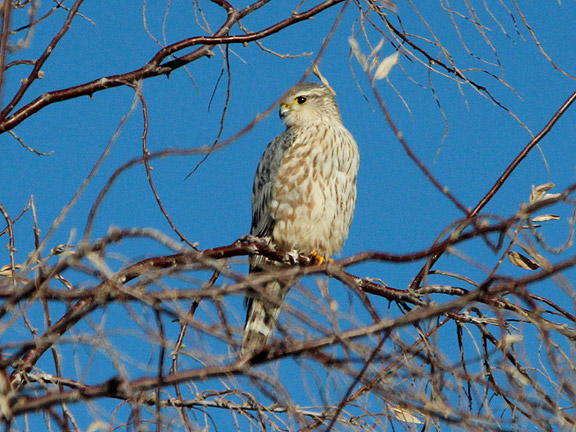
To yesterday.  Jeff Bilsky, Kenny Frisch, and I met up early to go and check the gull situation at Decker Lake, Lake Park, Lee Kay Ponds, and the International Center.  Although we knew Lake Park had the most potential, the good gulls end up showing up at all of these places.  Decker Lake had a fair number of California and Ring-billed Gulls, but no larger winter gulls.  Heading towards Lake Park we got excellent looks at a MERLIN just east of Bangerter Highway.

First Merlin of the day

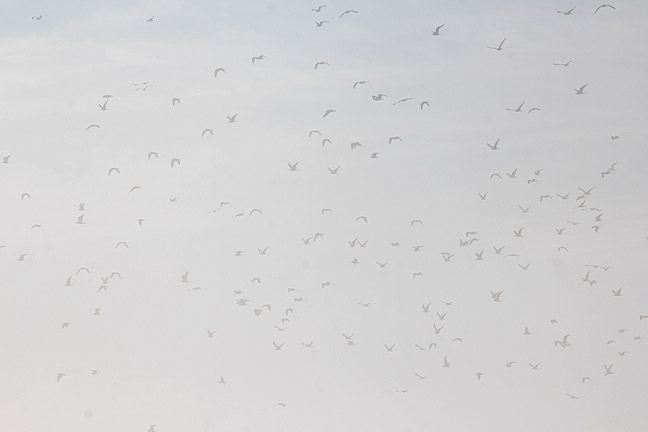
At Lake Park there were about ~1000 gulls on the Stonebridge Golf Course pond, so we figured that would be a good stop later in the day.  At the west pond at Lake Park we arrived to fog and about 500 gulls roosting next to the target Parking Lot.  When we set up scopes to try and look through them, everything took flight and circled the pond.

Gulls circling in the fog

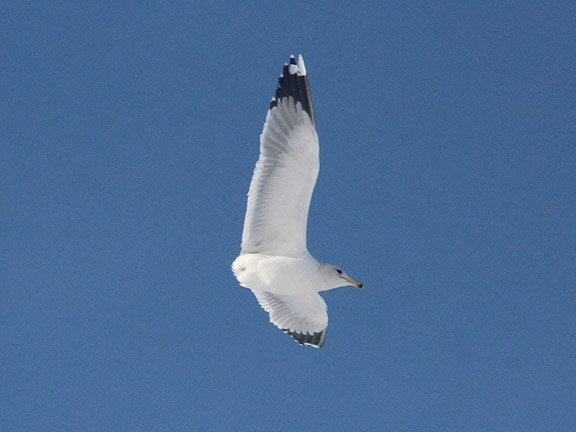
Perhaps one of the most interesting gulls of the day was seen at this time, when an adult California Gull with NO TAIL passed over us.  It looked almost comical yet sad without that tail.

The "tail-less" California Gull

We couldn't see the water because the fog was thick so we set out to the other locations mentioned.  Besides more fog and bad light, the only bird of note was a MERLIN on 7200 west by the landfill.

Second Merlin of the day

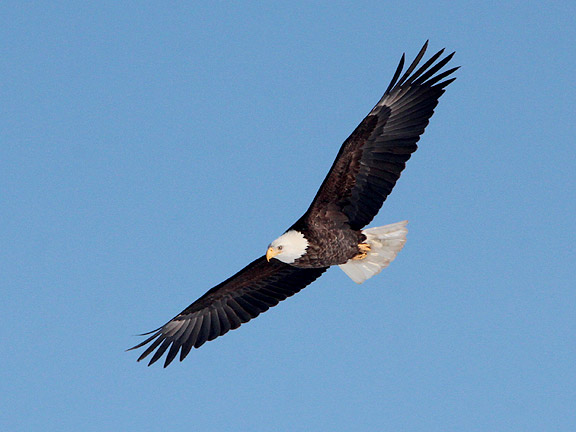
We headed back to Lake Park to wait for the trip to begin.  While we waited a BALD EAGLE made a pass and most of the gulls left.

Perfect lighting and being in the right place got this Bald Eagle photo

The gulls started to trickle back in as the birders did as well.  We waited till about 12:15 to start looking at gulls, because more and more people showed up.  All in all, including guides there were a total of 36 participants during the day--by far the biggest field trip we've organized.  The amazing thing is its a trip for gulls, and its in February!  Needless to say we were very happy with the turnout.

We took the group and crossed the field from the Target where we met and headed to the west pond at Lake Park.  As we walked over hundred of gulls came pouring into the basin from the north.  It was a perfect start to the trip and gave everyone the opportunity to be immersed in the gulls.  We set up and started scanning the 400 gulls on the water.  The majority were the common 2, but there were a number of HERRING GULLS mixed in, and one 1st winter, and one 2nd winter THAYER'S GULL.  Both Thayer's took flight shortly after we started looking at them.  After exhausting the gulls here, we walked around the pond and ogled the gulls in the field next to the Target.  Nothing new mixed in but we set up some great scope comparisons of Herring and California Gulls and giving us a chance to show everyone a 1st winter California Gull.

1st winter California Gull with adult California Gulls

Figuring their would be some mixing up, we headed everyone to Lee Kay Ponds to give Lake Park a bit of a rest.  At Lee Kay there were about 800 gulls on the ice.  The lighting wasn't great, but even with what we had, there was nothing out of the ordinary mixed in.  The highlight for many was a FALCON (probably Peregrine) that was dive bombing a flock of starlings far out over the dump, and a Bald Eagle perched along the power poles.

We checked out the International Center where about 250 Ring-billed Gulls and a handful of California were roosting on the ice.   Again, nothing unusual mixed in.  A Red-tailed Hawk flew over flushing all the gulls which left, and headed south towards Lake Park.

At this point we headed everyone back to Lake Park and headed to the main pond at Stonebridge Golf Course.  We found decent lighting on the northwest side of the pond and spent considerable time scanning the large flock on the ice.  Again, nothing unusual was mixed in.  It was almost unbelievable to have looked through so many gulls and not being able to find a single odd ball.  It was also a little frustrating because we knew there had been some really good birds here within the last couple days.

To end the day we headed back over to the west pond and made our way to the west side of the field south of Target where we had great lighting to view the gulls there.  Again, the common 3 gave great looks, and in the light provided ample photo ops.

Adult California Gull flying by

Ring-billed Gull coming in for a landing

Then it was really an odd moment when a domestic Mallard x wild Mallard hybrid flew over and all of the gulls took flight.  It made for awesome photos.

The whole mess of gulls taking flight

David Allan and his daughter (I'm sorry it slipped my mind) met up with the group at this last stop.  They drove all the way from Millard County up to Salt Lake and she had really hoped to see a Thayer's Gull for a life bird.  It was was great to see someone so young really excited about gulls.  And luck must have been on her side a few moments after the explosion of gulls Jeff yelled out that a Glacuous Gull was flying over-- I looke dup and yelled it again loud enough for everyone.  To the bare eye it looked like a great white ghost form beneath, but when I got my viewfinder of my camera on it, it became obvious that it had darker wing tips--THAYER'S GULL!  

3rd winter Thayer's Gull flying past at the end of the day

At first I thought it was the same 2nd winter bird from this morning, but after looking at the pictures I would say this is a 3rd winter bird, but think it was still the same bird from the morning because of the unique mess of a bill it had.  In any event it was a great lifer moment for the young birder from Millard, and made the trip really worthwhile there at the end.

Shortly after we called it a day and thanked everyone who had come.  Despite the lack of species, it was still  one hell of a great trip.  We raised $130 for Great Salt Lake Audubon, and got some great feedback from those who came.  It may be 12 months till the next Gullstravaganza but we are already thinking of ways to make it even better in 2014!

Thanks to everyone who came and made the event so great.  As a side note we learned that others headed back north made stops at Farmington Bay WMA where both WESTERN GULL and LESSER BLACK-BACKED GULL were present!  I guess we still should have hit 6 species for the day, but still no complaints from our end!

Labels: , , , , , ,

Bridgerland Audubon Society Field Trip: Antelope Island

posted by Ryan O'Donnell at
on Sunday, November 11, 2012 

Yesterday I led a group of seven birders on a field trip to Antelope Island for the Bridgerland Audubon Society.  This was a good turnout considering the weather: our first big snowstorm of the season had arrived the day before, and there were several inches of fresh snow on the ground and more was predicted for the rest of the morning.  Temperatures were predicted to reach highs just below freezing.  Even while meeting in the parking lot, though, our efforts were already being rewarded: a flock of about 8 EVENING GROSBEAKS flew overhead while we were waiting to depart.

The roads were not too bad, and before not too long we arrived at the Antelope Island Causeway and saw the first effects of the shifting weather on the birds: the storm had pushed hundreds of LEAST SANDPIPERS to the causeway.  By counting a small group and estimating how many groups that size we saw along the causeway, we estimated 500-700 Least Sandpipers.  According to eBird, this is the highest single checklist count of this species in Utah since a 1974 count at Fish Springs National Wildlife Refuge. Among the Least Sandpipers we were able to pick out one WESTERN SANDPIPER, three GREATER YELLOWLEGS, and several hundred KILLDEER. We learned to identify the common GULLS of the area, and saw four species: RING-BILLED, CALIFORNIA, BONAPARTE'S, and HERRING. One GREAT HORNED OWL perched on the snow near the causeway was a highlight for the group.

A Great Horned Owl perched on the snow along the Antelope Island Causeway.  Ryan O'Donnell photo.

One of the big draws of Antelope Island is the chance of spotting rare vagrant ducks, and as usual, the famous second bridge didn't disappoint.  A HARLEQUIN DUCK was first found along the causeway about three weeks ago, and continued for us.  We were also able to find three SURF SCOTERS at the same location.

A Harlequin Duck continued to oblige along the Antelope Island Causeway.  Ryan O'Donnell photo.

Three Surf Scoters pose together nicely for a photo, with a Lesser Scaup in the background. Ryan O'Donnell photo.

On the island itself, we started by driving up to the visitor's center for a bathroom break, but before we could make it there we found another rare bird for this time of year, a SAGE SPARROW.  We had brief looks at this bird up on top of a shrub before it dropped back down into the vegetation.

A late Sage Sparrow that should be migrating south soon.  Ryan O'Donnell photo.

At the visitor's center, the feeders gave us close looks at a DARK-EYED JUNCO, a CALIFORNIA QUAIL, and several CHUKAR.

A California Quail and a Chukar wait for their turn at the bird feeder at the Antelope Island Visitor's Center.  Ryan O'Donnell photo.

As we drove down the island towards historic Garr Ranch, we saw several more raptors, including ROUGH-LEGGED HAWKS and RED-TAILED HAWKS, and had a brief look at an unidentified SHRIKE.  We also added to our mammal list, with a COYOTE, many BISON, and very close looks at a herd of PRONGHORN.

A Pronghorn, part of a herd that blocked the road for a little while on our way out to Garr Ranch.  Ryan O'Donnell photo.

At Garr Ranch itself, we worked the trees around the spring and another pond to the south pretty thoroughly.  One of the first good birds here was a NORTHERN GOSHAWK right around the spring.  This species is very rare at Antelope Island - according to eBird this is only the second record for the park.  

An immature Northern Goshawk at Garr Ranch.  Mike Fish photo, used with permission.

Other raptors in the area included a RED-TAILED HAWK, an adult COOPER'S HAWK, a NORTHERN HARRIER, and this GREAT HORNED OWL, our second of the day.

Great Horned Owl at Garr Ranch.  Ryan O'Donnell photo.

The park ranger led us down to another small clump of Russian Olive trees where a very large MULE DEER buck had been hanging out.

A very large Mule Deer buck guards his harem at Garr Ranch.  Ryan O'Donnell photo.

Garr Ranch is famous as a migrant trap, a place where lost birds tend to show up when they get blown or wander off course.  We didn't find any great vagrants when we were there, but we did get some great looks at some common species, including this HERMIT THRUSH, and one out-of-season BROWN-HEADED COWBIRD.

One of two Hermit Thrushes at Garr Ranch.  This individual is pretty red, and I wonder if it might be in the eastern/northern subspecies group, rather than one of our local breeders.  Ryan O'Donnell photo.

A late Brown-headed Cowbird, or should I say "Brown-headed Horsebird?," 
found a warm place to perch in the snow at Garr Ranch.  Ryan O'Donnell photo.

Finally, before leaving the ranch, we checked the silo for BARN OWLS and came up with one.  Or, the wingtips and tail of one, at least!

"It counts."  These weren't the best looks one could hope for at a Barn Owl, but the wingtips
and tail are distinctive enough to identify the bird.  Ryan O'Donnell photo.

We ended the trip at Garr Ranch, but had a few more sightings on the way back to Logan, including three or four COYOTES, a couple of PORCUPINES, and a LOGGERHEAD SHRIKE.  

Join us for our next trip, on December 8th, and for the Logan Christmas Bird Count on December 15th.  See our website for details on this and all future trips, and contact Bryan Dixon to sign up for the Christmas Bird Count at bdixon@xmission.com.

Here are links to the complete eBird checklists from our trip, including a few bonus photos:

http://ebird.org/ebird/view/checklist?subID=S12010993
http://ebird.org/ebird/view/checklist?subID=S12011069

Labels: , , , ,

2012 Marathon Birding Recap - A Month Late

posted by Tim Avery at
on Monday, June 25, 2012 

It seemed like we just finished our big day when Jeff and I were back at it again with the Marathon Birding Trip for the Great Salt Lake Bird Festival on Sunday May 20th.  Take away a few miles, and a couple hours, throw in 14 other people, and you've got yourself a logistics nightmare trying to get 14 eyes on every bird.  Add in a car breaking down, and an eclipse that darkened the skies 2 hours early and the odds were not in our favor.  Yet, everything turned out alright in the end. In fact some how despite falling behind schedule almost from the start we ended up with our 2nd biggest Marathon total to date--only 6 short of a new record with 136 species recorded.  And something this year that really stood out wasn't just the number of species, but the quality of some of those species we got.  As usual some of the misses make me cringe just thinking about them--and how 150 species should have been a cinch!

But that's neither here nor there so lets talk about the trip.  Just after 6:00am we rolled out of Farmington with 3 mini vans, 2 guides, 3 drivers, 10 participants, and special guest Greg Miller (The Big Year).  Greg was a fun guy to go birding with and provided a ton of interesting information, plenty of funny comments, and made the experience memorable for everyone.  Our first stop was the ponds at the end of Glover Lane which were pretty dead in comparison to past year--very few waterfowl and shorebirds.  Plenty of FORSTER'S TERNS provided great looks for all.  We made our way into Farmington Bay where right inside the entrance we snagged a couple of great birds for the day.  A drake BLUE-WINGED TEAL and a SPOTTED SANDPIPER accompanied the various other waterfowl and shorebirds.  Both SNOWY and GREAT EGRET were picked up along the road to Egg Island.  At the raised parking area we got stellar looks at a WHIMBREL, a number of Long-billed Curlews, and 1 MARBLED GODWIT in the grass to the west.  A lone BLACK-BELLIED PLOVER, and a handful of Dowitchers were in the distance.

Common Yellowthroat at Antelope Island Causeway

Anyways, we left Farmington and headed to Antelope Island picking up AMERICAN CROW on Antelope Drive.  At the entrance station to the park a COMMON YELLOWTHROAT was in the bushes just singin' away.  On the causeway was a shorebirders delight.  Plovers, sandpipers, sanderlings, curlews, willets, whimbrel, phalarope, killdeer, knots, turnstones--it was a Thanksgiving Dinner and there was something for everyone to eat.  We started getting the easy stuff then the really good stuff, then the okay stuff.  People were getting new Utah birds, new life birds, and new year birds.  After a while I got down to business and started scoping the plovers--around 1,200 BLACK-BELLIED PLOVERS were there and mixed in were a few treats.  I found an AMERICAN GOLDEN-PLOVER still in basic plumage and everyone got great looks.  Then it was about 30 minutes of checking bird by bird looking for a reported PACIFIC GOLDEN-PLOVER from the previous day. GOT IT! Feeding on a mudflat about 150 yards out with a handful of Black-bellied.  The bird was still molting and seemed to have all the right features.  Front heavy, long slender bill, short primaries, thick white patch on the neck, and a beautiful golden back.

Possible Pacific Golden-Plover
at the Antelope Island Causeway

After having spent way too long on the causeway, we headed towards the island.  On the way we picked up another GREAT EGRET--funny to see one sitting along the edge of the briney water.  As we entered the island we added a surprise LARK BUNTING--an exceptional new day bird.  Everyone got to see the bird before it disappeared over the hill and we moved on.  We snagged the island regulars on the loop to the corrals and back before hitting the road north to Willard Bay.

Lark Bunting at Antelope Island

At Willard the GRAY CATBIRDS were out in force as well as the orioles, Yellow Warblers, Western Kingbirds, and grosbeaks.  Surprising was that we had ZERO empids here.  As we went to leave the van Jeff was riding in wouldn't start.  After a few minutes they got it started and we decided to head to the Flying J in Willard to decide what to do.  We found out we could get another vehicle delivered but it would be 45 minutes.  We took a break, had lunch then got everyone back in the cars and headed to Bear River Road.  The broken van made it up there, but not before they got the check engine light. We drove a short ways out the road just enough to find 4 EASTERN KINGBIRDS along the fence line. As we headed back towards the freeway the backup car arrived and we switched out vehicles--then headed towards Cache County.

Eastern Kingbird at Bear River MBR

A quick stop at Mantua didn't turn up anything new for the day except a TREE SWALLOW.  We skipped ALL of our usual Cache Valley stops to try and catch up on lost time--plus the potential for new birds was limited.  Our next stop was along the Logan River to scan the cliffs for swifts.  We managed to pick up VIOLET-GREEN SWALLOW--which were flying over the ridges in the hundreds.  Greg spotted a WHITE-THROATED SWIFT amongst the throngs, while a couple high flying birds that looked to be swifts were just specks in the distance.  We also managed to see our only WESTERN TANAGER of the day here--as well as a singing FOX SPARROW, and LAZULI BUNTING.  At a second stop we added AMERICAN DIPPER but nothing else.  Next we decided to try something different.  In the past the road to Tony Grove has always been closed for this trip--this year it was open.  The long drive in and out takes a lot of time, but we added a bunch of species, including a couple birds we haven't had on the trip before.  Most notably were a pair of WHITE-WINGED CROSSBILL that were foraging on the side of the road, and a HAMMOND'S FLYCATCHER in the same area.

American Dipper in Logan Canyon

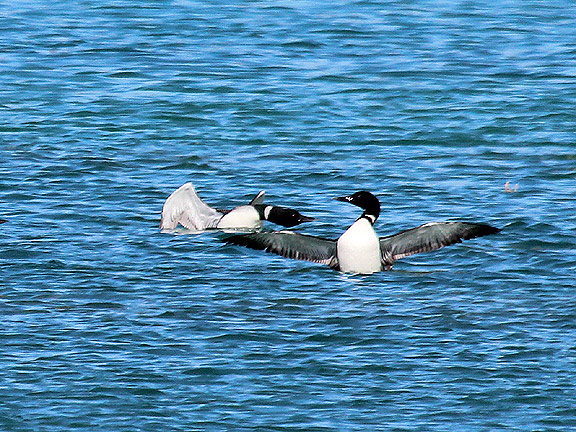
We picked up most of our high mountain species here, and what we didn't get on the road, we tracked down at Franklin Basin Road.  Big misses were all the mountain woodpeckers minus Flicker.  No sapsuckers, no Hairy, and no Three-toed--and we didn't get any of them later.  In fact the only woodpecker we got all day was NORTHERN FLICKER.  We skipped Beaver Mountain then cruised out of the high country to Bear Lake where we picked up COMMON LOON on the southwest shore. This was a first for this trip route.  It was fun to watch the loons chase and harass one another on the vibrant blue water.  Heading east towards the Wyoming border hoping to pick up some raptors we were missing on a portion of the route that normally produces.  It didn't let down as we added GOLDEN EAGLE and PRAIRIE FALCON along the way.

Common Loon at Bear Lake

Continuing to adjust our route, we skipped out on the majority of the Deseret Ranch Lowlands and instead only drove the first couple miles of Home Ranch Road where we added AMERICAN WIGEON and VESPER SPARROW.  Several WILSON'S PHALAROPE provided great looks just off the road which allowed for a nice photo opportunity.

Jumping the border we made our way to Woodruff Narrows Reservoir in Wyoming and added RING-NECKED DUCK on the water, NORTHERN ROUGH-WINGED and BANK SWALLOWS rounding out the swallows for the trip, and BREWER'S SPARROW which had been scant throughout earlier stops.  As we were leaving the last car with Jeff spotted 3 GREATER SAGE-GROUSE just off the road.  We were a 1/4 mile up the road and had to flip a u-turn to get back.  Our car saw the birds as they disappeared over the hill, and the 3rd car barely got looks--far from satisfying.  But all as not lost--as we turned to leave Mike spotted another grouse further up the road.  We saw one and it disappeared into the sage--so I walked with Greg out to see if he could get a photo.  Little did we know that one bird was with 5 others that waited till we were right on top of them before taking flight.  This time everyone saw the birds as they circled and dropped deeper into the sage flat. By now we were more than 2 hours behind schedule and rolled into Evanston around 7:00pm.  We took a quick dinner break as the sky started to dim as the sun and moon met in the sky to the west.  


"The Eclipse" - Lens Flare 

We had to chop out a couple of huge stops that could add 5 to 10 more species just to make it back into the mountains to try for a few more birds we needed.  We raced down I-80 towards Echo then cut over to Henefer and up East Canyon above the reservoir.  At Jeremy Ranch Road we missed Swainson;s Thrush, it may just be a tad early--but further up the canyon we added HERMIT THRUSH before dark.  A staked out RUFFED GROUSE site had been disturbed by people placing a power generator and gas can 5 feet away form the log the bird was using.  The grouse was there but left the log when I went to see if it was there.  Several in the group did get to hear it drum before it wandered off.  Unfortunately, I imagine this site will probably end up failing due to the generator and people in the area.

Ruffed Grouse in East Canyon

As darkness settled a breeze picked up and the forest grew quiet--Jeff and I both heard a FLAMMULATED OWL hooting but it quickly faded.  As we tried for the birds after we had no responses.  Jeff wandered down the road a few hundred feet and found another owl so the group followed--by the time we got there, silence.  And for 15-20 minutes nothing--well nothing but cars. It became frustrating--but even more so when an Owl out of nowhere would start hooting right as the cars were coming, then stop when the cars were gone. I was beginning to worry that we would miss looks at this tiny owl that was always a special end to the trip.  Then as a car headed up the road and one of the tiny birds started to hoot again I headed towards the sound.  The bird sounded close, and the car passed giving me a clear direction to the bird.  I didn't hesitate, putting my flashlight on what seemed like too small a tree for any owl, but as I scanned up the trunk of the tiny tree, there on the tiny limb was the tiny owl.  Everyone came towards me getting looks at the owl before the bird finally sick of the attention retreated into the woods.

For a number of attendees this was a highlight and a life bird.  For Greg Miller it was a visual lifer, one of very few birds of North America he had heard--but not seen.  Impressive for someone with a life list approaching 800.  While we were trying for the owl at one point Jeff called out a COMMON POORWILL but no one else heard it.  About 5 minutes later I heard the bird, but then it went quiet again.  And that's it.

We made another stop to try for Saw-whet and/or Pygmy-Owl, but nothing responded to my persistent whistling.  We headed back towards Salt Lake, then Farmington getting everyone back around 11pm.  17 hours, 136 species, and more than 300 miles later, another Marathon Birding Trip was over.  At the end of these days it is always crazy to look back and see what you missed.

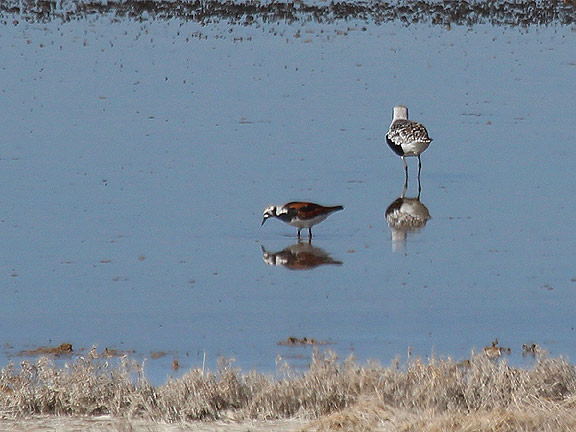
It's crazy for instance to think that we saw RUDDY TURNSTONES, but not Ruddy Ducks.  Or that we saw WHITE-WINGED CROSSBILLS, but not Red Crossbills.  Or how about the fact we had TWO species of GOLDEN-PLOVERS, but not a single Snowy or Semipalmated Plover.  

Ruddy Turnstone at the Antelope Island Causeway

We had no Scrub or Steller's Jay, no wodpeckers besides flicker, no empids besides Hammond's, and not a single Black-chinned Hummingbird.  This year might have had the most surprise misses.  Over the past 5 years the thing that has seemed consistent was a later than normal spring--this year we were weeks ahead and in the past where birds were clumped together in the mountains in search of food, now they were spread out on territories.  It made for an interesting time--but as always a great marathon trip!

On the drive home Jeff and I talked about the trip and the biggest dislike we have is the amount of driving time between stops.  Too much time is spent in the car trying to get to new patches of habitat to pick up 2 or 3 birds to keep building the number up--so next year we might switch things up a little and change the route to allow more time for birding--and maybe even more birds.  I guess we will have to wait another year to find out!

Labels: , , , , , ,

Antelope Island Field Trip 10/29/11

posted by Jeff Bilsky at
on Tuesday, October 25, 2011 


ANTELOPE ISLAND CAUSEWAY and GARR RANCH
Saturday, October 29th, 8am
Leader: Carl Ingwell

One of the premier birding locations in Utah, there is never a bad time to visit Antelope Island. Join Carl Ingwell as he leads us across its varied habitats in search of the many, diverse inhabitants. We'll check the causeway flats for shorebirds, followed by a pleasant, meandering drive across the rolling fields, hills, and tree patches to the storied 'hotspot' of Garr Ranch. We'll be looking for late fall migrants as well as early winter residents throughout our travels. There will no doubt be many surprises along the way. Won't you join us for what is bound to be a memorable trip? Meet in the south-east corner of the Shopko Parking Lot in Sugarhouse by 8am. Bring snacks, water and lunch. Call Carl (801-688-5017) for more information.

Labels: ,

BAS Field Trip Saturday: Cache County's High Mountains

posted by Ryan O'Donnell at
on Wednesday, July 13, 2011 


This Saturday, 16 July 2011, join me and the Bridgerland Audubon Society as we hike around Cache County, Utah's Tony Grove Lake and towards Naomi Peak in search of the specialties of our high mountains. Target birds include Red Crossbill, American Three-toed Woodpecker (above), Clark's Nutcracker, Golden-crowned Kinglet, and Steller's Jay, among others. Rarities seen in this area in previous summers include Band-tailed Pigeon, Red-headed Woodpecker, and White-winged Crossbill (below). Pack a lunch and lots of water, and be prepared for a strenuous hike, but at a slow birding pace. The trip is free, but bring a few dollars to help cover the $5 parking fee. Meet at 8 a.m. in the parking lot between Caffe Ibis and the Logan Fire Station (50 East, 150 North, Logan). All skill levels are welcome. We will be back in the mid-afternoon.

Labels: , , ,


UTAH BIRDERS FLICKR POOL


    SEE MORE AND SHARE ON FLICKR