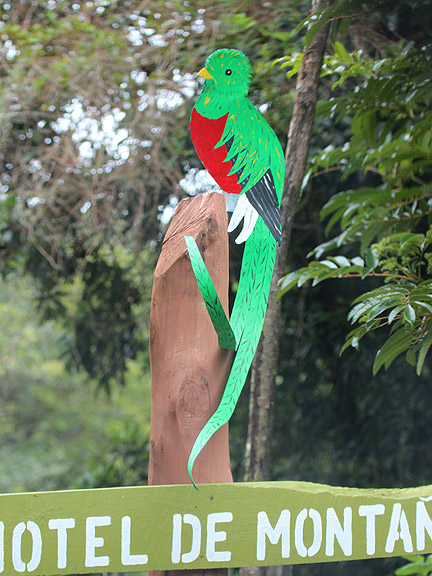
Signs like this dotted the Roads in the Highlands
The mountains that split Costa Rica into the Pacific and Caribbean sides rise up from sea level to over 13,000 feet and run from the Panama border north to Nicaragua. From the lowlands you pass through various stages of jungle and rain forest into the cloud forests and the Paramo. The terrain above the tree line is reminiscent of that in the high Uinta’s but with far more and interesting vegetation. The cloud forests are lush and humid, and unlike anything in North America. On our last 2 days in Costa Rica we traveled through the mountains—the following wraps up our 10 day adventure honeymoon in Costa Rica (I know--9 months later).
Day 9
On Monday the 20th we packed the car early in the morning, and left Uvita around 7:00am to head north into the mountains, back to San Jose and to end our trip at the Poas Volcano. From Uvita we traveled up the coast about 20 miles before turning east and following the Rio Baru up into the hills. The windy road took a while, but after about an hour we rolled into San Isidro de General. We made one stop just to the west of town on an overlook where
BLUE-AND-WHITE SWALLOWS were circling. Several
SHORT-TAILED HAWKS were soaring over the road, and a few miles down Sam spotted a
CHESTNUT-MANDIBLED TOUCAN sitting on the side of the road.
San Isidro De General from above.
After stopping for a few minutes to refuel and grab some food, we hopped on the Pan American Highway to begin our accent into the Talamanca Cordillera and the most reliable location in the world for Resplandant Quetzal. The actual distance to Kilometer 70 and the stretch of high elevation highway was only 40 or so miles, but the two lane “highway” was slow going because of the traffic and the visibility. As the road rise in elevation you enter the clouds and the visibility drops to under 100’ and in some areas even less. It took about an hour and a half from leaving the valley before we emerged above the clouds into the blue skies near Villa Mills. We took the drive out to the town to see what we could find but only encountered a
RUFOUS-COLLARED SPARROW.
One of numerous Rufous-collared Sparrows seen in the area.
Hopping back on the highway we kept heading north. Along the highway we started spotting
SOOTY ROBINS everywhere. I pulled over to photograph one which posed nicely a few feet from the car.
Sooty Robin along the Pan-American Highway
Further up the road we pulled over again where I could hear what I thought was a
WRENTHRUSH calling form the understory. As I sat pishing several birds started moving around and sure enough the Wrenthrush moved to the edge of the bushes. I had heard this bird was very difficult to get good looks at, and was glad I was able to see it nicely.
Secretive Wrenthrush peeking through the understory.
A little after 10:00am we rolled into Kilometer 70 and took the road to Paraiso de Quetzal to see if we could find one of the most sought after life birds for birders around the world. It had started to sprinkle as we arrived and I knew that was a possibility as we were in the rain forest, and more specifically the cloud forest where currently we were in the clouds! Along the road in there were several
NIGHTINGALE-THRUSHES perched on snags and the ground nearby. We parked at the hotel, and walked in just as several people were heading up the mountain to go look for quetzals. Inside they spoke basically no English but we were able to talk out what we wanted to do. They pointed us to the back of the building and the hummingbird feeders and was truly a spectacle. At the feeders were dozens of
FIERY-THROATED and MAGNIFICENT HUMMINGBIRDS fighting over the sugar water. I say dozens and I mean it; about two-dozen of each species were flocking to the food source. And they were not afraid of people at all.
Fiery-throated Hummingbird at Paraiso de Quetzal
After spending some time taking pictures and enjoying the show, the guide took us and we headed up the hill into the wild avocado orchard. The switchbacks up were paved and after a few minutes we were in the forest.
NIGHTINGALE-THRUSHES were singing everywhere. As we walked the guide started to whistle, switching back and forth between Costa Rican Pygmy-Owl and a Quetzal call. Some birds were reacting but no quetzals came in.
YELLOWISH FLYCATCHER could be heard calling in the trees, along with
OCHRACEOUS PEWEE, RUFOUS-BREASTED WREN, and G
RAY-BREASTED WOOD-WREN. A small flock of
BARRED PARAKEET came flying over and were gone in a moment, but the high elevation specialty was an exciting pickup.
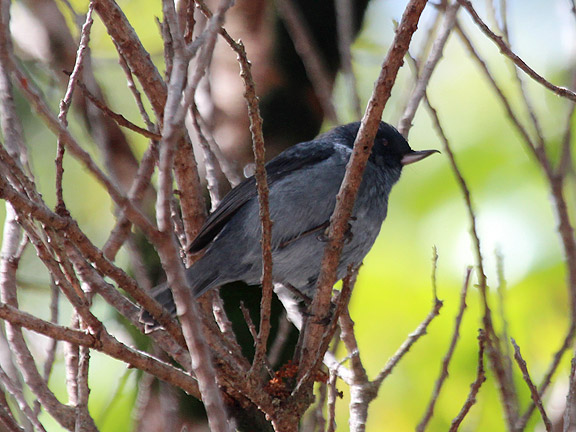
Black-billed Nightingale-Thrush at Cerro De La Muerte
After walking around a while the guide stopped and start whistling again, then he pointed and said,
“TAPACULO”. Two
SILVERY-FRONTED TAPACULO were chattering in the brushes ahead of us. I started pishing and one shot out across the trail into a bush nearby. Despite my best efforts the bird would not emerge for photos, but I was happy with the brief glimpse. Further up the trail the guide stopped again and started whistling—this time about 20 or 20 hummingbirds came in and were circling above us. I had never seen anything like that and it was pretty cool to watch—but still no quetzal. The ground was like a bog and the rain was constant. After an hour in the forest I told the guide, we were done. Sam said we could continue, but it seemed pretty hopeless. Hiking back the guide stopped and pointed out a couple
VOLCANO HUMMINGBIRDS feeding in a bush nearby. My camera was away in my backpack and I didn’t want to take it out in the rain to try and get a photo because I thought I would see more—I never saw another.
The Only Quetzals we saw at Paraiso de Quetzal
Back at the hotel we watched the hummingbirds for a little while longer before hopping in the car and heading north towards San Jose. We dropped out of the forests and back into the central valley and made our way through the bustling cities that create the capital area. It was probably the most stressful driving I have ever done. The highway would become city streets, then turn into highway again, then turn into a round-about, and then back into highway, and so on and so forth. It was nuts, and I was ecstatic when we made it through and to the east end of San Jose in Alajuela. From here we took the short drive out of the city towards Poasito. Just outside of Alajuela I spotted a
STRIPED OWL perched on the power wires along the road. We stopped and took a look before continuing up again gaining elevation as we made our way up the south slope of Poas Volcano.
Striped Owl we saw along the highway.
Along the road we saw a couple birds, nothing new for the trip. Finally, in the late afternoon we arrived at the Poas Lodge. It is a deceptive looking place, but I highly recommend it for anyone staying in the area. The caretakers were from South Africa and extremely nice. They also had great food, and an amazing view of San Jose from their restaurant.
Poas Lodge
After settling in I went out to the hummingbird feeders where there were
PURPLE-THROATED MOUNTAIN GEMS and VIOLET SABREWINGS fighting over the sugar water. The hummers were not nearly as tame as those earlier in the day. As I watched a flycatcher nearby caught my attention, it was a
MOUNTAIN ELEANIA, a life bird and one of only a handful of small flycatchers I saw on the trip.
Mountain Eleania at Poas Lodge
Back in the lodge, I made my way to the restaurant where there were more feeders, and a few hummingbirds were visiting. A
SCINTILLANT HUMMINGBIRD stopped by briefly—while in the distance I caught a glimpse but more the sound of a flock of
AZURE-HEADED JAYS flying across a meadow. Also from the lodge I could hear
BROWN JAYS making a racket out in the clouds, but too far away to see. We ended the day at the lodge with an amazing view of the city lights below after dark.
Scintillant Hummingbird at Poas Lodge
Day 10
For our last day in Costa Rica we started off the morning by driving up the road into Poas Volcano National Park. After parking we started walking towards the visitor center when I spotted a couple
LARGE-FOOTED FINCHES digging through the debris under some bushes.
Large-footed Finch at Poas Volcano
After trying to take a few pictures we headed up to the volcano. There weren’t really any birds on the way up, nor at the actual crater. We spent about 40 minutes on top waiting for a clear view between long stretches of being fogged in. When we finally did it was an amazing view, and there was a single bird to top it off— a
RED-TAILED HAWK soaring out of the crater.
Poas Volcano
Walking back down the road to the visitor center the birding started to pickup. First, several
COMMON BUSH-TANAGERs flew by, followed by a couple
BLACK-BILLED NIGHTINGALE-THRUSHES foraging along the trail. Near the restrooms I spotted a lifer in a
RUDDY-CAPPED NIGHTINGALE-THRUSH that allowed a couple of shots.
Ruddy-capped Nightingale-Thrush at Poas Volcano
Continuing down the road we found a few
SOOTY-CAPPED BUSH-TANAGERs, then got great looks at a
SLATY FLOWERPIERCER. Nearby a
SLATY FINCH didn’t give us long enough looks for photos, followed by a
BLACK-AND-YELLOW SILKY-FLYCATCHER flying over. And then that was it. It got quiet and we didn’t see nay more birds walking back to the car.
Slaty Flowerpiercer at Poas Volcano--awesome bill.
Driving out of the park we headed to the Doka Estate Coffee Plantation to buy some coffee, and just take a look around. We didn’t spend a great deal of time at the plantation before heading over to the La Paz Waterfall Gardens. In the parking lot there were a few
PASSERINI’S TANAGERS, the Caribbean counterpart to the Cherrie’s we saw all over the previous 9 days. After paying the $35 per person entrance fee we made our way into the gardens and right away were stopped by the fruit feeders and a handful of tanagers coming in. A
BAY-HEADED TANAGER was a nice addition for the trip here, while the
BLUE-GRAY TANAGERS came and went.
Bay-headed Tanager at La Paz Waterfall Gardens
We headed down and walked through a couple exhibits before ending up in the hummingbird gardens. If you have never been to Costa Rica this is a must see. It is pretty much the coolest place to see hummingbirds in the country (or at least that we visited) There were probably 30 or 40 feeders, and more hummingbirds than you could count. The number of species only makes it even more of a spectacle.
COPPERY-HEADED EMERALD, BLACK-BELLIED HUMMINGBIRD, VIOLET SABREWING, GREEN-CROWNED BRILLIANT, GREEN THORNTAIL, GREEN HERMIT, PURPLE-THROATED MOUNTAIN-GEM, BROWN and GREEN VIOLET-EAR, and BANANAQUITS roamed the gardens. There was a constant flurry of activity and it was almost hard to keep up. I added 5 lifers while in that small area and spent well over an hour photographing the birds there.
Mountain-Gem, Sabrewing, Thorntail, Emerald, Brilliant, and Violet-Ear
Aside from the wild birds here, the aviary was exceptional, and we were able to get close looks at a bunch of colorful and local birds. The Toucan cage allowed visitors to hold toucans and see them at an arms length.
Me holding a couple young Toucans.
Even if you don’t get to see a number of species in the wild, it’s cool to see so many so close to get an idea of what you can see. Continuing through the gardens I added
SILVERY-THROATED TANGER and saw a couple
SLATE-THROATED REDSTARTS. The trail down to the waterfalls put us back in rain forest .
Slaty-backed Nightingale-Thrush at La Paz Waterfall Gardens
SLATY-BACKED NIGHTINGALE-THRUSHES were singing all over the place. I got some night shots of one on a hillside along the trail. At the first waterfall a
COMMON BUSH-TANAGER made an appearance while a few other birds called in the forest—that I never did ID. I got excited for a minute when I saw what I suspected was a Torrent Flycatcher, but when I got a second look I felt it was too big, only confirming that it was actually an
AMERICAN DIPPER when I got my binoculars on it. Perhaps the strangest bird to see so many 1000’s of miles from home that I see just a few miles from my house here in Utah.
American Dipper at La Paz Waterfall Gardens
After making our way to the bottom of the falls, we caught the bus back to the visitor center. Before we took off we headed out to the fruit feeders one more time—and were lucky we did. 3 or 4
SILVER-THROATED TANAGERS were coming in along with
PASSERINI’S and BLUE-GRAY TANAGERS. A handful of
MASKED TITYRA came in for a minute, before the bell of the ball showed up. Just about 5 feet away a
GOLDEN-BROWED CHLOROPHONIA appeared—too close to photograph but an amazing thing to see so close. After backing up I started to get some shots of what was truly an awesome bird to see. I didn’t include this bird in my top 10 list, and quickly realized what a mistake that was. It is a stunner, a spectacular show stopping bird. Each person that walked by stopped and admired it when I pointed it out. A bird even a non-birder can admire.
Golden-browed Chlorophonia at La Paz Waterfall Gardens
After enjoying the bird for a few more minutes we headed out. Along the road back a flock of
BROWN JAYS flew across the road and into the jungle. Back to Poasito we got our bags from the lodge, and headed towards San Jose. And just like that the trip came to an end. Before we knew it we were sitting in the airport, waiting for 12 hours overnight for our flight home. The last lifer of the trip—the Chlorophonia; what a way to end a journey! And the next day we were back home, our honeymoon over, and 4400 pictures to go through. The memories will last forever but the brief trip is already a blur…
Now 9 months later the pictures are done, the lists are entered in eBird and I know I saw 245 species, while in Costa Rica. It’s not a spectacular number given how many species can be found there, but the 200+ lifers were most I had had in a year since the first year I was birding almost 20 years go.
In the time since the 2nd part, I received word from Timarai Bamboo Resort that they have closed their business. I think about the 50 or so lifers I added in the area and realize that no one will ever get to experience that. I feel lucky that I was able to.
Costa Rica holds so many other beautiful places, and we only touched on a few. We both knew the minute we left we wanted to go back. It’s just a matter of when. I know I will go back and can’t wait for the time I do. The best part of the entire journey was the person by my side while I did it; the memories with Sam will be there long after the birds.
Our last morning in Costa Rica at Poas Volcano.
Labels: costa rica, life birds, photography, Travel, trip reports
 A few things about the pattern on the tips to the outer primaries of Red-tailed Hawks. On juvenile Harlan's, the tips are almost always banded instead of solid dark (see photo above, click to enlarge). However, a few can be solid like other races. Also, other races can show banded primary tips, especially Eastern and even more commonly on Krider's. One thing I have heard a bit too often is birders discussing the primary tips of adult birds....this issue only pertains to juveniles, so don't confuse the issue by trying to help determine the race of an adult based on primary tip pattern.