Utah Birds, Utah Birding, and Utah Birders. Promoting the sharing of information, and the conservation of habitat for birds in Utah and elsewhere. We are a group of people who want to share what we know, and create a positive birding experience in Utah.

BIRDERS BLOG

a blog by and for Utah Birders

eBirding Your Home Town

posted by Tim Avery at
on Friday, February 20, 2015 

I've been tied a lot closer to home the past 6 months with the addition of a son to our family.  It's meant I don't manage to go birding for as long, or as far from home as usual.  I've still managed to do a lot of birding, but really changed my pattern.  One thing I have decided to work on is building out locations in and around Sandy, Utah creating a patchwork of personal birding location in eBird to micro list as I go about my day to day.  It's actually really simple and ends up keeping me in tune with what birds are where around my current home town.

My personal locations in blue--hotspots in red.

It started rather simply a couple years ago.  I had my house as a personal location, my neighborhood as another, and then I created a spot for a woodlot along my drive home from work.  There are two hot spots along my routes to and from work--the Sandy City Cemetery and Dimple Dell Park. I also created a location a few years ago at La Caille for the trail down to Quail Hollow Park, that is now listed as Little Cottonwood Canyon -- Mouth (incl. La Caille). Larkin Sunset Gardens also has a hotspot but I rarely make it up the road to this location.  East of I-15 and in Sandy City these are the only hot spots.  There are a couple spots long the Jordan River, and of Course the Sandy Urban Fishery.  But you get the idea, there just aren't a ton of birding spots on the map.  So I changed that.

Sandy -- Porter Rockwell Trail at 10600 South

I started by creating two spots along the Rail Trail (Trax)--one at 9000 South and another at 10600 South.  The locations were named accordingly Sandy -- Porter Rockwell Trail and Sandy -- Expo Station @ 9000 S 146 E. I decided to use the eBird naming schema for locations in a given area.  Since these were all personal I used Sandy as the location with each sub location following dashes.  Next I added Lake Hills Cemetery on State Street, and then another location along 10600 south at about 1050 East just past the Dimple Dell Rec Center.  I also had a location that I rarely used listed at the Sandy Amphitheatre, which I adjusted to Sandy -- Quarry Bend and Amphitheatre.  From here I branched out and while out and about in the past week I created 3 location along the I-15 corridor just east of the freeway.  One near 9000 south at the old Classic Fun Center where a small ditch has a marsh habitat.  I also created two locations around the Southe Town Mall.  One north of the mall along Centennial Parkway  where a tiny pond is surrounded by marsh.  And another along the freeway the length of the west side of the mall where these is an expansive marsh.

Sandy -- South Towne Center Marsh

Deciding I needed to break Sandy down even more I decided to create locations at a number of local parks: Storm Mountain Park, Lone Peak Park, Bell Canyon Park, Pebble Brook GC, Falcon Park, Flat Iron Mesa Park, and Quail Hollow Park.

Sandy -- Flat Iron Mesa Park

I didn't create spots for every park, but ones I pass or spend some amount of time at on a monthly basis.  My goal going forward is to submit at least 1 list per month at each location in Sandy, and eventually work on getting a list for every week of the year to create a full data set for these locations.  It won't be comprehensive but will give me a good overlay of the entire city!

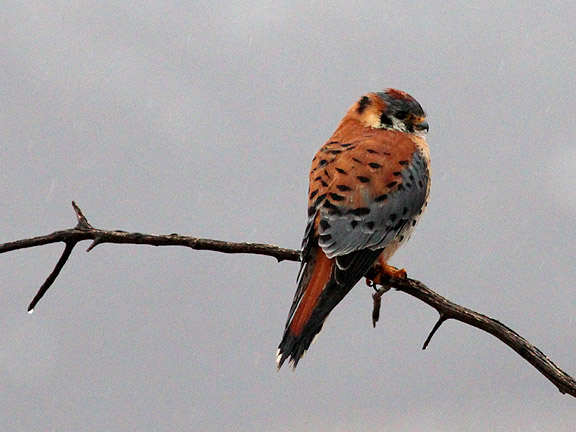
Generally the lists contain a lot of Rock Pigeons and European Starlings--a realistic look at what most urban birding looks like.  But the lists get sprinkled with Mourning and Eurasian Collared-Doves, Americn Robins, Western Scrub-Jays, Black-billed Magpie, American Kestrel, House Finches and Sparrows, California Gulls, etc.  Just for laughs I have submitted 61 Checklists for the Sandy Ciy Cemetery--comprising exactly 14 species! With this micro birding there are far more checklists than species generally.

American Kestrel

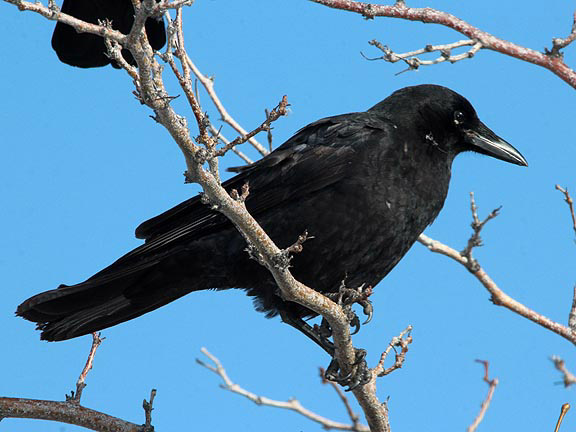
On a daily basis I try to enter lists when I stop at lights or keep an eye out for birds while driving.  I also usually stop at one or two locations on the way home for a just a couple minutes to listen to what's calling. It gives me the opportunity to fit in a little birding every day away from my home and office.  It has also made me really aware of specific birds that have set up territories along the route. I have 2 spots where I know American Kestrel are on territory; 1 Red-tailed Hawk that frequents a certain woodlot; and of course the specific locations where you almost always find American Crow in the city.

American Crow

So if you can't get away from home as much as you'd like, or you prefer birding locally, without a car, on foot, bike, or scooter I suggest creating your own patchwork of local birding locations and working on micro listing your area. Not only will you provide valuable data for citizen science, but you'll really get to know the birds around you.

If you'd like me to share any of my personal locations with you just let me know--I don't suspect a lot of folks go birding at many of these places, but if more than one were interested I would certainly love to add more data from more birders!

Labels: , , , ,

Status and Distribution of "Western" Flycatcher in Utah?

posted by Tim Avery at
on Wednesday, February 11, 2015 

Sorry to get scientific with the post title--but this post will delve a little or a lot bit in to the realm of science--depending on how you want to look at things. I am not a scientist or a biologist, but on a daily basis I analyze data, and use that data to make predictions, hypotheses, and come up with solutions to problems.  Today I'm not solving a problem, but more or less looking at a problem and proposing some ideas.  These ideas came to fruition after a phone call with Rick Fridell about a number of reports in eBird of Pacific-slope Flycatcher.  Back in 2006 Rick and I found 2 empids at Red Hills Golf Course in January.  Both birds represented the first winter records of empids in southwestern Utah--and the only in eBird for Utah during the winter months.  Historical information about empids in Utah is quite lacking so there may be some from pre-2000, but the data just isn't there to look at.


One of the birds was rather straight forward and was a DUSKY FLYCATCHER.  The other bird was a bit more troubling as it was a "WESTERN" FLYCATCHER, so either a Cordilleran or a Pacific-slope Flycatcher.  At the time the general though was--it's winter, it's a Western-type Flycatcher, it's not calling, so it's best left to just "Western" Flycatcher species.  However, conventional wisdom at the time suggested that ONLY Pacific-slope Flycatchers over-wintered in the interior southwest, with a handful of reports annually in southern California and Arizona along the Colorado River.

Dusky Flycatcher in St. George from January 2006

But I'll digress, at the time I left it as just a spuh and moved on.  Later that same week, Rick found another "Western" Flycatcher in Washington County, making it 3 empids in one week in winter.  Fast forward to this week and the phone call I had with Rick.  I am for the time being helping review sightings in Washington County on eBird--Rick will be taking over in the near future, but I was doing some cleanup and noticed he had submitted a handful of reports for PSFL. In all 11 reportfrom the spring and fall. This was unexpected for me; even more so was that one checklist from May 27, 2012 had 5 PSFL included on the report. Unprecedented in Utah.

If you don't know Rick, quite frankly he's probably the best birder in Utah hands down.  He's been responsible for numerous state first records, and finds great birds on an almost weekly basis down in Washington County.  So when Rick added these birds to his lists, he immediately had my attention.  Basically what Rick shared with me, was that birders in Arizona and Nevada birding at lowland habitats during migration were not finding Cordilleran Flycatchers, ONLY Pacific-slopes.  During the spring calling birds were identified by their audibles, and based off banding projects it was basically assumed that all Western's at these sites were actually PSFL's.  What?

This one really through me for a loop.  Although I was sure this species migrated through Utah, I thought that it was impossible to say for sure which species we were actually seeing during migration. De-facto I called everything in Utah a Cordilleran--even birds not calling.  Have we been doing this wrong for years? Is it only safe to identify on territory or calling Cordilleran Flycatchers? Were we actually seeing Pacific-slope as the majority of valley and lowland Western Flycatchers during migration?  Was this a Pacific-slope Flycatcher?

Migrant "Western" Flycatcher at Fontenelle, Wyoming in May 2005
Due to inland location and overall elevation it was ID'd as a Cordilleran.
However, Fontenelle, is a "lowland" trap by Wyoming standards.

The assumption that the lowland birds are all Pacific-slope seems to go hand in hand with the idea that Cordilleran Flycatchers migrate through the mountains and highlands to their wintering sites, predominately in the mountains and pacific slopes of south central Mexico.  Parallel ideas are that of birds like Cassin's Vireo, Townsend's, Nashville, and Hermit Warbler, and Rufous Hummingbird.  All  of these species are rare and some non-existant in spring in Utah.  Some do show up occasionally, but these are predominantly only fall migrants in Utah  None-the-less they are only found during migration--like the speculation of PSFL and its occurence here.

Hermit Warbler interestingly are rarely if almost never found away from high elevation sites with a coniferous component in the interior southwest during the fall.  While all the others tend to show up at various elevations and habitats.

So I've droned on--but lets actually look at some maps I generated via eBird and customized to show information about Cordilleran and Pacific-slope Flycatchers.


This first map shows the year round range (via actual detections in eBird) of both COFL and PSFL.  COFL is shown in blue; strictly in the mountain west through central Mexico.  PSFL is show in red from Alaska to southern Mexico on of all things the Pacific coast and slopes.  The purple blocks represent overlap where both species have been or are reported.  Much of this is migration and winter grounds.  Note the interior range of PSFL into Washington State and Canada almost directly north of Utah.

Do we assume these birds migrate "around" the Great Basin, following the Sierra Nevada slopes and the coast, north and south during migration, or is it more likely they shoot straight over one or both directions?  Looking at this map is seems almost impossible that this species misses Utah, and that in all likelihood a large number pass through at least during the fall; but presumably also during the spring.


The map above shows year round Cordilleran Flycatcher reports from eBird specifically in southwest Utah. The light green spots represent breeding reports from what mostly appear to be high elevation sites as they should.  The blue and orange dots represent migrant reports  You'll notive that while there are numerous locations around the light green dots, there are alos some out in low laying areas; notably around Las Vegas and St. George.  The dark green spots represent overlap where birds have been reported at a minimum of at least spring and/or fall migration and the breeding season.  Again the majority of these dark dreesn show up at the high elevation sites.  ONe thing to note is that there are no winter records from this region.
Well what about Pacific-slope Flycatcher reports? Below shows the map of reports year round from the same region as above. Take a look...


There are obvioulsy much fewer reports on this map; and that is expected. Afterall a large portion of the map is high elevation coniferous forest around Flagstaff, the North Rim of the Grand Canyon, and throughout southern Utah.  This is the breeding habitat of COFL.  Of note there are no breeding season reports from this area; there were several reports from the first week of June at lowland sites around Las Vegas which presumably are late northbound migrants.

The interesting thing about this map is the clear data points to the west, southwest, and south of Utah, basically everything around our fair state.  Yet in Utah; nada. There is something wrong with this picture, and had Rick not brought this to my attention, I don't know how long I would have gone before actually looking at these maps.  I think its a fair assumption that the lack of reports in Utah is not due to the fact that they don't occur here; but instead is due to the fact that physically they look the same as our Cordilleran Flycatchers.  How many Pacific Slope Flycatchers have been right underneath our noses? I pulled up the list of Cordilleran Flycatcher sightings just from Lytle Ranch.  Every record occurs in spring or fall migration and in all there are only 22 individual birds reported from 17 dates. That's actaully very slim numbers in comparison to let's say Dusky Flycatcher where there are over 50 indicvidaul reports.

The last figure I created below is of the winter reports of both species of "Western" Flycatcher.  In pink you can see PSFL, and in blue is COFL.  The purple dots along the Pacific slope in Mexico represent overlapping reports.


Aside from 4 or 5 wintter reports in America for COFL--all east of El Paso, Texas; all other reports in the lower 48 in winter are of PSFL.  Notably in the desert southwest in rizona, California and along the Colorado River.  So what does this mean?

I went into eBird and changed all my spring/fall lowland sightings in Washington county to Cordilleran/Pacific-slope Flycatcher. There are now 16 reports in queue to be reviewed for PSFL in Washingtong County during the spring or fall with an additiaonl 7 or 8 Pac-slope/Cordilleran already approved.  I used that nomenclature for the time being as it is safest.  However, where Rick has heard the vocalizations it can likely be said his birds were indeed PSFL.

But what is the true extnet of this species in Utah?  Does it extend beyond the reaches of Washington County?  Realistically how mnay Western Flycatchers submitted to eBird from lowland sites around the state were heard vocalizing? And what is the typical migration pattern for Cordilleran Flycatcher?  I for one will be taking more time to listen and make sure I know this vocaliztion this spring whne I hit the field:

Labels: , , , , ,

eBird and the Issue with Domestics

posted by Tim Avery at
on Thursday, February 5, 2015 

So I love eBird--you know this if you've read my posts in the past.  I have a few gripes with some things they do wrong--its a fact that the software is pretty amazing, but there are some very easy ways to make improvements that will give users much more control over how they view data.  One such improvement that I haven't spoken about in the past is the ability to filter out DOMESTICS.  Love them or hate them (I'm in the latter camp) I've never seen the point in having the ability to add domestic birds into checklists; and then display that data in search results and lists for locations.  Simply put the birds ARE NOT WILD!  They are not recognized as wild species, and in my opinion they clutter things up in the data.  Some people really seem to enjoy putting them on their checklists though.  As birders we know they occur and in general know where they occur.  So why put them on checklists?

I am having trouble finding eBirds official reasoning for this, although I suspect on some level it is because they do have an impact on native wildlife; and perhaps there is some interest in local populations of domestic fowl, etc.  So I can be okay with these being available as inputs on checklists and outputs in data.  But what I would love to see is the ability at a user level to either HIDE ALL domestics in submission forms and in output data as a setting.  If I could go in and switch a toggle that says I don't want to see this; for me personally it would be an improved experience.  There could also be the ability to filter them out in data outputs.  This is actually still my biggest gripe with species maps, lists, and other data outputs.  The general lack of filtering ability.  The filters they have set in place are location, season, and year based. All great tools. But more complex filters to hide or show "spuhs", domestics, hybrids, etc would be really useful when looking at output data.  Here is an example...


I pulled up the bar chart for the Salt Lake International Center.  Right at the top of the list we have2 domestics, then a either/or (that's like Ross's/Snow Goose). A few more down is another domestic, then a spuh.  All said the list has the 197 wild species + 22 "other taxa".  These others are the domestics, the hybrids, the spuhs, and the either/ors.  It's all valuable data, but maybe I am a purist and only truly care about actual wild occurring species.

Now to be honest this isn't a bad list by any means--197 to 22 is a okay ratio.  Let's look at a bigger less manageable list--the Utah statewide bar chart. 458 Species and 168 other taxa.


Out of the first 15 "species" line items, 8 are OTHER TAXA.  Now waterfowl in general is like this since there are lots of hybrids and domestics.  But going down the list, almost every section of 15 species has 1 of these other taxa. Gulls are particularly ugly as well!


Okay so how do we take care of this.  Much like my suggestion to add the ability to toggle on or off invalid sightings on the maps page; there would be a simple filter on the bar charts or any page that has output data that would allow us to filter this other junk out. A quick redesign of the top of each table and it would be easier to read, and create a nice placement for a filter button.


I already feel better jsut cleaning up the table header :)  So lets see what would happen when you click the "Filter This Checklist" button.


You would be able to filter by time of year, date, a number of toggles for what species types you want to see, and hell, lets even throw in the ability to show invalidated reports--this will eb my life long goal with eBird I think.  So if we were to go through and turn all the species filters off except for wild like so:


The output would change and we would see the following, removing all the spuhs, hybrids and such--giving us a real total for the wild species in Utah:


And of course just for laughs if we were to go in and adjust the toggle for invalid reports the screen would change ever so slightly to now show invalid species in a red (the abundance marker would be red as well), and next to the species total would list the invalid species as well, keeping thisngs clean.


Maybe its just me, but this tool can be used in so many ways, and make eBird even better for its users.  I've seen some crazy stuff put on checklists in the past.  Park ducks and gees from an aviary. Emu and Ostrich from what are obviously farms.  Guineafowl on private property; a number of exotic ducks again on private property, or public ponds operated by private entitities.  I am a birder, and I really only have an interest in teh free flying wild stuff.  Don't get me wrong there are some free flying escapees--and I think that is a hole other classification of birds that we could add into the database--the ability to mark something as a free flying escapee on a checklist would add a new dyanamic.  Mandarin Ducks, Bar-headed Geese, Pochards, Budgies, etc.

Free Flying Escaped Bar-headed Goose in Provo

What I am getting at is I don't really care what they allow people to put into the system.  I get the importance of tracking domestics (to a certain extent); but that's not something I will ever do.  Adding more rich features to enhance the user experience of the data output will only make eBird more valuable to its users, researchers, and team eBird.

Labels: , , , ,

Northern Pygmy-Owl: The Death Blow

posted by Tim Avery at
on Tuesday, February 3, 2015 

Sorry that it's a little shaky.  I didn't grab my tripod and trying to hand hold for video usually doesn't work out to great.  Needless to say the last 3-4 seconds of this video show how fierce this tiny little owl is:


This winter has seen a higher than usual number of detections of Northern Pygmy-Owls.  Winter is usually the best time to observe these owls in Utah but this year it seems to be a banner year. This individual was seen in the town of Rockville, Utah right along the busy Highway leading into Zion National Park.


We watched it drop and take the mouse out, before finally putting it out of its misery, and after a few minutes starting to dig into its catch.


Of all the pygmy-owls I've seen this was by far the coolest interaction I've had! What are some of the experiences others have had with this species this winter, and in winters past?

Labels: , , , ,

January 2015 Review, February Preview

posted by Tim Avery at
on Monday, February 2, 2015 

Wow, what a January!  Looking back in all the years I've lived in Utah I can't remember a year starting off with such a bang.  For starters I don't think anyone can help but notice the big month Kenny Frisch had.  Just check out the eBird Top 100... He destroyed the biggest January record which was 158 species in 2013 by Dennis Shirley. That 158 was impressive, but Kenny topped the charts at 177 species for the month! I personally had my biggest January ever, so there must have been something in the water.  In comparison, in 2007 when I did my Utah Big Year I got 122 which seemed like a lot of work... In fact I didn't hit 170 till March 31st! I guess I have some competition this year!

Kenny's month is actually the biggest winter month ever in Utah--that's November, December, January, February, and March! So congrats Kenny!

January was a big month in general with 177 verified eBird reports and a handful of sightings that have yet been reviewed--the month total will likely be somewhere in the mid 180's.  That's a big January!

Some of the birds were down right impressive.  How about:

Laughing Gull (2nd report ever)
photo by Mike Hearell

Purple Finch (2nd or 3rd report)
photo by Tim Avery

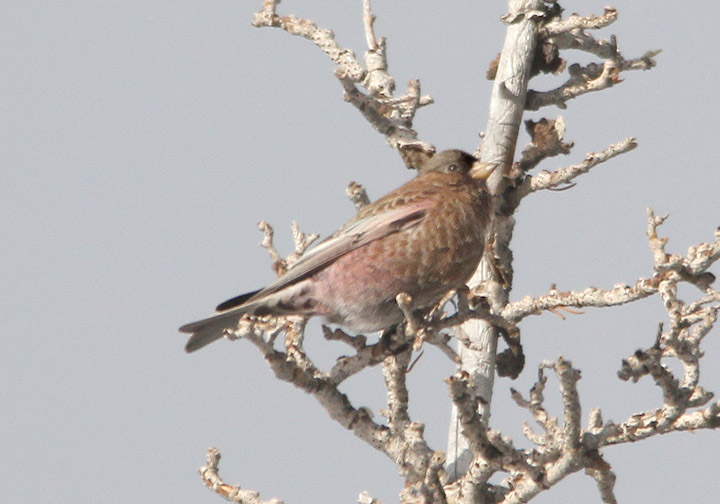
Brown-capped Rosy-Finch (2nd report)
photo by Tim Avery

Brown Pelican (between 5-10 reports)
photo by Stephanie Greenwood

Red-headed Woodpecker (3rd non historical)
photo by Tim Avery

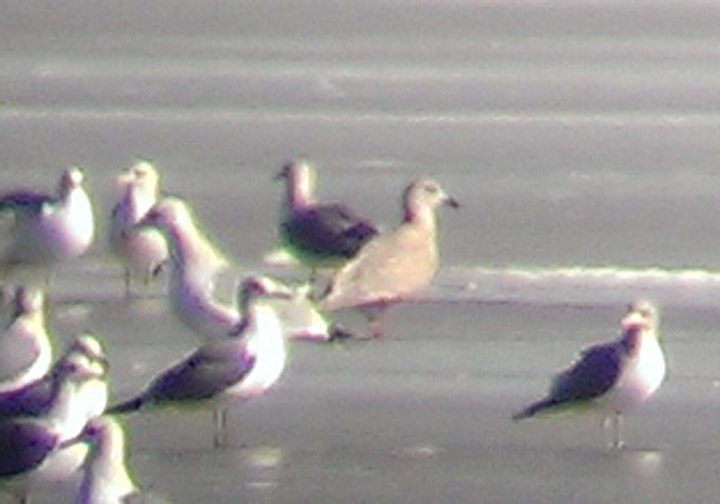
Iceland Gull (5-10 reports)
photo by Tim Avery

Those are some great birds! The weather this January was very un-January-like and that could have impacted things.  Although the expected snows and winter storms that often bring in great birds from the north never materialized, great birds still showed up.  Southern Utah saw handfuls of great stuff, and most of the birds were long staying so lots of people got to see them.  Is this type of January the new normal in Utah?  It would drastically change birding going forward, seeming more Arizona-like than what we're used too.


How's February looking so far?  Well Punxsutawney Phil saw his shadow this morning, so 6 more weeks of winter... I hope not.  Or I guess if today's forecast is how those 6 weeks will go I am okay with that.  What does that mean for birding?  IF it continues to be mild the birding should be much like it was throughout January.  Expect some early northbound migrants, or earlier than normal arrivals and departures for the month.  This includes geese, gulls, and swans.  February albeit being typically a slow month in Utah for birding, has a few notable events this month.

Bald Eagle Day - Sat, Feb 14th

The ever-popular Bald Eagle Day will be on Saturday, February 14, 2015. Viewing times will vary depending on which site you'll be visiting: Salt Creek Waterfowl Management Area from 10 a.m. to 3 p.m., Farmington Bay Waterfowl Management Area from 9 a.m. to 4 p.m., Fountain Green State Fish Hatchery from 9 a.m. to 3 p.m., Split Mountain/Green River from 9 a.m. to 3 p.m., Rush Lake Ranch from 9 a.m. to 2 p.m.


Every winter as California Gulls congregate on the edges of the Great Salt Lake to search for food at nearby landfills, parks, wildlife management areas, and anywhere that may have open fresh water--other gulls that stray from their normal winter ranges end up mixed in.This creates one of most unique inland gulling hot spots in the nation. Along with the thousands of California Gulls are smaller numbers of Ring-billed Gulls, and decent numbers of Herring Gulls. Mixed in with those you are likely to find a few Thayer's Gulls. Aside from those 4 species a handful of others show up every year including: Glaucous, Glaucous-winged, Mew, Lesser Black-backed, Western, and Iceland.


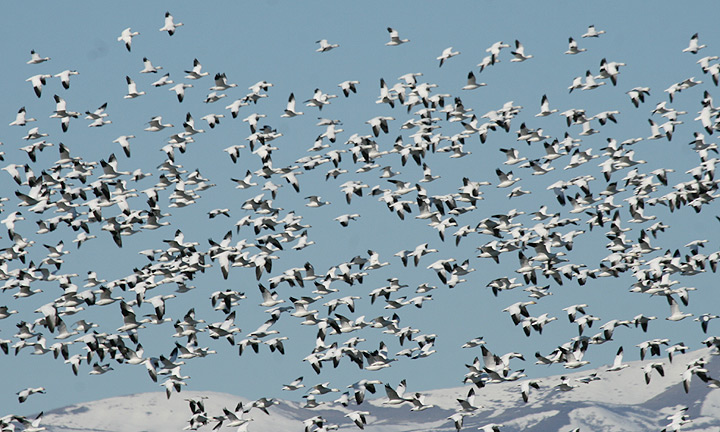
Early each spring, thousands of Snow Geese begin their 3,000 mile voyage home to Canada's northwest territories. Starting from where they winter in Southern California & Mexico, these travelers navigate their way home with amazing precision and faithfulness. Delta, Utah is privileged to be situated along their annual migration route. Come join us for this year's annual Delta Snow Goose Festival! Bring your camera and be ready to join the fun.

2015 is off to a great start, an this should be a great February for birding in Utah!

Labels: , , ,


UTAH BIRDERS FLICKR POOL


    SEE MORE AND SHARE ON FLICKR