Utah Birds, Utah Birding, and Utah Birders. Promoting the sharing of information, and the conservation of habitat for birds in Utah and elsewhere. We are a group of people who want to share what we know, and create a positive birding experience in Utah.

BIRDERS BLOG

a blog by and for Utah Birders

Introducing the 2014 Utah Birders Sticker

posted by Tim Avery at
on Tuesday, January 28, 2014 

Being a new year we decided to launch a new Utah Birders Bumper car decal/sticker.  When we came up with the Steller's Jay as our original bird for the Utah Birders we did so because it was simply put, one bad a$$ bird.  It wasn't a dainty little thing with some pink marking--like the Black Rosy-Finch, which was my first choice (I know, I know...).  Anyways, we've now had 6 different stickers over the past 2 years--3 for specialty trips we've led, and 2 different versions of the Jay.  The all new 2014 Utah Birders Sticker however came about from our recent poll conducted by Matt Pendleton--this years sticker was the #1 bird most representative of Utah based off the Top 10 Poll--the 2014 sticker boast the WESTERN TANAGER!


So you may be wondering--how can I get my hands on one of these bad boys?  Easy enough question to answer.  For starters, if you sign up for the 2014 Utah Birders Challenge, we will mail you one.  Then throw that thing on the back of your car so we know you're out to find the coolest and some of the most hard to find bird in Utah.

We will also periodically hand them out at field trips, and as giveaways throughout the year.  And if you haven't created a Utah Birders Profile yet, you can also get one by doing that! If you have created a profile recently and don't have you're sticker yet, this is the one you will get!

We'll still have other stickers at various events specific to that event, but we wanted to have something new and fresh for everyone for 2014!

Labels: , , ,

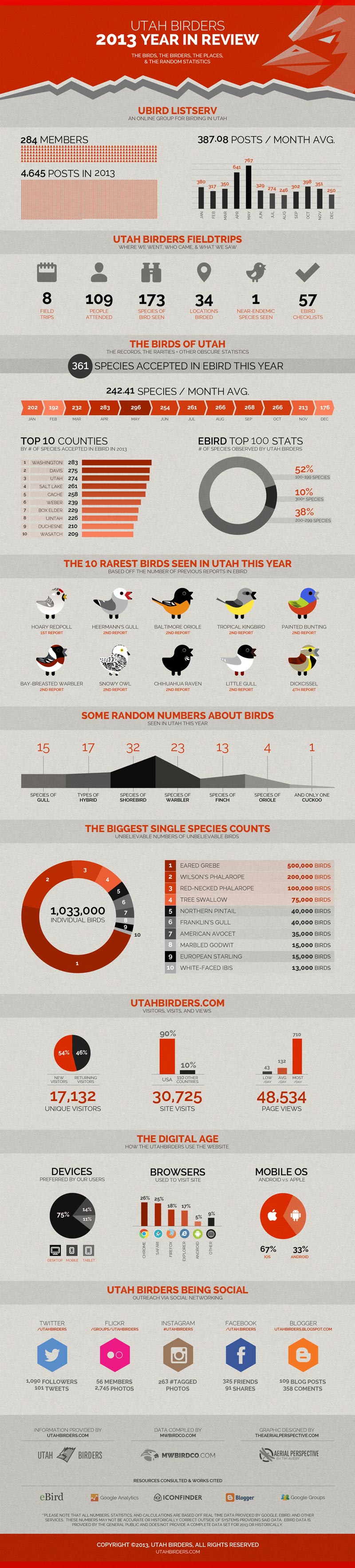
Utah Birders 2013 Year in Review

posted by Tim Avery at
on Tuesday, December 31, 2013 

Without further ado, here it is! Click to view full size!


Labels: , , , , , ,

My 2013 Year of Birding

posted by Tim Avery at
on Friday, December 27, 2013 

In just a few days 2013 will come to a close--another year, another batch of birding memories.  For me 2013 was an excellent and memorable year.  I made my first trips to several continents and a handful of countries.  I saw lots of birds, lots of endemic birds, and lots of life birds!   Instead of rambling on with a blog post, I thought I would share my year of birding via an infographic:

Labels: , , ,

A Few More Finished Drawings

posted by Tim Avery at
on Sunday, April 1, 2012 

Nothing like a rainy day to finish up a couple of the drawings I started in the past week.  I wrapped up the Golden Tanager this morning:


This afternoon and evening I dove into the details on the Bearded Mountaineer.  It was 100's of strokes for the feathers, but it was worth it, turning out nicely:


Next Up:  Gilded Barbet, Gray-breasted Mountain-Toucan, Paradise Tanager, and Golden-collared Tanager.  I also have a few more hummingbirds I want to work on, and plenty of tanagers I will get to.  Not to mention the Fruiteaters, Aracaris, and Parrots.  

Labels: , , , ,

Drawing More Birds on the Computer

posted by Tim Avery at
on Tuesday, March 27, 2012 

Seems like I've caught the illustration bug at least for the moment.  After finishing the Rufous-crested Coquette last week I started on a couple more illustrations.  But not before I had a print made of the coquette--and put it in a matte and frame:

5" x 7" print in 11" x 14" cream matte with 2" black frame
(click image for larger version)

If you are interested in a print,  I can have more like this made.  A photo quality print on matte stock costs $35.  A framed and matted version can be picked up for $60.  Just let me know what you want at western.tanager@gmail.com and we can work something out.

But like I said above the coquette was just the beginning.  Maybe it's the fact that the birds of Peru are so colorful and amazing to look at that I just want to make my own renditions.  Right after I finished the first one I started working on a second bird, that was even more stunning than the Coquette--a Golden Tanager:

Golden Tanager about 50% Complete

Right now it's about 50% finished.  I have a lot of details to add but got a good start on it.  The Golden Tanager is an absolutely striking species and the color is so vibrant.  I've worked on this one an hour or two most nights this week and will probably finish it up this weekend.

I also started working on a Peruvian specialty this week--a bird with one of the coolest names, the Bearded Mountaineer! Cool right?  It's a species of hummingbird endemic to southern Peru and has some very stunning but simple features.  This one is about 10% finished so it's probably over a week out, but you can see the various states from beginning to end with what I've done so far.

Bearded Mountaineer about 10% Complete

You can see how I start with the basic shapes then go into smaller and smaller details as I layer the design.  On this last one I have the basic shapes, and most of the low level details laid out.  I have a at least a couple more birds in mind to work on in the next couple weeks.  I'll be sure to share those as well as the finished versions of the above when they're done.

If you have something you want illustrated let me know and I can see what I can do.

Labels: , , , ,

Drawing Birds... On the Computer

posted by Tim Avery at
on Saturday, March 24, 2012 

Rufous-crested Coquette Illustration
click on the image for full size version

Growing up I liked to draw things.  In my grade school years and teens I took art classes learning to paint, and to illustrate.  When I got into birding I started to sketch and draw a ton of birds and always wanted to illustrate a book with birds, or contribute to a field guide.  When I went to college and decided to continue to pursue art in a Studio Art program I shifted from drawing to photography.  I loved what  you could do with a camera, and in my college years it was the dawn of the digital age.  I took a computer illustration course at the end of my freshman year.  After all, you had to have a breadth of classes for the degree, and I figured it was worth a shot to see what could be done on a computer.  My first illustrations were simple, and usually contained little detail.  As I became more comfortable with it I was able to create illustrations with subtle details, and over time was able to crank designs out pretty quick.  The class was the only digital class that my college offered at the time and after it was over everything I did was on my own.  

I shifted from illustrations into photo manipulation as I tried to figure out where I was going in life--I only illustrated a few things after that first year, and mostly forgot about what an art it was.  By my senior year I started doing web design and did a little illustration for the designs, but no full scale drawings.  And after I graduated it was much of the same.  I shifted my work to user interface design, and most of what I was doing had to do with laying out pages and figuring out how to make a graceful experience for people visiting a website.  I was no longer an illustrator.

I still had to illustrate the occasional icon, or graphic, but nothing that was overly complicated and nothing that required a ton of detail.  Occasionally I feel like drawing something and will hop in and give it a shot.  Usually, I get frustrated and just walk away from what I am working on because it isn't turning out how I hoped.  This week I had an urge to draw a hummingbird.  I started and the first couple versions jsut sucked.  The shapes were off, the details were too big, and I just wasn't liking the final product.  So last night I sat down and dove into a drawing.  I picked up again this morning and finished everything up.  The picture above is what I came up with.  I worked off this picture:

Photograph from Kolibri Expedtions

Overall I'm pretty happy with how it turned out.  This species is one of the birds I hope to see when I go to Peru this fall--a truly spectacular hummingbird.  I was able to get a lot of detail without having to draw any real feathers.  The individual lines helped create the feathered look.  

Based off this first try I might have to do a few more--it has been a long time since I have seriously illustrated and I lost some of my finesse, but I really enjoy it and it's not something anyone is really doing (semi-realistic photo illustrations of birds).

In any event I hope you enjoy! 

Labels: , ,

Merry Christmas

posted by Utah Birders at
on Saturday, December 24, 2011 


Labels: , ,

On the Benefits of Birding by Sketching

posted by Utah Birders Guest Blogger at
on Thursday, December 22, 2011 

I have often related bird ID to facial recognition, especially in birds of prey. The multiple factors that contribute to making a bird recognizable are similar, but unique. Much like the face, these variables all contribute to creating a wide variety of distinct but similar patterns. The challenge in identifying birds comes from this diversity, and so the birder is charged with the daunting task of in depth study and practice to learn each bird not only by sight, but sound as well.

There are many helpful hints and techniques to enhance the birder's skills, some better than others. I would like to touch on one technique, neither new nor unusual, but often overlooked, The practice of field sketching has become extinct in most regards, due mainly to the advances in photography. The camera is an invaluable tool, and has done incredible things for the birder and bird world alike, but it fails to serve in educating the birder as well as the pen, brush, and paints. By slowing the process of birding and truly digesting what flits and flutters around you, learning to recognize birds by impression will become effortless and natural.

Due of the role of color in bird identification, I would encourage anyone interested in bettering their birding to add watercolors to their sketching kit. I simply put some paints in a tin container with a small vile of water, and threw them in a nap-sack along with my pen. You do not need to use watercolor paper for you journal, but remember to use less water and paint to get your desired effect when recording your sightings.

Field Kit

Because I am currently working as a field technician on winter raptor surveys, I spend a great deal of time in the high desert. My sketching lately deals with the birds I have seen in this landscape. These birds are not the most difficult to identify, however the practice of sketching can still prove valuable even for the most common bird. Take the time to sit and watch. You will need to stay in one place long enough to see enough of a bird to sketch it properly.

Pay attention to what stands out, and record your first impressions. Do not worry about the quality of the sketch. As an artist I struggle with this, as it is hard to fight the urge not to make the sketch as perfect as possible. Whether your artwork will win an award or not matters nothing for what is being accomplished. It is the process that matters, so don't get hung up on what your sketches look like. Also, be sure to make notes about what you notice that makes the bird unique. I have included a few examples that show how I sketch.

Loggerhead Shrike

Because I took the time to really look at the Loggerhead Shrike, I was able to pick up on the differences that led me to recognize a Northern Shrike soon after. Another bird I have recently become much more familiar with is the Sage Thrasher. When I found the bird appropriately sitting on a sage branch, I took the opportunity to record the bird and learn what makes the Sage Thrasher recognizable and unique. Notice on my sketch that the colors are not quite accurate, and the most helpful hint, the light yellow eye, is not enhanced in the illustration. I made sure to make a note that this was a helpful hint, not necessarily for future reference, but to go through the motions to help me retain the information and solidify the birds image in my mind.

 Sage Thrasher and Horned Lark

As I mentioned before, the purpose for my time in the field lately has been wintering raptors. Raptors are an incredible group and can present some of birding's biggest challenges. The trick to raptors, and in reality most birds, is birding by impression. The easiest way to speed up the learning process in my opinion and experience is sketching. Raptors have so many exceptions to the rule of ID with color morphs, subspecies, and hybridization. Begin sketching the birds you see and you will soon begin to recognize what makes each bird unique, and when the chance arises that you happen upon a strange or abnormal bird, you will be armed with the knowledge and skill to pick apart what might lead to a positive ID with little help and council from more experienced birders.

Winter Raptors

I absolutely love reviewing my illustrations and annotations. I find so much satisfaction in the process of creating my own images, no matter the quality. I also admit that I am enthralled with the work of others. I would love to be exposed to a wide variety of creativity in respect to the bird world. In the future, I hope to see many sketches accompanying long lists of birds on UBird. Till that day, happy birding.

Bryce Robinson


---------------------------------------------------------

Do you have an idea for a guest blog post? Submit your idea for a blog post by clicking the button below:


Labels: , ,

Birds, Tattoos, and Tattoos of Birds

posted by Utah Birders Guest Blogger at
on Wednesday, December 7, 2011 


Firstly, I'd like to extend my gratitude to The Utah Birders for inviting me to write this guest post about birds and getting bird tattoos.

Since I began birding two and a half years ago, I've discovered that birds have much more to teach than what may be observed on a more literal level. Without ascribing human characteristics to these creatures (anthropomorphize is a mouthful to say), a lot can be learned about ourselves, others, and the world we live in. All in all, that's my primary reason for birding. I've known one day a particular species would speak to me and my birder's soul on a much deeper level. I recently 'ticked' my 300th lifer and each species has taught me a little bit more than I could have possibly imagined. Looking for birds is a great exercise in being present in the moment. Birds are an excellent conduit for reconnecting ourselves with the natural world and finding a sense of wonder. I've been on a quest to find MY bird. One that represents my personal character as an individual. Last month, I discovered that bird to be the Cedar Waxwing (Bombycilla cedrorum).

With it's elegant, silky appearance and lovely high-pitched call, the Cedar Waxing is a easy bird to fall in love with. They are an attractive bird. A few key traits reveal a lot about why they are meaningful to me. First of all, they are very gentle birds. They are a highly social species who are almost always found in flocks. Cedar Waxwings are known to pass food to each other and become surfeited after feeding on fermented berries. For that, some call them the party bird! They're enthusiastic eaters and a bit overindulgent. Their unselfish manner during courtship/mating is also impressive. As one who loves to explore, their nomadic travel appeals to me. As a music maker, the Cedar Waxwing's song is a delight. I won't go into any further detail describing these birds. You can find good information about them at http://www.allaboutbirds.org/guide/Cedar_Waxwing/id

Although I love spending time with birds, some of the best birding experiences have come from the people. 'Bird people' are as diverse and varied as the species we find. I've had the privilege of taking many school kids on field trips, met photographers/film crews, twitchers, hunters, land owners, college students, federal and state land managers, volunteers, ornithologists and other scientists, travelers, journalists, and all manner of birderwatchers/birders. I think my favorite is making birders out of non-birding folk. If I've got my binoculars handy (I ALWAYS do) and a bird comes by, anybody will take a look. Most of the time, those looks end in a smile. Enthusiasm is contagious. I'm fortunate enough to spend a lot of time looking for birds. The people I meet in the field have made me a better birder and make this hobby/sport of birding the more rewarding and life enriching. We share the same passion. In that, we are the same. I'm big on unity. I'm a social creature and so are Cedar Waxwings. I'll confess to being a bit of a 'lush' as well. Oh, and as pretty as a waxwing! (Joking of course)

November was a fine month for Cedar Waxwings in Northern Utah. I began noticing them in larger flocks just before Halloween. Good timing since they're a masked bird! During a snowstorm early in the month, we had an 'earful' show up in our front yard. We had long looks and throughout the day we saw 100's. My wife and I spent the afternoon studying them and delighted in the sighting. We studied their calls, flight patterns, and general appearance. By the end of the day, we were armchair waxwing experts. Since then, one of us has seen them every single day. Awesome! Most sightings have been incidental. As reported to Ubird, I had a particular abundant amount of waxwings appear in our yard just before Thanksgiving. It was then I knew Cedar Waxwings were MY bird and called my tattoo artist to make an appointment.


So on December 1, while the wind tore our city of Bountiful, Utah to bits, I headed to Salt Lake City to commit the Cedar Waxwing's image to my body. My wife had reported daily sightings of waxwings in Washington Square for several weeks. Since her office is across the street from the tattoo shop, I stopped in to visit and do some urban birding. Sure enough, two separate groups of waxwings came through and I walked across the street to get some ink. I have lot's of tattoos, but I've never become accustomed to the wretched pain involved. If it didn't hurt, more people would have them. An hour of pain for a lifetime's reward! Well worth it. Getting the tattoo was a simple process that took only an hour. My artist's name is CJ Fishburn. My wife and I have been getting tattoos from him for 7 years and hold the distinction of his longest return customers. His shop is Cathedral Tattoo located on 400 South in Salt Lake City. He also runs a non-profit for displaced pets, called 'Cause for Paws'. Something notable about this piece is CJ used a gun from 1943. I thought of the 1000's of people who must have been tattooed by the same gun. I thought of the 1000's of birds I've seen as a birder. I thought of all the birders I've met in the process. I thought of all the birders I hope to meet. And while I sat there retching, I told of the joys of discovery that birding provides. I'm thankful to have discovered birding and will wear this tattoo proudly!


Last May, just for kicks, I got a tattoo of a bird on my right forearm. It doesn't really hold any more meaning other than it's a cool symbol for my bird love. When people ask me why I get tattoos, I give them the same simple answer I give when asked why I spend so much time looking for birds.... because it's awesome!

Enjoy your enjoys
Shyloh Robinson


---------------------------------------------------------

Do you have an idea for a guest blog post? Submit your idea for a blog post by clicking the button below:


Labels: , ,


UTAH BIRDERS FLICKR POOL


    SEE MORE AND SHARE ON FLICKR