The last week of April the past 6 years I have headed to Washington County to meet the first big wave of northward passerine migrants as they arrive in Utah. This weekend can bring large numbers of migrants and quite an array of species to the various oases around St. George. Eastern vagrants are extremely rare this early, but the variety and numbers of birds make it worthwhile. By now the majority of breeders to the Mojave Desert region are back and already nesting--while several species such as Brown-crested Flycatcher, Lesser Nighthawk, and Blue Grosbeak are still scant. Each year the birding is different. In 2007 when I was doing my Utah Big Year migration was in full swing and I picked up just about every usual migrant in the course of a couple days. The past few years migration has felt a little slower. There have been plenty of migrants, but nowhere near as heavy. The last couple years we have seen a later than normal migration in Utah so it’s not surprising that the end of April hasn’t been as great.

Not a Migrant, but this Eurasian Collared-Dove
picture turned out pretty sweet.
Fast forward to this past weekend and it looks like migration is just about on schedule--that being not too early nor late. Keeping up with tradition my wife and I hit the road Friday night and headed to Washington County. We left Salt Lake later in the evening to miss the traffic through Utah County Construction. That put us into St. George just after 11pm, where it was 70 degrees--wonderful! We made out way out to the Beaver Dam Slope and set up camp above Lytle Ranch on the bluffs overlooking the Beaver Dam Wash. I sat out enjoying the stars and singing
COMMON POORWILLS all around us. The highlight of the night were 5 or 6 large flocks of shorebirds that came flying over our campsite. The whistling of their tiny wings and the chattering calls and squeaks were unlike any I have heard before. I have no idea what species they even were--only that for a half an hour I was in awe of the sounds.
Saturday got a late start as we didn’t leave the tent till 9am. Winds were thrashing the slope and we didn’t hear much singing. A couple
BLACK-THROATED SPARROWS and House Finches were about it. We arrived at the ranch where there were more cars than I had ever seen there. We had brought our dog so we opted to pass the ranch and walk Beaver Dam Creek. But before we left the parking lot I enjoyed hearing the lovely notes of several
SUMMER TANAGER, the melody of a lone
HOODED ORIOLE, the chattering of a
BULLOCK’S ORIOLE, numerous
LUCY’S WARBLERS, and a couple
BELL’S VIREO. Spring at Lytle is always a blast.
Lucy's Warbler are everywhere in Washington County in April
We hit the river and slowly made our way up creek about a mile. This is the equivalent of walking just past the main pond on the ranch property. There weren’t a ton of birds, but the water felt good on the feet, and I did manage to pick up all 6 species of regular swallows along the way. I hadn’t been to Lytle since last May--my trip south in January skipped the wash--so all the local species were new year birds.
PHAINOPEPLAS, LADDER-BACKED WOODPECKER, and
BLACK-TAILED GNATCATCHER all were brilliant to see for the first time in almost a year. The surprise of the morning was a
WILD TURKEY zipping through the Cottonwoods--apparently there are more than a dozen hanging out on the property now.
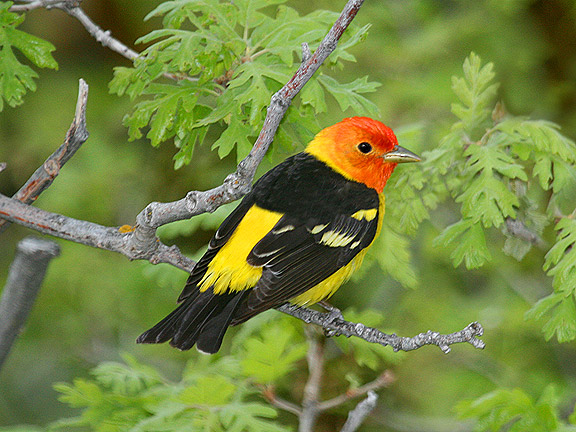
Summer Tanager add a splash of color to the desert.
As we neared the gate on our walk back down river we ran into the Sommerfeld’s and Merrill Webb who had seen just about the same birds as us. It seems like we always see the same faces this time of year down there--if we ran into Rick Fridell it would be a true end of April trip. Back at the ranch I checked out the Hummingbird feeders and picked up Black-chinned, Costa’s and an
ANNA’S HUMMINGBIRD for the year while
WHITE-THROATED SWIFTS chattered overhead, and the tanagers continued to serenade the property. The group of vehicles was an Audubon event that was scouring the ranch--with so many people around we decided to check out a few other places.
The Beaver Dam Slope
Driving across the slope we didn’t add any new birds for the trip--but at Utah Hill we added the expected
BLACK-CHINNED SPARROWS, and a singing
GRAY VIREO. We ended up at Gunlock Reservoir for lunch where a pair of
COMMON BLACK-HAWK are nesting again this year. There reservoir is still full from last years runoff so there was a ton of activity at the inlet where some shallow water persists. A surprise
MUTE SWAN was hanging out here, along with a
GREAT EGRET, a couple
BLUE-WINGED TEAL, cormorants, White-faced Ibis, Spotted Sandpiper, and Black-necked Stilt. Singing Rock and Canyon Wren kept us company while we ate as well.
Mute Swan at Gunlock (looks pretty ruffled)
After lunch we hit the usual spots around St. George in Ivins Reservoir, Tonaquint Park, Springs Estate Pond, and the Washington Fields. Nothing out of the usual at those locations, although the young
SNOW GOOSE that was present at Springs Estate in January is still there and all grown up.
Lingering Snow Goose at Springs Estate Pond
After getting our fix of city it was back out to the slope. We decided to hike Welcome Springs Canyon which was wind free and a great hike to end the afternoon. Birds were scarce, but a singing
BLACK-THROATED GRAY-WARBLER was a new year bird, along with Blue-gray Gnatcatcher, and Bushtit. The highlight of the trip came when I was watching the swifts and Violet-green Swallows dip and dive in the air above the canyon. As I was looking up I noticed a very “blunt” looking hawk way up in the thermals. When I got my binoculars on the birds I was stoked to see a dark adult
BROAD-WINGED HAWK. The only other spring Broad-winged I have seen in Utah was at Lytle Ranch less than 10 miles away--this same weekend in 2007.
Beautiful high flying dark BROAD-WINGED HAWK
We ended the day on the slope where Mockingbirds,
CACTUS WRENS, Black-throated Sparrows, Ash-throated Flycatchers, and Western Kingbirds took turns singing for us. While watching the sun dip over the desert a
PRAIRIE FALCON let out a cackle and came curing past our campsite--a first for me on the slope. It was a clear and calm night--great for camping in southern Utah.
Sunset on the Slope
Sunday morning we were up a little earlier, driving across the slope and adding a
GRAY FLCYATCHER hanging out in a Joshua Tree. Gambel’s Quail were everywhere, and flocks of
BREWER’S SPARROWS were also on the move. As we rolled into the ranch a
CRISSAL THRASHER crossed the road. This time I headed up ranch while Sam walked the dog down river. It was calm near the camping area but windy in the orchard where I didn’t add any birds--but I did manage a sweet shot of a White-winged Dove.
White-winged Dove at Lytle Ranch
I guess it was an end of April trip though--as I ended up back at the campsite Rick Fridell was hanging out with his family at a camp site. Rick had seen a handful of empids in the ranch but not much else. I mentioned that I was surprised that I hadn’t seen or heard any Scott’s Orioles as they are usually quite prevalent by now. He mentioned that he had heard one singing this morning nearby. As I left I headed in that direction, and sure enough picked up the
SCOTT’S ORIOLE for the trip--and the 3 Oriole Weekend.
Beaver Dam Creek in April
Sam and I headed to the river crossing where we added a couple more birds for the trip in FOY singing
PLUMBEOUS VIREO and
WESTERN WOOD-PEWEE. After that we slowly made our way back into town stopping again at Utah Hill adding
CASSIN’S KINGBIRD, Lark Sparrow, and Western Scrub-Jay for the trip.
Lark Sparrow at Utah Hill
After having lunch in town we swung by Quail Creek where one
COMMON LOON and
5 RED-BREASTED MERGANSERS were both new year birds. From there we hit the highway and headed north. We stopped at Chicken Creek Reservoir in Juab County where waterfowl were out in force.
GREATER SCAUP, Bufflehead, and Common Goldeneye were all still present. The lack of shorebirds was unusual for this date here--no phalarope, peeps, or dowitchers. There were a few
FRANKLIN’S GULLS on the lake as well a couple
BONAPARTE’S GULLS.
We opted to skip I-15 through Utah County so we took the west side of Utah Lake. Near Goshen we saw plenty of
HORNED LARKS, and between Elberta and Saratoga Springs we picked up most of the usual raptors including: Red-tailed Hawk, Swainson’s Hawk, Golden Eagle, Northern Harrier, and American Kestrel.
And just like that the weekend was over. We tallied somewhere around 125 species in the 2 days. That’s a little lower than normal as we didn’t pack as much birding into the weekend, and skipped out on any high elevation stuff. 150 species is about normal for this weekend. Rick Fridell mentioned that last year they picked up 165 on their usual Washington County Big Day the last week of April. If you’ve never been birding in Washington County this time of year, it’s a great time to go and well worth the drive. It also takes care of having to wait for all those passerine migrants up here in the north!
Labels: migration, orioles, raptors, tanagers, warblers, washington county