Utah Birds, Utah Birding, and Utah Birders. Promoting the sharing of information, and the conservation of habitat for birds in Utah and elsewhere. We are a group of people who want to share what we know, and create a positive birding experience in Utah.

BIRDERS BLOG

a blog by and for Utah Birders

Top Ten Utah Birds pt. 2 - The Top 10

posted by Unknown at
on Thursday, December 12, 2013 


Now for the top ten!!

As a reminder, we had 63 participants which made a good enough sample size for us to be really excited about how it turned out. 174 different bird species were represented across the many lists. The variety was fun to see.

Scoring was done by giving a first place vote ten points. The second place vote received 9 points and a third place vote 8 points. All the way down to a tenth place vote receiving 1 point. If there was a tie then the bird with more total votes was bumped up.

And the top ten birds of Utah are...

#10 - Peregrine Falcon


"I started with 35 and had to beat it down to 10. Not easy! Then to put them in order. So not easy!"

• • •

#9 - American Kestrel

• • •

#8 - Greater Sage-Grouse
by Tim Avery

"Just about all my species were lifers for me after I moved out to Utah two years ago and most of them are found in habitats that were new to me before I moved to Utah, whether it be pinyon-juniper, sagebrush, desert or mountains. My top 3 are birds that are only found in a handful of states which makes them even more special.  Gunnison Sage-grouse is very range restricted and only found in Utah and Colorado. To see several of them on lek was an experience I will never forget."

• • •

#7 - American White Pelican

• • •

#6 - Black Rosy-Finch
by Tim Avery

• • •

#5 - Bald Eagle
by Shyloh Robinson

"Because I lived in the midwest previously and didn't have experience with many birds of Utah, many common birds here caught my eye  and that is reflected on my top 10. All of the birds are specifically found in the western part of the country except the bald eagle which I added because of the great numbers it gathers in here, especially at Farmington Bay. I think that the eagle is a great representative for Utah because although Utah doesn't have any bird specific to the state, Utah has many unique habitats and populations of birds, the Bald Eagles at Farmington being a great example"

• • •

#4 - Red-tailed Hawk

• • •

#3 - Flammulated Owl
by Tim Avery


• • •

#2 - American Avocet


"I have seen some rare ones in Utah, but to me this list represents what Utah birding is about and what people who come from other areas want to see.  The avocet is just so Iconic to me, that is why I put it #1.  None of these are rare by any means but to me what makes Utah birding so great."

• • •

And the #1 bird...........

#1 - Western Tanager

"I still remember the first Western Tanager I saw in real life.  I remember months before flipping through the field guide as I had just gotten into birding and thinking, wow, this is an incredible bird--it was instantaneously my favorite.  There is not a summer hike in the mountains of Utah where the two-note call of the Western Tanager or i's melodious song isn't heard.  When you see one it's an unforgettable experience for the birder and non-birder alike.  The flaming face and bright yellow body make it undeniably the quintessential Utah Bird."

• • •

I am not a statistics major so I apologize for any flaws in my logic but I thought it would be nice to give some additional stats.

Given the previously described point system here is how the top ten fared:

# Species Points %
1.Western Tanager 166 26.3%
2.American Avocet 130 20.6%
3.Flammulated Owl 107 16.9%
4.Red-tailed Hawk 86 13.7%
5.Bald Eagle 82 13.0%
6.Black Rosy-Finch 80 12.7%
7.American White Pelican 71 11.3%
8.Greater Sage Grouse 63 10.0%
9.American Kestrel 62 9.8%
10.Peregrine Falcon 59 9.4%

Percentages are based against a highest possible score not against the total points. Thus percentages will not add up to 100% but instead reflect percentage of a perfect score. For example if all 63 lists had Western Tanager as there first place bird then it could score 630 out of a possible 630.

Top ten Utah birds based on number of votes:


# Species Points %
1.Western Tanager 24 38.1%
2.American Avocet 21 33.3%
3.Flammulated Owl 15 23.8%
4.Bald Eagle 13 20.6%
5.Red-tailed Hawk 12 19.0%
6. American White Pelican 12 19.0%
7. Greater Sage Grouse 12 19.0%
8. Black Rosy-Finch 10 15.9%
9.American Kestrel 9 14.3%
10.Lazuli Bunting 9 14.3%


Percentage based on the number of lists that had the species in there top ten.

Top ten Utah birds based on the number of 1st place votes:


# Species 1st place Votes
1.American Avocet 6
2.Western Tanager 4
3.Black Rosy-Finch 4
4.Red-tailed Hawk 3
5.Greater Sage Grouse 3
6.Peregrine Falcon 3
7.Bald Eagle 2
8.American White Pelican 2
9.American Kestrel                      2
10.Golden Eagle                     2


Birds of prey made a huge showing on almost every ones list, in fact 23% of the total votes:
  

Family Votes Points
Owls44 271
Hawks 44 222
Falcons 22 166
Eagles 20 138
TOTAL 130 Votes 797 Points

             
The Corvids also made a solid showing at 4% of the total vote:


Corvids Votes Points
TOTAL 25 Votes 138 Points


Thanks again for every ones participation!

Labels: , , ,

Juvenile Harrier Eyes

posted by Jerry Liguori at
on Wednesday, December 11, 2013 

In regards to Harrier eye color and plumages, I was asked about juveniles, so I thought I'd put up some pics to show the differences. First of all, it has been proposed or talked about for years that juvenile males and females have a slight difference in plumage, but for the most part this is not true. The plumages overlap greatly; there might be a slight difference on average, but it is unreliable to sex juveniles based on body plumage alone. I won't even say what those differences could be, because it would be misleading more than helpful to the birding community, and too often I hear field marks perpetuated that are absolutely false (another post I should write). Here is a link to the post I am referring:

http://jerryliguori.blogspot.com/2013/10/juvenile-harrier-color.html

Anyway, juvenile males have yellowish eyes, and juvenile females have brown eyes. Sometimes, juvenile males show a bluish-yellow eye, or even brownish-yellow. Hawk banders know this stuff. Here are some examples below that will help you identify photos of juveniles, of course, noting eye color in the field can be extremely difficult. And remember, fairly streaked juvenile males with yellow eyes can be confused for adult females, so check your photos!

  Juvenile Female

Juvenile Female

  Juvenile Male

  Juvenile Male

Labels: ,

Top Ten Utah Birds pt. 1 - The Runners Up

posted by Unknown at


The top ten are in, thank you for everyone who participated. We had 63 entries which made a good enough sample size for us to be really excited about how it turned out. 174 different bird species were represented across the many lists. The variety was fun to see.

Scoring was done by giving a first place vote ten points. The second place vote received 9 points and a third place vote 8 points. All the way down to a tenth place vote receiving 1 point. If there was a tie then the bird with more total votes was bumped up.

There were so many good birds that did not make the top ten but deserve a mention that I decided to give 20-11 first.  Here are the good birds that didn't quiet make the final ten, along with some of the things everyone said about the birds they chose and why.

#20 - Steller's Jay

"Our neighborhood scrub jays rule the feeders, scare away the cats and scream at me to hurry up loading the feeders.  It's a tossup whether the raccoon that vandalize the yard by night or the jays by day are the more arrogant.  I miss the Steller's Jay--I haven't seen them down in the valleys in years."

• • •

#19 - Western Scrub-Jay
by Shyloh Robinson

"Having spent my first 37 years in The Great Northwest, and not actively birding, I figured the list of Utah birds and my favorite birds wouldn't be hard to separate.  I have seen the vast majority of my favorites here.  But as I started paring down I realized that although they aren't my all-time favorites the finished product are birds that ""feel"" Utah to me.  Birds like the Red-Winged Blackbird and the Western Meadowlark who in a few notes ground me solidly in my new home. I can't imagine a spring without their soul stirring songs.  The Common Raven, a bird more common in forested mountains back in Seattle is suddenly seen everywhere here.  A clear indication that I truly am in a new place - the Ravens outnumber Crows.  There are birds that I had no idea existed and would never have known, except that I was trying to learn about this new environment.  The Northern Harrier, and Common Nighthawk will always be Utah to me because it was here I discovered them first.  After a few accidental discoveries I started to seek specific birds out.  The American Kestrel was my first true goal.  A few amazing experiences with this bird locked it into my heart forever.  Then the Mountain Bluebird!  Dreams of childhood were fulfilled when I saw my first ""true"" bluebird!  As a small child in Seattle I called Stellars Jay's ""bluebirds"". After being informed of my mistake I spent the next 30 years hoping to see a ""real"" one.  Altamont Utah poured flocks of bluebirds into my world.  The Tundra Swan.  Magnificence personified.  One of the few beings that make hard winters not just tolerable - but anticipated eagerly.  I believe this may be the most uplifting bird I have ever experienced.  The feeling of gratefulness upon seeing flocks of swans, and the spiritual lift they give with their hardiness and beauty is unmatched in this world."

• • •

#18 - Black-capped Chickadee

"I'm a CA transplant (6+ years) and these are the birds that, to me, epitomize my birding experience in UT. These are the "reliable" birds I'm always happy to see (well, maybe not always the Magpies!). My favorite would, of course, be last year's SNOW in Cache Co, but not really a Utah bird."

• • •

#17 - Black-billed Magpie


"What a hard list to create, a list that could alter tomorrow, but that is finally an amalgam of birds loved because of familiarity or accumulated memories or their particular subtle beauty, loved because they tug at my heartstrings in some known and yet unfathomable way. Robins lead my list in part because their quality of "commonness" has made them only more precious to me. I listen for robin calls throughout the winter, when so many other birds are absent or silent. I follow their voices to the big blue spruce up the street where I watch them join chickadees and juncos, waxwings and finches, deep inside the branches of their nightly roost--a chatter of sounds as birds arrive, a talking tree that falls silent as the birds settle into the cold and darkness. I listen for their early morning singing in the spring, when I think of them as my matins singers. I love their evensong, as they sing into the twilight, an avian vespers to end the day. They add delight to my days, connecting me to wonder, and they speak to the sky of the holiness of wild things--all because they are robins and they do robin things."

• • •

#16 - Eared Grebe
by Shyloh Robinson


"When I think of Utah birds on a broad scale, two major habitats come to mind: Great Basin and Colorado Plateau. Birds...Black-necked Stilt is a common Utah bird, especially on the GSL. And the Black Rosy-Finch is about as close as Utah has to an endemic species. Of course I could have added another 2-3 dozen species that are common/characteristic to Utah. Fun to think about."

• • •

#15 - Canyon Wren
by Tim Avery

"Although these birds occur across the western US and are common, when I think of birds in UT, I think of these birds, because they are either frequent visitors to my yard or because I associate them with AI and the AIC, which is one of my very favorite places.  I love going to AI in February to listen to the Meadowlarks sing.  It is such a lovely break from the dregs of winter.  There are many others that belong on this list too... Black-necked Stilt, American Avocet, Northern and Loggerhead Shrikes, Snowy Plovers, Yellow-headed Blackbirds, Marsh Wrens, Sage Thrush, California Quail...... the list could just go on and on and on.  We are so very fotunate to have the diversity of species we have in UT."

• • •

#14 - Mountain Bluebird

"Ranking is difficult because the best birds change for me depending on where I'm birding and who I'm introducing to birding in Utah. I tried to simplify this by ranking birds based on what someone from the eastern half of the US might see as a "western" or "Utah" bird. My list will likely be different every time I'm asked. I'm very interested in seeing the results."

• • •

#13 - Ferruginous Hawk
  
"The State is dominated by the Great Salt Lake and it's surrounding habitat. This is why my list is heavy with waterfowl and shorebirds. 75% of the world's population of Cinnamon Teal nest in the Great Basin and over 45% of North America's Pintails migrate through. The reason Chukar in #1 is that most birders you run into while out of state always ask about the Chukar. It is the Utah bird that is tops in their mind, it's the one they feel Utah is the best chance of adding it to a life-list. The southern Utah specialties are from too small of an area."

• • •

#12 - Golden Eagle

"We found a Golden Eagle nest and watched it for a couple of months until the two eggs hatched, and then as the two eaglets grew up. The greatest sight was watching the four Golden Eagles flying free across the desert and safe at the end of the nesting season. We spotted a Prairie Falcon swoop and dive to get a meal once out in the desert. It was the year of the Western Tanager invasion. The falcon got one in an explosion of yellow and orange feathers. We scoped it as it ate its meal. It was raw nature at its finest.

• • •

#11 - Lazuli Bunting

When I asked my birding instructor to name his favorite bird, he replied "I can't do that, but I can tell you that that bird is in my top 500."  It has become my favorite response when asked the same question.  On that note and as a part-time Utah resident, my list includes birds that my visitors would want to see--for the most part, birds that can't be easily found in the eastern part of the country.  An exception is the Wilson's Snipe.  Normally elusive, I love to see them perched on fence posts in Heber and Kamas in the summer.
Whew, that was hard. I finally ended up listing the ones who come before my eyeballs the most, with a million other ones left off of the list, and no nods to the everyday birds like Magpie, Crow, Robin, Starling, etc. When I think of Utah, I think first of the birds of prey.

Top Ten soon to come! Sorry you will have to be patient.

Labels: , , ,

Birding Africa Conclusion - Aftermathrica

posted by Tim Avery at
on Wednesday, December 4, 2013 

a.k.a. The Aftermath of Africa...

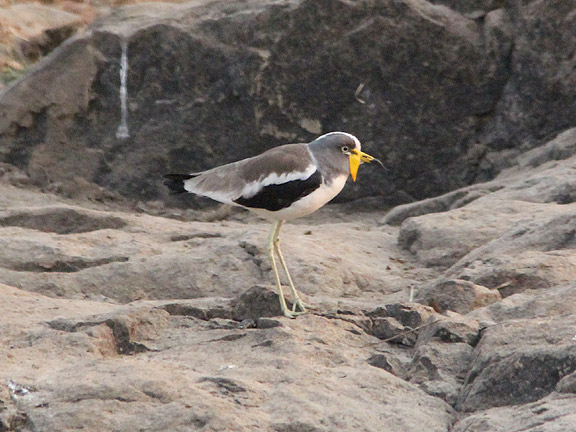
The last morning in Africa, was going to be the start of a very very long day.  I woke to my alarm at 5:00am to get dressed and meet up with Alan to hike onto the island just off the property on the Zambezi River.  We were going to try for Pel’s Fishing Owl one last time.  It was just getting light enough to see when we headed to the river, crossing the mostly dry north channel to the island.  It was a rather quiet morning--not a lot of birds singing, and not much wildlife around, besides the WHITE-CROWNED LAPWINGS making a racket along the shore...

White-crowned Lapwing on the rocks on the Zambezi

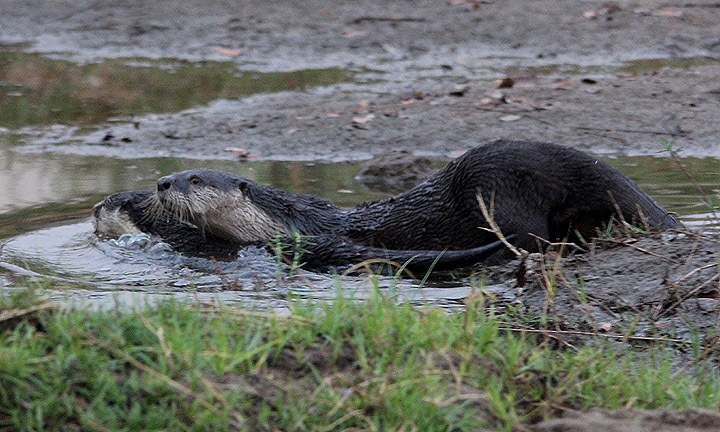
On the island we hadn’t gone too far when we came over a small rise and we caught some movement going into the bushes ahead.  Alan wasn’t sure, but thought they might have been AFRICAN CLAWLESS OTTERS.  We cut around the hill where the bushes were hoping to cut whatever it was off on the other side--but once there nothing came out.  We headed back around to where we first were and as we got there, we saw, them, an adult and young otter heading back through the puddle they’d been at, towards the river.

African Clawless Otters running towards the water

I hadn’t expected to be taking photos so my camera was not in the best mode for low light shooting--I snapped about 20 pictures as the two animals leapt and bound up and over another small hill and out of sight.  The pictures I got weren’t great, but were still cool--seeing these otters out of water is a bit of a treat I guess.

African Clawless Otters making their getaway

I won’t spend any more time on what we saw on the island--because it wasn’t much.  The loop we made was much like the one several days earlier--and we didn’t find the owl.  There were a couple VERREAUX’S EAGLE-OWLS around, but no Pel’s.  My 3rd international trip where I missed my #1 target bird--damn!  But such is birding--and as I always say, it just means I have to go back!

Not a Pel's--but a Verreaux's Eagle-Owl at Bushbuck

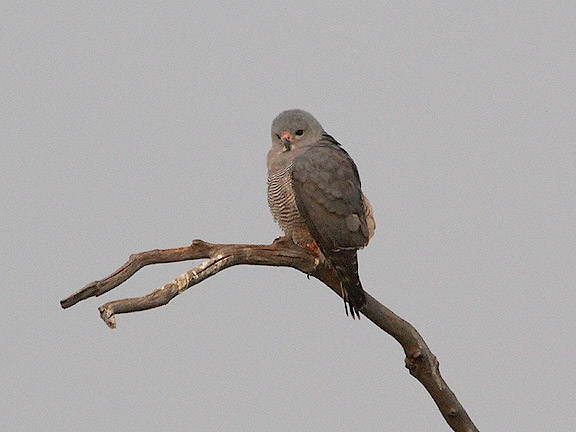
As we headed back towards the mainland, I spotted a hawk perched in a tree on the far west end of the island--I wasn’t sure what it was, but Alan thought it might be a LIZARD BUZZARD.  It was a beautiful little hawk and I enjoyed watching it for a few minutes before we finally left.  We later checked the guides and confirmed that it was a Lizard Buzzard.

The last lifer of the trip, a Lizard Buzzard at Bushbuck

Back at the house Sam was already awake and packing--my queue to do the same.  We had a couple hours to just relax before heading to the airport, and just spent it on the porch enjoying our last bit of the bush.  A little before noon we were ushered back to Livingstone and parted ways with Alan. 3 flights and 36 hours later we were on the ground in Salt Lake.  The adventure was over… or so we thought.

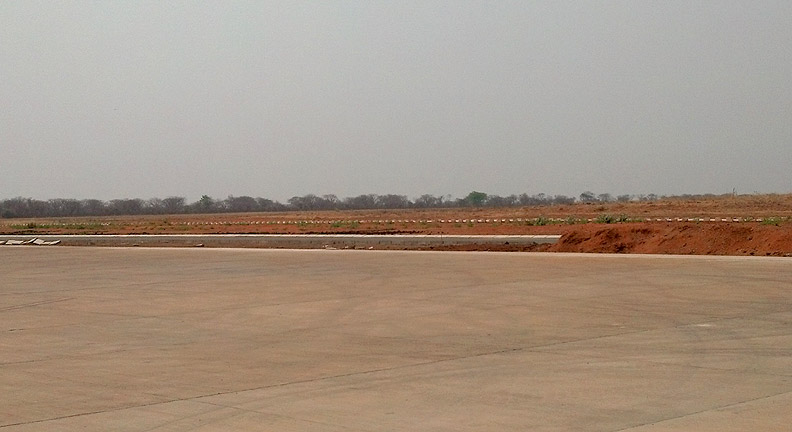
The runway at the Livingtone Airport as we left...

About a week after getting home, the tickle in my throat turned into a full fledged sore throat, and I was out of work sick for 3 days plus a weekend.  When I finally started feeling a little better I went back to work, only to have a rash develop on my feet and legs.  I had been home 13 days which is right about the average incubation time for a number of diseases you can pick up in Africa--I immediately headed to the doctor.  The rash wasn’t some crazy African disease, but he didn’t know what it was--I was diagnosed with Pneumonia, and the doctor figured the rash was related in some capacity.  I had gotten sick on my Pelagic trip , and the shark diving the following day only exacerbated things.  Once back in Utah things just went south real quick.  I visited a specialist who misdiagnosed my rash which only got worse over the following week.  I went through a round of tests, and they took a biopsy.  This revealed that I actually had a very bad strain of strep--which a rapid strep test missed before--the strep caused the rash and all the dots were connected.

Since then I spent the better part of a month house ridden--and now over two months after returning home am still dealing with the remnants of the illness-which the doctor said could last up to 6 months.

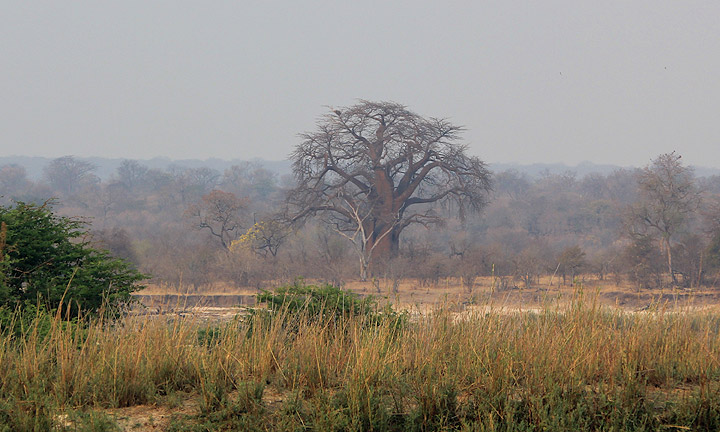
The Boabab, an icon of the horizon in Africa

After all was said and done its apparent that I could have gotten sick and had the same thing happen at home--but the root cause was the two ocean activities in the south Atlantic.  Needless to say the aftermath of the trip hasn’t been too fun--but the trip was one for the ages--a trip of a lifetime that I would do over and over and over if I could.  Africa is one of those places I suggest every birder go at some point in their life--save for it, plan it out and just go--you won’t regret it--I don’t!

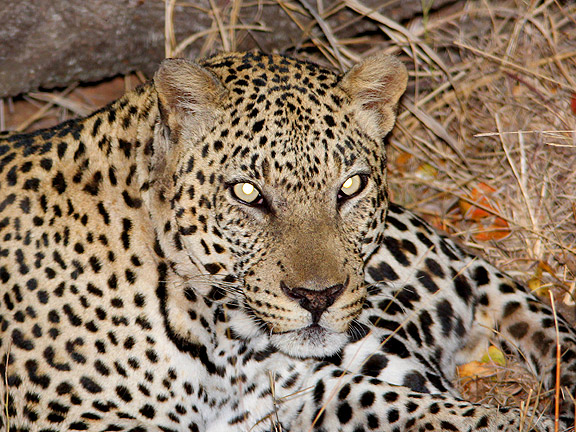
Leopard outside Olifants on a night Safari drive

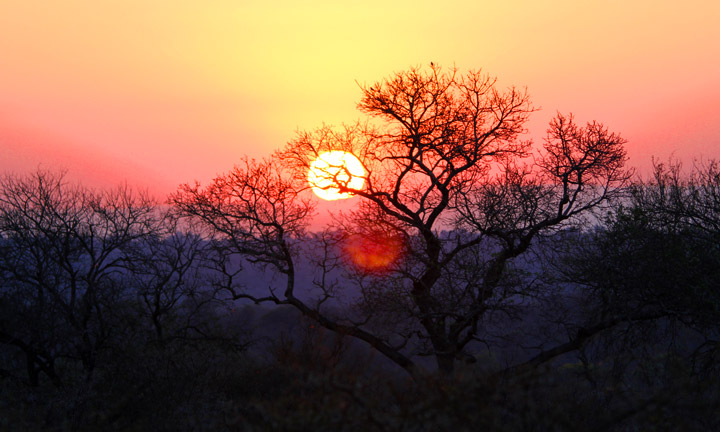
Every trip has highs and lows, and if you’ve read my series on Africa you have heard both sides--the highs obviously made up about 99% of the commentary.  Africa is an amazing continent--in less than 3 weeks I saw over 350 new species of birds, around 50 species of mammals, Great White Sharks, a number of reptiles, and some of the most breathtaking scenery in the world.  The sunrises and sunsets on a daily basis in Africa were spectacular to say the least.

Sunset at Skukuza Camp on our first night of Safari

I’d always wanted to go to Africa, but never imagined it would happen so early in life.  One thing that I have learned traveling the last few years is that if you really want to go somewhere, you can work to make it happen.  I won’t drone on about the trip anymore, I think the posts cover that enough.  Hopefully, if you are planning to go, or wanting to go to Africa, these posts were helpful in one way or another.  Below are all my posts in order for easy access:

Birding Africa pt. 1 - Via France
Birding Africa pt. 2 - JoBurg, Airport Game Lodge
Birding Africa pt. 3 - Welcome to Kruger National Park
Birding Africa pt. 4 - Skukuza Camp & Lake Panic
Birding Africa pt. 5 - The Heart of Kruger Park
Birding Africa pt. 6 - Olifants & Letaba
Birding Africa pt. 7 - Exit From Kruger
Birding Africa pt. 8 - Kurisa Moya Nature Lodge
Birding Africa pt. 9 - Ga-Mailula to Sterkfontein
Birding Africa pt. 10 - Cape Town & Robben Island
Birding Africa pt. 11 - Cape Town Pelagic
Birding Africa pt. 12 - Great Whites & Jackass Penguins
Birding Africa pt. 13 - Cape Point, Kirstenbosch, & Rondevlei
Birding Africa pt. 14 - The Bushbuck River House, Zambia
Birding Africa pt. 15 - Victoris Falls & The Zambezi River
Birding Africa pt. 16 - Chobe River & National Park, Botswana

And the posts I wrote before the trip:

My Next Great Birding Adventure...
South Africa: My Top 25 List - part 1 of 2
South Africa: My Top 10 List - part 2 of 2
After we were back home, we both longed to be back in Africa--there is just something about a place that wild that tugs at your soul.  We actually thought about going back next year, and just going to Botswana, cutting out layovers in France, and anything no wildlife related.  But it looks like that’s on hold as I have to go to Belize and India for work in the spring--a tough life I know.  So instead of Africa, it looks like we will spend a couple weeks at the end of my business trip exploring India--don’t worry though, the blog posts from that trip will be much shorter!

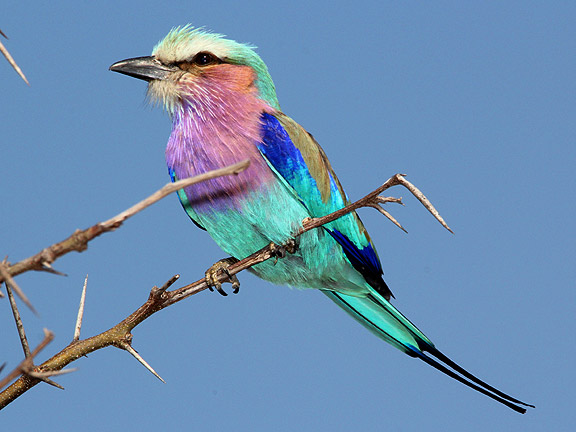
Absolutely stunning Lilac-breasted Roller in Kruger Park

Oh an last thing--that whole top 25 list thing I do--well out of the top 25 I snagged 17 species--68% of the total list--my best total yet--still now quite to that 80% mark that I had hoped, but pretty close!


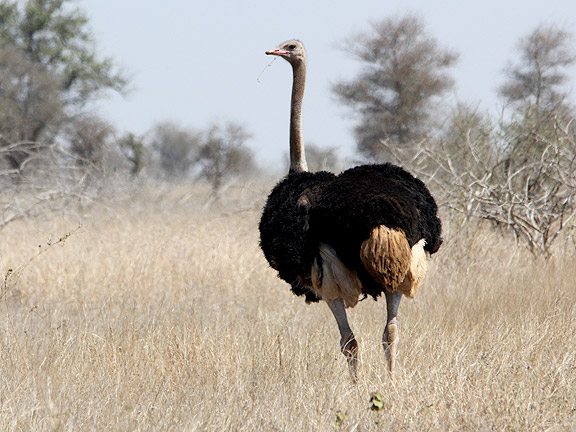
Common Ostrich, #2 on my top 25 list!

1 life bird the final morning / 358 total trip life birds / 382 total trip species

photos from the the last morning:
http://www.timaverybirding.com/photos/thumbnails.php?album=1120

entire photo gallery from Africa:
http://www.timaverybirding.com/photos/index.php?cat=67

eBird Checklists from this morning:
Bushbuck River House, Zambia

Labels: , , , , , , , , , , ,

Black Friday... Birding!

posted by Tim Avery at
on Monday, December 2, 2013 

The day after Thanksgiving is a great time to get out and shop till you drop.  Spend lots of money, help boost companies end of year revenue, and stimulate the economy... It's also a nightmare to those of us who look at the whole things as the epitome of American gluttony--its sadly disgusting in many respects and speaks volumes about our society.  So this year we decided instead of joining other in our community partaking in this "Event", we would do a sort of anti-Black Friday--where instead of trying to trample our neighbors for that flat screen, we would go birding and be as far away from the commotion as possible.

As a disclaimer I will note that I did go to Home Depot and Shopko before making my way to the field trip--my haul: 2 four-mode headlamps and 4 strings of Christmas lights.  Hardly stuff worth fighting over, which is why I waited till the crowds dispersed.  In any event the trip began with 12 of us meeting up at the Wal-Mart on Foothill and Parley's Way--of all places we thought it a tad bit ironic, but also a bit clever. The group was quite varied and included several young Utah birders, including Kendall Watkins and Brenton Reyner, as well one of Utah's youngest and brightest birders, Ivan Richardson, 10, from St. George, along with his dad Tom.

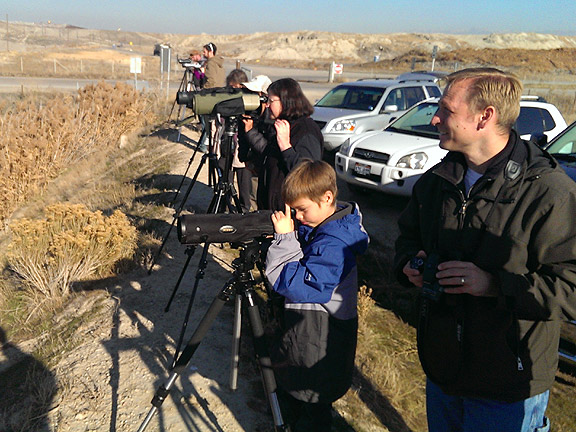
Utah Birders scanning the ducks at the Jordan River

To get started we headed to the Jordan River, Redwood Trailhead at about 2300 South.  Here the group got great looks at both species of Goldeneye, with an exceptional count of 25 BARROW'S GOLDENEYE.  Other waterfowl included, Bufflehead, Green-winged Teal, Mallard, Gadwall, Ruddy Duck, and Canada Goose.

eBird Checklist:
http://ebird.org/ebird/view/checklist?subID=S15799637

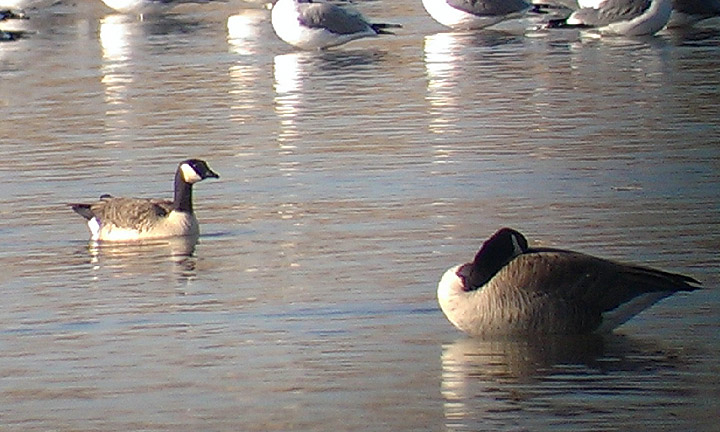
From the river we hopped a short drive over to Decker Lake where we picked up a COMMON MERGANSER along with the usual California and Ring-billed Gulls, as well as plenty of Mallards and domestic Geese.  There were about 100 CANADA GEESE on the grass near the parking area, including the hybrid Canada X Grayleg that has been around at least the past 2 winters.  As we were getting ready to leave geese started pouring in, and as we watched them we picked out a couple CACKLING GEESE in the air.  We waited till the landed and found 2--while we were watching them 3 more came in for a count of 5 CACKLING GEESE.

Cackling Goose (left) with Canada Goose at Decker Lake

eBird Checklist:
http://ebird.org/ebird/view/checklist?subID=S15799687

After getting our fill of these geese it was onward to Lake Park in hope of more geese, perhaps some gulls, and maybe, just maybe the Pacific Loon that had been present the week before.  Well there were few geese (by Lake Park standards), almost no gulls, and the loon I would say its safe to assume is gone.  We did however pick up a pair of HOODED MERGANSERS on the river behind the IHC building.  They were accompanied by a handful of Common Mergansers.  We also watched a PRAIRIE FALCON hunting in a large field to the west of there, providing great looks for the group.

Prairie Falcon coming in for a landing at Lake Park

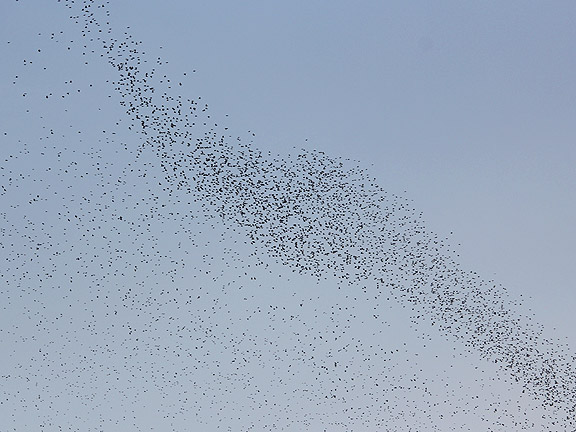
At the west pond we did add a lone RED-BREASTED MERGANSER for the 3 species sweep for the day.  The only other thing of note was an enormous flock of EUROPEAN STARLINGS, perhaps 5,000 birds that came form the west and flew over us, murmurating, as they headed east.

Just a portion of the European Starling flock over Lake Park

eBird Checklist:
http://ebird.org/ebird/view/checklist?subID=S15799725

The next stop was Lee Kay Pond which was inundated with Gulls, approximately 2,500~ mostly on the west pond--the best viewing was from the east, but it put us at an extreme distance.  From the entrance to the middle pond we scoped the birds and picked out a couple HERRING and THAYER'S GULLS form a distance.  The Thayer's was a lifer for Ivan so that was quite exciting.  

Utah Birders Ivan and Tom Richardson scanning the gulls at Lee Kay Ponds

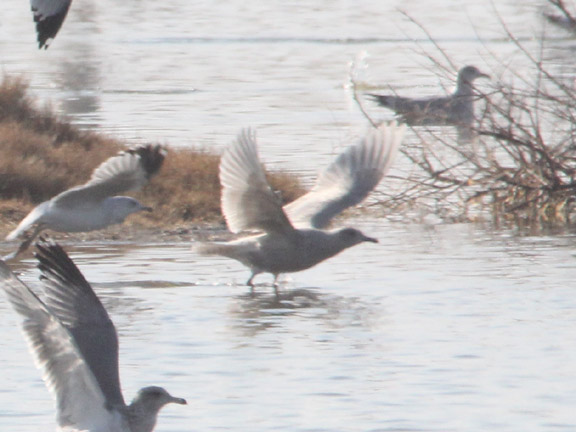
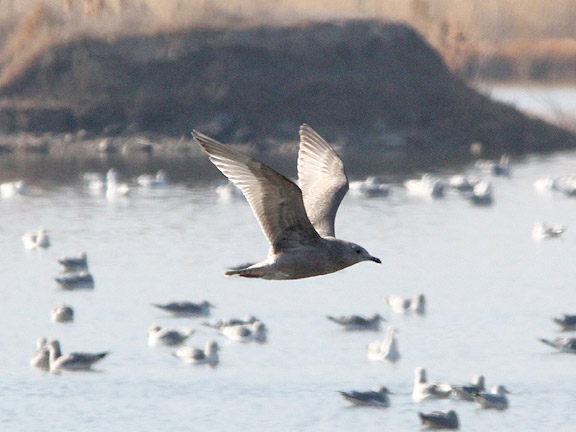
After giving it a good while we drove the road along the middle pond where we spotted more HOODED MERGANSERS.  We looped back to the west pond, closer to the flock to try scanning a little closer while we still had some good light.  We weren't out of the car 5 minutes when Kenny shouted that he had an ICELAND GULL.  I took a quick look through his scope and excitedly hollered for everyone to come over.  That's when we went into crisis mode--no one could get the bird in a scope, besides Kenny's and trying to get everyone on the bird was like a nightmare.  Finally, as a stroke of luck would have it the bird emerged form the throngs of gulls and sat in the open for everyone to see nicely--a life for many on the trip, including Ivan who had now picked up one of Utah's hardest to get gull species.

Iceland Gull taking flight--the highlight of the day and lifer for many.

Eventually a THAYER'S GULL flew right over us proving excellent looks for the entire group.  This was followed by the Iceland Gull taking off and flying to the west beach where it landed and began preening.  We drove down and spent a few more minutes watching it before continuing on our way.

Thayer's Gull flyby at Lee Kay Ponds

eBird Checklist:

We made a quick drive up 7200 West with nothing of note--bird wise and otherwise.  We made a quick stop at the International Center to refuel and grab snacks.  A quick check of the ponds there revealed a few gulls, ducks, and geese, but nothing of note.

7200 West eBird Checklist:

SLIC eBird Checklist:

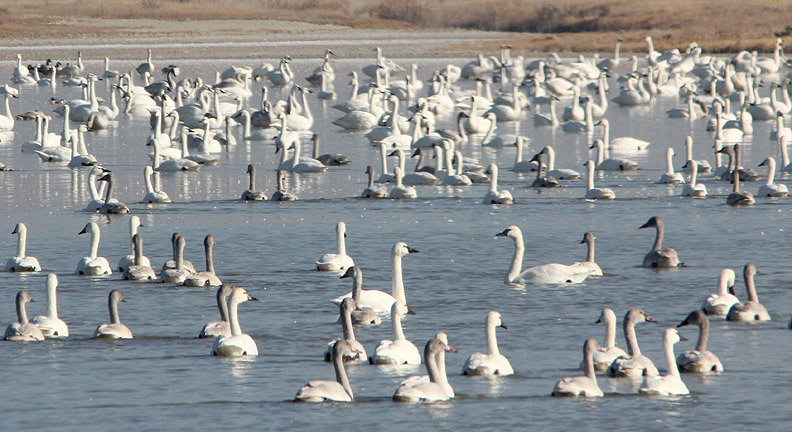
After our short break we drove the frontage road along I-80 towards Saltair.  Our stop here was at Kennecott's Inland Sea Shorebird Reserve--a private mitigation wetland that provides much needed protection to both habitat and birds on the south shore of the Great Salt Lake. The target bird here was Tundra Swan (among others), which this time of year can number in the thousands.  As our luck would have it there were about 1,000 TUNDRA SWANS present, and we spent the better part of an hour watching them from various distances, with different lighting and back drops.  It was a highlight for many on the trip.

Small portion of the Tundra Swans at the ISSR

We also added both GOLDEN and BALD EAGLE and had NORTHERN HARRIER and several ROUGH-LEGGED HAWKS.  No shrikes, but several in the group did get short looks at a small flock of AMERICAN TREE SPARROWS that passed by the vehicles.

eBird Checklist:

Our final stop of the trip was at the Great Salt Lake State Park marina to scan the gulls along the shoreline.  We hoped the Heermann's Gull from the previous week was still present but with great lighting we quickly found that it was not.  We spent some time just relaxing and talking while scanning, bring the trip to a quiet end.

eBird Checklist:

We did however have one more sighting of note, as we made our way back to the Wal-Mart we passed Parley's Gulch where form the interstate were able to pick out 2 LEWIS'S WOODPECKERS remaining on the poles along the bike path.  A great end to a great trip.  

eBird Checklist:

Thanks to everyone who took part and made for a great day of birding some of the lesser visited places in the county--the south shore is often overlooked as a a birding hot spot but it definitely is one of the best places along the lake to look for waterbirds.  

Labels: , , , , ,


UTAH BIRDERS FLICKR POOL


    SEE MORE AND SHARE ON FLICKR